

A GPU-count forecast is not a capacity plan. AI compute capacity planning 2026 has to account for what can actually be delivered: workloads that shift, supply that changes, and sites where power and deployment align. The number of GPUs on a spreadsheet matters less if the capacity isn’t ready when critical workloads need it.
It’s reasonable to want a firm forecast before committing capital. But model changes, inference growth, and uncertain deployment schedules can make a single point estimate brittle. Plan across a defensible range instead, with room to adjust as demand and infrastructure realities become clearer.
This framework shows how to translate AI workloads into capacity scenarios, compare flexible GPU-as-a-Service with dedicated financed sites, and connect sourcing decisions to power, deployment, and financing. The goal is a delivery portfolio, not a bet on one forecast. Backplane connects compute requirements with powered industrial sites and infrastructure financing, helping organizations structure staged capacity decisions around operational needs.
Key Takeaways
- AI compute capacity planning 2026 starts with workload evidence, not a single GPU target. Separate measured baselines from assumptions so forecasts can adapt as needs change.
- Build a usable capacity range by inventorying workloads, mapping technical requirements, modeling utilization, and testing scenarios.
- Compare compute sourcing options against flexibility, access certainty, control, deployment effort, and commitment structure.
- Stress-test demand and utilization alongside power readiness, deployment timing, and financing. These constraints shape what capacity can actually come online.
- Turn the plan into an actionable brief with workload, scale, timing, power, and commitment needs to guide the path from compute demand to infrastructure.
Why AI compute capacity planning in 2026 requires more than a GPU forecast
A forecast can count accelerators. A plan has to show whether they can serve actual workloads, at the required time, within the limits of power, networking, storage, and deployment. That distinction matters in 2026, as organizations adjust models and workloads while infrastructure decisions take time to execute.
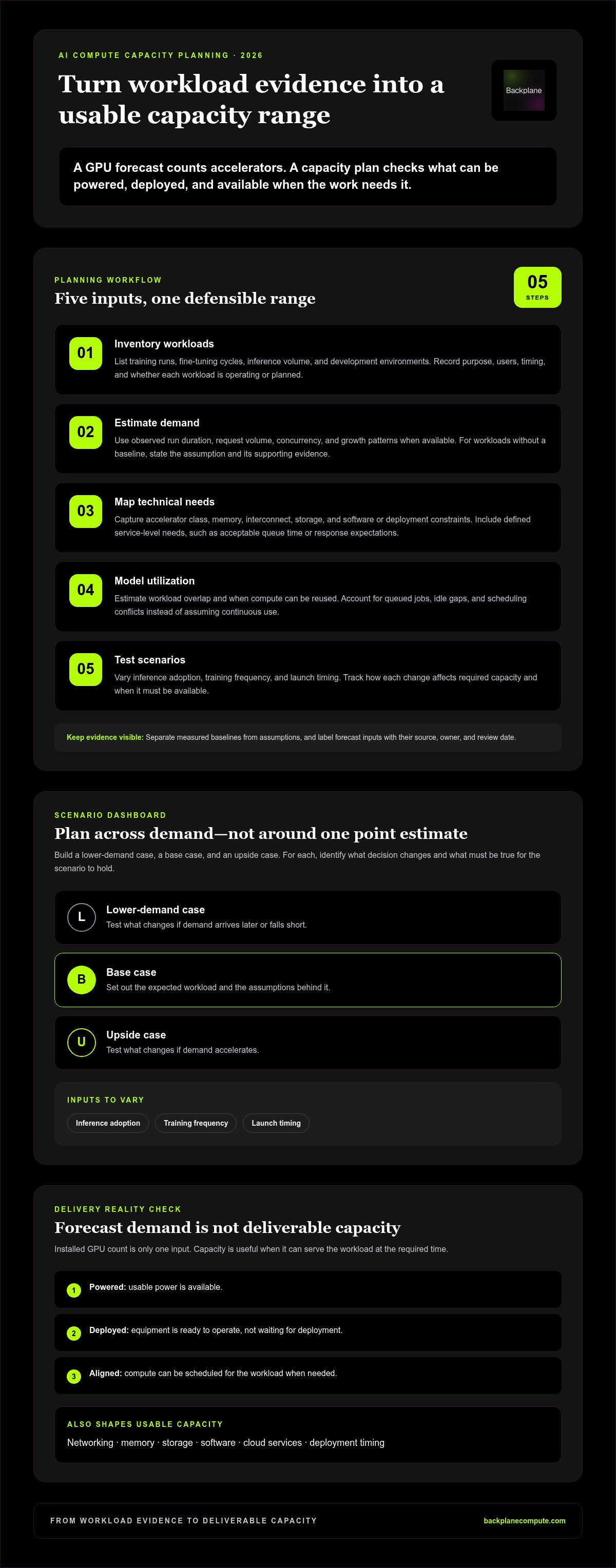
Capacity planning matches expected workloads with compute that is powered, deployed, and available when needed; forecast demand is an estimate, while deliverable capacity is what operations can use. Installed GPU count is only one input. Equipment that is awaiting deployment, lacks usable power, or cannot be scheduled for the workload does not meet demand.
The broader AI infrastructure includes more than accelerators: data center facilities, networking, memory, storage, software, and cloud services all shape usable capacity. A credible plan connects these components rather than treating a GPU total as the outcome.
What changes when AI workloads scale?
Training, fine-tuning, and inference put different demands on compute. Training may require concentrated accelerator capacity for large runs. Fine-tuning can create shorter, recurring bursts. Inference demand follows product usage and may need to remain available as requests arrive. These profiles affect the type, amount, and timing of capacity required.
Assumptions can shift within a planning cycle. A new model may change compute requirements; a product launch may increase inference demand; adoption may grow more slowly than expected. Treat these as variables to test, not as a single certain trajectory. Separate durable planning factors, such as workload mix and infrastructure readiness, from short-term signals like an individual project’s projected usage.
For each workload, document its purpose, expected operating pattern, technical requirements, and when capacity is needed. Then record which inputs are measured and which remain estimates. This gives teams a basis for revising the plan as real utilization data replaces assumptions.
Why a single-point forecast creates planning risk
One estimate can hide two opposite failures: too little capacity if demand accelerates, or costly idle capacity if demand arrives late or falls short. It can also conceal timing mismatches. Capacity delivered after a launch may be technically sufficient but operationally useless for that milestone.
Build a range instead. For example, model a lower-demand case, a base case, and an upside case, then identify what decision changes in each. A staged sourcing approach can preserve flexibility while the workload becomes clearer, rather than committing the full requirement against one forecast.
Diagnose the constraint before adding supply. A shortage means the required compute is unavailable. Low utilization may instead point to scheduling, workload placement, or deployment issues. Adding GPUs will not fix idle time caused by poor coordination. For more on the facility and systems behind usable compute, see this high-performance computing infrastructure guide.
AI compute capacity planning 2026 is therefore a delivery problem as much as a demand exercise. The useful question is not simply how many GPUs appear in the forecast. It is how much capacity can be brought online, aligned to workload timing, and kept available for the work that matters.
Translate AI workloads into a usable 2026 compute capacity range
Start with the work the organization expects to run, not a target number of GPUs. A defensible AI compute capacity planning 2026 process converts workload evidence into low, expected, and high capacity scenarios, then records what must be true for each scenario to hold. Estimates should be scenarios, not false precision, because workload timing, concurrency, and technical requirements can change.
Use this workflow in order. Keep measured baselines separate from assumptions, and label every forecast input with its source, owner, and review date.
- Inventory workloads. List training runs, fine-tuning cycles, inference volume, and development environments. Record purpose, users, expected timing, and whether each workload is already operating or planned.
- Estimate demand. Use observed run duration, request volume, concurrency, and growth patterns where available. For new products or models without a baseline, state the assumption and the evidence behind it.
- Map technical needs. Capture accelerator class, memory, interconnect, storage, and software or deployment constraints. Note service-level needs, such as acceptable queue time or response expectations, where teams have defined them.
- Model utilization. Estimate how demand overlaps across workloads and when compute can be reused. Account for queued jobs, idle gaps, and scheduling conflicts rather than assuming every workload runs continuously.
- Test scenarios. Change key inputs, such as inference adoption, training frequency, and launch timing. Track how each change affects required capacity and when it must be available.
Build workload scenarios that reflect operating reality
Separate predictable baseline demand from burst, experimental, and seasonal work. A recurring inference service may need steady capacity, while a training run can create a concentrated requirement and development environments may have flexible schedules. Record duration, concurrency, memory, interconnect, and service-level needs where known. Build low, expected, and high cases from workload evidence, not a universal utilization target.
For each input, mark whether it is measured, estimated, or a planning decision. That simple discipline makes the range auditable. It also shows decision-makers which assumptions carry the most weight, and where a forecast needs better operational data.
Convert workload scenarios into capacity requirements
Translate each scenario into a complete system requirement, not an accelerator count alone. Map compute alongside memory, networking, storage, and scheduling. Include maintenance windows, deployment ramp, and contingency capacity as explicit planning factors, then identify which requirements are fixed and which can flex.
Review the model when product or model roadmaps change. A new release, revised launch date, or different inference pattern should trigger an update to affected assumptions, not an untracked adjustment to the final total. Teams aligning compute demand with site viability and infrastructure financing can explore Backplane’s compute and infrastructure approach.
Compare cloud, GPU-as-a-Service, and dedicated AI compute capacity
Capacity sourcing is a portfolio decision. Cloud, GPU-as-a-Service, and dedicated infrastructure differ in how access is arranged, how much control the organization holds, and what it must commit to make capacity usable. No model is universally best. The right fit depends on workload predictability, scale, timing, and the operating responsibilities the organization can take on.
Compare each option against the same five dimensions:
- Flexibility: How easily can capacity scale up, scale down, or shift between workloads?
- Access certainty: What reservation or allocation structure supports availability when demand peaks?
- Control: How much influence is needed over the environment, configuration, and workload operations?
- Deployment effort: What integration, migration, and operational work is required before workloads can run?
- Commitment structure: Does the demand justify usage-based access, a defined reservation, or a longer-term infrastructure commitment?
Compare total cost only after defining the project inputs. Relevant factors include expected usage, utilization, workload duration, data movement, service terms, deployment work, and the infrastructure required to support capacity. A headline rate alone cannot show the cost of capacity that sits idle, arrives late, or does not fit the workload.
When flexible cloud or GPU-as-a-Service fits
Flexible access can suit variable demand, early experimentation, and workloads whose long-term profile is still emerging. Teams can use it to test model behavior or support demand that changes over time, subject to the provider’s access terms. Planning still matters: examine reservation options, scaling mechanics, service terms, workload portability, and dependencies such as data location and software configuration.
GPU-as-a-Service is a sourcing option, not a replacement for workload analysis. Define the workload and access window first, then assess whether a service model fits the requirement. The enterprise GPU-as-a-Service guide covers the model in greater depth.
When dedicated capacity fits
For sustained, well-characterized workloads, dedicated capacity may merit evaluation alongside more flexible supply. It can support a plan built around defined requirements, but it also ties the decision to infrastructure, deployment, power readiness, and a longer commitment structure. Dedicated does not automatically mean faster, simpler, or more economical; those outcomes depend on project conditions.
Test whether workload continuity and scale support the commitment, and map dependencies before treating a site or deployment plan as usable capacity. Dedicated infrastructure and flexible access can also serve different stages of the same capacity path. Learn about the dedicated AI compute sites model to understand the private infrastructure approach.
For AI compute capacity planning 2026, align the sourcing mix with workload evidence, not preference for one model. Organizations translating requirements into compute access and viable infrastructure can explore Backplane’s compute and infrastructure approach.
Stress-test the 2026 plan against power, deployment, and demand risk
A capacity scenario is only actionable if its dependencies can be delivered. Demand, utilization, equipment timing, power readiness, and financing affect one another. If a project depends on a specific deployment date, a delay in power or equipment can leave capacity unavailable even when the workload forecast is sound. Stress-test these variables together, not as separate workstreams.
Start by distinguishing a site’s power potential from capacity that is verified and usable. A promising location is not the same as confirmed available power. Record the evidence for available capacity, the interconnection status, remaining dependencies, and the delivery timeline. Mark unknowns explicitly, assign an owner to resolve each one, and avoid treating an unverified date as a planning fact.
- Power: What capacity is available, and what steps remain before it can serve the project?
- Cooling and facility readiness: Can the site support the planned infrastructure and operating profile?
- Network and equipment: Are connectivity, equipment, and deployment dependencies aligned with workload timing?
- Permitting and financing: Which approvals, project milestones, or financing decisions must be completed before deployment?
These checks are project-specific. A site’s power opportunity, for example, may depend on an interconnection process that affects equipment installation and financing milestones. The AI data center site selection checklist provides a deeper set of criteria for evaluating infrastructure readiness.
Test the plan against practical delivery constraints
Run a scenario in which one critical dependency slips. If a site’s power delivery moves later than the workload launch, determine whether flexible compute can bridge the gap, whether workload timing can shift, or whether the plan needs a different deployment path. Then test the reverse: capacity is ready, but demand ramps more slowly. This exposes financing and utilization pressure before commitments become difficult to adjust.
For each scenario, document the dependency, evidence, decision owner, and consequence of delay. Keep site-specific facts and timelines tied to their source and review date. Don’t convert an indicative estimate into a committed delivery assumption.
Use staged commitments to manage uncertainty
Set decision gates before expanding a commitment. Triggers might include sustained workload demand, utilization reaching an internal threshold, a product milestone, or verified progress on power and deployment dependencies. Define what evidence activates each gate, and when the team will reassess reservations or workload forecasts. The thresholds should reflect the organization’s operating needs, not a universal target.
Staging balances two exposures: unused capacity can absorb capital without serving workloads, while constrained access can delay critical work. Capacity has value only when power, deployment, and workload timing align. AI compute capacity planning 2026 should make those dependencies visible before a commitment is made.
To connect capacity requirements with powered industrial sites and infrastructure financing, assess your compute infrastructure path with Backplane.
Turn an AI compute plan into a capacity path with Backplane
A forecast becomes actionable when it can guide sourcing, site diligence, and commitment decisions. Convert the planning work into a brief that gives infrastructure and financing discussions a clear operating basis. Keep it specific enough to evaluate, but distinguish confirmed requirements from open assumptions.
Include the core decision inputs:
- Workload: What will run, and what operating pattern or technical requirements shape the demand?
- Scale: What are the low, expected, and high capacity cases?
- Timing: When must capacity be usable, and which milestones drive that date?
- Power: What power requirements apply, and what is known about site readiness?
- Commitment profile: Which needs are steady, which can remain flexible, and what evidence would justify expansion?
Backplane connects AI compute buyers with powered industrial sites and structures financing for infrastructure development. Depending on the workload profile and project requirements, a staged plan may combine GPUs-as-a-Service for flexible access with dedicated financed sites for infrastructure tied to sustained demand. These are potential paths to evaluate, not interchangeable answers. The right structure depends on the operating requirement and the infrastructure conditions.
From capacity requirements to infrastructure diligence
Site assessment compares a property’s characteristics with project needs. That diligence can bring workload requirements, power considerations, and deployment needs into the same view as site viability and financing structure. Matching committed compute demand with powered industrial properties helps connect the buyer’s requirement to infrastructure under consideration, without presuming a particular property will meet every project condition.
The AI infrastructure brokerage model explains how this matching process connects compute buyers, power-backed sites, and infrastructure development. A clear brief helps make that process more focused: it defines the demand to be matched and the questions site diligence must address.
Choose the next step based on the planning gap
If you’re a compute buyer with a defined workload and near-term requirement, bring the scale, timing, power needs, and commitment profile into a structured capacity discussion. If you own a property being considered for AI infrastructure, a property viability assessment can help evaluate its potential against project requirements. In either case, separate established facts from items that still require diligence.
AI compute capacity planning 2026 is most useful when it leads to a viable path from demand to delivery. Once the brief is assembled, discuss your AI compute capacity requirements and the infrastructure path that fits your project.
Move from planning assumptions to an executable capacity path
The next step is to turn planning into a sequence of decisions. Identify what must be resolved now, what can wait for stronger workload evidence, and which milestones should trigger a change in commitment. That creates room to adapt without allowing critical infrastructure requirements to drift behind the AI roadmap.
Strong AI compute capacity planning 2026 is not about eliminating uncertainty. It’s about making uncertainty visible, assigning ownership, and keeping infrastructure decisions tied to evidence. Backplane connects compute buyers with powered industrial sites and works across site assessment, financing structuring, and infrastructure deployment to help translate requirements into a project path.
Bring your workload needs, target timing, and current planning questions into the next discussion. Discuss your AI compute capacity requirements and identify a practical path from demand to deliverable infrastructure. A clear next decision is enough to build momentum.
Frequently Asked Questions
What is AI compute capacity planning?
AI compute capacity planning is the process of estimating the resources an organization will need and aligning them with usable compute and delivery timing. For AI compute capacity planning 2026, start with workload evidence, then distinguish confirmed requirements from assumptions. For example, a team can separate compute already consumed by production services from capacity projected for a product launch. This makes the plan useful for operational and investment decisions, not just procurement.
How often should an enterprise update its AI compute capacity plan?
Update the plan on a regular operating cadence and whenever a material input changes. A model roadmap revision, unexpected inference growth, a shifted launch, or changed infrastructure assumptions can all warrant a review. The interval should match the pace of change: teams with rapidly evolving products may need to revisit assumptions more often than teams with stable workloads. Log each revision so decision-makers can see what changed and why.
Should AI capacity planning treat training and inference differently?
Yes. Training and fine-tuning often have scheduled job windows, while inference demand can follow user traffic and require consistent service. Track them separately before combining them into a portfolio. For example, a training job may be schedulable outside a launch window, but inference serving a customer-facing feature may need capacity during peak usage. This distinction helps teams prioritize workloads when they compete for the same compute resources.
How can an organization avoid overprovisioning AI compute?
Use observed utilization and workload records as the baseline, then isolate experimental projects and unvalidated growth assumptions. Before adding supply, check whether queue management, job scheduling, or workload placement can address the constraint. Set a decision trigger for expansion, such as sustained demand or a defined service impact, rather than reacting to a short-lived peak. Review whether the trigger still reflects business priorities as projects mature.
What information is needed to forecast AI compute demand?
Collect workload purpose, launch timing, run duration, concurrency, model and memory requirements, service expectations, and current utilization. Include development and experimentation, not only production services. For instance, a planned feature may create both testing demand before release and serving demand afterward. Label each input as measured or assumed, and note its source. This helps teams identify which missing evidence could materially change the forecast.
When should a company consider dedicated AI compute instead of flexible access?
Evaluate dedicated capacity when workloads are sustained or predictable and operational requirements make a longer commitment worth analyzing. Flexible access may better suit experiments, uncertain demand, or intermittent jobs. Consider how much control the workload needs, how dependable access must be, what deployment work is involved, and whether infrastructure dependencies align with the operating schedule. A mixed approach can also separate stable workloads from demand that still needs flexibility.


