

What if the hardest part of a GPU farm isn’t acquiring the GPUs, but proving that power, site, cooling, and demand can work together before capital is committed? That’s the central test in large scale GPU farm development. A powered property alone doesn’t make a viable compute asset. Neither does a pipeline of buyers without infrastructure capable of serving them.
That’s the challenge operators and investors face: technical diligence, financing, procurement, and deployment must happen in the right order, with credible compute demand shaping the project from the start. Build too far ahead of demand, and capital is committed to an unproven plan. Move ahead without validating site capacity, and the intended GPU density may never become operational.
This article lays out a practical path from demand validation to an operational GPU farm. It covers how to assess power and site viability, align cooling and infrastructure with compute requirements, structure financing, and sequence procurement and deployment around key diligence gates. Backplane connects powered industrial properties with AI compute demand through GPUs-as-a-Service and dedicated financed sites. The objective is to bring demand, infrastructure, and capital together before development momentum outruns project readiness.
Key Takeaways
- Start large scale GPU farm development with credible compute demand, then align the project’s site, infrastructure, and capital around it.
- Assess how IT load, facility power, cooling, and networking fit together before committing to a GPU density or deployment design.
- Distinguish utility service capacity from power that can actually reach the site and support usable IT capacity.
- Treat former industrial and energy sites as candidates for diligence, not as viable GPU locations by default.
- Use a sequenced path through demand validation, site assessment, design, financing, and deployment to connect commercial commitments with capital decisions.
What Large-Scale GPU Farm Development Involves, and Why Demand Comes First
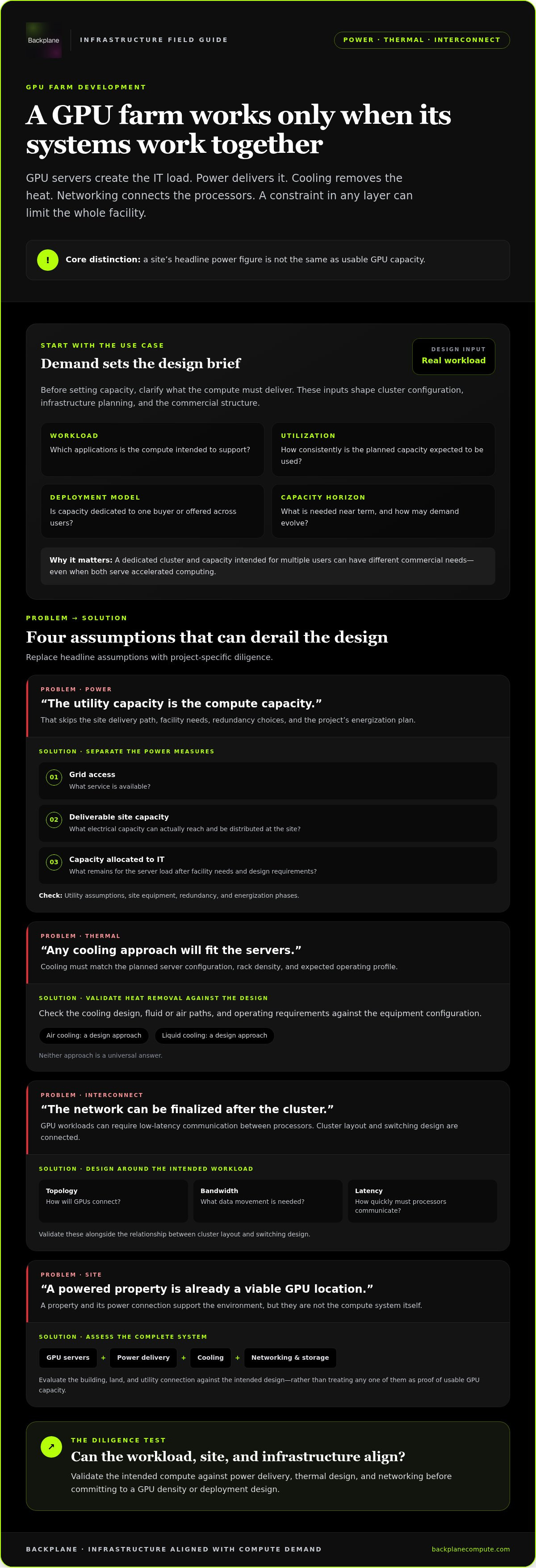
A GPU farm is a coordinated compute environment in which GPU servers, power delivery, cooling, networking, storage, and operational systems work together to serve defined workloads. Large scale GPU farm development means designing that system around a real use case, not simply assembling hardware or securing an industrial property.
“Large-scale” has no universal GPU-count threshold. The right scale depends on the workload, required capacity, deployment design, and how demand is expected to develop. A project may be built in phases or as a dedicated cluster. Either way, the development case must connect what buyers need with what the site can support.
What separates a GPU farm from a conventional data center?
A conventional data center can host many types of computing. A GPU farm is organized around accelerated workloads, which can place distinct demands on power density and low-latency communication between processors. A Graphics Processing Unit (GPU) handles many computations in parallel, making it useful for workloads such as AI model training and inference.
The compute environment includes GPU servers, clusters, networking, and storage. Facility systems supply power and remove heat. The building, land, and utility connection support that environment, but they are not the compute system itself. Separating these layers helps teams assess whether a property can host the intended design instead of assuming that available power automatically means usable GPU capacity.
Why should development begin with workload and demand?
Demand determines what the project needs to deliver. Before setting capacity, establish the workload type, expected utilization, deployment model, and capacity horizon. These inputs help shape cluster configuration, infrastructure planning, and the commercial structure. A dedicated environment for one buyer may call for a different development approach than capacity intended to serve multiple users.
Buyer requirements also influence phasing. A credible initial commitment can inform what should be built first, while a defined expansion path can keep later capacity aligned with expected demand. Avoid designing around the assumption that every AI workload needs identical hardware, networking, or facility conditions.
- Workload: Identify the applications the compute is intended to support.
- Utilization: Estimate how consistently the planned capacity will be used.
- Deployment model: Clarify whether capacity is dedicated to one buyer or offered across users.
- Capacity horizon: Define the near-term requirement and how demand may evolve.
These questions turn interest into a development brief. For example, a buyer seeking a dedicated cluster and a buyer seeking access to GPU capacity have different commercial needs, even if both require accelerated computing. Matching demand with site viability before capital is committed helps keep the project grounded in a deliverable use case. Backplane connects AI compute demand with powered industrial properties, supporting a pathway from assessment to operational infrastructure.
Designing GPU Farm Infrastructure Around Power, Cooling, and Networking
Infrastructure must be designed as a connected system. GPU servers create an IT load. Electrical equipment delivers power to that load, while cooling removes the heat it generates. Networking links GPUs so they can exchange data, and storage feeds the workloads. A constraint in any one layer can limit the performance or capacity of the whole facility.
That relationship is central to large scale GPU farm development. A site’s power figure is not the same as its usable IT capacity. Facility systems also require power, and the path from utility service to the server rack depends on electrical distribution, redundancy choices, and the project’s energization plan. Treating headline capacity as available compute can lead to a design that cannot be delivered as intended.
How does available power shape GPU farm design?
Separate three measures: grid access, electrical capacity deliverable at the site, and the portion that can be allocated to IT after facility needs and design requirements. Redundant equipment can improve resilience, but it also affects usable capacity. Phased energization can determine when each block of compute can come online. Verify interconnection assumptions and capacity figures for the specific project.
Power: What capacity can be delivered, distributed, and allocated to IT? Validate utility assumptions, site equipment, redundancy, and energization phases.
Thermal: How will heat be removed at the planned server density and operating profile? Validate cooling design, fluid or air paths, and operating requirements against the equipment configuration.
Interconnect: How will GPUs exchange data for the intended workload? Validate network topology, bandwidth, latency, and the relationship between cluster layout and switching design.
How do cooling and networking affect cluster performance?
Thermal design must match the server configuration, rack density, and expected operating profile. Air cooling and liquid cooling are both design approaches, not universal answers. Air systems move heat through airflow; liquid systems move heat through a fluid circuit. Suitability depends on equipment requirements, facility design, and how heat will be managed across the site.
Network topology matters too. Workloads that distribute computation across GPUs can depend on fast, coordinated communication. InfiniBand or Ethernet choices should follow communication patterns, cluster configuration, and operational needs, rather than being selected in isolation. A network that doesn’t fit the workload can constrain the cluster even when power and cooling are adequate.
Coordinate engineering across these layers before fixing the design. Rack arrangement affects electrical distribution and cooling paths. Cluster size and workload influence network topology, which can shape equipment placement and capacity phasing. Evaluate these decisions together, then test them against site conditions and buyer requirements. Backplane connects powered industrial properties with AI compute demand, bringing site viability and infrastructure planning into the same development pathway. Explore GPU farm site and infrastructure alignment as part of that process.
Assessing Sites for Large-Scale GPU Farm Development
A property can have substantial electrical infrastructure and still be a poor fit for compute. Site assessment must establish what power can actually be delivered, which equipment and land are usable, and what constraints could delay or limit redevelopment. For large scale GPU farm development, a site’s history is a starting point for diligence, not evidence of readiness.
Retired power plants, closed mills, and decommissioned mining facilities may have useful features, such as existing electrical assets, industrial access, or land that could support redevelopment. But equipment may be outdated, damaged, undersized, or unsuitable for the proposed project. Buildings, access routes, and site layout also need to be assessed against the intended infrastructure plan.
Which industrial assets can merit a GPU farm assessment?
Powered industrial properties may offer a useful starting point because prior operations can leave infrastructure and site configurations relevant to redevelopment. That advantage is conditional. Confirm ownership and site control, review the condition and serviceability of existing assets, and examine whether the land and buildings can accommodate the proposed development. A former facility’s name or past use does not establish its technical suitability.
What must site diligence establish before development advances?
Diligence should replace broad claims with documented findings. Confirm the status, scale, and deliverability of power, including the interconnection position and the equipment between utility service and the intended compute area. Project-specific review should also identify permitting, environmental, structural, and utility questions for qualified evaluation. Record assumptions and dependencies rather than treating unresolved items as settled.
- Power and interconnection: Distinguish existing service from capacity that can be delivered to the project. Document what is verified, what depends on utility work, and what remains unresolved.
- Site control: Establish ownership, control, access, and any relevant easements or property constraints that could affect development.
- Physical condition: Review buildings, foundations, electrical infrastructure, and access for suitability, condition, and potential reuse.
- Redevelopment constraints: Identify permitting, environmental, structural, and utility issues for qualified project-specific review.
- Expansion potential: Assess whether the site layout and infrastructure pathway can support planned phases without assuming future capacity is already available.
The distinction is practical: existing infrastructure is what remains on the property; usable infrastructure is what can serve the project; suitable infrastructure is what can do so within its requirements and development plan. A substation, industrial building, or prior power connection may be relevant, but each must be evaluated for condition, compatibility, and deliverability.
A disciplined screen also clarifies where further diligence is warranted and where a constraint could change the project’s scope. For a broader screening framework, use the AI data center site selection criteria guide. Backplane’s property viability assessment connects powered industrial assets with AI compute requirements, grounding site decisions in project-specific viability before development advances.
Moving from GPU Farm Feasibility to Financing and Deployment
Feasibility becomes actionable when each development decision is tied to evidence, ownership, and a clear gate. Demand informs project scope. Technical diligence tests whether the site can support that scope. Financing, procurement, and deployment planning then need to reflect what the project can actually deliver. In large scale GPU farm development, these workstreams inform one another; they shouldn’t be treated as separate approvals made in isolation.
Use a sequence to manage decisions, but keep the plan iterative. A finding about site capacity can change the phase size. A buyer’s requirements can affect equipment and network design. A financing structure can influence which development responsibilities sit with each party. Each gate should resolve critical questions before the team makes the next major commitment.
What are the core development gates?
Advance when the evidence supports the next decision, not simply because a project has reached a calendar milestone. The sequence below links commercial need to technical readiness and capital deployment:
- Establish workload and demand. Define the intended use, deployment model, capacity needs, utilization expectations, and demand horizon. Document buyer requirements and the strength of commercial commitments that support the proposed scope.
- Validate the site and infrastructure. Test power deliverability, site control, cooling and network design, physical constraints, and development dependencies against the workload. Separate verified conditions from assumptions that still require diligence.
- Set scope and responsibilities. Align the build plan with credible demand and realistically deliverable capacity. Determine how development, infrastructure, financing, procurement, and deployment responsibilities fit together.
- Structure capital and procurement. Connect the financing approach to the project’s scope, risk allocation, and development plan. Sequence procurement decisions around design maturity, funding decisions, and project dependencies rather than assuming equipment can be ordered independently.
- Build, commission, and verify readiness. Coordinate construction and equipment deployment, then test the integrated systems against defined operational requirements before treating the facility as ready for compute.
How can teams reduce execution risk?
Execution risk grows when teams track the same dependencies in separate plans or leave assumptions implicit. Maintain one project plan with accountable owners, decision gates, dependencies, and evidence required for each decision. Mark items as verified, open, or conditional. Update the plan as technical diligence and financing work advance, so a change in one area is visible to the others.
Phase development against confirmed demand and capacity the project can realistically deliver. For example, if later capacity depends on additional utility work or site upgrades, keep that dependency distinct from the capacity supported by current findings. Don’t treat a potential expansion as operational capacity or commit procurement on an untested assumption.
Capital decisions should follow the evolving project case. Financing structure, commercial commitments, and technical findings need to remain aligned as scope develops. The AI infrastructure financing strategy provides further context on financing structures and capital considerations. Backplane connects compute demand, powered industrial sites, and infrastructure financing structuring to help move viable projects toward deployment. Align GPU farm demand, sites, and capital with a development pathway built around the project’s requirements.
How Backplane Connects GPU Farm Demand, Sites, and Capital
GPU farm projects bring together parties with different assets and requirements. Property owners may control powered industrial sites. Compute buyers need capacity that fits their workloads. Infrastructure capital must support a project with a credible scope and development pathway. Backplane connects these interests, aligning AI compute demand with powered properties and the financing and development support needed to advance viable sites.
This is more than matching a buyer to a building. The site must be assessed against the intended compute use, and the project’s scope must reflect what the property can support. Backplane’s property viability assessment grounds development decisions in site conditions. Infrastructure financing structuring brings capital considerations into the development pathway, so the project’s commercial and physical requirements can be considered together.
The brokerage model connects stakeholders who might otherwise approach the project from separate angles. The AI infrastructure brokerage model explains how powered sites, compute demand, and capital can be brought into a coordinated process. For large scale GPU farm development, that coordination keeps demand and site viability in view before deployment decisions take shape.
When can a brokerage-led development model help?
A brokerage-led model is useful when project progress depends on coordinating property owners, compute buyers, and infrastructure capital. Each party brings a different piece of the development case. Connecting them can help clarify whether a site and a buyer’s requirements are aligned, what diligence remains, and how project scope should evolve before deployment commitments are made.
For example, an industrial property may have power-related assets, while a compute buyer has a defined capacity objective. Assessment can help identify whether those conditions fit and what development work may be needed. It doesn’t make a site automatically viable or guarantee capacity. It gives stakeholders a clearer basis for decisions, financing discussions, and next steps.
Which path fits a compute buyer’s objective?
The right route depends on whether the buyer’s priority is access to GPU capacity or a dedicated infrastructure pathway. These options serve different objectives; neither is a universal fit.
- GPUs-as-a-Service: Provides access to GPU capacity through a usage arrangement. It can suit buyers seeking compute access without pursuing a dedicated financed site as their development route.
- Dedicated financed sites: Provide a route to purpose-built infrastructure for a buyer whose requirements call for a dedicated site and a project-specific development and financing pathway.
Backplane works across site assessment, financing structuring, and infrastructure deployment to connect these pathways with real project requirements. Buyers can clarify their compute objectives and align demand, site viability, and capital. Discuss a GPU farm development pathway with Backplane.
Set the Next Development Decision in Motion
Give the project a clear next decision, not just a broad ambition. Prepare a concise development brief that states the intended compute use, the evidence behind demand, what is known about the site, and which assumptions still need resolution. Assign an owner to each open question. This creates a working basis for deciding what diligence should happen next and what evidence is needed before capital or procurement commitments advance.
That brief can also help align parties around scope and responsibility. Backplane connects powered industrial sites with AI compute demand, with project support spanning property viability assessment, financing structuring, and infrastructure deployment. The aim is to move from separate interests to a development pathway grounded in project requirements. For operators and investors evaluating large scale GPU farm development, progress comes from making the next decision clear, then advancing it with the right information.
Discuss a GPU farm development pathway with Backplane and put your project’s next step into focus. A well-defined starting point can turn a complex opportunity into a more actionable plan.
Frequently Asked Questions
How long does it take to develop a large-scale GPU farm?
There is no fixed timeline for large scale GPU farm development. A project’s schedule depends on utility interconnection and upgrade work, permitting, design coordination, equipment procurement, construction, and commissioning. Map these as separate workstreams with decision gates rather than relying on a single completion estimate. For instance, a site may be ready for construction while power delivery or equipment procurement remains unresolved. Set target dates only after dependencies, owners, and evidence are clear.
How much power does a large GPU farm require?
A GPU farm’s power requirement depends on planned IT load, not a universal GPU count. Estimate the electrical demand of the intended servers, then account for facility systems, distribution losses, redundancy, and the phase to be energized. Utility capacity may exceed the power deliverable to racks. Treat early figures as planning inputs, then have engineers validate load assumptions against site equipment and utility conditions before fixing project scope.
Can an abandoned industrial facility be converted into a GPU farm?
Yes, an abandoned industrial facility can be a candidate, but its former use doesn’t establish suitability. A closed mill, retired power plant, or former mining site may have relevant land or electrical assets, yet those assets could be damaged, obsolete, or mismatched to the proposed project. Assess ownership and site access alongside building condition, environmental history, structural capacity, and the redevelopment pathway before relying on the property in a development plan.
What infrastructure does a GPU farm need besides GPUs?
GPU servers need a complete operating environment: electrical distribution and protection, thermal management, high-speed networking, storage, and facility monitoring and controls. The required design depends on the cluster and workload. For example, distributed training may depend heavily on fast communication between servers, while storage must support the data flow the applications require. Planning these systems as one operating design helps avoid procuring compute that the site cannot support effectively.
Is liquid cooling required for a large-scale GPU farm?
No single cooling method is right for every GPU farm. Air cooling may fit some server configurations and operating conditions; liquid cooling may suit designs with greater thermal demands or specific equipment requirements. The decision depends on server specifications, rack arrangement, heat rejection, and facility design. Evaluate cooling alongside electrical capacity and cluster layout, rather than choosing a method on its own or assuming a particular approach is mandatory.
How is a GPU farm development project financed?
Financing is structured around the project’s scope, asset base, commercial commitments, development risks, and the parties’ responsibilities. A capital plan should distinguish infrastructure funding needs from compute deployment decisions, then test how each project phase is supported. Site diligence and buyer demand inform the project case; financing terms, in turn, can affect phasing and scope. Backplane’s infrastructure financing structuring connects these considerations within a broader development pathway.
What is the difference between GPUs-as-a-Service and a dedicated GPU site?
GPUs-as-a-Service provides access to GPU capacity through a usage arrangement, without making a dedicated site the buyer’s development route. A dedicated financed site is a pathway to infrastructure developed for a buyer’s requirements. The distinction is access versus a dedicated project: the first centers on using compute capacity, while the second centers on pursuing a purpose-built site. The better fit depends on the buyer’s workload, control requirements, and capacity plans.


