

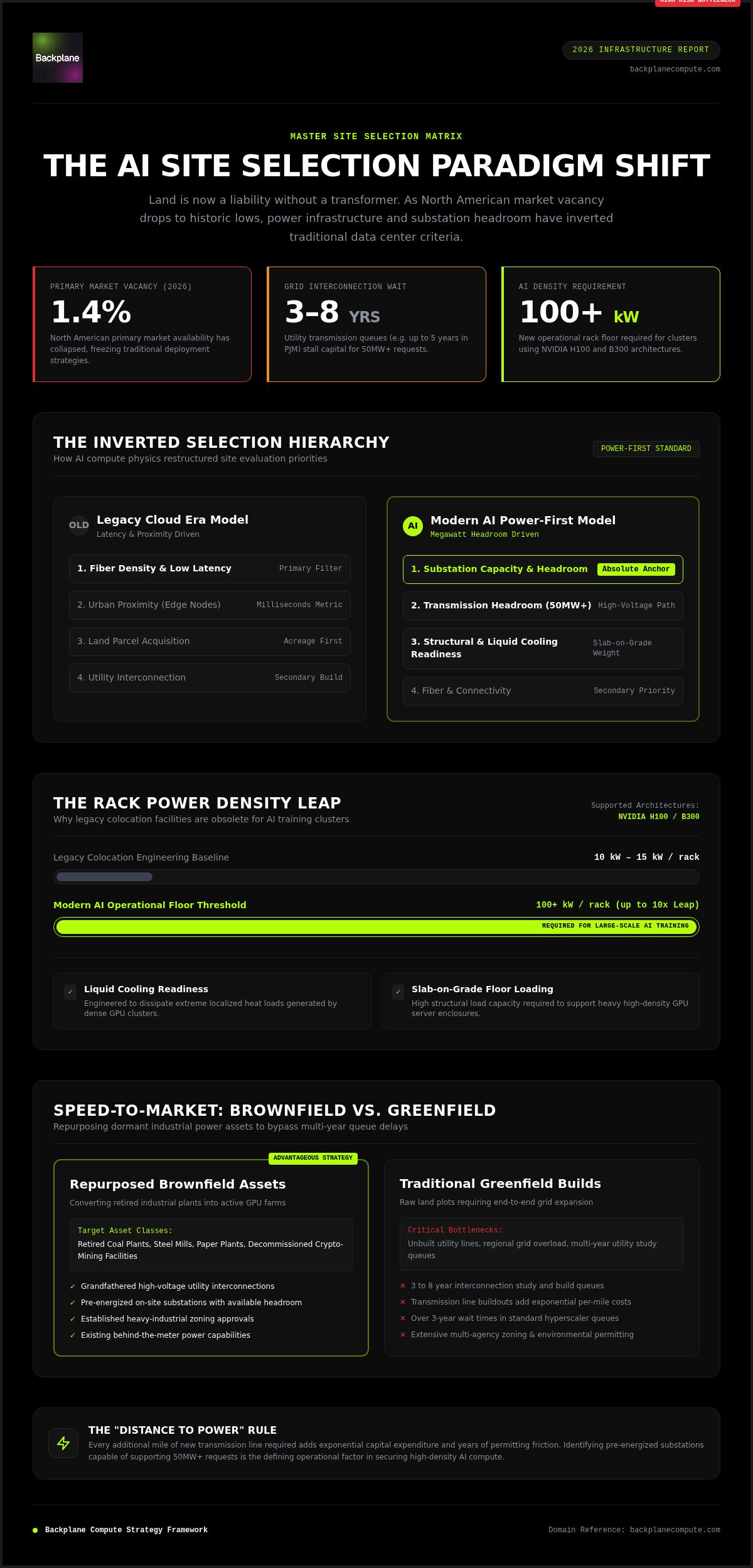
Land is no longer the primary asset in the compute race; it's a liability if it doesn't come with a transformer. In 2026, North American primary market vacancy has collapsed to a record 1.4%. If you're waiting in a hyperscaler queue, you're already behind. The game has shifted from finding a plot of land to securing a path to power. Traditional data center site selection criteria have inverted. You don't look for fiber routes first. You look for substation headroom and transmission capacity.
We understand the pressure of grid interconnection timelines that stretch up to five years in markets like PJM. It's a bottleneck that kills momentum and freezes capital. This guide provides the master checklist to bypass the queue and secure viable sites quickly. You'll master the high-stakes variables of AI site selection, from industrial power interconnection to brownfield speed-to-market strategies. We're moving from identifying dormant industrial assets to deploying active, financed infrastructure. It's time to stop waiting for the grid and start building the future of AI compute.
Key Takeaways
- Learn why substation capacity and transmission headroom have replaced land and fiber as the primary drivers of site viability.
- Master the technical data center site selection criteria for AI, focusing on slab-on-grade floor loading and liquid cooling readiness.
- Compare the speed-to-market advantages of repurposing industrial brownfields against the multi-year delays of greenfield projects.
- Discover how to structure infrastructure financing to convert retired industrial power plants into high-density GPU farms.
- Navigate grid interconnection bottlenecks to secure dedicated financed sites and bypass traditional hyperscaler queues.
The AI Shift: Why Traditional Site Selection Criteria Are Obsolete
The cloud era was defined by milliseconds. Proximity to end users was once the primary metric for success. Today, the physics of artificial intelligence has inverted that logic. Traditional data center site selection criteria prioritized fiber density and urban connectivity. For AI training workloads, these metrics are secondary. The new baseline is raw power density. The inversion of data center site selection criteria means developers must filter by utility capacity before they even look at a land parcel.
Most legacy colocation facilities were engineered for 10kW to 15kW per rack. AI training clusters, particularly those utilizing NVIDIA H100 or the upcoming B300 architectures, demand a massive leap. We are seeing a 100kW per rack threshold as the new operational floor. This shift necessitates a move toward specialized AI data centers that can manage extreme heat loads and high-voltage power distribution. If a site cannot support liquid cooling and slab-on-grade weight requirements, it's obsolete before the first server arrives. The "Power-First" hierarchy is now the standard: substation capacity comes first, followed by transmission headroom, structural load capacity, and finally, connectivity.
Density vs. Connectivity: The New Trade-off
AI training prioritizes raw megawatt capacity over millisecond latency. Large-scale model training is compute-heavy; it doesn't require the same edge-node proximity as a streaming service or a retail platform. This has led to the decline of the "Edge" in the context of massive training clusters. Operators are now evaluating sites based on their ability to host dense GPU clusters in remote, power-rich regions. In this new environment, the substation is the anchor. If the transmission network cannot support the load, the fiber count is irrelevant.
The Hyperscaler Queue Bottleneck
Relying on Tier 1 providers has become a strategic liability. With pre-leasing velocity at record highs, wait times for hyperscale capacity often exceed three years. This delay is unacceptable in a market where the "Time Value of Compute" determines winner-take-all outcomes. Dedicated, financed sites offer a decisive alternative. By repurposing industrial assets with existing high-voltage interconnections, operators can move faster than the traditional build cycle allows. You can find more on bypassing hyperscaler GPU queues to secure high-density compute without the wait. Speed to market is no longer about construction; it's about power procurement.
Power Infrastructure: The Primary Selection Criterion
In the current market, power infrastructure isn't just a utility. It's the deal. Modern data center site selection criteria have moved beyond fiber maps to focus almost exclusively on high-voltage access. If a site lacks immediate proximity to a substation with available headroom, it's a non-starter. The reliability of the local transmission network now dictates the viability of high-density GPU clusters. Operators must navigate a landscape where grid interconnection wait times can span three to eight years. Securing sites with existing "behind-the-meter" power assets or on-site generation is no longer a luxury; it's a survival strategy for speed-to-market.
Substation Viability and Interconnection
The "Distance to Power" rule is absolute. Every mile of new transmission line required adds exponential cost and years of permitting delays. Navigating utility company queues for 50MW+ requests has become the primary bottleneck in North American development. According to U.S. Department of Energy guidance on electricity demand growth, the rapid expansion of AI is straining existing grid frameworks. This makes existing infrastructure more valuable than the land it sits on. Interconnection capacity is the ultimate AI asset. Identifying sites where the substation is already energized and capable of supporting 100kW+ rack densities is the only way to meet 2026 deployment targets.
Repurposing Industrial Power Assets
Retired coal plants, steel mills, and paper plants are the gold mines of the AI era. These brownfield sites offer a rare combination of heavy-industrial zoning and grandfathered high-voltage interconnections. They are often "plug-and-play" ready for the power-to-GPU conversion. Even decommissioned crypto-mining facilities are being re-evaluated for their power density potential. These assets allow developers to bypass the years-long greenfield queue. We specialize in property viability assessment to identify these dormant resources and convert them into active infrastructure. Matching industrial owners with compute buyers is the fastest path to bridging the capacity gap. Renewable energy availability remains a critical secondary filter for ESG compliance, but it must be balanced against immediate grid reliability.
Technical Suitability: Cooling and Structural Readiness
Power is the entry ticket; technical suitability is the execution. Once you secure the megawatt capacity, the building itself must survive the workload. Legacy data center site selection criteria often focused on raised access floors and standard air handlers. For 2026 AI clusters, those specs are structural liabilities. High-density training environments require a radical departure from traditional architecture. The focus must shift to liquid cooling loops and extreme point-load tolerances. If the shell cannot support the hardware, the power remains stranded.
Liquid Cooling and Thermal Management
Air cooling is insufficient for the 100kW+ rack densities required by modern GPU clusters. The shift to direct-to-chip and immersion cooling is no longer optional. This transition fundamentally changes the site's thermal envelope. Operators must evaluate water access and wastewater infrastructure with the same rigor as grid capacity. According to the International Energy Agency's report on Energy and AI, the physical bottlenecks of the grid are compounded by the cooling demands of next-generation silicon. Siting a facility without a robust plan for N+1 or N+2 thermal redundancy is a recipe for catastrophic downtime. Repurposed industrial buildings often provide the high ceiling clearances necessary for complex hot-aisle containment and overhead coolant manifolds.
Structural Load and Spatial Efficiency
The floor is the silent bottleneck of the AI race. A fully loaded NVIDIA Blackwell rack cluster can exert static equipment weights of 3,000 to over 4,000 lbs per cabinet. Standard data center floors, often rated for 150 to 250 lbs per square foot, will fail under this pressure. This is where old mills and heavy industrial campuses offer a distinct advantage. Their slab-on-grade construction provides the structural integrity required for dense compute without the need for expensive retrofitting. It's a matter of physical reality over corporate aesthetics.
When assessing data center site selection criteria, spatial efficiency must account for future cluster expansion. You need room for Coolant Distribution Units (CDUs) and the medium-voltage switchgear that supports these massive loads. The site must accommodate the weight of the hardware and the volume of the infrastructure required to keep it running. We prioritize sites that allow for modular growth. This ensures that a 10MW deployment today can scale to 50MW without a complete structural overhaul. Speed depends on the building's ability to absorb the technology of tomorrow.
Speed-to-Market: Brownfield vs. Greenfield Analysis
Greenfield development is now a high-risk gamble. While some market participants argue that building from scratch allows for total customization, they ignore the 36 to 60 month lead times currently plaguing new construction. In the AI race, the "Time Value of Compute" is the only metric that matters. Waiting five years for a greenfield site to energize means missing two generations of GPU evolution. Modern data center site selection criteria must prioritize speed over aesthetic perfection. If you aren't deploying today, your competitors are training on the hardware you're still waiting to house.
The Brownfield Advantage
Converting existing shells often cuts 12 to 18 months from the deployment schedule. Industrial assets like decommissioned mills or retired power plants provide immediate structural enclosures and "Shell and Core" infrastructure. These sites frequently offer grandfathered permitting paths within established industrial zones. Navigating "Change of Use" permits is significantly faster than rezoning agricultural land for data center use. We've seen decommissioned paper mills successfully converted into high-density GPU farms because the heavy lifting was already done. The shell was intact. The slab was robust. The power was already at the fence.
Zoning and Regulatory Navigation
Speed requires a "By-Right" development strategy. AI-friendly jurisdictions offer fast-track permitting for projects that revitalize dormant industrial corridors. These regions often provide aggressive local tax incentives for brownfield redevelopment to stimulate economic growth. Managing community relations and noise ordinance constraints is also simpler in heavy industrial zones where the "social license to operate" is already established. You don't have the luxury of multi-year litigation over zoning variances. You need a site that is ready for immediate infrastructure deployment.
Don't let bureaucracy stall your compute strategy. We provide the expertise to secure dedicated financed sites that bypass the greenfield trap. Execution is the only competitive advantage left in a power-constrained market. Every month saved in the permitting phase is a month gained in the training cycle.
Executing the Deal: Financing and Brokerage Strategy
Identifying a viable site is a technical victory. Executing the deal is a financial one. In the current market, the capital requirements for AI infrastructure far exceed traditional real estate benchmarks. You aren't just financing a building shell; you're financing a high-voltage ecosystem capable of sustaining 100kW+ rack densities. This requires a sophisticated approach to infrastructure financing structuring that bridges the gap between industrial real estate and high-performance compute. Modern data center site selection criteria must include financial feasibility as a primary pillar. Without a structured path to capital, a site with perfect power remains a dormant liability.
Structuring Infrastructure Finance
Traditional lenders often struggle to reconcile the long-term nature of real estate debt with the rapid depreciation cycles of GPU hardware. We solve this friction by leveraging committed compute contracts as the primary security for capital. This strategy creates a robust link between the physical asset and the revenue-generating workload. It allows for the aggressive financing of "Power-to-GPU" conversions that traditional banks might overlook. Securing the necessary liquidity requires a deep understanding of both the energy markets and the compute demand. You can explore our detailed approach to financing AI infrastructure to understand how we secure capital for these high-stakes deployments.
The Backplane Brokerage Model
The Backplane brokerage model acts as a decisive bridge between two complex worlds. We don't just list properties. We operate a two-sided marketplace that matches industrial property owners with committed compute buyers. Our focus is on identifying underused assets, such as retired power plants and closed mills, that already meet the most stringent data center site selection criteria. By specializing in these high-value industrial brownfields, we bypass the standard market queues and provide a faster path to deployment. A Dedicated Financed Site becomes a turnkey enterprise solution, moving from identification to active compute in a fraction of the time required by greenfield builds.
Every execution begins with a rigorous property viability assessment. We evaluate the technical readiness of the site and the economic feasibility of the power interconnection. This ensures that every project is grounded in physical reality and financial logic. We manage the end-to-end deployment, from site matching to infrastructure financing structuring. This lean, boutique approach prioritizes speed and execution over corporate bureaucracy. In the AI race, the winner isn't the one with the biggest land bank. It's the one who can energize and finance compute at scale before the window of opportunity closes. Speed is the ultimate outcome of disciplined execution. To ensure your critical infrastructure is protected from physical and operational risks, you can visit Palisade International LLC.
The traditional playbook for digital infrastructure has been rewritten. Success in 2026 requires an aggressive shift toward power-centric models. You must prioritize substation capacity over metropolitan proximity. You must choose brownfield speed over greenfield uncertainty. The updated data center site selection criteria demand a blend of industrial grit and financial agility. Waiting for the grid is a strategic failure that stalls innovation and freezes capital. Securing off-market industrial power assets is the only path to maintaining a competitive edge in the training race.
We provide the decisive bridge between dormant resources and active compute. Through financed infrastructure delivery and a specialized brokerage model, we eliminate the friction of deployment. It's time to stop navigating queues and start executing on sites that are ready for immediate load. Secure your dedicated AI compute site with Backplane to capitalize on accelerated speed-to-market. The window for prime industrial power is closing. Move now to lock in the capacity that defines the next decade of compute.
Frequently Asked Questions
What is the most critical factor in data center site selection for AI?
Power is the absolute priority. While connectivity and latency were once the dominant data center site selection criteria, the focus has shifted to substation headroom. You can't train models on fiber alone. A site is only as viable as its path to energization. We prioritize assets with existing high-voltage interconnections to bypass the multi-year queues currently crippling greenfield developments in major North American markets.
How much power density is required for a modern GPU farm?
Modern GPU farms require a minimum of 100kW per rack to support next-generation architectures like NVIDIA's Blackwell. Legacy facilities designed for 10kW to 15kW simply can't provide the power density or thermal management required. This jump in density forces a move toward specialized AI data centers. These facilities utilize medium-voltage distribution and advanced cooling loops to keep high-performance silicon within operational thermal envelopes during intensive training cycles.
Why are retired power plants being converted into data centers?
Retired power plants offer a rare combination of grandfathered substation infrastructure and heavy industrial zoning. These brownfield sites are essentially "plug-and-play" for high-density compute because the most difficult part of the build is already complete. Backplane identifies these underused assets and arranges financing to convert them into operational GPU farms. This allows operators to secure massive power blocks in months rather than years, bypassing the congestion of greenfield development.
What is the difference between brownfield and greenfield data center development?
Greenfield development involves building on raw land, which currently carries a three to five year lead time for grid energization. Brownfield development focuses on repurposing existing industrial shells, such as closed mills or power plants. This approach significantly accelerates delivery by utilizing established structural load capacities and existing utility interconnections. In a market where speed is the primary competitive advantage, brownfield sites offer a decisive path to immediate deployment.
How long does it take to secure grid interconnection for a new site?
Securing a new grid interconnection can take anywhere from 36 to 96 months depending on the regional transmission organization. In PJM, wait times average over three years, while some Texas queues are even more congested. This is why data center site selection criteria have shifted toward sites with existing capacity. Waiting for a new utility hookup is a strategic risk that most AI operators can't afford to take.
Can existing industrial buildings handle the weight of AI server racks?
Most legacy commercial buildings can't support the weight of AI server clusters. A fully loaded rack now exerts static weights between 3,000 and 5,000 lbs. Standard raised floors are insufficient for these loads. We target industrial sites with reinforced slab-on-grade construction. These buildings provide the structural integrity required to house dense GPU clusters without the need for the expensive and time-consuming floor reinforcements that plague traditional office-to-data-center conversions.
What are the cooling requirements for high-density compute clusters?
High-density clusters require liquid cooling to manage the extreme heat generated by 100kW+ racks. Air cooling is physically incapable of removing heat at this scale. Sites must support direct-to-chip or immersion cooling infrastructure, which necessitates advanced water access and wastewater management. This technical requirement is a non-negotiable part of modern site selection. If the building's thermal envelope can't handle liquid manifolds, it's not fit for AI.
How does infrastructure financing differ for AI data centers?
AI infrastructure financing bridges the gap between traditional real estate debt and the rapid depreciation of GPU silicon. We use committed compute contracts to secure capital for these projects. This approach allows for the financing of "Power-to-GPU" conversions that traditional lenders often find too complex. Backplane matches property owners with compute buyers and structures the financing required to build out the data center infrastructure, ensuring technical and economic viability.


