

The era of the ten-year real estate exit is over. In the AI economy, infrastructure is no longer a property play; it's a high-velocity power arbitrage. You've likely felt the friction of traditional lenders trying to apply legacy warehouse logic to 2026 compute demands. Hyperscaler waitlists are stretching into years. Traditional financing moves too slow to capture the current window of opportunity. To win, you must master structured finance for data centers to bridge the gap between dormant industrial assets and urgent GPU demand.
We're providing the 2026 playbook to help you bypass the queue and secure dedicated financed sites on your own terms. You'll learn how to identify high-value power assets that others overlook and convert them into liquid infrastructure. We'll break down the specific frameworks required to value industrial power, structure the capital stack, and deploy high-density compute at scale. It's time to move beyond the waitlist and start building the backbone of the next industrial revolution. This is how you secure predictable costs and institutional-grade speed in an unconstrained market.
Key Takeaways
- Move beyond legacy real estate debt. Learn to construct a multi-layered capital stack that prioritizes industrial power assets over traditional property square footage.
- Leverage Asset-Backed Securities and Power Purchase Agreements to secure long-term financial stability for capital-intensive GPU infrastructure projects.
- Quantify the hidden costs of hyperscaler dependency. Discover why dedicated financed sites provide the agility needed to bypass current compute deployment queues.
- Establish a rigorous framework for structured finance for data centers to bridge the gap between dormant industrial assets and high-density AI demand.
- Master the technical viability standards for H100 and B200 clusters, including the critical cooling and floor load requirements for next-generation compute.
The Evolution of Data Center Financing: From Real Estate to AI Compute
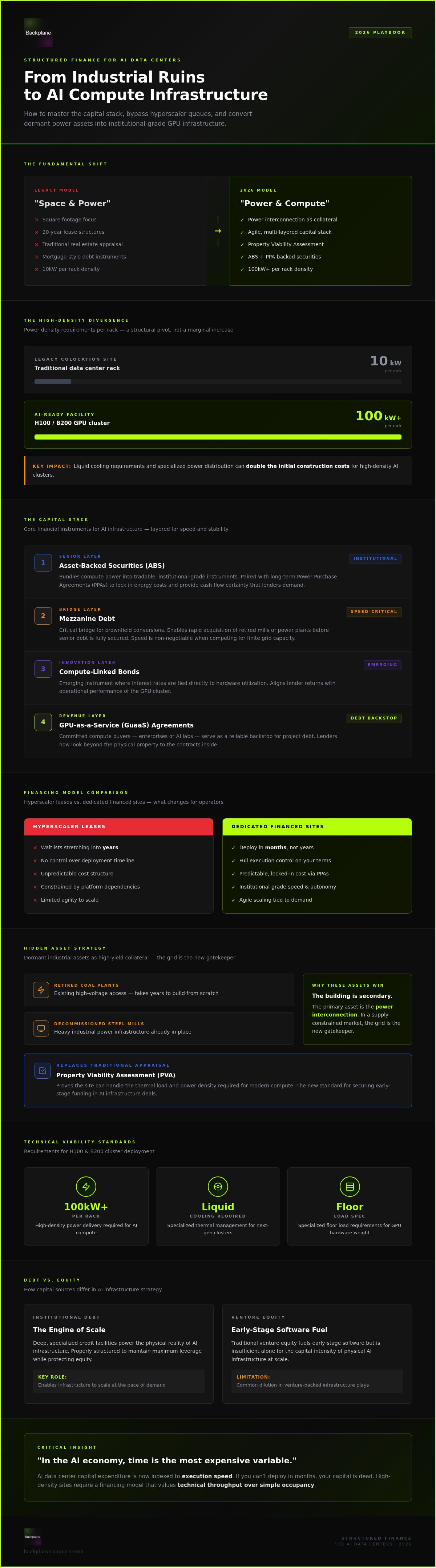
The legacy model of data center financing is broken. For decades, lenders treated these facilities as specialized warehouses. They focused on square footage, shell construction, and 20-year leases. That era ended with the rise of generative AI. Today, structured finance for data centers has evolved into a multi-layered capital stack designed for agility, not just stability. It represents a fundamental shift in asset valuation. Land is static. Compute is liquid. We're no longer financing "space and power." We're financing "power and compute."
The High-Density Divergence
Traditional mortgage-style financing fails because it cannot account for the radical density of AI clusters. A legacy colocation site might pull 10kW per rack. An AI-ready facility demands 100kW or more. This isn't a marginal increase; it's a structural pivot. Liquid cooling requirements and specialized power distribution can double the initial construction costs. Because of these constraints, AI data center capital expenditure is now indexed to execution speed. In the AI economy, time is the most expensive variable. If you can't deploy in months, your capital is dead. High-density sites require a financing model that values technical throughput over simple occupancy.
The Power Interconnection as Collateral
In a supply-constrained market, the grid is the new gatekeeper. The building is secondary. The primary asset is the power interconnection. We're seeing a massive movement toward repurposing decommissioned industrial assets. Retired coal plants and steel mills are no longer just industrial ruins. They're high-yield collateral because they possess existing high-voltage access that would take years to build from scratch. Securing early-stage funding in this environment requires a rigorous Property Viability Assessment. This replaces the traditional real estate appraisal. It proves the site can handle the thermal load and power density required for modern compute. By leveraging these dormant assets, operators can bypass hyperscaler queues and go straight to execution.
Core Mechanisms of Structured Finance for AI Infrastructure
Operational execution in the AI era requires a specialized financial toolkit. Traditional real estate debt is insufficient for the rapid depreciation cycles of H100 or B200 clusters. Instead, structured finance for data centers utilizes Asset-Backed Securities (ABS) to bundle compute power into tradable, institutional-grade instruments. These securities are frequently paired with long-term Power Purchase Agreements (PPAs) to lock in energy costs. This pairing provides the cash flow certainty that lenders demand in a volatile energy market. Mezzanine debt serves as the critical bridge for brownfield conversions. It allows for the rapid acquisition of retired mills or power plants before senior debt is fully secured. This speed is non-negotiable when competing for finite grid capacity.
The complexity of these transactions makes infrastructure brokerage and financing a necessity rather than an option. Success fees in this space are structured to align with speed-to-market and capitalization efficiency. We don't just find sites; we engineer the capital stack to ensure the project remains viable from groundbreaking to the first GPU boot.
Debt vs. Equity in AI Infrastructure
Institutional debt is the engine of scale. While venture equity fuels early-stage software, the physical reality of AI requires deep, specialized credit facilities. We're seeing the emergence of compute-linked bonds where interest rates are tied directly to hardware utilization. Properly high density data center financing requires balancing these instruments to maintain maximum leverage. It's about protecting equity while ensuring the infrastructure can scale at the pace of demand. This balance allows operators to bypass the dilution common in traditional venture-backed infrastructure plays.
Revenue-Based Financing Models
Lenders now look beyond the physical property to the contracts inside. GPU-as-a-Service (GuaaS) agreements serve as a reliable backstop for project debt. A committed compute buyer—an enterprise or AI lab with a multi-year training contract—transforms a speculative build into a predictable utility. This revenue-based approach allows for higher loan-to-value ratios than traditional real estate metrics permit. Predictable cash flow models for multi-node training clusters are the new standard. Lenders value a committed buyer as a tier-one credit event, allowing for the conversion of high-density hardware into a bankable asset class. If you're ready to move beyond the waitlist, you can structure your next infrastructure deal with our execution team.
Comparing Financing Models: Hyperscaler Leases vs. Dedicated Financed Sites
Relying on hyperscalers for large-scale AI training is a tactical error for long-term growth. While the "click-to-compute" convenience is tempting, it carries a heavy Hyperscaler Tax. You pay for their margins, their overhead, and their egress fees. More importantly, you pay for their schedule. When demand spikes, even the largest cloud providers resort to queues and capacity rationing. Structured finance for data centers provides a viable alternative. By financing dedicated sites, enterprises secure direct control over their hardware and power costs. This shift from leasing to owning allows for a tailored Total Cost of Ownership (TCO) model that often results in significant savings over a three-year training cycle. For organizations running persistent, high-density workloads, the strategic advantage of dedicated GPU clusters is undeniable.
The Capex vs. Opex Debate in 2026
The financial narrative is shifting back toward a hybrid CAPEX model. Enterprises now recognize that core AI intellectual property is inseparable from the infrastructure it runs on. Owning infrastructure on repurposed brownfield sites offers unique tax advantages, particularly when leveraging specialized enterprise zones. Accelerated depreciation is the primary driver here. Because GPU hardware has a functional life of roughly three to five years, structured finance for data centers must be engineered to match these rapid cycles. This allows firms to front-load tax benefits while maintaining the agility to refresh hardware as next-generation chips emerge. It's a clinical approach to balance sheet management that treats compute as a depreciating industrial asset rather than a vague service fee.
Bypassing the Queue: The Execution Premium
In the AI race, the cost of delay is often higher than the cost of capital. Waiting six months for a hyperscaler allocation can result in a permanent loss of market share. We quantify this as the Execution Premium. Structured finance enables the immediate acquisition and conversion of sites, ensuring "ready-to-use" availability. By utilizing GPU farm financing solutions, operators can secure immediate capacity without waiting on a third-party roadmap. This speed-to-market is the ultimate differentiator. It transforms infrastructure from a bottleneck into a competitive weapon. When you control the financing, you control the timeline.
Risk Mitigation and Asset Viability in AI Deal-Making
Risk management in the AI sector is a physical discipline. While legal teams often focus on cybersecurity or data privacy, the primary threat to capital is technical and operational. Structured finance for data centers must account for the extreme thermal and mechanical demands of next-generation hardware. A facility that cannot support 3,000 lbs per square foot or provide redundant liquid cooling isn't an asset; it's a liability. We mitigate this through rigorous technical vetting before a single dollar moves. Hardware obsolescence is equally critical. We structure deals with shorter amortization schedules to ensure the project doesn't carry legacy debt on obsolete chips. Counterparty risk is managed by vetting the compute buyer's balance sheet against their multi-year training requirements. If you need to de-risk your next project, you can request a Property Viability Assessment to confirm your site's readiness for high-density compute.
Industrial Asset Diligence
We prioritize the "Speed to Power" metric above all else. A retired steel mill with 100MW of existing grid access is worth more than a greenfield site with a five-year interconnection queue. However, diligence must extend to environmental remediation and local zoning. Decommissioned facilities often carry legacy industrial baggage that can stall a project. We also evaluate retired crypto-mining sites for their conversion potential. While these sites have power, they often lack the floor load capacity or cooling infrastructure required for enterprise-grade AI. They require significant retrofitting to meet institutional standards. Transmission delays are the silent killer of project IRR. Navigating local power constraints requires a clinical understanding of the regional grid and the specific transmission hurdles that can delay a boot date by years.
Contractual Protections for Lenders
Lenders require more than just a lien on the property. They need performance guarantees that ensure the compute environment stays operational 24/7. Step-in rights are a standard requirement in our structured finance for data centers frameworks. These rights allow an infrastructure manager to take control of the site if the operator defaults, protecting the underlying capital. We also utilize "take-or-pay" clauses in compute brokerage contracts. This ensures that the revenue backing the debt remains predictable, even if the buyer's compute needs fluctuate. It turns volatile GPU demand into a bankable, fixed-income asset. Generational shifts are relentless. A deal structured for H100s must be flexible enough to pivot to B200s or future architectures without collapsing the capital stack. We ensure every contract is engineered for the future, not just the current hardware cycle.
Navigating the Transaction: The Backplane Execution Framework
The Backplane Execution Framework is designed for speed and clinical precision. We've moved beyond the "why" of infrastructure and into the "how" of deployment. This framework bridges the gap between dormant industrial assets and high-density compute requirements. It's a repeatable four-phase process that moves projects from site identification to live compute in months, not years. By removing the bureaucracy of traditional real estate, we allow operators to capture the current window of AI opportunity.
Phase 1 focuses on site identification and a rigorous Property Viability Assessment. We don't look at aesthetic appeal; we look at megawatt capacity and transmission proximity. We evaluate retired plants and mills for their immediate grid access. If the power isn't there, the site doesn't move to Phase 2.
In Phase 2, we match these pre-vetted industrial assets with committed compute buyers. These are enterprises and AI labs that require dedicated, high-density environments for LLM training. By matching the site with a buyer early, we eliminate the speculative risk that often stalls traditional infrastructure projects. This creates a bankable contract that lenders value.
The third phase is where structured finance for data centers becomes the primary lever for execution. We don't just find lenders; we engineer the capital stack. This involves layering institutional debt with mezzanine financing to ensure the project is fully capitalized before the first rack is installed. By aligning the financing with the hardware's rapid depreciation, we protect equity while maintaining the speed required for AI deployment.
Execution culminates in Phase 4 with infrastructure deployment and live compute management. We oversee the transition from a dormant industrial shell to a high-density AI cluster. This phase ensures that the cooling, power distribution, and networking meet the precise training demands of the buyer. We manage the physical reality of the site so you can focus on the compute.
The Brokerage Advantage
We act as the decisive bridge between two opaque worlds. Property owners understand mills and plants; AI labs understand clusters and latency. Backplane speaks both languages. Our two-sided marketplace reduces friction in the diligence process, moving deals from assessment to groundbreaking in a fraction of the time required by traditional real estate firms. We pre-vet both the power and the buyer, ensuring that every transaction is built on technical and financial viability.
Securing Your Compute Future
The window for 2027 capacity is closing. Enterprises must act now to secure the power assets that will drive their next training cycles. The first step is a clinical evaluation of your target assets to ensure they can handle the thermal and power loads of H100 or B200 clusters. You can Contact Backplane to structure your next AI infrastructure deal and bypass the hyperscaler queue permanently. Don't wait for a waitlist to clear when you can own the infrastructure today.
Capitalize on the Power-to-Compute Pivot
The window to dominate the AI infrastructure landscape is narrow. Success in 2026 requires moving beyond legacy real estate models and embracing the power-to-compute pivot. You've seen how structured finance for data centers transforms dormant industrial assets into high-yield GPU farms. It's no longer about square footage. It's about megawatt capacity, thermal efficiency, and execution speed. By bypassing hyperscaler queues and securing dedicated financed sites, you regain control over your training timelines and operational costs. This is the only path to sustainable scaling in an unconstrained market.
Backplane serves as the decisive bridge between industrial real estate and high-finance. We bring fast-moving brokerage energy backed by deep institutional knowledge to every transaction. Our team specializes in converting retired plants and mills into active compute engines, ensuring your capital is indexed to results rather than waitlists. The future of AI belongs to those who own their infrastructure. Take the first step toward operational independence and secure your AI compute infrastructure with Backplane. The grid is waiting. Let's build.
Frequently Asked Questions
What is structured finance in the context of data centers?
Structured finance for data centers is a specialized capital stack that goes beyond simple mortgage debt. It involves layering institutional debt, mezzanine financing, and Asset-Backed Securities (ABS) to fund high-density compute projects. This framework prioritizes power interconnection and hardware throughput over traditional real estate metrics. By bundling GPU clusters and power agreements, we create bankable instruments that attract high-finance capital. It's a clinical approach to managing rapid depreciation and intense CAPEX.
How does data center financing differ from traditional commercial real estate?
Traditional commercial real estate financing relies on 20-year leases and static square footage. AI compute infrastructure operates on a three-to-five-year hardware refresh cycle. We value the "power and compute" throughput rather than "space and power" occupancy. This requires accelerated amortization schedules and flexible credit facilities. Lenders in this space focus on technical viability, such as liquid cooling capacity and floor loads, rather than just the shell construction or warehouse location.
Can retired industrial sites really be converted into AI data centers?
Yes, retired industrial sites like coal plants and steel mills are prime candidates for conversion. These locations often possess grid-scale power interconnections that would take years to build from scratch. We use a Property Viability Assessment to confirm if the existing infrastructure can handle the thermal and mechanical demands of H100 or B200 clusters. Converting these dormant assets allows operators to bypass hyperscaler deployment queues and secure immediate, high-voltage capacity for training.
What are the main risks for lenders in GPU infrastructure projects?
Lenders primarily face hardware obsolescence and technical operational risks. GPU generations shift rapidly, so deals must be structured to prevent legacy debt on outdated chips. Technical failure is another concern; a site that can't provide redundant cooling or adequate floor load is a liability. We mitigate this through performance guarantees and step-in rights. Finally, counterparty risk is managed by vetting the compute buyer's balance sheet against their multi-year training commitments and revenue models.
How does GPU-as-a-Service impact data center financial modeling?
GPUs-as-a-Service (GuaaS) transforms speculative infrastructure into a predictable, revenue-generating asset. These subscription contracts serve as a reliable backstop for project debt in structured finance for data centers. Lenders view committed compute buyers as tier-one credit events, allowing for higher loan-to-value ratios. This shift from speculative building to contract-backed deployment provides the cash flow certainty needed for institutional-grade financing. It turns volatile compute demand into a bankable, fixed-income stream for investors.
What is the role of an infrastructure broker in data center finance?
An infrastructure broker acts as the decisive bridge between industrial property owners and AI compute buyers. We operate a two-sided marketplace that matches powered assets with committed demand. Our role extends beyond matching; we engineer the capital stack and manage the diligence process. We remove the friction between property owners who understand industrial shells and AI labs that understand cluster latency. This boutique approach prioritizes speed and execution over traditional corporate bureaucracy.
How long does it typically take to structure and close an AI data center deal?
Closing an AI data center deal takes months rather than the years required for traditional greenfield builds. Our phase-based execution framework accelerates the process by focusing on pre-vetted industrial sites with existing power. Site identification and viability assessments happen in weeks. Matching with compute buyers and structuring the financing follows immediately. By repurposing dormant assets, we bypass the lengthy interconnection queues that stall infrastructure projects, allowing for rapid deployment of compute resources.
Why are hyperscalers not always the best option for enterprise AI infrastructure?
Hyperscalers often impose a tax through high margins, egress fees, and rigid hardware roadmaps. Enterprises frequently face long waitlists and rationing during peak demand cycles. Owning a dedicated, financed site provides direct control over hardware, cooling, and long-term energy costs. It eliminates the dependency on a third-party's deployment schedule. For persistent, high-density workloads, the TCO of enterprise-owned infrastructure is significantly lower than leasing capacity from a cloud provider over a three-year cycle.


