

Your real estate is worthless without energized megawatts. While traditional lenders obsess over floor plates and zip codes, the market has moved to a new benchmark of 100kW per rack. Securing high density data center financing in 2026 requires a fundamental shift in how you structure the capital stack. The bottleneck isn't the building. It's the power interconnection and the speed at which you can deploy H100 or B300 clusters.
You've likely seen hyperscaler queues stall critical model training while traditional banks fail to value your power assets correctly. It's a friction point that costs millions in lost compute time. This guide serves as the definitive execution manual for institutional operators and AI labs to structure, secure, and deploy 9-figure capital. We will break down the framework for valuing industrial power assets, navigate the 225 bps credit spread between hyperscale and merchant compute, and outline how to bypass the multi-year utility queue to achieve immediate speed to market.
Key Takeaways
- Learn why 2026 valuations prioritize energized megawatts over physical square footage to secure institutional infrastructure capital.
- Discover the specific technical audit requirements lenders demand before issuing a term sheet for high density data center financing.
- Master the framework for comparing traditional debt against structured infrastructure finance models tailored for B300-ready GPU clusters.
- Follow a five-step execution roadmap to secure power interconnections and bypass the multi-year hyperscaler queue.
- Understand how Dedicated Financed Sites leverage retired industrial assets to accelerate deployment for large-scale AI labs.
The Shift to Power-First Financing Models
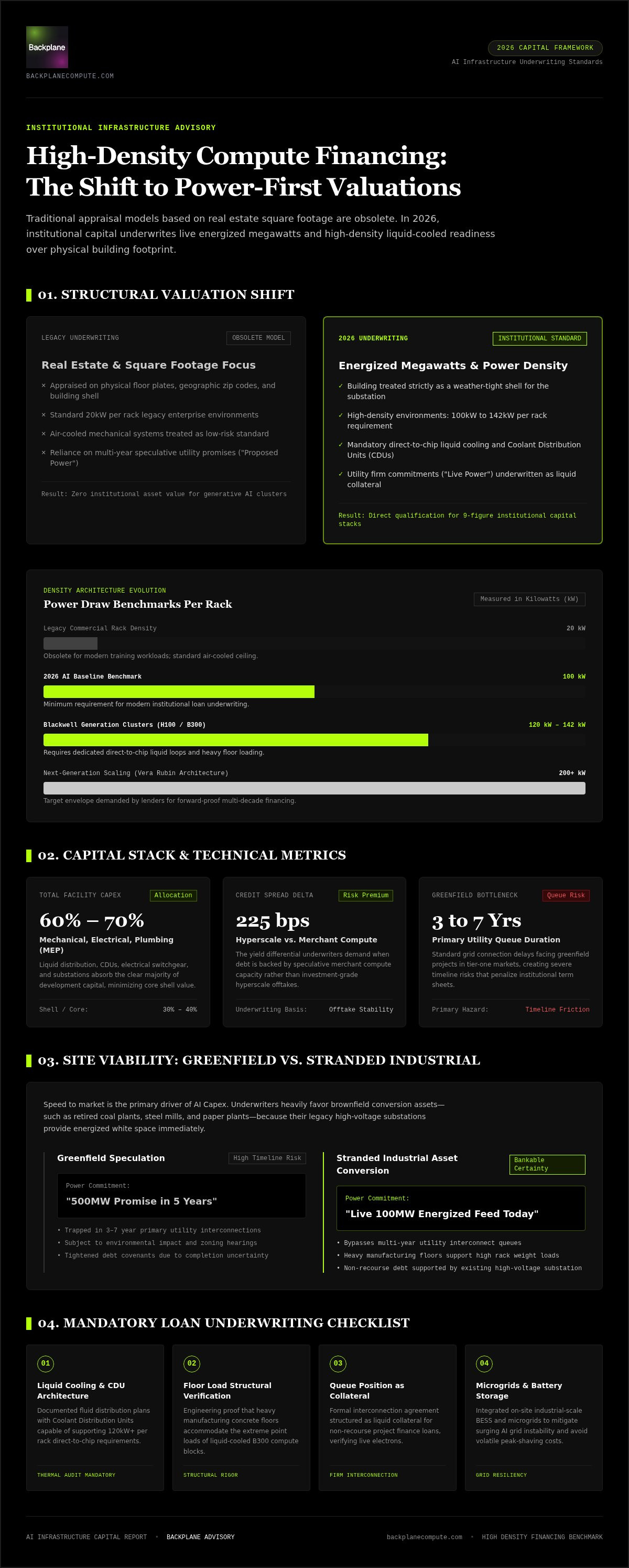
The real estate market is undergoing a violent correction. Traditional appraisal methods that value a site based on square footage are obsolete in the age of generative AI. Lenders now prioritize high density data center financing based on energized capacity, not building dimensions. In 2026, the building is merely a weather-tight shell for the substation. The market has moved past the 20kW rack. Today, high density is defined by 100kW to 140kW per rack environments that require liquid cooling and massive electrical draws. If a site lacks the immediate ability to deliver these loads, its value as an AI asset is zero.
Structuring these deals requires a departure from standard commercial mortgages. Institutional capital now flows toward assets that can support Blackwell or Vera Rubin clusters. This shift forces a transition from square-footage metrics to megawatts-per-deal. Underwriters are no longer looking at the rent roll; they are looking at the utility's firm commitment to deliver power. This is the new collateral.
Valuing Stranded Industrial Power
Quantifying the value of a grid connection is the first step in any modern infrastructure deal. Retired coal plants, steel mills, and paper plants have become the most valuable assets in the industrial landscape. These brownfield sites possess legacy high-voltage substations that allow operators to bypass the 3 to 7 year utility queues found in primary markets. This speed to market is the primary driver of AI data center capital expenditure in 2026. A site with a live 100MW feed is worth significantly more than a greenfield site with a 500MW promise that is five years away. Lenders value the certainty of energized white space because it guarantees immediate revenue from GPU clusters.
Interconnection as an Asset Class
Queue positions are now treated as liquid collateral. In a market where power is the scarcest resource, a secured interconnection agreement is an asset that can be leveraged or sold. Sophisticated project finance frameworks are being adapted to treat these agreements as the primary security for non-recourse debt. Greenfield development carries too much timeline risk for current AI deployment cycles. Lenders are tightening covenants around "Proposed Power" while loosening them for "Live Power" sites. To secure high density data center financing, you must prove that the electrons are available today. This focus on physical reality over development speculation is what separates successful AI infrastructure from stranded real estate assets.
Evaluating Site Viability for Infrastructure Loans
General property appraisals are a relic of the past. To secure high density data center financing, you must present a technical audit that proves thermal and electrical viability. Site selection is the foundation of financing for AI infrastructure. If the site can't support the 120kW to 142kW draws of Blackwell generation clusters, it's a stranded asset. Underwriters require documented proof of fluid distribution plans and coolant distribution units (CDUs). The audit must detail the path to direct-to-chip liquid cooling. This requirement significantly shifts the loan-to-cost (LTC) ratio. In 2026, mechanical, electrical, and plumbing (MEP) systems account for 60% to 70% of total facility Capex. Lenders treat air-cooled shells as high-risk ventures. They want to see infrastructure that can scale to the 200kW+ requirements of the next generation.
The Brownfield Conversion Audit
Brownfield conversion is a technical surgery, not a renovation. Repurposing retired industrial facilities requires verifying structural integrity for rack loads that far exceed traditional enterprise standards. Heavy manufacturing floors often provide the necessary load-bearing capacity for liquid-cooled clusters. Retrofitting these sites minimizes speed-to-market risks. It allows operators to bypass greenfield zoning hurdles and environmental impact studies. A professional property viability assessment identifies these advantages early. It turns a shuttered mill into a bankable AI asset by proving the existing shell can handle modern compute density. Lenders see these brownfield conversions as lower-risk because the core infrastructure already exists.
Power Redundancy and Grid Stability
Lenders focus on reliability amid surging electricity demand from AI workloads. Financing packages now frequently include on-site microgrids and industrial-scale battery storage. This infrastructure mitigates the risk of grid instability and peak-shaving costs. We're seeing a shift toward Energy-as-a-Service models where power delivery is structured as a separate, financeable operational layer. This is a critical component of modern high density data center financing. It decouples the volatility of energy markets from the stability of the real estate debt. Underwriters favor this model because it clarifies cash flows and provides a hedge against rising utility rates. Site viability is the precise intersection of immediate power availability and liquid-cooling readiness.
Structuring the Transaction: CAPEX vs. OPEX Frameworks
Traditional real estate debt is too slow for the AI era. Standard mortgages assume a thirty-year asset life, but GPUs face obsolescence in three. This mismatch creates a fundamental friction point in high density data center financing. To bridge the gap, operators must separate the shell from the silicon. The building is a long-term infrastructure play. The GPUs are a high-turnover compute play. Successfully structuring these deals requires a dual-track capital stack that treats the facility and the hardware as distinct financial instruments.
We've seen a surge in GPU farm financing solutions that blend equipment leasing with infrastructure debt. This model allows labs to move massive upfront costs into predictable operational expenses. It aligns the hardware's depreciation schedule with the revenue generated by the compute. By 2026, this structured approach has become the baseline for institutional-grade AI deployments.
Equipment-Backed GPU Financing
Lenders now accept H100 and B300 clusters as depreciating collateral. This shift in risk management is supported by a robust residual value insurance market. Insurance providers now guarantee the secondary market value of AI hardware, making it a bankable asset for neoclouds and labs. The GPU-as-a-Service model further strengthens this position. When compute is sold via multi-year, take-or-pay contracts, those contracts act as the primary revenue-backed loan driver. It transforms hardware from a liability into a high-yield engine.
Off-Balance Sheet Financing Strategies
Scaling quickly requires protecting the corporate balance sheet. Special Purpose Vehicles (SPVs) allow operators to ring-fence individual site builds, isolating the debt from the parent company. This is essential for managing the massive capital expenditure required to scale data centers. When a Tier-1 lab commits to a long-term contract, that commitment becomes the collateral for the SPV's debt. This strategy avoids the high premiums of the hyperscaler market while maintaining the agility of a private site.
Tax implications also drive these structures. In 2026, accelerated depreciation schedules for liquid-cooling systems and high-voltage distribution help offset the high cost of capital. You aren't just building a facility. You're engineering a financial vehicle designed for maximum tax efficiency and rapid deployment. This is how the market leaders maintain their edge in the race for compute dominance.
5 Steps to Securing High-Density Compute Capital
Execution is the differentiator. In a market where 120kW racks are the standard, your ability to secure high density data center financing depends on a precise, five-step roadmap. Institutional capital is no longer interested in speculative greenfield projects. They want energized megawatts and committed compute buyers. Speed is the only metric that matters when your competitors are already training on B300 clusters. If you can't prove a path to power, you won't get a seat at the table.
Step 1 & 2: The Foundation
Lenders won't issue a term sheet based on a proposed power plan. You must secure the power interconnection and the industrial site before initiating the capital search. This means having a utility-signed agreement in hand. Once the power is locked, you must provide a technical viability assessment. This audit proves the shell can handle the thermal loads of high-density clusters. Lenders require documentation on fluid distribution loops, secondary coolant circuits, and structural floor reinforcement. A power-ready state for 2026 projects is defined as a site with a utility-confirmed interconnection agreement and a substation capable of delivering 100MW+ of energized capacity within 18 months.
Step 3-5: The Capital Close
Capital flows toward certainty. To bridge the gap between real estate and compute, you must structure your demand through Take-or-Pay contracts. These agreements turn volatile GPU demand into bankable revenue streams. Lenders see these contracts as the primary security for the debt. Next, you must engage a specialized infrastructure broker who understands the nuances of the 2026 AI market. Generalist real estate firms lack the technical depth to value liquid-cooled environments. A specialized partner matches your project with private credit funds and infrastructure trusts that prioritize execution.
Finally, execute the structured financing plan. This involves coordinating the SPV setup, equipment leasing, and facility debt into a single, cohesive closing. The goal is to beat the hyperscaler deployment cycles. If you can't energize in 12 to 24 months, your capital will find a faster project. You can accelerate this timeline by utilizing our Infrastructure Financing Structuring expertise to lock in a power-first site today. Securing high density data center financing is a race against the utility queue. Don't let your project stall at the substation.
Accelerating Deployment with Backplane’s Financed Site Model
Speed is the only currency in AI infrastructure. Waiting for a hyperscaler to clear its backlog is a strategic failure. Backplane eliminates this friction by bypassing traditional queues through Dedicated Financed Sites. We don't wait for utility promises. We identify dormant power, structure the capital, and deliver energized white space. This model ensures that GPU as a service for enterprise isn't just a software layer but a fully financed physical reality. By controlling the entire stack from substation to rack, we compress deployment timelines that typically take years into months.
Our approach to high density data center financing is rooted in industrial reality. We recently oversaw the conversion of a decommissioned paper mill into a live GPU farm in under 12 months. This was achieved by leveraging existing high-voltage substations and dual-feed utility lines that the market had overlooked. While greenfield developers were still filing zoning permits, our site was already hosting 120kW racks. This is the Backplane advantage: we find the power others can't see and finance it with speed they can't match.
The Two-Sided Marketplace Advantage
Lenders are traditionally cautious about neocloud volatility. Backplane reduces this risk by operating a two-sided marketplace. We match powered industrial sites with committed, credit-worthy compute buyers before the first dollar is deployed. This pre-vetted demand provides the certainty required for complex high density data center financing structures. We act as the orchestrator, ensuring the technical viability of the site aligns perfectly with the capital requirements of the lender. This transparency accelerates the underwriting process and secures more favorable terms for our partners.
Deployment Speed: From Financing to Live Infrastructure
Predictability drives performance. We use structured templates for mechanical and electrical fit-outs to avoid the "bespoke" delays that plague traditional builds. These pre-financed sites allow AI labs to maintain aggressive model training schedules without the risk of infrastructure bottlenecks. When the capital is already structured and the power is live, the only remaining variable is hardware installation. This methodical approach transforms a complex industrial project into a streamlined professional workflow. To move from proposal to power without the red tape, contact Backplane to structure your high-density financing today.
Securing the Future of AI Infrastructure
The race for compute dominance is a race for power. Traditional lending models fail because they ignore the physical constraints of 2026 era GPU clusters. To win, you must pivot from real estate metrics to energized capacity. Success requires a structured approach to high density data center financing that values power interconnections as liquid collateral and treats cooling readiness as a non-negotiable asset. You cannot train the next generation of models on promises; you need live infrastructure.
Backplane acts as the decisive bridge between these complex industrial realities and institutional capital. We specialize in stranded power arbitrage, identifying underused assets like retired mills and converting them into high-performance compute farms. Our boutique agility allows us to move faster than traditional corporate entities, matching your demand directly with specialized AI capital. We cut through the red tape that stalls hyperscaler projects, providing a direct path to energized white space.
You don't have to wait for the utility queue to clear. By leveraging our expertise in infrastructure financing structuring, you can bypass the bottlenecks and deploy at the speed of the market. Secure Your Dedicated Financed Site with Backplane and lock in the power your model training requires today. The infrastructure for the next generation of AI is ready for execution.
Frequently Asked Questions
What is the minimum power requirement for high-density financing in 2026?
100kW per rack is the new floor for high-density projects. Financing for high density data center projects usually triggers at the 100MW site level. Lenders prioritize energized capacity over square footage. If your site cannot deliver the sustained electrical draw required for Blackwell or Vera Rubin clusters, it won't qualify for institutional infrastructure capital. We focus on sites where the power is already live or available within an 18 month window.
Can I use existing industrial assets as collateral for GPU clusters?
You can leverage retired power plants, closed mills, and decommissioned industrial campuses as powerful collateral. These assets possess legacy high-voltage substations that are far more valuable than the land itself. Lenders treat the utility interconnection agreement as the primary security. By repurposing these sites, you bypass the multi-year grid queues that stall greenfield developments. This makes brownfield assets highly attractive for infrastructure financing structuring.
How does high-density financing differ from traditional data center loans?
Traditional loans focus on real estate appraisals and long-term tenant leases. High density data center financing prioritizes power availability and hardware cash flows. It often utilizes Special Purpose Vehicles to ring-fence the risk. Because AI hardware depreciates in three to five years, the debt structure is more aggressive than a standard thirty-year mortgage. It requires a sophisticated blend of real estate debt and equipment leasing to be viable.
What is the typical timeline for securing AI infrastructure capital?
Closing a structured finance deal typically takes three to six months. However, the entire timeline from site assessment to live infrastructure deployment targets 12 to 24 months. This speed is necessary to beat hyperscaler cycles. Delays in structuring often lead to lost compute revenue. We use pre-vetted templates to accelerate the closing process, ensuring your capital is deployed as soon as the technical viability of the site is confirmed.
How do lenders value GPU hardware as collateral?
Lenders treat GPUs as high-turnover equipment with a short economic life. They require residual value insurance to hedge against the rapid pace of hardware innovation. To make hardware bankable, you must back it with multi-year, take-or-pay compute contracts. This transforms the GPUs from a depreciating liability into a predictable revenue engine. Most institutional lenders won't finance hardware without a clear, contracted buyer for the compute capacity.
Is it possible to finance the conversion of a brownfield site for AI?
Financing brownfield conversions is a core strategy in the 2026 market. Shuttered industrial sites provide the heavy electrical infrastructure needed for liquid-cooled clusters. Backplane specializes in matching these powered sites with AI labs and structuring the required capital. These projects are often seen as lower risk than greenfield builds because the core utility connections already exist. This significantly reduces the time to first electron and revenue.
How do 'Take-or-Pay' contracts influence financing terms?
Take-or-pay contracts are the foundation of non-recourse infrastructure debt. They guarantee revenue regardless of actual compute usage, which provides the certainty lenders demand. These contracts allow operators to secure higher loan-to-cost ratios and better spreads. Without a bankable contract from a credit-worthy buyer, securing nine-figure capital for merchant compute is extremely difficult. It effectively shifts the credit risk from the operator to the compute buyer.
What role does liquid cooling play in securing a data center loan?
Liquid cooling is a mandatory lending condition for any site targeting 100kW per rack or higher. Lenders view air-cooled shells as high-risk stranded assets that cannot support next-generation chips. Your technical audit must include a detailed plan for fluid distribution and thermal containment. Proof of liquid-cooling readiness is often a prerequisite for reaching the term sheet stage. It ensures the facility remains viable throughout the life of the loan.


