

In 2026, the success of your AI strategy won't be measured by the size of your budget, but by the speed of your interconnection. The global surge in AI data center capital expenditure has reached a tipping point where capital is no longer the primary constraint. Physical reality is. While hyperscalers report record-breaking spends, the actual deployment of high-density GPU clusters is stalling against the hard limits of power availability and greenfield construction timelines. You can't compute on a promise. Waiting eighteen months for a traditional build-out is a competitive death sentence.
You've likely realized that the current queue for hyperscaler capacity is a bottleneck that threatens your technical roadmap. It's a friction point that demands an immediate shift in strategy. We'll analyze the 2026 CAPEX landscape to show how leading enterprises are bypassing these delays through strategic infrastructure financing and brownfield development. You'll discover how to identify high-efficiency investment targets and secure dedicated compute without paying the "hyperscaler tax." We're moving past the era of speculative spending and into the era of clinical execution speed.
Key Takeaways
- Analyze how the trillion-dollar milestone in AI data center capital expenditure is shifting focus from speculative hardware acquisition to immediate power grid access.
- Identify why power interconnection has become the most critical line item in the CAPEX stack and how to navigate saturated utility queues.
- Compare the efficiency of brownfield conversions against greenfield builds to reduce infrastructure deployment timelines from 36 months to under nine.
- Discover how structured financing and project-based debt are replacing venture equity for securing high-density GPU clusters.
- Learn a clinical framework for bypassing hyperscaler delays by matching dormant industrial assets with active compute demand.
The 2026 CAPEX Landscape: Beyond the Trillion-Dollar Milestone
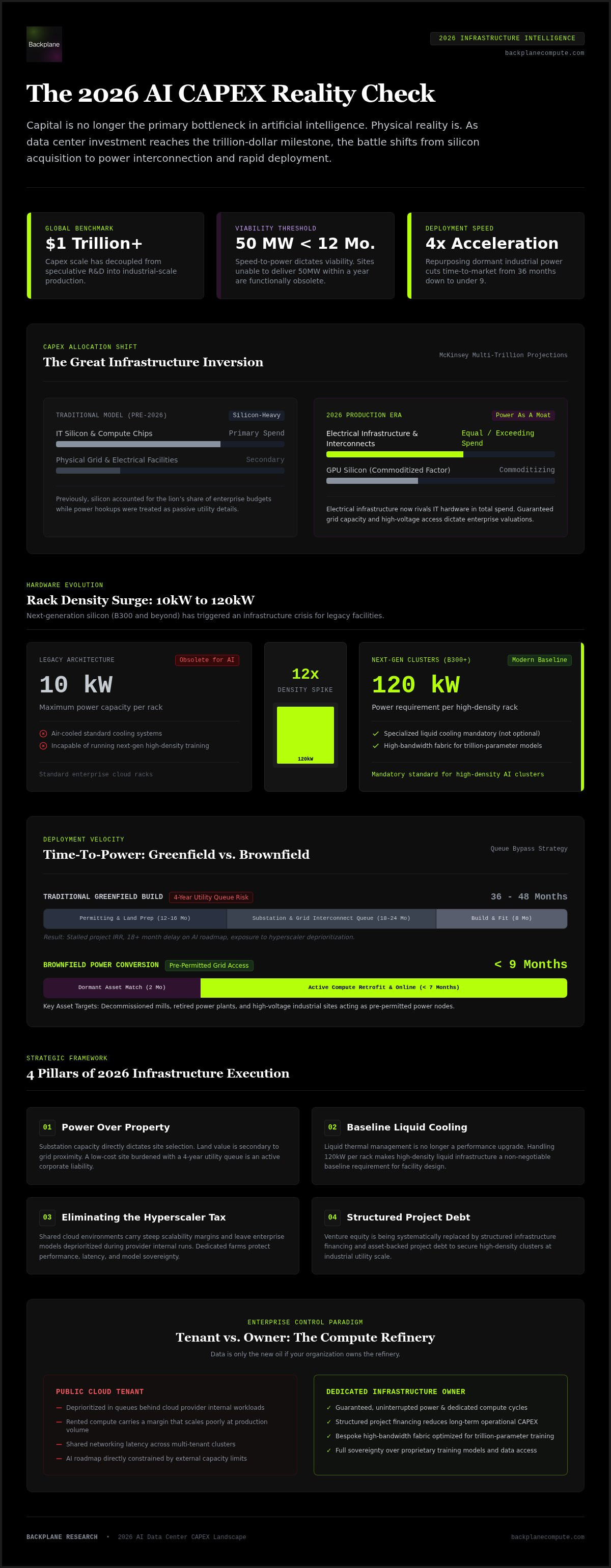
The trillion-dollar milestone is no longer a forecast. It's a baseline. In 2026, AI data center capital expenditure has decoupled from speculative R&D. We've entered the era of industrial-scale production. Success isn't measured by the number of chips ordered. It's measured by how many of those chips are actually drawing power. The Hyperscaler Tax, the premium paid for flexibility in shared environments, is facing intense enterprise pushback. Organizations are tired of being deprioritized in favor of the cloud providers' own internal workloads. Speed to power has replaced cost per square foot as the primary metric for viability. If a site can't deliver 50MW in under twelve months, it's irrelevant.
Deconstructing the 2026 AI Spend
The CAPEX stack has inverted. Previously, silicon accounted for the lion's share of investment. Now, the physical AI data center infrastructure required to house that silicon commands the highest premium. Power interconnection is no longer a utility detail; it's a competitive moat. This shift represents a fundamental change in how AI data center capital expenditure is allocated across the enterprise. Efficiency is now defined by the conversion of raw energy into model training cycles.
- Power over Property: Substation capacity dictates site selection. Land costs are secondary to grid proximity. A cheap site with a five-year power wait is a liability.
- Thermal Management: High-density clusters require specialized liquid cooling. This isn't an upgrade; it's a baseline requirement for modern facility design.
- Networking Fabric: Spend on high-bandwidth interconnects is rising as clusters grow to accommodate trillion-parameter models.
The Rise of Private AI Infrastructure
The shift toward dedicated, private farms is accelerating. Enterprises are moving away from public clouds to reclaim control over their technical destiny. The cost-benefit analysis is clear. Rented compute carries a margin that scales poorly at production volumes. By securing dedicated financed sites, firms bypass the queue. They eliminate the latency of shared networking. They protect the sovereignty of their proprietary models. Data is the new oil, but only if you own the refinery. Private clusters allow for bespoke networking configurations that public clouds simply cannot support. This isn't just about saving money. It's about ensuring that your AI roadmap isn't subject to a third party's capacity constraints. You don't just need compute. You need certain, dedicated, and high-performance access to it. It's the difference between being a tenant and being an owner.
Where the Capital is Flowing: Hardware vs. Power Interconnection
The 2026 AI data center capital expenditure model is undergoing a violent correction. Silicon is becoming a commodity. Power is becoming a luxury. The introduction of next-gen GPUs, specifically the B300 and its successors, has pushed rack densities toward 120kW. This isn't just a hardware upgrade. It's an infrastructure crisis. Legacy facilities designed for 10kW racks are functionally obsolete for high-density training. We see capital flowing away from traditional real estate and toward high-voltage interconnection assets. McKinsey's data center capital expenditure projections highlight this multi-trillion-dollar race to scale, where electrical infrastructure now rivals IT hardware in total spend. Core sites are for massive training runs. Edge sites are for high-speed inference. Both require one thing: guaranteed electrons.
The Premium on High-Density Power Interconnection
Grid access is the ultimate bottleneck. In 2026, the value of an industrial site is tied directly to its substation capacity. The interconnection queue has become a primary risk factor for institutional investors. Traditional greenfield developments are stalling under four-year utility wait times. This is why retired industrial sites are the hidden gems of the current market. A decommissioned mill or a retired power plant isn't just a shell. It's a pre-permitted power node. These brownfield assets allow operators to bypass the queue and reach commercial operation in months, not years. This speed directly protects your project IRR. Every month spent waiting for a utility hookup is a month of hardware depreciation without revenue.
Thermal Management: The Invisible CAPEX Driver
Air cooling cannot sustain 2026 compute loads. The transition to 100% liquid-cooled environments is now a mandatory CAPEX line item. Retrofitting existing facilities is a complex, high-risk endeavor. You must evaluate floor loading, fluid dynamics, and heat rejection capacity with clinical precision. It's no longer enough to have a roof and a floor. You need a facility that functions as a massive heat exchanger. Before committing capital, performing a property viability assessment is essential to ensure the physical shell can support the weight and thermal demands of high-density clusters. If the facility fails the thermal test, the GPU investment is stranded assets.
Greenfield vs. Brownfield: The CAPEX Efficiency Debate
In the 2026 market, time is the most expensive line item. Traditional greenfield development is a three-year bet on a future that won't wait for you. Brownfield conversion is a tactical strike. By repurposing dormant industrial assets, operators are slashing deployment timelines from 36 months to under nine. This isn't just a cost-saving measure. It's an aggressive optimization of AI data center capital expenditure designed to capture market share before the hardware cycle turns. You don't build for the future. You acquire it.
Brownfield Conversion: The 2026 Speed Play
Speed is the primary differentiator. A retired power plant or an old mill already possesses the two things greenfield builds lack: heavy concrete and high-voltage interconnection. The U.S. Department of Energy's data center electricity evaluation underscores how these legacy energy sites are critical for meeting the explosive demand of AI workloads. These sites bypass the primary bottlenecks of 2026: zoning approvals and utility queues. While a new build waits for a transformer to ship, a brownfield conversion is already installing liquid cooling loops.
Success requires clinical diligence. You must verify structural floor loading and environmental remediation before the first rack arrives. Leveraging structured financing for AI infrastructure allows you to bridge the gap between acquisition and operational revenue. The goal is to turn a dormant asset into a high-density compute farm while the competition is still filing permits. It's a matter of converting existing physical advantages into immediate technical capacity.
Greenfield Realities: Why the 'New Build' Model is Faltering
The greenfield model is hitting a wall of physical constraints. Supply chain delays for specialized components like high-voltage switchgear have turned 18-month projects into three-year marathons. Land with existing grid access now commands an unsustainable premium, often pricing new builds out of the market. Regulatory hurdles are also mounting. Local opposition and environmental impact studies create friction that agile operators can't afford.
In 2026, building from scratch is a luxury of the slow. If your AI data center capital expenditure is tied up in a project that hasn't broken ground, you're losing ground. You need power. You need it now. You need a site that was built for industry, not a vacant lot with a promise. The market no longer rewards the promise of future capacity. It rewards the delivery of current compute.
Financing the AI Frontier: Structured Models for High-Density Compute
The 2026 market has outgrown venture equity. Dilutive capital is a blunt, expensive tool for building physical power capacity. As AI data center capital expenditure scales into the billions, the industry is pivoting toward project-based debt and sophisticated financing for AI infrastructure. This shift treats GPU clusters as industrial assets rather than speculative software bets. It's a move toward institutional maturity that fundamentally alters the trajectory of AI data center capital expenditure. Lenders now prioritize compute-purchase agreements (CPAs) to de-risk their positions. These agreements act as a guarantee offtake, providing the predictable cash flow required to unlock large-scale infrastructure loans. If you have the demand and the site, the capital is available. You just have to structure it correctly.
Asset-Backed Financing for GPU Clusters
Securing capital for high-density compute requires a clinical approach to collateralization. In 2026, the GPUs themselves serve as the primary security. But hardware is only half the story. Successful GPU farm financing solutions now rely on rigorous residual value assessments that account for the rapid pace of silicon innovation. Lenders don't just value the chips. They value the powered shell and the interconnection rights that make the silicon operational. Financing is no longer a generic credit line. It's a structured deal that balances hardware cycles against long-term power costs and specialized liquid cooling requirements. This creates a dedicated, fully financed site that remains resilient against the volatility of public cloud spot pricing.
Bridging the Gap: The Infrastructure Brokerage Model
The friction between industrial property owners and compute buyers is the primary barrier to execution. Property owners sit on high-voltage assets but lack technical depth. Compute buyers have the technical roadmap but lack a physical footprint. Backplane serves as the decisive bridge between these two worlds. We don't just match parties. We structure the financing that converts a dormant industrial asset into an active, revenue-generating GPU farm. This is a high-stakes brokerage model designed for speed. We handle the property viability assessments and the financial structuring to ensure that every project is bankable from day one. By removing the bureaucratic friction of traditional site development, we accelerate the movement of capital into active infrastructure. If you need to bypass the queue, you need to structure your infrastructure financing with a partner who understands the industrial reality.
Navigating the 2026 Spend: How Backplane Accelerates Deployment
The 2026 mandate is clear: execute fast, buy power, go brownfield. Traditional methods of managing AI data center capital expenditure are too slow for the current hardware cycle. Backplane identifies underused industrial assets that the market overlooks. We transform dormant infrastructure into high-density compute environments. This eliminates the "Hyperscaler Queue" by providing dedicated financed sites that you control. For many, the path to scale is through GPU as a service for enterprise. It offers the agility of the cloud with the performance of dedicated hardware. You get the compute you need without the "hyperscaler tax" or the administrative delays of shared environments.
From Site Assessment to Live Infrastructure
Our workflow is built for speed. We move from initial diligence to deployment with a focus on institutional precision. Backplane's boutique energy cuts through the corporate bureaucracy that stalls larger firms. We don't just find property. We assess its fundamental capacity to support liquid-cooled AI clusters. Every engagement begins with a clinical Property Viability Assessment. We verify the power. We verify the structure. We verify the timeline. If the site doesn't meet the 2026 standard for execution speed, we move on. This discipline protects your capital and your roadmap. We handle the heavy lifting of infrastructure financing structuring, ensuring your site is bankable and ready for immediate deployment.
Securing Your Compute Future
The 2026 power grab is a zero-sum game. Every megawatt secured by a competitor is a megawatt unavailable to you. Waiting for greenfield builds or hyperscaler availability is no longer a viable strategy. It's a risk to your technical relevance and market position. Backplane provides direct access to H100 and B300 clusters through our specialized brokerage. We match your compute demand with powered industrial reality. We structure the financing. We secure the site. We ensure your deployment happens in months, not years. The window for securing high-density power is closing fast. The market rewards those who move with clinical speed and industrial purpose. Contact us to secure your site today and take control of your infrastructure destiny. Don't let your AI roadmap be dictated by someone else's construction delays.
Capturing the Industrial Advantage
The 2026 landscape is defined by a single reality: power is the new primary currency. Managing your AI data center capital expenditure requires more than just a large check. It requires the clinical identification of powered assets and the speed to secure them before the market saturates. You've seen how brownfield conversions and structured project finance bypass the multi-year delays of traditional builds. The era of waiting for hyperscalers is over.
Backplane provides the decisive bridge between high-stakes industrial real estate and high-performance compute demand. We specialize in industrial site conversion, turning decommissioned power plants and mills into active GPU farms. Our brokerage model provides direct access to high-density power and accelerated speed-to-market via structured finance. The window for securing these dormant assets is narrow. Move with precision. Capture your capacity today.
Secure your dedicated AI compute site with Backplane and take control of your technical roadmap. Your execution speed starts now.
Frequently Asked Questions
What is the projected AI data center capital expenditure for 2026?
Global AI data center capital expenditure for 2026 is projected to surpass the trillion-dollar milestone. This spend represents a fundamental shift from experimental R&D to industrial-grade production capacity. Capital is no longer the primary constraint; physical power and interconnection speed are the decisive drivers. Most of this investment is flowing into high-density infrastructure and specialized hardware clusters that support trillion-parameter models at scale, moving beyond speculative software bets.
Why is brownfield development preferred over greenfield for AI data centers?
Brownfield development is preferred because it slashes deployment timelines from years to months. A greenfield build typically requires 18 to 36 months for permitting and construction. Converting a retired industrial site takes six to nine months. These sites already possess the heavy concrete and high-voltage power required for high-density compute. In a market where speed is the primary differentiator, brownfield conversions offer a decisive competitive advantage over traditional new builds.
How does power interconnection impact data center CAPEX?
Power interconnection is now the single most expensive line item in the infrastructure stack. Grid access dictates site viability and project IRR. In 2026, the value of an asset is tied directly to its substation capacity rather than its square footage. Saturated utility queues mean that securing power interconnection often costs more than the land itself. It's the ultimate bottleneck that defines the success and execution speed of any large-scale AI deployment.
What are the common financing models for private GPU farms in 2026?
Financing has moved away from dilutive venture equity toward structured project-based debt and asset-backed models. Lenders now use GPUs and powered infrastructure as collateral. These deals are often supported by compute-purchase agreements that guarantee revenue offtake. This shift allows enterprises to fund massive AI data center capital expenditure without sacrificing ownership. It's a clinical, institutional approach to scaling compute capacity through specialized infrastructure financing structuring that prioritizes speed and asset security.
How can enterprises bypass hyperscaler GPU queues?
Enterprises bypass hyperscaler queues by securing dedicated, fully financed sites or utilizing GPUs-as-a-Service. These models eliminate the "hyperscaler tax" and the risk of being deprioritized in shared public cloud environments. By owning the infrastructure or securing a dedicated contract, firms gain certain access to H100 and B300 clusters. This strategy removes the technical and administrative bottlenecks associated with traditional providers, ensuring your AI roadmap remains on schedule and under your control.
What is the role of an AI infrastructure brokerage?
An AI infrastructure brokerage like Backplane bridges the gap between industrial property owners and compute buyers. We identify underused assets like retired power plants and match them with active compute demand. The role involves more than just matching; it includes property viability assessments and infrastructure financing structuring. We handle the technical and financial complexity of converting dormant resources into operational GPU farms, effectively accelerating the entire deployment lifecycle for institutional investors and operators.
How does liquid cooling affect the CAPEX of modern data centers?
Liquid cooling is no longer optional for 2026 densities; it's a mandatory requirement for high-performance environments. Racks exceeding 100kW cannot be sustained by traditional air cooling. This shift increases the initial spend on facility design and specialized plumbing but improves long-term efficiency. Retrofitting existing facilities for liquid cooling is a high-risk endeavor that requires precise technical and financial evaluation. It's a critical CAPEX driver that allows for much higher compute density per square foot.
Is repurposing retired power plants for AI compute viable?
Repurposing retired power plants is the most efficient strategy for securing immediate capacity in 2026. These facilities are pre-permitted power nodes that bypass the four-year utility wait times typical of greenfield builds. They offer the structural integrity and heavy electrical infrastructure required for massive GPU clusters. Backplane specializes in these conversions, turning dormant industrial assets into high-performance compute refineries. It's a tactical move that converts legacy advantages into modern AI infrastructure with clinical speed.


