

Compute is no longer a software challenge. It's a power and industrial real estate problem. In 2026, the distance between an AI roadmap and a live model is measured in megawatts and grid interconnection timelines. You've likely felt the friction of hyperscaler queues. You've seen the 18 month lead times for B200 clusters. It's a market defined by scarcity. The old ways of procurement are failing. You're facing unpredictable costs and egress fees that can inflate bills by 30 percent. You need a faster path to scale. This guide details how to bypass those queues by utilizing GPU as a service for enterprise through an infrastructure-first sourcing model. We'll show you how to secure dedicated H100 and B300 capacity by treating the power-to-compute chain as a physical asset. We'll explore the transition from volatile cloud instances to dedicated, financed sites built on retired industrial assets. The era of waiting for allocations is over. You'll learn to secure the high-density compute required for 2026 by moving upstream of the gridlock. It's time to own the infrastructure that drives your intelligence.
Key Takeaways
- Hyperscaler queues have become a strategic bottleneck. Grid-level power constraints now define the speed of AI deployment for 2026.
- Secure dedicated H100 and B300 clusters by utilizing GPU as a service for enterprise through infrastructure-first sourcing.
- Eliminate the hyperscaler tax on long-term training runs. Dedicated GPU farms provide predictable costs without the overhead of shared services or egress fees.
- Accelerate your deployment timelines by repurposing dormant industrial assets. Brownfield development converts retired power plants into high-density compute hubs.
- Transition from heavy CAPEX to a streamlined OPEX model. Structured infrastructure financing allows you to own the power-to-compute chain without traditional hardware procurement delays.
The GPU Scarcity Trap: Why Hyperscaler Queues are Breaking Enterprise AI
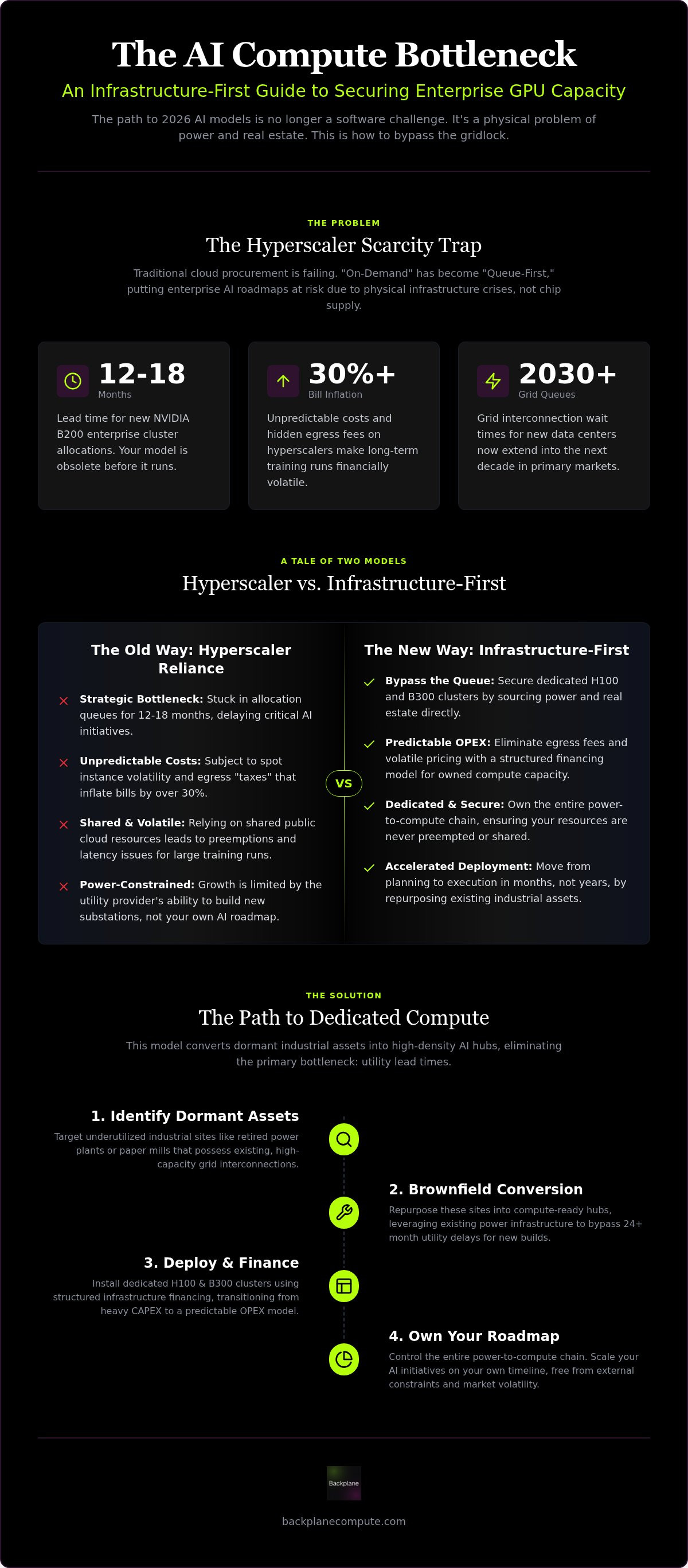
The 2026 AI market is defined by a brutal paradox. Hardware is faster than ever, yet access is slower than ever. Enterprises that once relied on "Cloud-First" strategies now find themselves in a "Queue-First" reality. Demand for B300 and H100 clusters has fundamentally outpaced grid capacity. This is no longer a manufacturing delay. It's a physical infrastructure crisis. When you wait 12 to 18 months for a B200 allocation, your model is obsolete before the first epoch runs. Market share doesn't wait for cloud providers to upgrade their substations. We define "Enterprise GPU Scarcity" as a power-access problem, not a chip-supply problem. The silicon exists. The sockets do not.
The Failure of Standard Cloud Allocations
Traditional hyperscalers are no longer reliable partners for high-density compute. They prioritize their own internal workloads and Tier-1 CSP partners first. For most, "On-Demand" has become a misnomer. You cannot simply spin up a multi-node cluster of a Graphics Processing Unit (GPU) for large-scale training anymore. Spot-instance availability has vanished in the face of record demand. Relying on shared public clouds for GPU as a service for enterprise leads to unpredictable latency and sudden preemptions. It's a high-stakes gamble where the house always wins. The volatility of these instances makes multi-month training runs nearly impossible for non-priority clients.
The Power Bottleneck: The New Limit on AI Growth
The bottleneck has shifted from the silicon to the socket. Data center power density requirements have tripled in the last 24 months. Modern clusters demand megawatts that the aging electrical grid cannot provide on short notice. In 2026, grid interconnection wait times are the primary friction point for every major operator. This delay is the silent killer of AI innovation. The Power-to-Compute Gap is the core enterprise challenge where the demand for high-density energy exceeds the utility's ability to deliver it.
- NVIDIA B200 Lead Times: New enterprise orders face 12 to 18-month delays as of May 2026.
- H100 Spot Volatility: Prices surged 40% since October 2025 as supply shifted to newer generations.
- Grid Lock: Interconnection queues for new data centers now extend into the next decade in primary markets.
True GPU as a service for enterprise requires moving beyond the virtual machine. It requires a direct connection to the power source. If you don't own the power-to-compute chain, you don't own your roadmap. The scarcity trap is real. It's physical. It's breaking the standard enterprise AI model. To escape, you must look where the power already lives.
Infrastructure-First GPU Sourcing: Beyond the Virtual Machine
Compute is not an abstraction. It's a physical asset anchored to the electrical grid. While software providers focus on orchestration, the enterprise market is currently strangled by a lack of physical sockets. Shifting to an infrastructure-first model means securing the power interconnection before the hardware even leaves the factory. This approach redefines GPU as a service for enterprise by moving the focus from virtual instances to dedicated physical capacity. It's the difference between renting a seat and owning the building.
We target dormant industrial assets. Retired power plants and closed paper mills aren't relics; they're high-capacity power hubs. These sites already possess the massive electrical interconnections that greenfield builds wait years to acquire. Converting these brownfield sites into active compute clusters is the fastest route to market. It eliminates the 24-month utility lead times that currently stall traditional data center construction. You move from planning to execution in months, not years.
Industrial Asset Viability for AI
Our assessment focuses on three pillars: megawatts on-site, fiber proximity, and liquid cooling potential. Decommissioned crypto-mining facilities have become a critical component of the modern AI stack. These sites are already engineered for high-density power and rapid deployment. We identify these underused assets and verify their suitability for H100 and B300 clusters. Technical optimization at this level is essential for performance. Research into Intelligent GPU Autoscaling highlights how infrastructure-level efficiency directly impacts the output of dedicated hardware. We ensure the physical site supports these high-level operational requirements.
Accelerating Delivery Timelines
Speed is the primary competitive advantage in 2026. We bypass traditional utility queues through a sophisticated site brokerage model. This "Site-as-a-Service" concept delivers dedicated compute on dedicated power. We match industrial site owners with committed compute buyers to create a direct pipeline for scale. This model provides a transparent, high-speed alternative to traditional GPU as a service for enterprise, offering direct ownership of the power-to-compute chain. It removes the hyperscaler from the middle of the transaction. You can evaluate your infrastructure options to see how dormant power can be converted into active compute clusters. By securing the site first, you ensure your models aren't left waiting for a grid that's already at capacity.
Hyperscalers vs. Dedicated GPU Farms: A TCO Audit
Financial math is the final arbiter of AI strategy. For multi-month training runs, the public cloud is a strategic liability. You're paying for a massive software layer and shared services you'll never use. This "Hyperscaler Tax" funds their ecosystem, not your model. When scaling to 1024+ GPU clusters, the cost of convenience becomes a barrier to viability. The house always wins in the public cloud because they sell you flexibility you can't use for 24/7 training workloads.
Performance Benchmarks: Bare Metal vs. Virtualized
Virtualization kills performance at scale. Every layer of abstraction adds micro-latency to the networking fabric. Large-scale LLM training requires direct, non-shared interconnects to maintain high throughput and prevent training stalls. Dedicated bare metal sites eliminate "noisy neighbor" performance degradation by ensuring your workloads never compete for memory or system resources. You get the raw power of the silicon without the hypervisor overhead. In a high-stakes race, that 15 percent efficiency gain is the difference between leading the market and chasing it.
The Economics of Dedicated Infrastructure
The economics of GPU as a service for enterprise shift dramatically when you move to dedicated farms. You eliminate the hidden costs that bleed cloud budgets dry. You trade variable, opaque billing for structured, predictable infrastructure costs. Securing power interconnection rights today is the ultimate hedge against future inflation in the compute market. You stop renting time and start owning capacity.
- Egress Fees: These charges add 15 to 30 percent to monthly bills on centralized platforms; dedicated farms typically waive or negotiate these away.
- Training Efficiency: Bare metal configurations often yield 15 to 20 percent higher efficiency for multi-node workloads.
- Wholesale Savings: Specialized providers and dedicated sites are often 40 to 70 percent cheaper than hyperscale on-demand rates for identical hardware.
- Price Stability: Structured deals protect you from the 40 percent spot price surges seen in the H100 market since late 2025.
Switching to a dedicated model moves compute from an unpredictable utility to a controlled industrial asset. You gain visibility into the power-to-compute chain. You secure your roadmap against grid volatility. This isn't just about saving money. It's about ensuring your ability to execute at scale when the rest of the market is stuck in a queue.
Structuring the Deal: Financing Enterprise GPU Capacity
Financing is the engine of the power-to-compute chain. It is the mechanism that converts raw industrial potential into active intelligence. In 2026, the complexity of securing B300 and H100 clusters requires more than a standard procurement budget. It requires a sophisticated capital structure. We bridge the gap between institutional investors looking for infrastructure yield and enterprises needing guaranteed compute. This isn't a simple hardware loan. It's the financing of a dedicated industrial asset.
We mitigate the inherent risks of AI scaling through fully financed, ready-to-deploy sites. By moving upstream of the hyperscaler queues, we allow you to secure capacity without the upfront burden of a massive CAPEX outlay. Institutional capital is now the primary driver of AI infrastructure. These investors prioritize the long-term value of secured power interconnection rights over the short-term volatility of chip markets. We align these interests to build dedicated GPU farms that scale with your roadmap.
CAPEX vs. OPEX Strategies for 2026
Ownership is a liability in a high-speed hardware cycle. Buying H100 or B200 clusters outright puts depreciating assets on your balance sheet. By the time the hardware is fully amortized, the next generation has already rendered it obsolete. Forward-thinking enterprises are shifting toward GPU as a service for enterprise to maintain technical agility. This OPEX model provides significant tax advantages and keeps your balance sheet lean. Structured finance models allow you to subscribe to compute capacity that matches your development cycles. You pay for the intelligence generated, not the silicon that generates it.
Viability and Due Diligence
A deal is only as strong as the site that supports it. We conduct rigorous Property Viability Assessments to ensure every location meets the extreme demands of modern AI. Our technical diligence covers the entire spectrum of infrastructure needs. We don't just look at the grid; we look at the future of the site. Our process includes:
- Electrical Capacity: Verifying actual megawatts available at the transformer vs. theoretical grid limits.
- Thermal Management: Assessing cooling potential and liquid-to-chip readiness for high-density racks.
- Redundancy: Evaluating backup power systems and fiber path diversity to ensure 99.99% uptime.
- Economic Viability: Analyzing local utility rates and tax incentives to lower the total cost of compute.
Backplane handles the entire Diligence-to-Deployment pipeline. We remove the friction of site sourcing and the complexity of infrastructure financing. You can structure your dedicated compute site today to bypass the 18-month lead times facing the rest of the market. Secure your capacity. Protect your capital. Execute your AI strategy without the constraints of traditional hardware procurement.
Backplane: The Decisive Bridge to Dedicated AI Compute
Backplane operates at the intersection of heavy industry and high finance. We solve the physical constraints of the AI era. While hyperscalers manage queues, we manage megawatts. Our model is built for speed and precision. We don't wait for grid expansions. We find where the power is already active. This is the definitive GPU as a service for enterprise solution for teams that cannot afford a two-year delay. We provide the fast-track to B300 and H100 clusters by moving upstream of the gridlock. If you don't own the power-to-compute chain, you don't own your roadmap. We ensure you own both.
The Backplane Methodology
We identify dormant industrial assets with massive existing power interconnections. Retired mills and decommissioned power plants are the foundation of our portfolio. These sites represent a shortcut to scale. We perform the technical diligence and secure the infrastructure financing required to convert these shells into high-density compute hubs. It's a two-sided marketplace. We match the physical site with the enterprise demand. We match institutional capital with industrial viability. This methodology bypasses the utility lead times that currently paralyze the broader market. We convert dormant resources into active infrastructure. We turn brownfield sites into AI engine rooms. The result is dedicated compute on dedicated power, delivered at the speed of a modern brokerage rather than a legacy utility.
Next Steps for Enterprise Leaders
The window for securing 2026 capacity is closing. You must evaluate your 12-month compute requirements with a focus on physical viability, not just software quotas. Waiting for a hyperscaler allocation is a passive strategy. It's a strategy that risks model obsolescence and lost market share. We cut through the industrial red tape and financial complexity to deliver clusters that are ready to run. Our process is direct. Our results are transparent. We provide the infrastructure-first sourcing that the current market demands. Do not let your AI strategy be dictated by a utility's interconnection queue. Inquire about our dedicated financed sites for immediate occupancy and secure your competitive advantage. The era of the virtual machine is over. The era of the dedicated compute farm has arrived.
Secure your dedicated GPU capacity with Backplane. We bridge the gap between industrial potential and active intelligence. We accelerate your timeline. We secure your scale. We are the decisive bridge to the B300 era.
Commanding the Power-to-Compute Chain
The 2026 AI landscape rewards the decisive. Waiting for hyperscaler allocations is a strategy for obsolescence. You've seen the shift from software orchestration to physical power acquisition. Accessing GPU as a service for enterprise is no longer about browsing a cloud console; it's about securing the power-to-compute chain. By leveraging brownfield industrial assets and specialized infrastructure financing, you bypass the gridlock that stalls your competitors.
Backplane delivers speed through brokerage expertise in industrial power assets. We convert dormant mills and plants into active H100 and B300 clusters. Our accelerated delivery timelines and structured financing remove the friction between your roadmap and the physical grid. You gain predictable costs. You secure dedicated bare metal performance. The constraints of the public cloud don't have to be your constraints.
Bypass the queues and secure your dedicated GPU clusters with Backplane. The infrastructure for your next breakthrough is ready for deployment.
Frequently Asked Questions
How does GPUs-as-a-Service for enterprise differ from standard public cloud?
Standard public clouds sell you a slice of a shared machine. They prioritize their own internal workloads and Tier-1 partners. Our GPU as a service for enterprise provides dedicated bare metal clusters. You bypass the noisy neighbor effect and volatile spot pricing common in virtualized environments. This model is built on infrastructure-first sourcing. It secures the power and the silicon exclusively for your roadmap. You move from renting software to commanding a physical asset.
What are the typical lead times for a dedicated financed GPU site?
Standard greenfield data center builds currently face utility interconnection delays exceeding 24 months. We bypass these queues by targeting brownfield industrial sites. These locations already possess the necessary megawatts for high-density compute. By repurposing existing power interconnections, we accelerate the delivery of B300 and H100 clusters. Our brokerage model prioritizes speed over traditional construction timelines. We deliver operational capacity while others are still waiting for grid approval.
Can Backplane help repurpose our existing industrial assets for compute?
Repurposing industrial assets is a core component of our brokerage model. We conduct Property Viability Assessments for owners of retired power plants and closed mills. Our team evaluates the site's electrical capacity, fiber path diversity, and cooling potential. If the asset meets the technical criteria for AI compute, we structure the financing to convert it. This process transforms dormant industrial resources into high-value, active infrastructure for the global AI market.
How do you handle cooling for high-density H100 or B300 clusters?
Modern clusters require sophisticated thermal management. High-density H100 and B300 racks demand liquid cooling or advanced air-to-liquid exchange systems. During our site assessment phase, we verify the facility's ability to support these loads. We analyze local utility water access and internal mechanical redundancy. This technical diligence ensures the infrastructure can sustain the heat output of 2026-era hardware without throttling. We build sites specifically engineered for the thermal limits of high-performance compute.
Is bare metal GPU compute more secure than virtualized cloud environments?
Bare metal environments offer a significant security advantage over virtualized clouds. By removing the hypervisor, you eliminate the vulnerabilities inherent in multi-tenant systems. There is no shared memory or system overhead between your workload and another user. This physical isolation is critical for enterprises training proprietary models on sensitive datasets. You maintain full sovereignty over the hardware stack. Dedicated compute ensures your intelligence remains entirely within your control.
What happens to the infrastructure financing if our compute needs change?
Our financing structures move compute from a CAPEX burden to an agile OPEX subscription. We use institutional capital to align with your development cycles. If your requirements shift, the structured deal provides the flexibility to adjust your capacity without the weight of depreciating hardware. This approach protects your balance sheet and maintains your technical agility. We treat compute as a managed industrial asset, allowing you to pivot as the hardware market evolves.
How does Backplane secure power interconnection faster than traditional data centers?
Speed is a function of existing infrastructure. Traditional data centers wait years for new power lines to be built. Backplane targets sites where the massive electrical interconnection is already live. We source retired industrial hubs that previously operated at grid-scale. This strategy allows us to deliver GPU as a service for enterprise months faster than greenfield competitors. We don't ask the utility for new power; we unlock the power that's already there.
Do you provide managed services or just the raw GPU infrastructure?
Backplane is an infrastructure brokerage and financing firm. We specialize in the physical site, the power interconnection, and the capital structure required for deployment. We deliver raw, dedicated GPU infrastructure and the fully financed site to support it. Our expertise lies in cutting through industrial red tape and accelerating the movement of assets. We provide the decisive bridge to capacity, allowing your technical teams to manage the software layer without infrastructure constraints.


