

Scaling an AI model on a public cloud credit line is a gamble. Most enterprises lose before the first training run is complete. The choice between a Vultr vs dedicated GPU deployment isn't just about technical specs. It's a calculation of capital efficiency and operational sovereignty. You've likely experienced the friction of hyperscaler queue delays. You've felt the sting of opaque pricing margins that erode your bottom line. These are the inevitable growing pains of an industry outgrowing its training wheels.
We agree that speed to market is non-negotiable. Reliability shouldn't be a premium add-on or a matter of luck. This analysis provides the definitive framework for when to leverage Vultr’s cloud agility and when to secure dedicated, financed GPU infrastructure. We'll examine the shift toward guaranteed H100 and B200 availability. We'll look at the total elimination of virtualization overhead. We'll map the path to predictable compute costs and custom power control. We're moving past the experimentation phase. This is the roadmap for institutional execution in 2026.
Key Takeaways
- Distinguish between virtualized prototyping and industrial-grade sites built for sustained, high-density AI training.
- Navigate the Vultr vs dedicated GPU decision by prioritizing interconnect latency and multi-node InfiniBand requirements over raw single-node specs.
- Escape the cloud rental trap by transitioning from high-margin OPEX to structured infrastructure financing and depreciating assets.
- Secure immediate H100 and B200 availability by bypassing hyperscaler capacity queues in favor of dedicated, powered industrial facilities.
- Execute a 2026 roadmap that moves your enterprise from a cloud consumer to a strategic owner of high-performance compute assets.
Defining the Tiers: Vultr Cloud vs. Bare Metal vs. Industrial Dedicated GPU
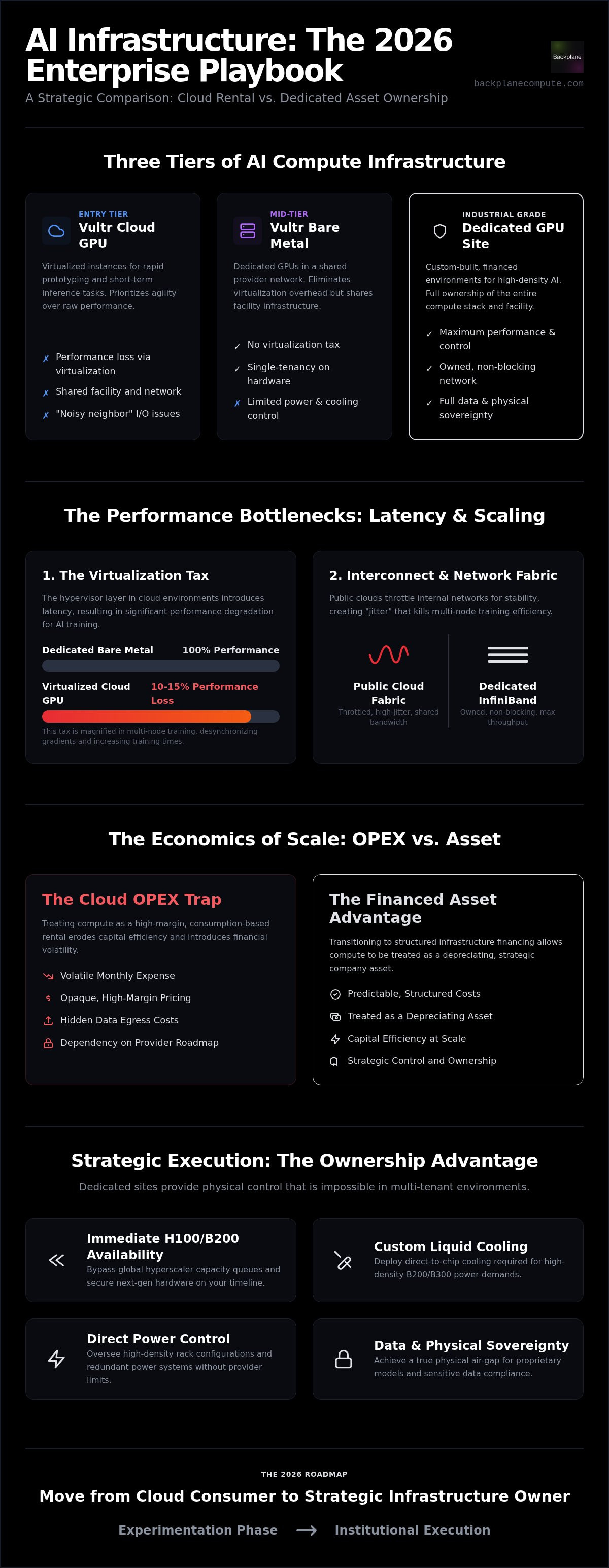
The infrastructure market in 2026 is split into three distinct strata. Vultr Cloud GPU represents the entry tier. These are virtualized instances designed for rapid prototyping and short-term inference. They offer speed but sacrifice raw performance. Vultr Bare Metal occupies the middle ground. It provides dedicated discrete graphics processing units within a shared provider network. You own the OS, but you share the facility. The third tier is the Industrial Dedicated GPU site. This is a fully financed, custom-built environment optimized for high-density AI. This transition involves moving away from consumption-based billing toward structured infrastructure financing. It allows enterprises to treat their compute as a depreciating asset rather than a volatile monthly expense.
Choosing between Vultr vs dedicated GPU depends on your institutional scale. Public clouds are built for elasticity. Industrial sites are built for intensity. The fundamental shift here is moving from using a service to deploying a strategic asset.
The Virtualization Tax in AI Training
Virtualization is a bottleneck because it introduces a hypervisor layer between the code and the silicon. Research indicates this "virtualization tax" can result in a 10-15% performance loss compared to bare-metal environments. In multi-node training, this latency is magnified. Shared cloud kernels often suffer from "noisy neighbor" effects where other tenants impact your I/O throughput. Bare-metal benchmarks show that removing the hypervisor tax restores the deterministic performance required for synchronized training. Without this, gradients can become desynchronized, leading to longer training times and potential model instability. Virtualization is the primary friction point preventing linear scaling across massive GPU clusters.
Single-Tenancy vs. Site-Tenancy
Vultr Bare Metal provides single-tenancy at the hardware level. You aren't sharing a chip, but you are sharing a room. You rely on the provider's standard power and cooling infrastructure. This is a critical constraint for the next generation of hardware. The NVIDIA B200 and B300 chips demand power densities that traditional data centers weren't built to handle. Dedicated sites offer site-tenancy, providing a level of control that goes beyond the server rack.
Dedicated sites offer specific advantages for large-scale operators:
- Custom Liquid Cooling: Direct-to-chip cooling systems that public clouds rarely support at scale.
- Power Control: Direct oversight of high-density rack configurations and redundant backup systems.
- Data Sovereignty: Physical isolation of proprietary model weights to meet strict compliance mandates.
Security is the final pillar of site-tenancy. Multi-tenant environments, even with bare-metal isolation, share networking backbones. For organizations handling sensitive datasets or proprietary weights, a dedicated site provides a physical air-gap that cloud providers cannot replicate. When evaluating Vultr vs dedicated GPU, the ultimate differentiator is whether you are renting a slot or owning the foundation of your AI stack. Infrastructure ownership ensures your roadmap isn't dictated by a provider's facility limitations.
Performance Constraints: Interconnect Latency and Multi-Node Scaling
Single-node benchmarks are a distraction for enterprise AI. When evaluating Vultr vs dedicated GPU deployments, the chip speed is rarely the bottleneck. The real friction exists in the fabric. Foundational model training requires massive synchronization across hundreds of nodes. Public cloud providers often throttle internal fabric to maintain multi-tenant stability. They prioritize network fairness over raw throughput. This creates "jitter" that kills training efficiency. Dedicated GPU sites bypass this hyperscaler tax by utilizing non-blocking InfiniBand topologies. You aren't competing for bandwidth with a thousand other tenants. You own the pipe.
The economics of this infrastructure are stark. Scaling in a public cloud environment incurs hidden costs in data egress and internal bandwidth. When you calculate the total cost of ownership for on-premise solutions, the value of dedicated networking becomes clear. Dedicated sites allow for Remote Direct Memory Access (RDMA) at full wire speed. This is the difference between a model that converges in weeks and one that stalls indefinitely due to interconnect latency.
Scaling Beyond the Single Rack
Vultr’s bare-metal offerings are excellent for isolated workloads. However, scaling to 512+ GPU clusters for foundational model training reveals the limitations of shared provider networks. Industrial-grade sites are designed for non-blocking fabric. They eliminate the hop-count latency found in traditional data center leaf-spine architectures. If your roadmap requires linear scaling, you need a bespoke site design that treats the entire cluster as a single, unified computer. Organizations looking to build these massive clusters often start by conducting a property viability assessment to ensure the physical site can support the necessary networking backbone.
Power Density and Cooling as Performance Metrics
Performance in 2026 is measured in kilowatts per rack. The NVIDIA B300 and future Blackwell architectures demand power densities that standard cloud racks cannot support. Most public cloud facilities are capped at 15-20kW per rack. Industrial dedicated sites are being engineered for 100kW+ densities. This requires liquid cooling. In the cloud, liquid cooling is a rare luxury. In a dedicated AI farm, it's a structural necessity. Backplane assesses site viability based on these industrial constraints. We match your compute requirements with facilities capable of handling the thermal load of next-generation silicon. If your facility can't cool the chips, the chips will throttle. That is a performance failure no software can fix.
The Economics of Scale: Cloud OPEX vs. Financed Infrastructure
Cloud rentals are a high-priced bridge to a permanent infrastructure problem. When analyzing the Vultr vs dedicated GPU trade-off, the "Cloud Rental Trap" emerges over any 36-month horizon. Vultr provides immediate access to H100 and GH200 clusters. This is vital for prototyping and short-term inference. However, for sustained enterprise training, the math shifts. You are essentially paying for the provider's real estate, their support staff, and their profit margin. Structured finance offers a decisive alternative. It allows you to treat GPU infrastructure as a depreciating asset. You move compute from a volatile monthly expense to a controlled capital investment.
Backplane acts as the strategic architect for this transition. We match compute buyers with institutional financing partners to fund dedicated site builds. This approach secures your infrastructure roadmap. It eliminates the pricing unpredictability inherent in public cloud models. We specialize in infrastructure financing structuring to ensure your CAPEX is deployed with maximum efficiency.
Analyzing Provider Margins
Managed cloud services include significant hidden costs. These include network maintenance, facility cooling, and administrative overhead. When you rent a bare-metal instance, you are subsidizing the provider's entire operational footprint. Dedicated sites allow enterprises to capture that middleman margin for themselves. Financial modeling indicates a clear tipping point for institutional operators. If your compute utilization remains above 60% for more than 18 months, the switch to a dedicated financed site becomes a fiscal mandate. You stop paying for their growth and start investing in your own.
Asset Ownership and Residual Value
Ownership creates a layer of operational sovereignty. You aren't just securing chips; you're securing the power interconnection and the industrial site foundation. In the context of the ongoing GPU supply chain crisis, physical site control is a massive competitive moat. Lead times for high-end silicon continue to fluctuate. Ownership ensures your 2026 and 2027 roadmaps are protected from market spikes.
The Backplane model emphasizes the long-term viability of the physical asset. We specialize in the conversion of decommissioned industrial facilities into high-density GPU farms. This ensures the residual value of your investment stays on your balance sheet. Even after the hardware reaches its end-of-life, the powered site remains a valuable piece of industrial real estate. You aren't just buying compute. You're building an institutional asset class that can be repurposed as technology evolves.
Availability and Delivery: Bypassing the Global Capacity Queue
"On-demand" is a strategic euphemism in the 2026 GPU market. For flagship silicon like the H100 or the upcoming NVIDIA B300, availability is rarely a matter of a few clicks. The Vultr vs dedicated GPU decision often collapses when cloud inventory shows zero capacity for the multi-node clusters required for foundation models. Enterprise buyers are increasingly exhausted by hyperscaler queues. AWS and Azure prioritize their internal AI services. Vultr offers agility, but it still operates within the constraints of a shared provider network that can reach saturation during peak demand cycles.
Backplane solves this by bypassing the public queue entirely. We act as a high-speed bridge between compute buyers and dormant industrial power. Our brokerage model identifies off-market capacity that cloud providers overlook. We don't wait for a provider to build a new data center. We convert decommissioned facilities into active GPU farms. This compresses the timeline from procurement to production. When weighing the logistics of Vultr vs dedicated GPU, the primary bottleneck isn't just silicon; it's the queue itself. We eliminate that friction by moving you to the front of the line.
Securing 2026 Hardware (NVIDIA Blackwell and Beyond)
Procuring NVIDIA Blackwell chips is a global lottery. Cloud providers are the primary gatekeepers, but they are also your competitors. They prioritize their own managed services over third-party bare-metal users. A dedicated site changes the procurement dynamic. By structuring a dedicated, financed site build, you secure a direct hardware allocation. You aren't renting a slice of a provider's fleet; you are deploying your own asset on your own timeline. Strategic site selection is the key. We find power in decommissioned industrial sites where others see waste. This allows for rapid scaling that public clouds cannot match due to their rigid infrastructure cycles.
Bypassing Middleman Latency
The support gap is a silent performance killer. Industry forums are filled with reports of multi-day response times during critical training runs. When a node fails in a public cloud, you are at the mercy of their ticket queue. In a dedicated site, you maintain direct control over hardware maintenance and replacement cycles. You own the SLA because you own the site. Brownfield site development compresses deployment timelines by leveraging dormant power infrastructure that is already connected to the grid.
If you're ready to secure your roadmap, you can access GPUs-as-a-Service without hyperscaler queues through our specialized brokerage. We cut through the red tape to deliver the compute your enterprise requires.
Strategic Execution: Moving from Cloud User to Infrastructure Owner
Execution is the final differentiator. The transition from cloud consumer to infrastructure owner is a four-step strategic shift. First, you must assess your 2026-2028 compute roadmap. This involves projecting model parameter growth and the resulting power requirements. When evaluating the Vultr vs dedicated GPU pathways, the long-term power constraint is often the deciding factor. Second, you must evaluate site viability for high-density deployment. You need a facility that can handle the thermal load of B200 and B300 chips without throttling. You need infrastructure that doesn't compromise on density.
Third, you structure the financing. This is where you move from a high-margin OPEX model to a structured capital investment. You aren't just paying for compute. You're building equity in a physical asset. Finally, you execute the transition. This is the moment you move primary training runs from shared cloud environments to your own dedicated AI compute farm. Backplane acts as the decisive partner in this process. We bridge the gap between technical requirements and the industrial reality of powered real estate. We move assets from dormant to active at high speed.
The Backplane Brokerage Model
We don't just find space. We match powered industrial properties with committed compute buyers who need scale. Our process involves the clinical conversion of decommissioned mills and power plants into live, high-density GPU infrastructure. This is about asset transformation. We take dormant resources and turn them into the foundation of your AI stack. It's a methodical approach to infrastructure that prioritizes speed and execution. For a deeper look at the operational mechanics, see The Enterprise Guide to GPUs-as-a-Service.
Taking the Next Step
The timeline for deploying ready-to-use GPU sites is shorter than traditional builds. We leverage existing brownfield power to accelerate your roadmap. The first move is a Property Viability Assessment. We analyze the electrical backbone, cooling capacity, and structural integrity of potential sites against your specific 2026 roadmap. This ensures that when you deploy, you aren't fighting facility constraints. The Vultr vs dedicated GPU choice becomes clear once you see the performance gains of a site built specifically for your workloads.
Stop competing for shared resources. You can secure your dedicated AI compute capacity today and move your enterprise to the front of the global capacity queue. Our team is ready to structure the financing and secure the site that your 2026 roadmap demands. We cut through the red tape so you can focus on the model.
Securing Your 2026 Infrastructure Roadmap
The divergence between Vultr vs dedicated GPU is a matter of institutional maturity. Cloud instances serve the immediate need for rapid experimentation. Dedicated, financed sites serve the strategic requirement for market dominance. You've seen how interconnect latency and power density dictate the limits of performance. You've analyzed how structured finance converts a volatile monthly burn into a tangible balance sheet asset. The path forward is clinical. It requires the conversion of dormant industrial facilities into high-performance compute farms.
Backplane provides the decisive edge in this transition. We offer expertise in industrial asset repurposing and structured finance solutions for high-density compute. Our direct brokerage of powered data center sites ensures you don't wait for a hyperscaler to grant you permission to scale. We bridge the gap between financial viability and industrial reality with precision and speed.
Bypass the cloud queue and secure dedicated AI compute sites.
Your models deserve a foundation as ambitious as your vision. Let's build the infrastructure that powers your next era of execution. We're ready to secure your position at the front of the capacity queue.
Frequently Asked Questions
Is Vultr Bare Metal actually dedicated hardware?
Yes, Vultr Bare Metal provides single-tenant hardware isolation. It removes the hypervisor layer but operates within a shared provider network. You own the operating system but remain subject to the facility's power and cooling limits. A dedicated site offers total sovereignty over the physical environment. This is the primary distinction when analyzing Vultr vs dedicated GPU options for large-scale training. You aren't just isolating a chip; you're securing the foundation.
What is the performance difference between Vultr Cloud and dedicated GPU sites?
The performance gap is defined by the virtualization tax and interconnect latency. Vultr Cloud instances incur a 10-15% performance loss due to the hypervisor layer. Dedicated sites provide raw bare-metal access and non-blocking InfiniBand fabric. This ensures deterministic throughput for multi-node training. You eliminate the "noisy neighbor" effect and network throttling inherent in multi-tenant cloud environments. It's the difference between a model that converges and one that stalls.
Why should I finance a GPU site instead of renting from a cloud provider?
Financing a dedicated site allows you to treat compute as a depreciating asset. Cloud rentals include significant provider margins and hidden operational overhead. By financing, you build equity in the underlying industrial real estate and the power interconnection. This model offers predictable costs in a volatile market. It's a strategic move for enterprises that have moved beyond the experimentation phase and require institutional-grade compute at a lower total cost of ownership.
How does Backplane accelerate the delivery of H100 and B200 clusters?
Backplane compresses deployment timelines by identifying brownfield sites with existing power infrastructure. We convert decommissioned mills and power plants into high-density GPU farms. This bypasses the multi-year lead times required for greenfield data center construction. Our brokerage model matches compute buyers with financed sites that are already grid-connected. We cut through the red tape to deliver H100 and B200 clusters on an accelerated schedule without waiting for hyperscaler permission.
Can Vultr support liquid-cooled NVIDIA Blackwell clusters?
Standard cloud environments are rarely engineered for the 100kW+ rack densities Blackwell requires. Vultr Bare Metal offers high-performance hardware, but it lacks the custom facility control needed for these extreme thermal loads. Most public cloud providers support air-cooled racks capped at 15-20kW. Dedicated sites are engineered from the ground up to support liquid cooling. This ensures your chips run at peak performance without thermal throttling, which is essential for next-generation architectures.
What are the TCO advantages of industrial site repurposing for AI?
Repurposing industrial sites captures the value of existing power interconnections. These decommissioned facilities often have dormant electrical capacity that is expensive and time-consuming to secure elsewhere. The TCO advantage comes from reduced site preparation costs and the residual value of the real estate. Even after the GPUs are retired, the powered industrial site remains a high-value asset. It's a dual-play on technology and industrial real estate that cloud rentals cannot match.
How do I bypass hyperscaler GPU queues in 2026?
You bypass the queue by moving from a public cloud consumer to a strategic infrastructure owner. The 2026 GPU market is defined by capacity queues and procurement lotteries. Backplane brokers access to off-market compute capacity that isn't listed on public cloud dashboards. We secure direct hardware allocations and match them with powered sites. This allows you to deploy H100 and B200 clusters without waiting months for a slot in a hyperscaler's shared fleet.
What is the minimum scale required for a dedicated financed site?
Dedicated financed sites are designed for institutional-scale AI projects. The minimum scale is typically determined by your power requirements and the complexity of your multi-node training runs. We conduct a property viability assessment to ensure the site can support your specific compute density. This path is for organizations that have outgrown the Vultr vs dedicated GPU comparison and need a permanent foundation for their AI roadmap. We prioritize sites with significant power expansion potential.


