

The cloud is no longer a safety net. It's a bottleneck. In a market where AI server lead times now reach 52 weeks and PJM capacity prices have surged to $325 per megawatt-day, the traditional procurement model is dead. You're facing indefinite queues for high-density compute. You're watching unpredictable scaling costs erode your margins. You know that relying on a hyperscaler's roadmap is a strategic gamble. Mastering compute capacity risk mitigation in 2026 requires an industrial-scale hedge. It demands a shift from software-defined agility to physical-world execution.
This framework provides the financial and operational strategies needed to bypass structural market constraints and secure your technical future. You'll learn to build a diversified supply chain, lock in predictable cost structures for multi-year scaling, and gain direct access to high-performance GPU clusters. We'll move from identifying macro-level frictions to executing a streamlined, step-by-step solution for infrastructure resilience. The goal is simple: move faster, spend smarter, and own your capacity.
Key Takeaways
- Reframe your strategy from traditional uptime metrics to access-based risk to ensure AI roadmaps aren't stalled by hyperscaler queues.
- Analyze the "Triple Constraint" of high-density power, silicon availability, and industrial real estate as a single, unified supply chain.
- Identify the hidden tenant risks of public cloud environments and the cost-efficiency of repatriating high-throughput workloads to dedicated hardware.
- Implement a 24-month framework for compute capacity risk mitigation by auditing demand against physical infrastructure constraints.
- Leverage brownfield site repurposing and integrated financing to accelerate deployment and bypass the global data center construction backlog.
The Anatomy of Compute Capacity Risk in 2026
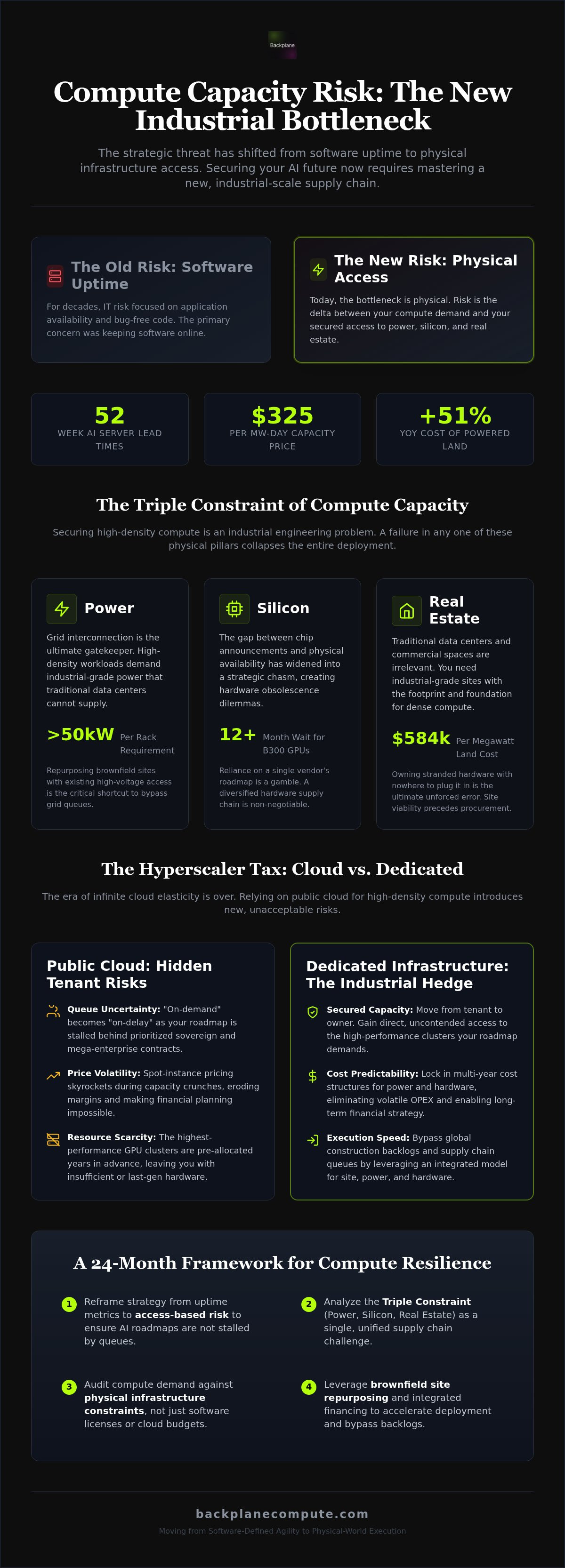
The definition of risk has shifted. For decades, IT risk management focused on uptime. It was a question of whether your software stayed online. In 2026, that focus is obsolete. The new threat is structural. Compute capacity risk is a fundamental failure of supply-chain availability. It isn't a bug in the code; it's a lack of silicon in the rack. Capacity risk is the delta between projected compute demand and secured hardware access.
The stakes are absolute. Enterprise AI roadmaps are stalling across every sector. Projects aren't failing because the models are bad. They're failing because the clusters don't exist. When lead times for AI server systems reach 52 weeks, a cloud subscription isn't a strategy. It's a prayer. This is a shift from virtual agility to physical reality. If your 2026 roadmap depends on hardware you haven't already secured, you're already behind. Compute capacity risk mitigation is no longer a technical choice. It's a balance sheet necessity.
The Shift from Software to Physical Constraints
Compute is now a physical commodity. It behaves like oil or electricity. You can't download more power. You can't patch a missing transformer. Power interconnection has become the ultimate bottleneck for global growth. Data center construction spending reached $75 billion in July 2026, yet the grid remains the gatekeeper. Organizations that treat compute as a mere utility are losing. Institutional survival now depends on securing multi-year capacity. If you don't own the physical path to the chip, you don't own your future. You're simply a tenant in someone else's scarcity.
The "Hyperscaler Tax" and Queue Uncertainty
Relying on a single cloud provider creates a dangerous dependency. We call it the "Hyperscaler Tax." It's the premium you pay for flexibility that doesn't actually exist during a shortage. During peak training cycles, "on-demand" becomes "on-delay." The queue doesn't care about your deadlines. Providers are increasingly forced to prioritize their largest sovereign or enterprise contracts, leaving mid-market players in the dark.
The risks are compounding in the current market:
- Tenant Risk: Your access is subject to the provider's internal prioritization logic.
- Price Volatility: Spot-instance pricing fluctuates wildly as capacity vanishes.
- Resource Scarcity: High-density compute clusters are pre-allocated months or years in advance.
Effective compute capacity risk mitigation requires moving beyond the public cloud. It requires a diversified supply chain that prioritizes direct access over middleman promises. The era of infinite cloud elasticity is over. The era of physical infrastructure has begun.
The Triple Constraint: Power, Chips, and Real Estate
Securing compute in 2026 is no longer a procurement task. It's an industrial engineering problem. The market is defined by a brutal triple constraint: power, chips, and real estate. If one pillar fails, the entire deployment collapses. Modern AI workloads require extreme power density, often exceeding 50kW per rack. Traditional data centers weren't built for this. They lack the cooling and the raw amperage to support next-generation clusters. Effective compute capacity risk mitigation now requires a deep dive into the physical layer of the stack.
The gap between chip announcement and data center floor has widened. It's a structural disconnect. While manufacturers announce new silicon, the physical infrastructure to house it takes years to build. Powered land in primary U.S. markets now costs an average of $584,000 per megawatt. That's a 51% increase year-over-year. Traditional commercial space is irrelevant. You need industrial-grade sites with existing high-voltage access. Without them, your hardware is just expensive, dormant silicon.
Grid Interconnection and Power Scarcity
Hardware is easy to buy compared to power. The risk of "stranded" hardware is real. You can own a thousand GPUs and have nowhere to plug them in. Grid interconnection is the ultimate gatekeeper. In the PJM market, capacity prices hit $325 per megawatt-day. This scarcity makes brownfield industrial sites the new gold mine. Repurposing decommissioned power plants or heavy industrial facilities provides a shortcut. These sites already have the transformers and transmission lines required for high-density compute. A rigorous Property Viability Assessment is the first step in identifying these dormant assets before they're claimed by the market.
Hardware Obsolescence vs. Availability
The wait for B300 GPU clusters is creating a strategic dilemma. Do you wait a year for the latest silicon, or do you deploy legacy chips now? Lead times for AI server systems currently sit between 32 and 52 weeks. Waiting isn't always an option. Compute capacity risk mitigation involves a rolling upgrade strategy. You secure the power and floor space today. You deploy available hardware to maintain momentum. Then, you use integrated financing to swap in next-generation clusters as they arrive. This brokerage-led approach turns a linear queue into a continuous supply chain. It ensures you aren't left holding obsolete hardware while your competitors scale at speed.
Public Cloud vs. Dedicated Infrastructure: A Risk Comparison
The public cloud is a shared resource; in a supply-constrained market, sharing is a risk. Hyperscalers market the cloud as infinitely elastic. For AI workloads in 2026, that elasticity is an illusion. You're subject to "Tenant Risk." This is the reality where your provider prioritizes sovereign contracts or tier-one tech giants over your enterprise training run. When capacity is tight, the smallest tenants are the first to be throttled or queued. Relying on a third-party roadmap for compute capacity risk mitigation is no longer viable for high-growth firms.
Dedicated infrastructure offers a different profile. It replaces the uncertainty of a queue with the certainty of an asset. You know exactly where your compute resides. You own the power contract. You control the physical location. This transparency is the only way to bypass the "hyperscaler tax" and the structural delays of the public market. You move from being a customer to being an operator.
Analyzing the Total Cost of Ownership (TCO)
The financial risk of an OPEX-only model becomes visible at scale. OVH has already forecasted cloud price increases of up to 10% in 2026. Other major providers are following suit as server procurement costs rise by 25%. Industry data suggests a "tipping point" for businesses spending over $5,000 monthly on cloud services; above this, the premium for abstraction can be four times the raw hardware cost. Dedicated financed sites allow you to hedge against these hikes and eliminate predatory egress fees. Transitioning to dedicated hardware provides a fixed-cost environment that delivers a 3x ROI for long-term model training compared to public cloud alternatives.
Security and Sovereignty Risks
Multi-tenant environments are inherently porous. Data leakage remains a persistent threat for companies handling proprietary IP or sensitive datasets. For enterprise AI, the risk of cross-tenant interference or unauthorized access is unacceptable. Dedicated, air-gapped clusters provide the only true security for core intellectual property. Sovereignty is also a regulatory requirement. The EU AI Act and new state-level mandates in the U.S. demand site-specific auditability. You must be able to prove exactly where your data is processed and how it is powered. A dedicated site makes compliance a matter of record, not a leap of faith.
Strategic Mitigation: Securing Industrial-Scale Compute
Mitigation is a process, not a product. It requires a transition from passive consumption to active asset management. To survive the 2026 market, enterprises must move beyond reactive procurement. A robust framework for compute capacity risk mitigation involves four decisive steps. First, perform a rigorous audit of 24-month compute demand versus current contracts. Most firms underestimate their growth by a significant margin. Second, diversify providers using a hybrid model that blends multi-cloud flexibility with dedicated hardware. Third, secure the physical site through specialized infrastructure brokerage. Fourth, structure the financing to preserve liquidity while locking in long-term rates.
This approach treats compute as a strategic asset rather than a line-item expense. It acknowledges that the hyperscaler queue is a structural failure you cannot wait out. By controlling the physical and financial layers, you decouple your roadmap from market volatility. You gain the agility to scale without the uncertainty of public cloud availability. Execution is the only hedge against scarcity.
The Brownfield Advantage: Speed to Market
Speed is the only defense against market volatility. Repurposing retired power plants or decommissioned industrial facilities cuts deployment time by 50% compared to greenfield data center builds. These sites already possess the high-voltage infrastructure required for AI clusters. A Property Viability Assessment eliminates the guesswork by verifying grid capacity and structural readiness before capital is committed. Converting a closed mill into a live GPU farm is no longer a niche project; it is the fastest path to industrial-scale compute.
Compute Financing as a Risk Hedge
The CAPEX requirements for AI infrastructure are historic. Structured finance models mitigate this burden by aligning debt with project timelines. This preserves cash flow for core development while securing the hardware needed to compete. During the build-out phase, firms often use GPUs-as-a-Service to bridge the gap. This ensures that model training continues while the dedicated site is finalized. It is a dual-layered strategy: immediate access through service models and long-term security through Infrastructure Financing Structuring. You secure the future without starving the present.
Execution: The Backplane Model for Compute Resilience
Backplane operates as the decisive bridge between industrial reality and AI demand. We don't just manage software; we move physical assets. The traditional procurement model has failed because it treats compute as a virtual utility. We treat it as an industrial commodity. Our two-sided marketplace model solves the availability crisis by surfacing dormant industrial power and linking it directly to enterprise demand. This is the ultimate form of compute capacity risk mitigation. It turns a structural supply chain bottleneck into a proprietary competitive advantage. For organizations at scale, bypassing the hyperscaler queue isn't just a preference. It's a strategic imperative for 2026.
We provide the execution layer that the public cloud lacks. By offering fully financed, dedicated sites, we allow enterprises to exit the cycle of unpredictable scaling costs. You move from being a tenant to being an owner of your technical destiny. This model ensures that your roadmap is limited only by your ambition, not by a provider's capacity constraints. Execution is the only hedge that matters in a high-stakes market.
From Industrial Asset to Live GPU Cluster
The conversion of a dormant resource into active infrastructure requires institutional-grade precision. Backplane manages the entire lifecycle from initial assessment to final deployment. We take retired power plants and heavy industrial facilities and transform them into high-density GPU farms. This end-to-end management ensures that the physical layer is optimized for the specific thermal and power requirements of AI clusters. For firms that require immediate scale, our GPUs-as-a-Service offering provides direct access to high-performance clusters. You get the speed of the cloud with the performance and security of dedicated hardware.
Securing Your Compute Future
The window of opportunity is closing. Grid-scale power is the scarcest resource on the planet, and the 2027 demand spike will only tighten the market. Waiting for a "better time" to secure capacity is a recipe for obsolescence. You must act while high-voltage assets are still available for repurposing. The first step is a property viability assessment to identify and secure your next site before your competitors do. Momentum in the AI era is won at the physical layer. Secure your dedicated AI compute capacity with Backplane and lock in your infrastructure future today.
Securing the Industrial Path to AI Scale
The era of virtual elasticity is over. AI leadership in 2026 is defined by physical execution and industrial foresight. You've seen how the triple constraint of power, chips, and real estate creates a structural ceiling for those relying on public cloud queues. You've analyzed why dedicated infrastructure is the only viable path for long-term model training and cost predictability. Effective compute capacity risk mitigation requires moving beyond procurement and into the realm of infrastructure financing and industrial repurposing.
Securing your technical future means securing the ground beneath your clusters. By bypassing hyperscaler queues with dedicated infrastructure and leveraging our expertise in high-density industrial repurposing, you gain a decisive market advantage. We provide the integrated financing required for large-scale GPU deployment; this ensures your capital remains as agile as your code. The transition from tenant to operator is the only way to own your roadmap and protect your margins.
Take control of your infrastructure before the market closes. Secure your dedicated AI compute capacity with Backplane. Your scale is waiting.
Frequently Asked Questions
What is compute capacity risk and why is it increasing in 2026?
Compute capacity risk is the structural failure of supply chain availability, representing the delta between your projected demand and actual hardware access. In 2026, this risk is surging due to AI server lead times reaching 52 weeks and unprecedented power grid constraints. Traditional uptime metrics are secondary to the risk of being unable to start a workload at all. Effective compute capacity risk mitigation requires securing the physical and financial layers of the stack before demand spikes.
How can I bypass GPU availability queues at major hyperscalers?
Bypassing hyperscaler queues requires a shift from public cloud subscriptions to dedicated infrastructure. By utilizing an infrastructure brokerage model, you can identify and secure powered industrial sites that exist outside traditional data center markets. This approach allows you to deploy hardware on your own timeline rather than waiting for a provider's internal prioritization. You gain direct access to high performance clusters without the delays inherent in multi tenant environments.
What are the benefits of repurposing industrial sites for AI data centers?
Repurposing industrial sites like retired power plants or closed mills offers a 50% reduction in deployment time compared to greenfield construction. These brownfield locations already possess the high voltage grid interconnections and heavy duty structural frames required for high density AI clusters. By leveraging existing industrial assets, you bypass the years long wait for new utility substations. This strategy converts dormant resources into active, high performance compute environments at a speed that traditional developers can't match.
How does GPU-as-a-Service differ from dedicated financed sites?
GPUs-as-a-Service provides immediate, subscription based access to compute clusters for short term or variable workloads. In contrast, Dedicated Financed Sites are bespoke infrastructure assets designed for long term, steady state training at scale. While the service model offers agility, the dedicated site model provides physical control, predictable cost structures, and asset ownership. We use integrated financing to bridge these two offerings, ensuring you have immediate compute while your permanent, industrial scale facility is being finalized.
What is a property viability assessment for AI compute?
A property viability assessment is a rigorous technical evaluation of an industrial site's ability to support 50kW+ per rack power densities. It verifies grid interconnection status, transformer capacity, and cooling potential before any capital is committed. This process prevents the risk of stranded hardware by ensuring the physical infrastructure can actually support next generation AI clusters. It's a critical first step in identifying viable brownfield assets for rapid data center conversion and effective compute capacity risk mitigation.
How can I mitigate the high CAPEX requirements of AI infrastructure?
Mitigating high CAPEX requires sophisticated Infrastructure Financing Structuring that aligns debt with your project's development timeline. Instead of absorbing the full cost of GPUs and facilities upfront, you can use structured finance models to preserve liquidity for core research and development. This approach turns a massive capital hurdle into a manageable, predictable cost structure. It allows you to scale your AI capabilities without starving your operations of the cash needed for innovation.
Why is grid interconnection a critical risk factor for AI scaling?
Grid interconnection has surpassed chip supply as the primary constraint for AI growth. In 2026, the scarcity of high voltage power means that even if you own the hardware, you may have nowhere to plug it in. PJM capacity prices have cleared above $325 per megawatt day, reflecting a tenfold increase in two years. Without secured power, your investment becomes dormant silicon. Interconnection lead times are now the longest pole in the infrastructure deployment tent.
What is the "hyperscaler tax" in AI compute?
The hyperscaler tax refers to the significant premium and hidden costs associated with using public cloud providers for steady state AI workloads. This includes unpredictable pricing, high egress fees, and the cost of the provider's abstraction layer, which can be four times the raw hardware cost. Beyond financials, it includes the tenant risk of being deprioritized during capacity shortages. Moving to dedicated infrastructure eliminates these inefficiencies and provides a much higher ROI for long term training.


