

The most expensive compute is the cluster you're still waiting for. Hyperscalers promise elastic scale. The reality is a bottleneck of shared queues and virtualized constraints. You shouldn't have to wait twelve months for a grid connection that might never materialize. Securing dedicated H100 clusters isn't just about procurement. It's about industrial execution. It requires a bridge between high-finance and the raw reality of power availability.
You've likely felt the friction of unpredictable scaling costs and the lack of bare-metal control. It's a compromise that stalls innovation. This guide shows you how to bypass the queue through institutional-grade site selection and structured finance. We'll explain how to convert dormant industrial assets into high-performance infrastructure that you actually own. You'll learn to move from a renter's mindset to true compute sovereignty. We'll explore property viability, infrastructure financing, and the path to a predictable CAPEX structure that guarantees your compute availability.
Key Takeaways
- Transition from shared cloud virtualization to private, single-tenant environments to achieve absolute compute sovereignty and bare-metal control.
- Navigate the technical constraints of high-density rack configurations and the critical shift toward liquid cooling for sustained H100 workloads.
- Secure dedicated H100 clusters by targeting brownfield industrial sites with pre-existing substation capacity and immediate grid access.
- Apply institutional-grade structured finance to manage CAPEX and OPEX, ensuring predictable costs while bypassing the hyperscaler tax.
- Leverage a methodical four-step assessment and deployment process to convert dormant industrial power into active, high-performance GPU infrastructure.
What are Dedicated H100 Clusters and Why is the Market Shifting?
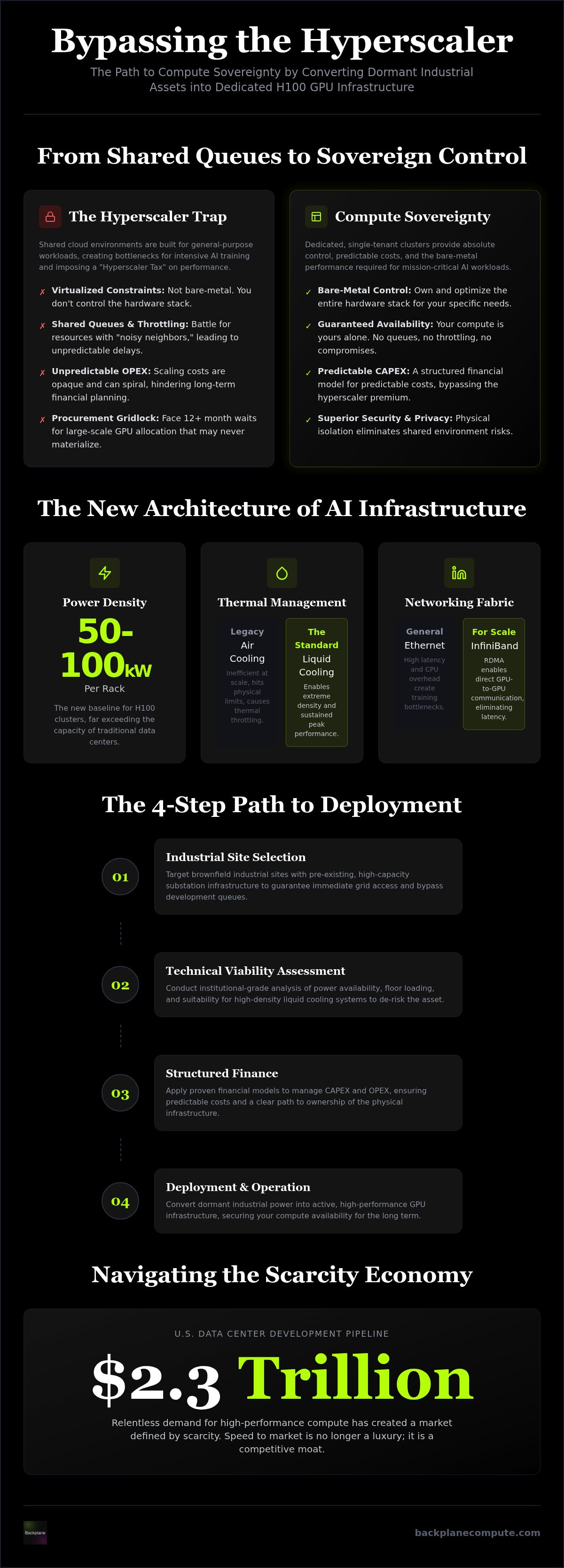
A dedicated H100 cluster is a private, single-tenant compute environment. It is the antithesis of the virtualized, shared instances found in public clouds. These clusters represent a shift toward sovereign hardware control. For enterprises training large language models, the hardware is the strategy. You aren't just buying chips; you're securing the high-speed interconnects and specialized power infrastructure required to run them at scale. Most Nvidia DGX systems rely on InfiniBand networking to ensure multi-node training doesn't choke on data latency. Without this dedicated fabric, your compute efficiency drops. The market is moving away from the "Hyperscaler Tax" because the hidden costs of shared infrastructure have become too high to ignore.
The Scarcity Economy of 2026
Demand for high-performance compute remains relentless. The U.S. data center development pipeline is approaching $2.3 trillion. Even with the release of newer B300 units, the H100 remains the industry's cost-performance leader. Hyperscalers have over-promised. Their "on-demand" capacity is often a mirage for large-scale operators. If you're running a massive model, you're likely relegated to low-priority queues. This creates a strategic bottleneck. Dedicated sites have emerged as a competitive moat for those who can't afford a twelve-month delay. Speed to market isn't a luxury; it's a requirement for survival. By securing dedicated H100 clusters, you bypass the logistical gridlock that paralyzes your competitors.
Sovereignty vs. Shared Infrastructure
Shared cloud environments are built for general-purpose workloads. They aren't built for the intensity of LLM training. Dedicated bare-metal environments offer superior data privacy and security. You don't share a kernel. You don't share a bus. This isolation eliminates "noisy neighbor" latency, which can devastate the synchronization of a multi-node cluster. When every millisecond of GPU idle time costs money, bare-metal control becomes a financial imperative. We focus on Bypassing Hyperscaler GPU Queues to give you total authority over your hardware stack. Ownership of the physical layer ensures that your scaling costs remain predictable. It's time to stop renting a slice of someone else's vision and start building your own infrastructure. Control is the only way to guarantee availability in a market defined by constraints.
Technical Architecture of Institutional-Grade GPU Clusters
The architecture of a cluster is a matter of physics, not just software. Institutional-grade dedicated H100 clusters require an uncompromising approach to power and thermals. They demand a fundamental rethink of data center density. Modern AI racks are no longer measured in single digits of kilowatts. We are seeing 50kW to 100kW per rack as the new baseline. Traditional data centers often lack the vertical airflow or the floor loading capacity to support this concentration of hardware. To maintain peak performance, you need a facility built for intensity, not general-purpose storage. If you need to assess your current site's readiness for this level of density, you can request a property viability assessment.
Networking: The InfiniBand Advantage
Ethernet is for general traffic. InfiniBand is for scale. In large-scale model training, the network is the primary bottleneck. Remote Direct Memory Access (RDMA) allows GPUs to communicate without CPU intervention. It moves data directly from one GPU's memory to another across the fabric. This reduces latency and eliminates the overhead that kills performance in multi-node training. Without a non-blocking InfiniBand fabric, your compute efficiency collapses as nodes wait for synchronization. InfiniBand is the nervous system of the cluster. It ensures that thousands of GPUs act as a single, cohesive machine rather than a collection of isolated islands. Storage must match this speed. High-performance NVMe tiers are required to feed these GPUs at line rate, ensuring that datasets move as fast as the processors can ingest them.
Power Density and Thermal Management
Air cooling has reached its physical limit. Managing 50kW+ per rack with traditional fans is inefficient and loud. It's a relic of a previous era. In 2026, direct-to-chip liquid cooling has become the standard for sustained H100 workloads. Liquid is a superior conductor. It allows for tighter rack spacing and higher compute density without the risk of thermal throttling. This shift is mandatory for those building Bare Metal GPU Clusters for Model Training. It's about reliability. It's about uptime. It's about ensuring that your capital-intensive hardware isn't sidelined by a heat spike. You don't just need chips; you need the industrial environment that allows them to run at 100% utilization. Control over the thermal envelope is the final piece of the sovereignty puzzle.
Industrial Site Selection: The New Frontier of Compute
The compute is only as good as the site that feeds it. In 2026, the primary constraint for dedicated H100 clusters isn't the silicon; it's the substation capacity. We're seeing a massive shift toward brownfield development. Developers are no longer looking for empty fields. They're looking for dormant industrial power. Decommissioned paper mills, retired power plants, and shuttered crypto-mines are the new gold mines of the AI age. These sites offer pre-existing grid-scale interconnection that greenfield projects can't match for years. Site viability depends on the raw ability to support high-density loads without waiting for a utility miracle.
Brownfield vs. Greenfield Development
Speed to market is the only metric that matters. Building from scratch often means facing a three-year wait for a new grid connection. Repurposing existing industrial assets allows you to bypass these timelines. You inherit the heavy-duty electrical infrastructure and cooling-ready footprints of a previous era. This is why we prioritize an Industrial Site Assessment for AI Viability before any hardware is ordered. It's a matter of converting dormant resources into active, high-performance infrastructure. Greenfield is a gamble; brownfield is a strategy.
Grid Interconnection: The Ultimate Bottleneck
Grid-connected power is the definitive ceiling on AI growth. While chip scarcity has eased, the availability of reliable, high-density power remains the primary friction point. You need to look for "Behind-the-Meter" opportunities. This involves securing power directly from the source or within an industrial microgrid to avoid public utility congestion. Negotiating these loads requires a blend of industrial expertise and financial agility. It's a high-stakes game of securing capacity before the grid reaches its limit.
In 2026, the true bottleneck isn't the availability of H100 chips; it's the scarcity of grid-connected power capable of supporting high-density compute.
Latency remains a factor, but it's secondary to the raw ability to turn the machines on. Proximity to fiber backbones is easier to solve than building a new substation. A site with 50MW of available power and 10ms of latency is infinitely more valuable than a zero-latency site with no power. You can't train an LLM on a promise of future capacity. You need the kilowatts today. Site selection is no longer just about real estate. It's about securing the physical foundation of your competitive advantage.
Structuring Finance for Dedicated AI Infrastructure
The Hyperscaler Tax is a tax on your long-term viability. Cloud providers charge a heavy premium for the illusion of flexibility. For persistent, multi-month training workloads, this premium becomes a structural drain on your capital. Moving to dedicated infrastructure requires a fundamental shift from a consumption model to an asset management strategy. You're no longer just paying for GPU seconds. You're building a balance sheet asset. A specialized brokerage acts as the decisive bridge between this industrial reality and the world of high finance. We match your compute demand with the structured capital necessary to execute at scale. The goal is to convert a volatile expense into a predictable, high-performance utility.
Project Finance Models for GPU Farms
Massive AI infrastructure requires sophisticated debt-to-equity structures. You don't have to carry the entire CAPEX burden on your own. Lease-back options for dedicated H100 clusters allow enterprises to maintain operational liquidity while securing exclusive, bare-metal hardware access. This isn't traditional real estate lending. It is a hybrid model that treats compute as a high-yield industrial asset. The financing follows the hardware lifecycle. You can explore Structuring Finance for AI Infrastructure Projects to see how these complex vehicles are assembled to accelerate your timeline. By leveraging the physical asset as collateral, we unlock capital that traditional banks often overlook.
Total Cost of Ownership (TCO) Analysis
Cloud hourly rates are inherently deceptive. They mask the compounding costs of data egress, high-performance storage, and management overhead. A private, dedicated site offers a predictable, fixed cost structure. You gain full control over the power delivery, the liquid cooling systems, and the maintenance schedule. When you compare the long-term TCO of a dedicated site against the volatility of public cloud pricing, the financial delta is undeniable. It is the difference between renting a temporary suite and owning the entire building. Our detailed comparison of Equinix vs. Private GPU Farms highlights exactly where these operational efficiencies are captured. Ownership allows you to optimize every watt and every dollar.
Risk is mitigated by the high residual value of the hardware itself. The H100 remains a liquid asset in the global secondary market. Even as newer generations enter the ecosystem, the sheer volume of AI demand ensures that high-performance silicon maintains significant value. This isn't a sunk cost. It is a strategic deployment of capital into a critical industrial utility. If you are ready to move beyond the hyperscaler queue, contact us to structure your infrastructure financing.
Securing Your Cluster: The Backplane Execution Model
Backplane is the bridge between industrial reality and high-stakes compute. We don't just identify potential sites. We execute the conversion of dormant power into active infrastructure. Our model is built on speed. We eliminate the friction between capital, real estate, and hardware procurement. This is a methodical approach to securing dedicated H100 clusters. We handle the complexity so you can focus on the model. Our execution follows a strict 4-step process designed to remove traditional bottlenecks.
- Property Viability Assessment: We audit power interconnection and physical site constraints.
- Infrastructure Financing Structuring: We build the debt-to-equity vehicle that fits your balance sheet.
- Hardware Procurement: We secure the H100 nodes and InfiniBand fabric through our supply network.
- Operational Deployment: We manage the installation, cooling integration, and final hand-off.
For organizations needing immediate capacity, our GPUs-as-a-Service offering provides an instant bridge. You can scale today while your dedicated financed site is being prepared. It is a dual-track strategy that ensures you never lose momentum. We recognize that in a market defined by scarcity, the only thing more valuable than hardware is time. We don't just provide a service. We provide a path to sovereignty.
The Brokerage Advantage
Traditional real estate brokers don't understand megawatt density. We do. The Backplane network provides exclusive access to off-market, powered sites that never hit public listings. We leverage institutional knowledge to cut through utility bureaucracy and local regulatory red tape. This is about execution, not just search. You can Secure your dedicated H100 cluster with Backplane and bypass the standard market delays. We find the power others miss.
Accelerated Deployment Timelines
Deployment cycles for traditional data centers are measured in years. We measure them in months. By integrating financing, site selection, and hardware procurement into a single workflow, we compress the timeline. We remove the silos that cause project drift. Every day your GPUs are idle is lost revenue. We ensure they are active. Compute sovereignty is a strategic asset. It requires a partner who operates at the speed of the market. We don't just plan infrastructure. We deliver it. Control is the final outcome. Speed is the method.
Commanding the Industrial Layer of AI
Compute is no longer a commodity to be rented. It's an industrial asset to be owned. The era of waiting in hyperscaler queues is over for those who prioritize execution over promises. True sovereignty requires a decisive bridge between the digital and the physical. It demands an institutional-grade site assessment and a clinical expertise in brownfield power repurposing. You need more than chips. You need the substations, the liquid cooling, and the structured financing that converts dormant industrial sites into high-performance engines.
Securing dedicated H100 clusters is a matter of strategic selection and financial agility. By bypassing the virtualized constraints of the public cloud, you lock in predictable costs and absolute hardware control. The path from a decommissioned power plant to a live GPU farm is complex, but the competitive advantage is self-evident. You can Bypass the queues and secure your dedicated H100 cluster with Backplane. The power is available. The capital is structured. Your infrastructure is ready to scale.
Frequently Asked Questions
What is the average lead time for a dedicated H100 cluster in 2026?
Lead times for dedicated H100 clusters are currently dictated by power interconnection rather than chip availability. While NVIDIA has stabilized its supply chain, grid-connected capacity remains scarce. A greenfield site might face a three-year wait for utility approval. Backplane compresses this timeline to months by targeting brownfield sites with existing substation capacity. We prioritize sites where the heavy-duty electrical infrastructure is already in place, allowing for rapid deployment of live hardware.
How does dedicated compute compare to hyperscaler spot instances for LLM training?
Hyperscaler spot instances are unsuitable for large-scale LLM training because they are preemptible. If an instance is reclaimed mid-training, the synchronization of your entire cluster collapses. Dedicated compute provides 100% availability and bare-metal performance. You avoid the "Hyperscaler Tax" and the latency overhead of virtualization. It is the difference between renting a temporary seat and owning the entire factory floor. Consistency is the only way to manage training costs.
Can I repurpose an existing industrial facility for high-density AI compute?
Repurposing retired industrial assets is the most efficient path to live infrastructure. Decommissioned paper mills, coal plants, and crypto-mines often possess the raw megawatt capacity required for high-density compute. Backplane specializes in converting these dormant resources into operational GPU farms. We audit the structural integrity and electrical viability of these facilities to ensure they can support 50kW+ rack densities and the specialized liquid cooling systems required for modern chips.
What are the power requirements for a 512-node H100 cluster?
A 512-node H100 cluster requires significant megawatt-scale power. Each 8-GPU node draws approximately 10kW to 12kW. When you factor in networking, storage, and cooling overhead, the total site load often exceeds 8MW to 10MW. Managing this density requires high-voltage interconnection and advanced thermal management. It isn't just about the total draw; it's about the substation's ability to deliver stable, high-density power without the risk of thermal throttling or grid instability.
How does Backplane handle the financing of GPU infrastructure?
Backplane utilizes structured infrastructure financing to match compute demand with institutional capital. We build debt-to-equity vehicles that allow enterprises to secure dedicated H100 clusters without a massive upfront CAPEX hit. Our model treats compute as a high-yield industrial asset rather than a simple IT expense. We offer lease-back options and structured project finance that align with the hardware's lifecycle and your balance sheet requirements. This approach accelerates scaling while maintaining liquidity.
Is liquid cooling mandatory for dedicated H100 deployments?
Direct-to-chip liquid cooling is essentially mandatory for sustained H100 workloads in high-density configurations. Air cooling typically fails at the 50kW-per-rack threshold. Liquid is a more efficient conductor, allowing for tighter rack spacing and consistent thermal performance. It reduces the energy required for fans and prevents the thermal spikes that lead to hardware degradation. For institutional-grade deployments, liquid cooling is the baseline for operational reliability and long-term hardware health.
What is the difference between bare metal and virtualized GPU clusters?
Bare metal clusters provide direct access to the underlying hardware without a hypervisor layer. This eliminates the "noisy neighbor" effect where other tenants impact your performance. Virtualized clusters introduce latency overhead that can devastate the synchronization of InfiniBand fabrics during multi-node training. Bare metal offers full control over the kernel and the driver stack. It is the only way to ensure 100% of the H100's performance is dedicated to your model training.
How do I assess the fiber connectivity of a brownfield industrial site?
Fiber assessment is a core component of our Property Viability Assessment. We evaluate a brownfield site's proximity to major carrier backbones and its existing conduit capacity. While power is the primary constraint, low-latency connectivity is required for data ingestion and model weights. We look for sites with multiple diverse fiber paths to ensure redundancy. A site with massive power but no fiber is a liability; we find the strategic balance between both.


