

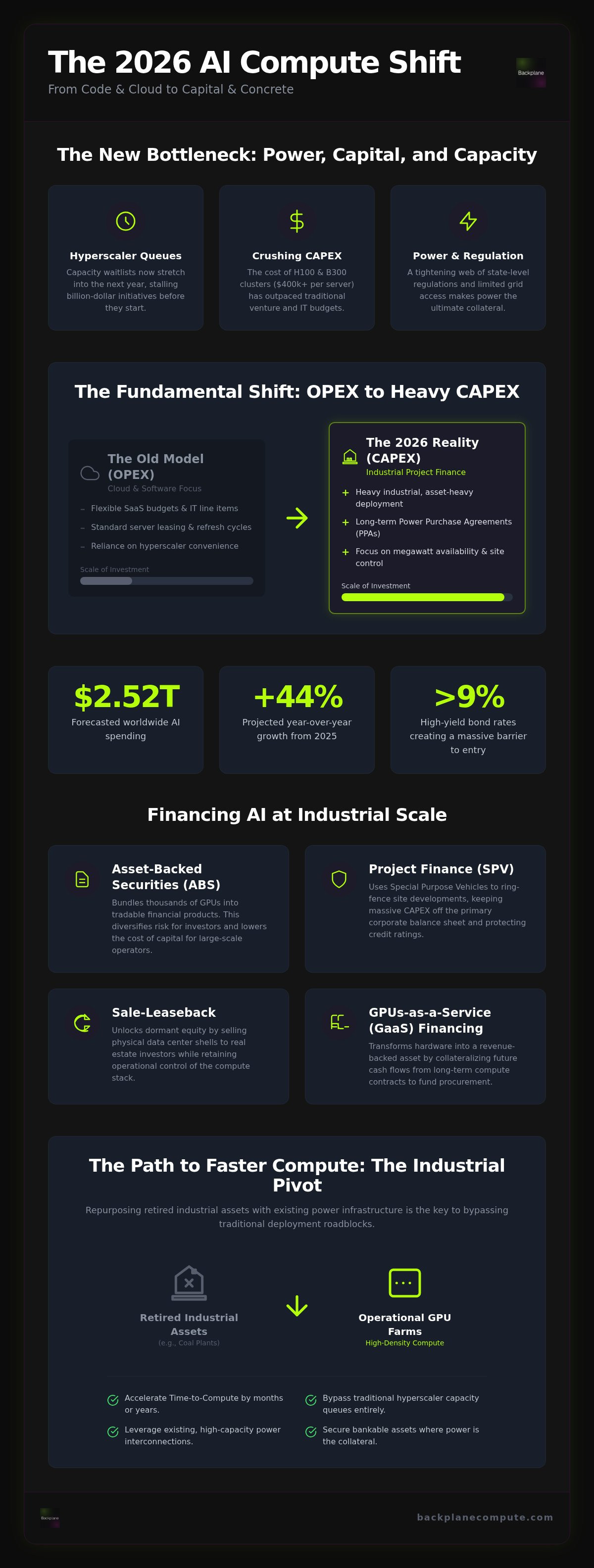
The race for compute has shifted from the software layer to the substation. In 2026, the primary constraint on enterprise scale isn't code; it's the high-stakes reality of the grid and the debt markets. Securing reliable financing for AI infrastructure now requires more than a standard budget request. It demands a sophisticated fusion of industrial real estate strategy and aggressive capital structuring. You're likely facing the same friction points as the rest of the market: hyperscaler capacity queues that stretch into next year, the crushing CAPEX requirements of H100 and B300 clusters, and a tightening web of state-level power regulations.
It's a volatile environment where power is the ultimate collateral. We agree that the traditional path to deployment is broken, leaving billion-dollar initiatives stalled at the interconnection phase. This article provides the roadmap to master this intersection of high-finance and industrial compute. You'll learn how to leverage existing industrial assets to secure the capital needed for next-generation deployments. We'll preview the specific mechanisms for reducing your time-to-compute by bypassing corporate bureaucracy and focusing on high-speed execution.
Key Takeaways
- Understand the mandatory transition from cloud software OPEX to heavy industrial CAPEX for high-density compute deployments.
- Identify the specific debt and asset-backed models used to secure financing for AI infrastructure in a high-yield market.
- Evaluate the speed and cost benefits of repurposing retired industrial assets, such as coal plants, into operational GPU farms.
- Mitigate hardware obsolescence by proactively structuring lifecycles for H100 and B300 clusters within volatile market conditions.
- Accelerate your time-to-compute by leveraging dedicated financed sites that bypass traditional hyperscaler capacity queues.
The 2026 Capital Shift: Why AI Infrastructure Financing is Unique
AI infrastructure financing is no longer an IT line item. It's industrial project finance. In 2026, the market has moved past the era of experimental SaaS budgets and entered a phase of massive, asset-heavy deployment. We are seeing a fundamental transition from flexible OPEX models to rigid, heavy industrial CAPEX requirements. Gartner forecasts that worldwide AI spending will reach $2.52 trillion this year, a 44% increase from 2025. This scale demands a new capital stack. You aren't just buying chips; you're securing high-density cooling, specialized physical shells, and massive electrical capacity.
The 2026 market dynamics favor private infrastructure over the "public cloud tax." While hyperscalers offer convenience, they also impose capacity queues and premium margins that erode enterprise ROI. Financing for AI infrastructure has become the strategic escape hatch for firms spending over $10 million annually on compute. In this environment, power interconnection is the fundamental value driver. A site with a secured 100 MW connection is a bankable asset. A site without one is just a warehouse. Understanding the physical AI infrastructure components is the first step in collateralizing these assets effectively.
The Decoupling from Traditional IT Procurement
Standard server leasing models fail for $100M+ GPU clusters. You cannot lease a substation or a cooling loop using a three-year IT refresh cycle. Financing for AI infrastructure now requires long-term power purchase agreements (PPAs) to be baked into the deal structure. The industry focus has shifted entirely from software features to megawatt availability. If you don't own the power, you don't own the compute. This shift forces a move toward project finance structures that mirror energy utility deals rather than hardware procurement.
Capital Intensity: The Billion-Dollar Entry Barrier
The sheer scale of investment for multi-node training clusters has outpaced traditional venture capital. Venture debt is too expensive and too small for the $400,000 to $500,000 cost of a single AI server system. Specialized infrastructure funds have emerged to bridge this gap. These funds treat H100 and B300 clusters as hard assets with predictable lifecycles. With 30-year U.S. Treasury bonds reaching 5.34% and high-yield bond "price whispers" hitting the 9% range, the barrier to entry is high. Only those who can structure complex, asset-backed debt will survive the next scaling phase.
Core Financing Models for Large-Scale AI Clusters
Traditional credit markets often struggle to price the rapid depreciation of advanced silicon. Banks understand the value of a physical substation but frequently flinch at the three-year lifecycle of a high-end GPU. This disconnect has birthed a specialized market for financing for AI infrastructure. Venture debt remains a viable option for early-stage scaling, yet its high cost and restrictive covenants limit its utility for gigawatt-scale deployments. The 2026 market demands more sophisticated vehicles that can bridge the gap between industrial reality and technological volatility.
The rise of GPUs-as-a-Service (GaaS) has transformed hardware into a revenue-backed financing vehicle. By securing long-term compute contracts, operators can collateralize future cash flows to fund immediate hardware procurement. Sale-leaseback arrangements are also gaining traction among established data center operators. These firms sell their physical shells to institutional real estate investors while retaining operational control of the compute stack. This strategy unlocks dormant equity to fund the next generation of B300 clusters without diluting corporate ownership.
Asset-Backed Securities (ABS) and the GPU Market
Asset-Backed Securities (ABS) represent the next evolution in compute liquidity. These instruments bundle thousands of GPUs into tradable financial products, diversifying risk for investors while lowering the cost of capital for operators. In 2026, GPU-backed ABS have become the primary mechanism for institutional investors to gain exposure to AI hardware without direct operational ownership. High hardware liquidity in the secondary market has stabilized these instruments, providing more favorable loan terms for large-scale clusters.
Project Finance vs. Corporate Debt
Project finance allows for the ring-fencing of specific site developments through Special Purpose Vehicles (SPVs). This approach keeps massive CAPEX off the primary corporate balance sheet, protecting the parent company's credit rating. It's particularly effective when combining industrial real estate equity with high-density compute debt. Evaluating the cost of capital across these funding vehicles requires a deep understanding of both the grid and the ledger. If you're currently assessing a potential site, a Property Viability Assessment can clarify the underlying asset value before you approach the debt markets.
The choice between project and corporate debt often hinges on the "Middle Mile" costs. Financing grid upgrades and substation construction requires longer-term, lower-interest capital than the GPUs themselves. Successful 2026 strategies blend these models, using asset-backed debt for the chips and project finance for the power infrastructure. This bifurcated approach ensures that the most volatile assets don't compromise the stability of the long-term industrial investment.
The Industrial Pivot: Financing Site Conversions and Power
Speed to market is the only metric that dictates the financing premium in 2026. Building from scratch takes years that the market doesn't have. Repurposing retired coal plants, decommissioned mines, and closed mills offers a decisive advantage. These sites are pre-permitted power hubs. They possess the "Middle Mile" infrastructure, specifically substations and grid interconnections, that would otherwise take five years to commission. Financing for AI infrastructure at these locations focuses on converting dormant industrial capacity into active compute. This conversion strategy is the foundation of the Dedicated Financed Site model.
The value of "stranded power" assets in a compute-hungry economy cannot be overstated. When a mill closes, its power allocation often remains tied to the site. Securing these assets allows operators to bypass the massive hyperscaler queues that have stalled enterprise growth. Lenders now view these industrial interconnections as the primary collateral, often valuing the power agreement more than the physical real estate itself.
Evaluating Brownfield Viability for Lenders
Lenders prioritize the interconnect over the physical shell. A July 2025 executive order aims to expedite federal permitting for data centers with project costs of at least $500 million or those requiring more than 100 MW of power. This regulatory tailwind makes large-scale brownfield sites highly bankable. However, institutional lenders still scrutinize environmental remediation costs. Any site assessment must quantify the cost of cleaning industrial legacy waste before the first rack is installed. The most valuable asset isn't the land; it's the documented right to draw power from the grid.
Repurposing Crypto Mines: A Tactical Financing Play
Former crypto mining facilities represent the fastest path to operational GPU farms. These sites already feature high-density power distribution and cooling shells. The financing challenge here is the retrofit. Transitioning from air-cooled ASIC miners to liquid-cooled GPU clusters requires significant capital for specialized plumbing and heat rejection systems. In 2026, we see a massive arbitrage opportunity in distressed industrial assets. As of April 2026, twenty-seven states are considering "large load" legislation. Operators who secure power now, before state-level moratoriums or new ratepayer protection costs take effect, are sitting on assets that command a massive liquidity premium.
Financing the Middle Mile involves more than just server hardware. It requires capital for substation upgrades and high-voltage transmission. By focusing on sites where this infrastructure already exists, developers reduce their time-to-compute and lower their overall cost of capital. The market no longer rewards the most innovative software; it rewards the most disciplined power strategy.
Risk Mitigation and Due Diligence in AI Projects
Mitigation is the difference between a bankable asset and a stranded liability. In 2026, the variables have multiplied. You are managing silicon that depreciates in months and grid connections that face increasing state-level scrutiny. Financing for AI infrastructure requires a clinical approach to due diligence that extends beyond the balance sheet and into the physical plant. It's a high-stakes environment where a single regulatory shift or a mechanical failure can compromise your entire capital stack.
Counterparty risk is the new frontier. As enterprise AI platform pricing fluctuates between $3 and over $100 per user, the stability of compute buyers is no longer guaranteed. Operational risk is equally acute. In high-density, liquid-cooled environments, the cost of downtime is catastrophic. A cooling failure doesn't just halt training; it can physically compromise $500,000 server systems. Investors now demand rigorous proof of facility resilience before releasing funds.
The Residual Value Debate
Lenders prioritize the secondary market liquidity of your hardware. If the secondary market pricing for H100 clusters remains robust, your loan-to-value (LTV) ratios stay healthy. The useful life of an enterprise AI processor is professionally defined as a thirty-six to forty-eight month window, after which performance-per-watt metrics typically render the hardware obsolete for tier-one training. Successful refresh cycles are now built directly into the debt structure to ensure the collateral remains current as new chips enter the market.
Power PPA Structuring
Energy is your largest variable cost. Protecting project margins requires long-term hedging against price spikes through Power Purchase Agreements (PPAs). The March 2026 Ratepayer Protection Pledge signaled a shift where developers must cover the full cost of new generation. Behind-the-meter financing strategies are becoming the gold standard for grid reliability. These models integrate renewable energy credits (RECs) to satisfy institutional ESG mandates while ensuring a stable, uninterrupted power draw.
Regulatory risk is local, not just federal. While the 2025 executive order streamlines permitting for $500 million projects, twenty-seven states are currently weighing "large load" legislation that could alter your cost basis overnight. You need a partner who understands these shifting constraints. For a precise breakdown of your project's viability, consult our experts on Infrastructure Financing Structuring to secure your capital with confidence.
The Backplane Advantage: Structuring for Immediate Deployment
Backplane operates at the intersection of industrial reality and financial speed. We solve the fundamental friction of the 2026 market: the gap between available capital and operational power. Traditional financing for AI infrastructure often stalls because lenders don't understand the grid and real estate operators don't understand the compute. We bridge that divide. Our brokerage model matches committed compute buyers with pre-powered, industrial sites. We don't just find space. We structure the entire deployment to accelerate the standard 18-month cycle into a high-speed execution phase.
The core of our strategy is the Dedicated Financed Site. This model allows enterprises to secure their own high-density clusters without the constraints of public cloud availability. We identify underused industrial assets, perform a Property Viability Assessment, and layer in the necessary Infrastructure Financing Structuring. This process converts dormant resources into bankable AI farms. It's a methodical, results-oriented workflow designed for institutional scale. We prioritize speed and execution over corporate bureaucracy.
Bypassing the Hyperscaler Tax
Relying on on-demand cloud instances is a strategic vulnerability in 2026. On-demand premiums eat into margins. Capacity waitlists freeze growth. By owning the infrastructure through a financed model, you lock in a predictable Total Cost of Ownership (TCO). You stop paying the "hyperscaler tax" for the privilege of compute access. We provide the path to dedicated H100 and B300 clusters that are yours to control. There are no queues. There are no shared resource pools. It's your power, your silicon, and your data sovereignty.
From Site Assessment to Success
The Backplane process is clinical and transparent. It begins with deep diligence into the power interconnect and the physical shell. We evaluate the substation capacity and the cooling viability before any capital is deployed. Once a site is cleared, we move to structuring the debt and equity components. This ensures that the financing for AI infrastructure is aligned with the hardware's useful life and the project's revenue potential. We leverage our global coverage to help firms achieve regional AI sovereignty, keeping compute close to the data source.
The market moves fast. Bureaucracy kills ROI. We cut through the red tape to deliver operational capacity when it matters most. Secure your dedicated AI compute site today and move your infrastructure from the balance sheet to the data center.
Securing the Future of Industrial Compute
The landscape of 2026 demands a departure from standard IT procurement. Success now hinges on your ability to collateralize power and silicon within a structured industrial framework. By prioritizing brownfield site conversions and leveraging asset-backed debt, you bypass the gridlocks that stall your competitors. Navigating the complexities of financing for AI infrastructure requires a partner who understands that a substation is just as critical as a GPU cluster. It's time to stop waiting on cloud providers and start owning your physical layer.
We've analyzed the transition to asset-heavy models and the strategic advantage of repurposing dormant industrial infrastructure. These aren't just technical choices; they are financial mandates for any enterprise operating at scale. Backplane provides the bridge. We are specialists in industrial site conversion with direct access to high-performance GPU clusters and a global brokerage network for powered assets. Scale your AI infrastructure with Backplane's financed sites today. The window for securing prime power is narrowing. Move decisively to own your infrastructure and lead the next era of industrial AI.
Frequently Asked Questions
What is the typical term for AI infrastructure financing in 2026?
The typical term for hardware-heavy financing ranges from thirty-six to sixty months. This aligns with the rapid depreciation cycle of high-density chips. Infrastructure debt, covering power and cooling, often extends to ten or fifteen years. In September 2026, high-yield bond offerings for these projects show price whispers in the 7% to 9% range. Lenders structure these deals to ensure the debt is retired before the compute assets reach obsolescence.
How do GPUs-as-a-Service subscriptions affect a company's balance sheet?
GPUs-as-a-Service subscriptions typically move compute costs from the capital expenditure (CAPEX) line to operating expenses (OPEX). This shift improves liquidity and avoids the massive upfront debt required for multi-node training clusters. It allows enterprises to access high-performance compute without carrying depreciating hardware assets on the balance sheet. This model provides the agility needed to scale without the long-term commitment of traditional asset ownership. It is a lean, results-oriented approach.
Can I use existing industrial property as collateral for compute hardware?
You can use existing industrial property as collateral if it possesses a secured power interconnection. Lenders value the grid-scale power capacity of retired plants or decommissioned mines more than the physical structures. Financing for AI infrastructure often relies on these "Middle Mile" assets to secure lower interest rates. A site with a confirmed 100 MW draw becomes a bankable instrument. It significantly reduces the cost of capital for your hardware procurement.
What is the difference between CAPEX and OPEX for AI infrastructure?
CAPEX involves the outright purchase of hardware like H100 clusters and industrial cooling systems. OPEX covers recurring costs such as power consumption, facility management, and cloud-based subscriptions. In 2026, many firms are shifting toward a hybrid model. They use CAPEX for their core, dedicated infrastructure while utilizing OPEX for burst capacity. This balance manages the high-stakes reality of industrial compute while maintaining the lean agility of a modern enterprise.
How does liquid cooling impact the financing of a data center?
Liquid cooling increases the initial financing requirement due to specialized plumbing and heat rejection systems. However, it significantly lowers the operational cost through improved efficiency and higher rack density. Lenders view liquid-cooled facilities as more resilient and future-proof. This technology is mandatory for the latest high-wattage chips. Proper financing for AI infrastructure accounts for this higher initial spend to ensure long-term viability and reduced power-usage effectiveness (PUE) metrics.
What happens to the hardware at the end of a financing term?
At the end of a financing term, hardware is typically sold into the secondary market or refreshed for newer silicon. Some deals include a fair market value buyout option for the operator. The secondary market for H100 clusters remains active, providing a floor for residual value. Operators often use the proceeds from decommissioned chips to fund the next generation of B300 deployments. This cycle ensures the compute stack remains competitive without permanent capital lock-in.
Why is power interconnection more important than the hardware itself for lenders?
Lenders prioritize power interconnection because it is a finite, permanent asset. Hardware depreciates rapidly, but a high-voltage substation remains valuable for decades. In the 2026 economy, power is the ultimate collateral. A project with secured megawatts can be refinanced or sold even if the chips change. The grid connection dictates the project's viability. Without it, the most advanced GPU cluster is a dormant liability that carries zero market weight in the debt markets.
How does Backplane accelerate the time-to-value for AI projects?
Backplane accelerates time-to-value by matching committed compute buyers with pre-powered industrial sites. We bypass the hyperscaler capacity queues that currently stall enterprise growth. Our process moves from site assessment to live infrastructure deployment in a fraction of the standard eighteen-month cycle. By handling the diligence and financing structuring simultaneously, we convert dormant industrial assets into operational GPU farms. This speed-to-market is the decisive advantage for operators who cannot wait on corporate bureaucracy.


