

The 12-week waitlist for high-density compute isn't a chip shortage; it's a structural bottleneck you don't have to accept. While your competitors stall on "capacity unavailable" errors, the most aggressive operators are already avoiding hyperscaler GPU queues by shifting their strategy from renting virtual machines to securing dedicated infrastructure. You've likely felt the frustration of unpredictable spot pricing and the opaque timelines that govern the public cloud. These friction points kill momentum and delay critical market entry for new models.
This article outlines the definitive enterprise strategy for 2026. You'll discover how to bypass waitlists by securing dedicated AI infrastructure through industrial arbitrage and structured financing. We'll detail the process of repurposing industrial assets into private GPU farms, providing you with full control over the hardware stack and guaranteed, predictable access. We're moving beyond the limitations of the public cloud to build a faster, more resilient path to market. It's time to bridge the gap between industrial real estate and high-performance compute to accelerate your training timelines.
Key Takeaways
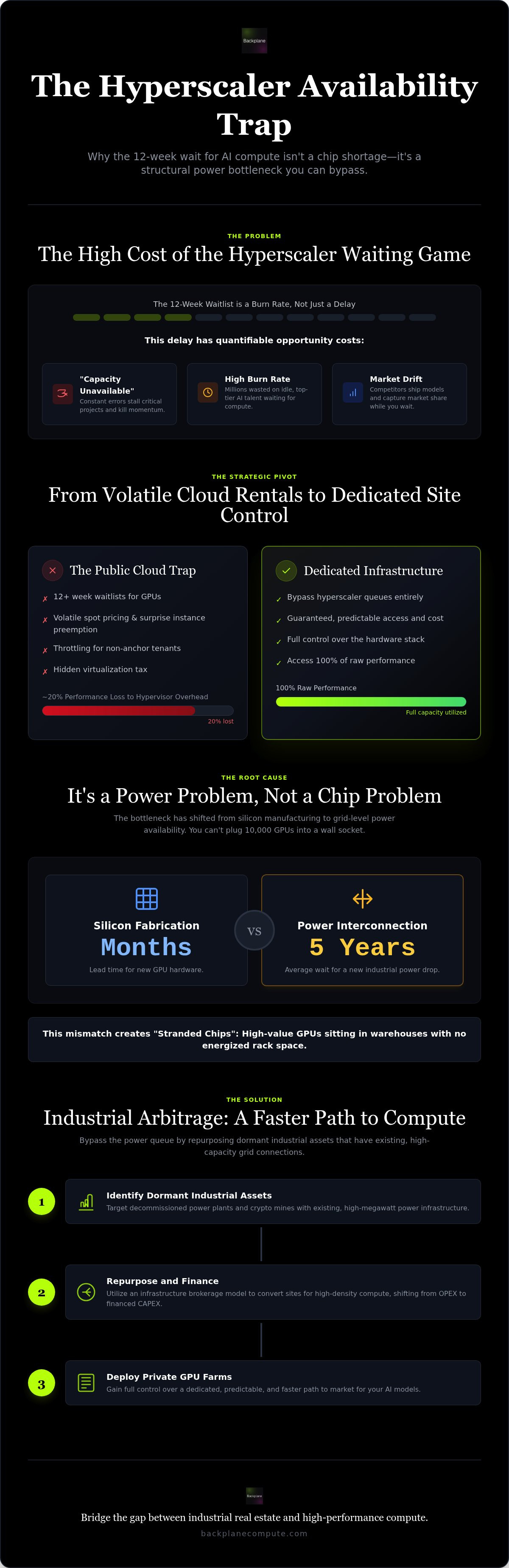
- Quantify the opportunity cost of the 12-week hyperscaler waitlist and recognize why "capacity unavailable" errors signal a need for a structural pivot.
- Identify the primary bottleneck as power grid access rather than chip supply, acknowledging the five-year lead times for new industrial power drops.
- Execute a strategy for avoiding hyperscaler GPU queues by transitioning from volatile OPEX cloud rentals to dedicated, financed site control.
- Accelerate your deployment timeline through industrial arbitrage by repurposing decommissioned power plants and crypto mines into high-density GPU farms.
- Utilize an infrastructure brokerage model to bridge the gap between dormant industrial assets and your enterprise's immediate AI compute demands.
The High Cost of the Hyperscaler Availability Trap
The cloud is not infinite. For enterprises scaling Large Language Models, the "on-demand" promise has devolved into a bottleneck. Tier-1 providers frequently return "capacity unavailable" errors; a polite euphemism for a structural shortage. This isn't a temporary glitch. It's a systemic failure. Avoiding hyperscaler GPU queues is no longer a luxury for the agile; it's a survival requirement for the institutional operator. When you rely on the public pool, you aren't just renting compute. You're renting a spot in a line that moves at the provider's whim.
Defining the GPU Availability Trap
The GPU Availability Trap is the gap between marketed cloud elasticity and the hard reality of physical hardware constraints. Hyperscalers operate on a strict internal hierarchy. They prioritize their own proprietary AI projects and massive anchor tenants over general enterprise needs. When global supply tightens, the public pool is the first resource to be throttled. Every Graphics Processing Unit (GPU) rented through a standard cloud provider also carries a hidden virtualization tax. You often lose up to 20% of raw performance to hypervisor overhead and network jitter.
The Availability Trap is a systemic failure of cloud scaling. It forces companies into a state of predictable stagnation. Reliance on spot instances only compounds this risk. These instances are a liability for production-grade AI workloads because they can be reclaimed at any moment. For training runs that require weeks of uninterrupted uptime, an unexpected preemption can corrupt checkpoints and reset progress. You cannot build a billion-dollar model on hardware that might vanish mid-epoch.
Opportunity Cost: The Real Invoice
A 12-week waitlist is not just a delay; it's a burn rate. While you wait for capacity, your AI researchers sit idle. Top-tier talent costs millions in annual compensation. Forcing them to wait for compute is an expensive waste of human capital that never appears on a cloud invoice. Meanwhile, competitors who have secured dedicated infrastructure are already shipping models and capturing market share. Speed is the primary currency of AI, and the queue is a tax on that currency.
Market drift is a permanent threat. In the fast-moving AI sector, a three-month lag can render a model architecture obsolete before it even finishes its first training run. You aren't just paying for the compute; you are paying for the time you lose while your hardware sits in someone else's datacenter. Vendor lock-in and "queue-hopping" between providers rarely solve the problem. They only mask the underlying lack of asset control. To win, you must own the infrastructure or the contract that guarantees it.
Why GPU Queues are a Power Problem, Not a Chip Problem
Silicon is no longer the primary constraint. You can order ten thousand GPUs today, but you cannot plug them into a standard wall outlet. The shortage has shifted downstream. It's now a battle for megawatts. The grid is the bottleneck. Hyperscalers are hitting a physical wall. They cannot build data centers fast enough to keep pace with the exponential growth in data center power consumption. If you want a definitive path toward avoiding hyperscaler GPU queues, you must stop looking at chip lead times and start looking at utility interconnection queues. The wait for a new industrial power drop now averages five years in major tech hubs. This is the hidden wall between you and your model training.
The Interconnection Crisis
There is a massive lag between GPU manufacturing and site commissioning. A chip can be fabricated in months. A transformer or a substation takes years. This disconnect has created the phenomenon of "stranded chips." These are high-value assets sitting in warehouses because there is no energized rack space to house them. Regional power shortages are now the primary map for AI development zones. If the grid is tapped, the compute is non-existent. This reality is why simply buying more hardware won't solve your capacity problem. You need a dedicated infrastructure strategy that prioritizes power availability over hardware procurement.
The End of Infinite Cloud Elasticity
The "infinite" cloud was a marketing myth that worked for lightweight web apps. It broke the moment Generative AI arrived. High-density clusters require massive amounts of power and specialized liquid cooling that traditional data centers weren't built to handle. We are seeing the end of easy elasticity. The transition is stark. Yesterday's strategy was about optimizing code. Today's strategy is about optimizing the physical location of the asset relative to the substation. If you don't control the power drop, you don't control your training schedule. It is that simple.
In 2026, the competitive advantage belongs to the "Compute Sovereign" enterprise. These are organizations that stop renting shared virtual machines and start securing their own power-ready sites. Avoiding hyperscaler GPU queues requires a fundamental shift in perspective. You aren't just buying Compute-as-a-Service anymore. You are securing Power-as-a-Service. By matching compute demand with powered real estate, you bypass the grid-locked public cloud entirely. This is the only way to ensure your training runs start on your timeline, not the utility company's.
The Brokerage Alternative: Dedicated Financed Sites
Renting virtual machines is a tax on your growth. When you rely on a Tier-1 provider, you pay for their massive margins, their cooling inefficiencies, and their administrative overhead. Avoiding hyperscaler GPU queues requires a fundamental shift from OPEX rentals to dedicated asset control. An infrastructure brokerage model solves this by matching your compute demand directly with powered industrial real estate. You stop being a tenant in a crowded cloud. You become the master of a dedicated site designed for a single purpose: high-density AI training.
Private GPU Farms vs. Public Cloud
The move to private GPU farms is driven by three critical factors: security, performance, and cost predictability. For proprietary models, air-gapped infrastructure is the only way to ensure total data sovereignty. Public clouds are inherently shared environments. Even with logical isolation, the risk of data leakage or lateral movement remains a concern for institutional operators. By securing a dedicated site, you eliminate the virtualization layer entirely. You get bare-metal performance with direct interconnects, ensuring your training runs utilize 100% of the hardware's capability.
Cost predictability is the final blow to the hyperscale model. Research shows that data transfer fees and storage can add 20% to 40% to monthly bills on public platforms. Egress fees typically range from $0.08 to $0.12 per GB. These hidden costs vanish in a dedicated site. You also escape the volatility of spot pricing, which can fluctuate by as much as 7x in a single week. With a financed site, your costs are fixed. Your access is guaranteed. Your training schedule is no longer subject to market whims.
The Financing Revolution
Scaling to 1,000+ GPU clusters requires more than just a purchase order. It requires sophisticated financial engineering. Traditional banks often struggle to value AI infrastructure, viewing it as volatile technology rather than a stable industrial asset. This is where structured finance changes the game. By treating the GPU cluster and the powered site as a single, productive asset, you can secure favorable terms that traditional cloud credits can't match. You move from a cycle of endless rental payments to building equity in a high-value infrastructure stack.
Backplane structures infrastructure financing that bridges the gap between industrial asset acquisition and active compute, slashing deployment timelines by months. This approach treats compute as a capital asset rather than a utility bill. It provides the liquidity needed to secure hardware and power simultaneously. In the race for model supremacy, the winner isn't the one with the most cloud credits. It's the one who controls the physical site. Dedicated financing is the bridge to that sovereignty.
Industrial Arbitrage: Repurposing Assets for Immediate Compute
Greenfield construction is a strategic trap. Building a data center from the ground up involves years of permitting, environmental reviews, and construction delays. Industrial arbitrage is the professional's move for avoiding hyperscaler GPU queues. You look for where the power already lives. Retired power plants and decommissioned crypto mines are the new AI goldmines. These sites possess the two things hyperscalers lack: massive, existing power drops and industrial-grade cooling capacity. The infrastructure is dormant, not absent. We simply re-energize it.
The Anatomy of a Brownfield Conversion
The transition from a dormant asset to an active compute farm follows a disciplined, three-step workflow. First, we identify underused industrial power assets with massive substation proximity. Second, a rigorous Property Viability Assessment determines if the thermal and structural limits can handle the 100kW+ rack densities of 2026-era clusters. Third, we execute the rapid deployment of modular GPU infrastructure into these energized shells. This process bypasses the five-year interconnection wait times that currently plague new developments in major tech hubs.
Speed is the primary objective. Converting a decommissioned crypto mine into an enterprise-grade GPU farm isn't just a hardware swap. It's a total environmental upgrade. We replace low-reliability consumer setups with Tier-3 equivalent power delivery and fiber-redundant backbones. By repurposing these sites, you go live in months rather than years. You control the stack from the transformer to the chip, ensuring your training schedule remains independent of public cloud congestion.
Why Industrial Sites Beat Traditional Data Centers
Traditional data centers were built for the lightweight web apps of the last decade. They struggle with the extreme heat and power draw of modern training clusters. Industrial sites offer a superior alternative. They sit on direct grid interconnections without residential competition. This means you aren't fighting a suburban neighborhood for electricity; you are the primary load on an industrial-scale circuit. These sites allow for innovative site selection that naturally lowers cooling costs through proximity to water or colder climates.
This is the decisive bridge between real estate and compute. Avoiding hyperscaler GPU queues through site repurposing provides a level of execution that larger, more bureaucratic entities cannot match. You aren't just renting a slice of a shared server. You are securing a sovereign industrial asset. This strategy ensures that when your hardware arrives, the lights are already on. You gain the lean agility of a boutique operator backed by the gravity of heavy industrial infrastructure.
Securing Your Compute Future with Backplane
Backplane exists at the intersection of heavy industry and high finance. We are the decisive bridge between dormant power assets and the urgent demand for AI compute. While hyperscalers struggle with grid congestion, we identify and re-energize sites that are ready for immediate deployment. This is the only scalable method for avoiding hyperscaler GPU queues in the 2026 market. We don't just offer compute; we offer sovereignty over the entire hardware stack. Our model is built for speed, transparency, and results.
The Backplane Advantage
Our advantage is built on three pillars: global reach, execution speed, and institutional expertise. We match powered sites with compute buyers worldwide, cutting through the red tape of traditional real estate. By focusing on brownfield assets, we reduce deployment timelines from years to months. Our team handles the complexities of Property Viability Assessment, infrastructure financing, and site commissioning. You get a direct path to Day 0 availability without the administrative friction of a legacy cloud provider. We act as a high-speed operator that prioritizes your execution over corporate bureaucracy.
For organizations requiring immediate scale without site ownership, we offer GPUs-as-a-Service. This isn't the shared, throttled compute of the public cloud. It is dedicated, high-performance infrastructure delivered through a brokerage model that prioritizes speed and reliability. You bypass the 12-week waitlists and the "capacity unavailable" errors that plague Tier-1 providers. You gain predictable access to the hardware you need to train at scale. We convert dormant resources into active infrastructure to ensure your momentum remains uninterrupted.
Next Steps for Enterprise AI Leads
The path to compute sovereignty begins with a clear audit of your current capacity needs. Enterprise AI leads must move beyond the reactive cycle of renting virtual machines. We facilitate the transition to Dedicated Financed Sites, providing a roadmap that moves from site selection to active training in record time. Our Infrastructure Financing Structuring ensures that you build equity in your compute stack rather than accumulating endless rental receipts. We provide the structured discipline of a high-end consultancy with the lean agility of a modern brokerage.
Stop waiting for the queue to move. It's time to initiate a compute capacity audit and secure your future. Secure your dedicated GPU capacity with Backplane and take control of your training timeline today. We are ready to help you bridge the gap between industrial power and AI demand. Avoiding hyperscaler GPU queues is a strategic choice. Make the move to dedicated infrastructure and outpace the competition.
Securing Your Sovereign Compute Advantage
The race for AI supremacy in 2026 is won at the substation, not the cloud dashboard. Relying on shared public pools is a strategic error that guarantees stagnation. We've established that the bottleneck is physical power, not chip availability. By leveraging industrial arbitrage and repurposing dormant power assets, you secure the physical foundation required for massive scale. Avoiding hyperscaler GPU queues requires a decisive shift from renting virtual machines to controlling dedicated infrastructure.
Backplane is your bridge in this high-stakes landscape. We combine boutique speed with institutional-grade financing to activate a global network of industrial assets. Our expertise in power-to-compute conversion ensures your hardware is energized the moment it arrives. Stop waiting for capacity that may never materialize on a public cloud. Bypass the queue; secure dedicated AI infrastructure with Backplane. Your training schedule should be dictated by your ambition, not a provider's waitlist. The infrastructure is ready. The power is available. It's time to execute.
Frequently Asked Questions
What is the average wait time for H100 GPUs at hyperscalers in 2026?
Hyperscaler waitlists for H100 capacity currently average 12 weeks for enterprise tenants. This delay stems from structural power bottlenecks rather than a simple chip shortage. Reseller lead times for physical nodes can extend from 36 to 52 weeks. Securing dedicated infrastructure is the only reliable method for avoiding hyperscaler GPU queues and maintaining a competitive training cadence in the current market.
How does industrial arbitrage help avoid GPU queues?
Industrial arbitrage involves identifying and repurposing dormant power assets like retired coal plants or mills for AI compute. These sites already possess the high-voltage interconnections that new data center builds lack. By converting these brownfield assets into GPU farms, you bypass the five-year wait for new grid capacity. It's a strategic shortcut that matches existing industrial power with immediate enterprise demand without the cloud waitlist.
What is the difference between bare-metal GPUs and hyperscaler VMs?
Hyperscaler virtual machines operate through a hypervisor layer that manages shared resources. This virtualization tax can degrade performance by up to 20% due to network jitter and overhead. Bare-metal GPUs provide direct, exclusive access to the hardware stack. This ensures maximum throughput for multi-node training workloads while eliminating the unpredictability of noisy neighbors in a shared cloud environment. You get the raw power you pay for.
Can I finance my own private GPU data center?
You can finance a private GPU data center through structured infrastructure financing. Backplane specializes in matching compute buyers with the capital required to build dedicated sites. This transition converts compute from a volatile monthly rental into a controlled capital asset. It provides the liquidity required to secure both the hardware and the energized real estate simultaneously. This strategy ensures long-term cost predictability and asset sovereignty.
Why are brownfield sites better for AI compute than new builds?
Brownfield sites are superior because the infrastructure is already energized. New greenfield builds face a five-year interconnection queue for industrial power drops in major tech hubs. Retired power plants and crypto mines offer the high power density required for 100kW+ racks. Repurposing these assets allows you to go live in months rather than years. You gain a decisive speed-to-market advantage by utilizing existing industrial gravity.
How does Backplane's GPUs-as-a-Service differ from AWS or Azure?
Backplane provides dedicated, sovereign infrastructure rather than shared virtual instances. Unlike hyperscalers, we don't return "capacity unavailable" errors or charge opaque egress fees. Our model bridges the gap between industrial real estate and AI demand. You get predictable, bare-metal access to clusters without the virtualization tax. This eliminates the risk of spot instance preemption that plagues legacy cloud providers and stalls critical training runs.
What is a property viability assessment for AI compute?
A property viability assessment is a clinical evaluation of an industrial site's readiness for AI workloads. We analyze substation proximity, power density limits, and cooling infrastructure viability. The assessment also verifies fiber-optic redundancy and structural load capacity for high-density racks. This technical diligence ensures the site can support the extreme thermal and electrical demands of modern clusters before any capital is committed to the project.
How do I secure dedicated clusters for model training?
Securing dedicated clusters for next-generation model training requires a proactive infrastructure strategy. You must move beyond the public cloud's waitlist by securing a dedicated financed site. This process involves matching your compute requirements with a power-ready industrial asset. By controlling the site and the financing, you ensure your training runs start on your timeline. It's the most effective path for avoiding hyperscaler GPU queues during high-demand cycles.


