

Financing a GPU farm is an industrial real estate play disguised as a technology investment. Power is the new oil; compute is the new refinery. While the market fixates on H100 benchmarks, the real bottleneck remains grounded in the physical world. You've likely felt the sting of an 18-month lead time from a hyperscaler while your model training sits in a queue. You realize that capital intensity is the primary barrier to entry, not the software. Building enterprise-grade clusters requires more than just venture capital; it demands sophisticated GPU farm financing solutions that can underwrite high-density power assets and brownfield infrastructure.
We're here to bridge the gap between industrial reality and AI demand. You'll master the capital structures and financing models required to secure dedicated hardware without the institutional delays that stall your competitors. This guide provides a clear roadmap for structuring a GPU farm deal that ensures predictable compute costs and faster time-to-market. We're breaking down the mechanics of dedicated financed sites to show you how to convert dormant industrial resources into active, high-performance infrastructure.
Key Takeaways
- Shift your perspective from technology investment to industrial infrastructure to solve the capital intensity of high-density H100 and B200 clusters.
- Master the mechanics of GPU farm financing solutions to align high-speed compute depreciation with the long-term stability of industrial power assets.
- Identify the three pillars of deal structuring: securing the physical site, locking in power interconnection, and procuring the silicon.
- Evaluate the trade-offs between direct CAPEX ownership and structured leases to maintain liquidity while scaling your AI infrastructure.
- Follow a clinical underwriting roadmap to bypass hyperscaler queues and accelerate your time-to-market for large-scale LLM training.
The Capital Gap: Why Traditional Financing Fails GPU Farms
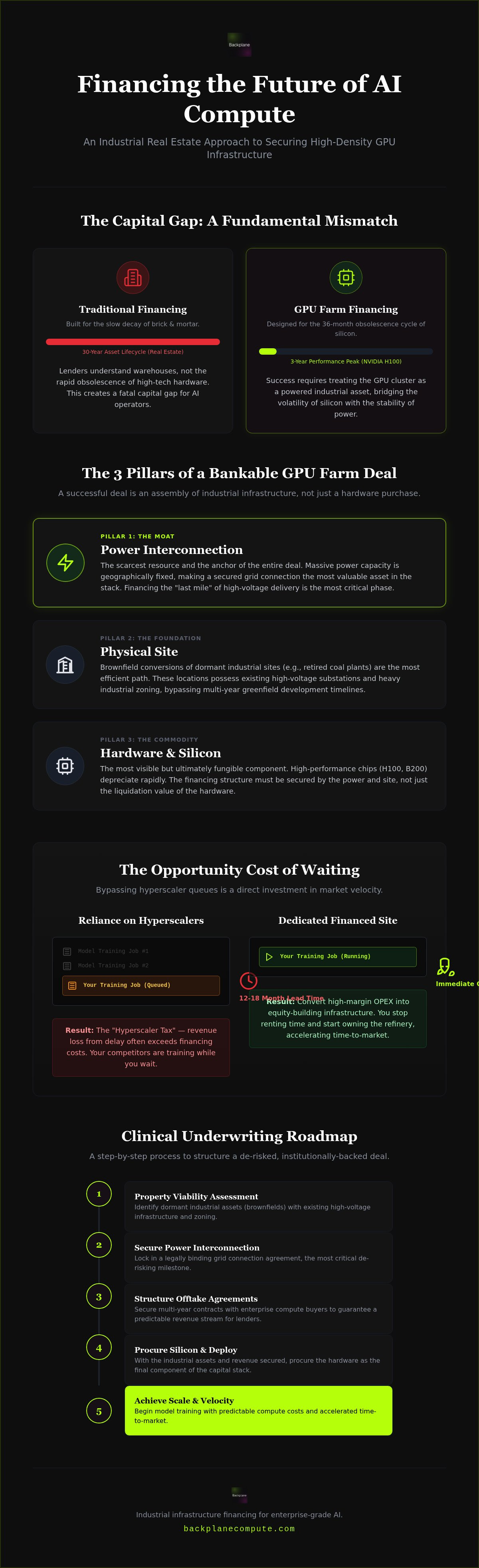
Traditional lenders are built for the slow decay of brick and mortar. They understand a 30-year mortgage on a warehouse. They don't understand the 36-month obsolescence cycle of an NVIDIA H100. This mismatch creates a fatal capital gap for AI operators. Financing a GPU farm isn't about buying hardware. It's about underwriting a high-density industrial ecosystem. By 2026, the market has shifted. Hardware-only loans are insufficient for the scale of current demand. Success now requires sophisticated GPU farm financing solutions that treat the cluster as a powered industrial asset. This approach bridges the gap between the volatility of silicon and the stability of industrial power.
The Depreciation Problem: Chips vs. Real Estate
Silicon represents a unique challenge for institutional credit. Real estate appreciates. Chips evaporate. A Blackwell B200 cluster delivers massive throughput today but faces steep residual value drops as the next architecture looms. Lenders struggle to model this volatility. They try to apply 5-year equipment lease logic to 3-year performance peaks. It's a fundamental misunderstanding of the asset class. Compute-as-Collateral in 2026 represents a dynamic underwriting model where the underlying asset's value is tied to its real-time processing power and power-usage efficiency rather than its physical resale price in a volatile secondary market. You need a partner who understands that the value isn't just in the chip. It's in the megawatt-hours it consumes and the tokens it generates.
The Opportunity Cost of Hyperscaler Queues
Reliance on legacy cloud providers introduces a hidden Hyperscaler Tax. It's the cost of waiting. When you're stuck in a 12-month deployment queue, your model isn't learning. Your competitors are. The revenue loss from a year-long delay often exceeds the interest costs of a private debt facility. Private GPU farm financing solutions unlock immediate capacity. Ownership isn't just about control. It's about velocity. Bypassing the cloud tax means you trade high-margin OPEX payments for equity-building infrastructure. You stop renting time. You start owning the refinery. This shift is essential for any enterprise aiming to lead in LLM training. The speed-to-market advantage of a dedicated, financed site is self-evident when compared to the bureaucratic friction of hyperscaler allocation.
Structuring the Deal: Power, Hardware, and Offtake
Execution in the AI sector requires a shift from vendor-led leasing to complex infrastructure assembly. A bankable deal rests on three pillars: the physical site, the power interconnection, and the silicon. Silicon is the commodity. Power is the moat. Without a secured grid connection, even the most advanced cluster is an expensive paperweight. Successful GPU farm financing solutions prioritize the underlying industrial assets to create a stable foundation for institutional capital. This ensures that the investment is backed by more than just rapidly depreciating hardware.
Financing the interconnection is often the most critical phase of the stack. It's the "last mile" of high-voltage delivery that determines the viability of a high-density deployment. While hardware can be shipped anywhere, massive power capacity is geographically fixed. Investors look for sites where the power is already on-site or the path to interconnection is clear and legally binding. Power is the most valuable part of the stack because it's the scarcest resource in the current compute race. It's the anchor that holds the deal together.
Asset Conversion: From Coal to Compute
The most efficient path to deployment involves brownfield conversion. Retired coal plants and decommissioned paper mills are ideal candidates. These sites possess existing high-voltage substations and heavy industrial zoning. Repurposing these assets bypasses the multi-year timelines associated with greenfield development. A clinical Property Viability Assessment identifies which dormant assets can be transformed into high-density compute hubs. Financing these conversions requires a deep understanding of environmental remediation and grid load requirements, blending industrial real estate expertise with modern financial engineering.
The Role of Offtake Agreements
Institutional lenders require certainty. Offtake agreements provide it. By securing multi-year contracts with enterprise compute buyers before the first rack is powered, you de-risk the entire capital structure. These agreements guarantee a predictable revenue stream. This allows lenders to underwrite the debt based on cash flow rather than just the liquidation value of the hardware. Matching enterprise demand with powered industrial supply is the final step in closing the financing loop. It transforms a speculative build into a predictable, high-yield infrastructure asset that attracts top-tier institutional interest.
CAPEX vs. OPEX: Comparing GPU Financing Models
The choice between CAPEX and OPEX is no longer a simple accounting preference. It's a strategic decision on how you'll survive the next compute cycle. Direct CAPEX ownership provides the ultimate moat. You control the physical layer, the power density, and the long-term cost of training. However, the capital intensity of GB200 and GB300 clusters makes outright purchase a barrier for many. Modern GPU farm financing solutions have evolved to offer structured leases that preserve liquidity while securing the latest silicon. These models allow you to lock in performance without draining your R&D reserves. By 2026, the tax implications of industrial compute have also matured; assets are often categorized under accelerated depreciation schedules that favor those who own the infrastructure.
Agility remains the primary driver for OPEX models. GPUs-as-a-Service provides the speed of the cloud but with the critical privacy of dedicated hardware. You aren't sharing a rack with a competitor. You're utilizing a dedicated slice of a financed site. This model shifts the burden of maintenance and cooling to the provider while giving you the flexibility to scale. It's the leanest way to deploy, provided you've accounted for the long-term premium of rental over ownership. The goal is to match your financing structure with your model's development roadmap.
Total Cost of Ownership (TCO) Analysis
Comparing Equinix colocation to a private financed farm reveals a stark contrast in efficiency. Colocation providers bake their own margins and redundancy costs into your monthly bill. You're paying for their real estate overhead. A private farm allows for PUE (Power Usage Effectiveness) optimization specific to high-density AI racks. You eliminate the "middleman markup" on cooling and maintenance. A dedicated financed site offers a radically lower five-year TCO compared to Tier-1 hyperscalers by internalizing the infrastructure margin and optimizing power-usage effectiveness for high-density AI workloads. When you own the refinery, you stop paying the retail price for the fuel.
The Hybrid Approach: Dedicated Financed Sites
We've pioneered a middle ground through Dedicated Financed Sites. This hybrid structure delivers the rapid deployment of an OPEX model with the operational control of CAPEX. You don't wait for a hyperscaler to allocate capacity. Instead, we structure the financing to build a site specifically for your cluster. You get a dedicated environment that scales as your training needs grow. This approach bypasses the traditional queue, allowing you to deploy H200 or Blackwell clusters in months rather than years. It's a decisive bridge for enterprises that need industrial-scale compute without the bureaucratic friction of legacy cloud providers.
Securing Underwriting in 2026: A Step-by-Step Guide
Underwriting a high-density cluster in 2026 is an exercise in clinical precision. It requires a move beyond speculative projections into the hard reality of industrial operations. To secure institutional backing, you must follow a methodical progression that de-risks every layer of the stack. Modern GPU farm financing solutions are no longer just about credit scores. They are about proving the viability of the physical environment. Lenders need to see a clear path from a dormant asset to a revenue-generating compute engine.
The underwriting process follows five distinct, high-stakes phases:
- Step 1: Technical Assessment. Verify the site can handle the extreme thermal and structural loads of Blackwell-class clusters.
- Step 2: Power Interconnection. Execute a Power Purchase Agreement (PPA) that guarantees both uptime and long-term cost-certainty.
- Step 3: Hardware Allocation. Secure a direct commitment for hardware from NVIDIA or AMD to prevent supply chain bottlenecks from stalling the loan.
- Step 4: Capital Structuring. Layer senior debt against the stable power assets while using flexible equity or mezzanine debt for the compute hardware.
- Step 5: Operational Management. Deploy a dedicated team to oversee the live infrastructure and maintain rigorous PUE targets.
Site Viability and Diligence
The foundation of any bankable deal is a rigorous Property Viability Assessment. In 2026, floor loads and cooling capacity are the primary constraints. High-density AI racks weigh significantly more than traditional enterprise servers. You must assess grid proximity and regulatory hurdles associated with brownfield sites early in the cycle. Decommissioned plants often carry legacy environmental issues that must be mitigated before a lender will release funds. If the physical site fails the stress test, the financing collapses before the hardware is even ordered.
Lender Oversight and Risk Mitigation
Lenders in this space have evolved. They now demand a governed record across the entire transaction. They don't just look at the chips. They look at the lien structures on the underlying power assets. Because hardware depreciates so rapidly, the power interconnection often serves as the primary collateral. Risk mitigation involves matching the debt maturity with the expected lifespan of the silicon. You must demonstrate a clear path to offtake to ensure the debt can be serviced even if market volatility hits compute pricing. If you're ready to move from theory to execution, you can begin your infrastructure financing structuring to lock in your position.
Scaling AI Compute with Backplane’s Financing Solutions
Backplane is the bridge. We eliminate the friction between dormant industrial assets and the insatiable demand for AI compute. Traditional finance is too slow. Hyperscalers are too crowded. We operate in the gap. By leveraging specialized GPU farm financing solutions, we transform high-voltage sites into active revenue engines in a fraction of the time required by legacy providers. You don't just get a lease; you get a dedicated infrastructure stack tailored to your specific training requirements. We focus on the movement of assets and the acceleration of your deployment timeline.
Our execution model was proven in the conversion of a decommissioned Midwest industrial facility. The site possessed a dormant 50MW substation but lacked the technical roadmap for high-density compute. We structured the capital, secured the hardware allocation, and matched the site with an enterprise LLM developer. The result was a live GPU farm delivered while competitors were still stuck in cloud allocation queues. This isn't just about brokerage. It's about market-making at the intersection of power and silicon. We convert dormant resources into active, high-performance infrastructure with clinical precision.
The Backplane Advantage: Speed and Execution
Speed is our primary metric. We bypass the corporate bureaucracy that stalls large-scale deployments. Through Infrastructure Financing Structuring, we provide the technical and financial framework to move from site assessment to live compute. Our boutique approach allows for a level of agility that larger entities cannot match. For those requiring immediate throughput, our GPUs-as-a-Service offering provides direct access to high-performance clusters without the long-term CAPEX commitment. We prioritize execution over preamble. We solve the physical constraints that others overlook.
Future-Proofing Your Compute Strategy
The 2027 hardware cycle will demand even greater power densities and cooling precision than we see today. Planning for this shift starts now. Waiting to secure your position is a strategic failure that results in lost market share. You must initiate your infrastructure play today to ensure capacity for the next generation of Blackwell and beyond. We act as your sophisticated guide through this transition, ensuring your capital structure is as robust as your hardware. Secure your dedicated compute site now to lock in your power interconnection and hardware roadmap. The window for industrial-scale compute is closing. Position yourself as an owner, not a renter, and take control of your AI future.
Dominate the Compute Cycle with Structured Infrastructure
The race for AI dominance is won in the physical world. You've seen that successful deployment hinges on treating compute as a powered industrial asset rather than a simple hardware purchase. By mastering GPU farm financing solutions, you shift from being a renter of cloud time to an owner of infrastructure. You've identified how brownfield conversion and secured offtake agreements de-risk the capital stack. This allows you to bypass hyperscaler delays and lock in predictable costs for your LLM training.
We provide the decisive bridge between industrial reality and your compute demand. Our expertise in brownfield conversion and direct access to high-density power ensures you don't wait 18 months for capacity. We accelerate your deployment timelines through clinical execution and institutional knowledge. It's time to move your model training from a queue to a dedicated refinery. We cut through the red tape that stalls larger entities.
Secure Your Dedicated, Fully Financed GPU Site with Backplane. Your roadmap to industrial-scale AI starts with a single structured deal. Take control of your infrastructure today.
Frequently Asked Questions
What are the most common financing models for GPU farms in 2026?
Common models include structured equipment leases, private credit debt facilities, and Dedicated Financed Sites. These models align the rapid 3-year depreciation of hardware with the long-term stability of industrial power assets. By 2026, the market has moved away from traditional hardware-only loans toward comprehensive GPU farm financing solutions that underwrite the entire infrastructure stack. This ensures capital is deployed against the most valuable asset: the power interconnection.
Can we use retired industrial sites like coal plants for AI data centers?
Retired coal plants and closed mills are prime candidates for high-density AI infrastructure. These brownfield sites already possess the high-voltage substations and heavy industrial zoning required for Blackwell-class clusters. Converting these assets is faster and more cost-effective than greenfield development. We specialize in assessing the technical and economic viability of these properties to ensure they meet the rigorous structural and thermal demands of modern compute.
How does GPU farm financing differ from traditional data center financing?
Traditional data center financing relies on the long-term value of the real estate and 10-year tenant leases. GPU farm financing is more agile and clinical. It must address the reality that AI hardware loses significant value within 36 months. Lenders focus on the "powered shell" and the interconnection rather than just the physical building. This approach requires a deep understanding of both high-finance and industrial power operations to be successful.
What is the typical timeline for securing financing and deploying a GPU farm?
The timeline varies based on site readiness, but our model typically compresses the process to a few months. This is a stark contrast to the 18-month wait times often found with traditional hyperscalers. Securing the financing happens in parallel with the property viability assessment and hardware allocation. By bypassing the bureaucratic friction of legacy cloud providers, we accelerate your speed-to-market for large-scale LLM training and inference.
Do lenders accept GPUs as collateral for large-scale infrastructure loans?
Lenders rarely accept GPUs as the sole collateral because their residual value is too volatile. Instead, they look at the entire industrial ecosystem. The primary collateral is typically the power interconnection, the site lease or ownership, and the offtake agreements from compute buyers. This structure provides the institutional security required for large-scale infrastructure loans. It shifts the lender's risk from depreciating silicon to stable, high-demand industrial power assets.
How do power purchase agreements (PPAs) affect GPU farm financing?
Power purchase agreements are the bedrock of any bankable compute deal. They lock in electricity costs for multiple years, providing the margin certainty that lenders demand. Without a secured PPA, GPU farm financing solutions are difficult to underwrite due to the volatility of energy markets. A strong agreement proves that the farm can operate at a competitive price point, ensuring the debt can be serviced through various market cycles.
What is the minimum deal size for Backplane's structured financing solutions?
We focus on enterprise-grade deployments that require significant power density and dedicated infrastructure. Our structured financing is designed for clusters that demand institutional-level capital and complex industrial site conversion. We don't list a fixed minimum because each deal is structured around the specific power capacity and hardware requirements of the buyer. We prioritize high-stakes transactions where our expertise in brownfield conversion and infrastructure brokerage provides the most value.
How does Backplane's model compare to hyperscaler GPU capacity?
Hyperscalers offer shared, multi-tenant cloud capacity with significant markup and long wait times. Our model provides dedicated, fully financed sites that you control. You get the privacy of a private cluster with the financial agility of a managed service. This eliminates the "cloud tax" and provides a lower total cost of ownership over a five-year horizon. It's the difference between renting a room in a hotel and owning the refinery.


