

A viable site doesn’t bring compute online by itself. HPC facility deployment depends on aligning power, property, network, cooling, compute demand, and capital in a workable sequence.
These workstreams rarely move at the same pace. A property can look promising but fall short in technical or commercial diligence. A power path can advance while network, cooling, or committed demand remains unresolved. If dependencies and decision owners aren’t clear, delays can leave investment tied to a site that is not ready to operate.
This guide sets out a practical deployment sequence, from feasibility and site diligence through infrastructure readiness and commissioning. It compares converting an industrial property with developing a new facility, and explains how to assess power, cooling, connectivity, compute requirements, and financing as parts of one project.
The goal is to match site capacity with capital and defined demand. Backplane connects powered industrial properties with AI compute buyers, bringing property assessment, diligence, financing, and deployment coordination into the same conversation.
Key Takeaways
- HPC facility deployment depends on aligning site readiness, infrastructure, compute demand, and capital before making major commitments.
- Assess power, cooling, network, and workload requirements together, because a change in one can affect the others.
- Compare existing-site conversion with new development based on the property, infrastructure gaps, and diligence required.
- Use clear decision gates to progress from demand scoping and site assessment through financing, deployment, and commissioning.
- Choose between GPUs-as-a-Service and a dedicated financed site based on the compute access and infrastructure pathway the project requires.
HPC Facility Deployment Starts with a Clear Readiness Case
Compute cannot run on a property’s potential. Before a site can support operational capacity, its power and interconnection path, cooling, fiber, and intended workload must align. A promising building may still have infrastructure gaps, uncertain demand, or commercial constraints. Readiness comes from diligence that connects these factors, not from an attractive address or an available parcel.
HPC facility deployment is the coordinated process of turning a viable site and its supporting infrastructure into operational compute capacity. It involves more than procuring GPUs. The facility must be able to supply and distribute power, remove heat, connect workloads, and support the intended operation. A useful foundation is the broader definition of High-performance computing (HPC), which encompasses the systems and technologies used to process demanding computational workloads.
What must be ready before an HPC facility enters deployment?
Start by defining the compute case: the expected demand, capacity requirement, and workload profile. These inputs shape the infrastructure assessment. Establish what power is available, what is required to deliver it to the site, and what electrical distribution is needed inside the facility. Then assess cooling and fiber connectivity against the proposed compute configuration and intended use.
Treat these as linked questions, not separate checkboxes. Workload requirements inform the compute configuration, which affects power and cooling needs. The site’s actual conditions determine what can be supported and what needs to change. Because requirements vary by project, assess feasibility against both the specific property and the defined demand.
How site selection feeds the deployment plan
Location, existing infrastructure, and conversion potential set the initial scope. An industrial property with relevant power infrastructure may offer a different starting point from a site that needs substantial development. Neither is ready for deployment based on appearance alone. Establish what is usable, what still requires diligence, and how well the property fits the compute case.
For a deeper screening framework, see the guide to AI data center site selection criteria. At the deployment stage, the key question is whether the site supports a credible path from infrastructure assessment to operating compute.
That distinction matters commercially. Site attractiveness indicates potential; readiness connects that potential to a defined workload, feasible infrastructure, and viable project case. Backplane brings powered industrial properties and AI compute buyers into the same evaluation, using property viability assessment and diligence to inform the deployment pathway.
Coordinate Power, Cooling, Network, and Compute as One System
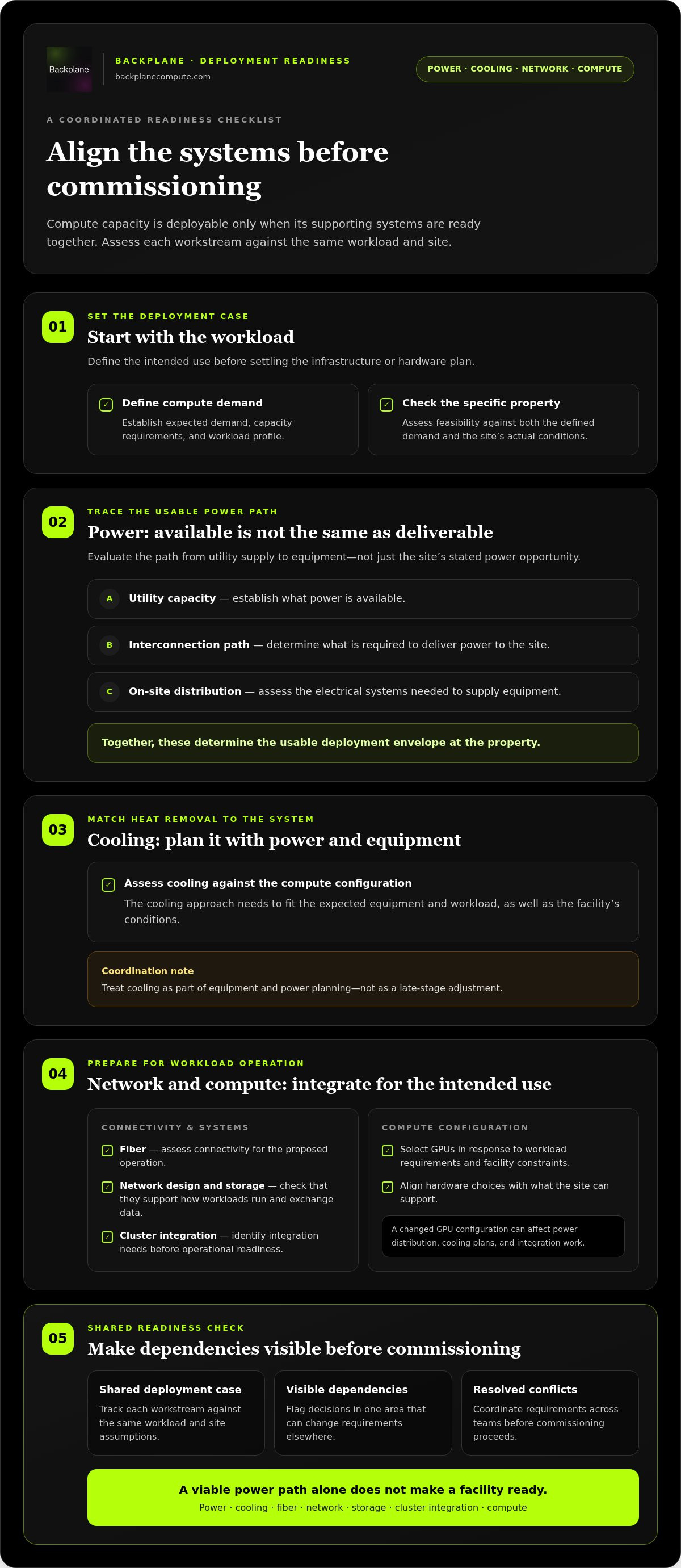
Infrastructure workstreams can progress at different speeds, but commissioning depends on their alignment. Utility power, the interconnection path, on-site electrical distribution, cooling, fiber connectivity, and compute integration all affect whether a facility can support its intended workload. A change in one area can alter assumptions elsewhere. For example, a revised compute configuration may change electrical and cooling requirements, affecting facility readiness even if other work is complete.
Compute capacity is deployable only when its supporting systems are ready together. Each workstream needs defined requirements, visible dependencies, and a shared understanding of what must be complete before commissioning can proceed.
Power and cooling determine the usable deployment envelope
A site’s power opportunity is not the same as power deliverable to equipment. Distinguish available utility capacity from the interconnection path and the electrical systems needed to distribute power within the facility. Together, these determine the usable deployment envelope at the specific property.
Cooling is also a workload- and equipment-dependent decision. The selected approach needs to fit the expected compute configuration and the facility’s conditions. Assess cooling alongside power and equipment planning, rather than treating it as a late-stage adjustment. For deeper technical context, see this high-performance computing infrastructure reference guide.
Network and compute integration shape operational readiness
Fiber connectivity is only one part of network readiness. Network design, storage, and cluster integration also need to support how workloads run and exchange data. A facility may have a viable power path but still be unready for its intended operation if connectivity or system integration remains unresolved.
GPU selection should follow workload requirements and facility constraints, not lead them. The chosen hardware informs infrastructure needs, so changing the GPU configuration can affect power distribution, cooling plans, and integration work. Define the workload and assess the site first, then align compute decisions with what the facility can support.
Make dependencies visible in a practical coordination plan. Track each workstream against the same deployment case, flag decisions that affect other teams, and resolve conflicts before commissioning. Connecting property diligence, compute demand, and project financing is central to this work. Backplane links powered industrial sites with AI compute buyers and structures infrastructure financing. Explore Backplane’s deployment coordination as part of a coordinated project pathway.
Compare Existing-Site Conversion with New HPC Development
Existing industrial sites can offer useful infrastructure and a route to repurposing. New development can give the project more control over facility design. Neither route is automatically faster, cheaper, or more viable. Compare them using project-specific evidence, including power deliverability, building condition, connectivity, cooling requirements, and redevelopment scope.
An existing power asset does not prove deployment readiness. A retired power plant, closed mill, or decommissioned compute facility may merit assessment, but its infrastructure could be outdated, unsuitable, or disconnected from current needs. Prior infrastructure is a starting point for diligence, not a readiness decision.
When can an existing industrial site support HPC deployment?
Determine what remains usable and what needs to change. A former plant may have power-related infrastructure, a mill may offer a building suited to conversion, and a decommissioned compute facility may have relevant layouts or connectivity. For each property, examine the current power and interconnection path, building condition, fiber access, cooling fit, and redevelopment scope. The findings establish whether conversion is viable and what work it involves.
What changes when the project is a new development?
For new development, define the site, utility coordination, infrastructure design, and construction scope together. This pathway can offer more control over designing the facility around the intended compute workload. That control also requires planning and delivering infrastructure rather than assuming it is already in place. Site feasibility, utility conditions, and construction requirements still need project-specific assessment.
| Decision criterion | Existing-site conversion | New development |
|---|---|---|
| Starting point | Existing property and infrastructure; current condition must be verified. | Site and infrastructure scope are defined for the project; requirements must be verified. |
| Design flexibility | Bound by building and infrastructure constraints; conversion scope needs assessment. | More opportunity to shape the design; construction scope needs definition. |
| Power and connectivity | Existing assets may help, but deliverability and fiber access require diligence. | Utility coordination and connectivity planning form part of development. |
| Key unknowns | Condition, cooling fit, usable capacity, and redevelopment needs: verify. | Site suitability, utility path, infrastructure design, and construction scope: verify. |
Apply the same decision standard to both pathways: can the site support the intended compute plan, and can the remaining dependencies be resolved within a viable project structure? A property viability assessment can clarify a conversion case or help define the scope of new development. To evaluate an industrial property against compute demand, assess a powered site for compute potential.
Move from Feasibility to Commissioning Through Defined Gates
HPC facility deployment progresses through linked decisions, not a single construction milestone. Each phase should produce evidence for the next commitment. Stage gates help prevent unresolved scope from turning into premature capital, procurement, or construction commitments.
- Scope demand. Define the intended workloads, compute demand, and capacity objectives. Move forward when the project has a clear demand case to use in evaluating site and infrastructure options.
- Assess the site. Examine the property, power path, existing infrastructure, redevelopment requirements, and commercial viability. Move forward when findings clarify what the site can support and which dependencies remain open.
- Resolve dependencies. Coordinate utility and electrical requirements with cooling, network, fiber, and compute plans. Move forward when the workstreams have defined scopes, owners, and a documented path for resolving material constraints.
- Structure capital. Align the financing structure with site scope, infrastructure needs, and committed compute demand. Move forward when the capital plan reflects the assessed project rather than untested assumptions.
- Deploy. Execute the defined property and infrastructure work while tracking dependencies across teams. Move to commissioning when the integrated systems and compute environment are ready for validation.
- Commission. Validate that facility systems work together and are ready for the intended operations. Operational readiness requires documented validation, not just completed construction.
What happens during site assessment and diligence?
Assessment connects the property to the deployment case. It brings together site condition, power and infrastructure, redevelopment scope, and commercial viability. The findings refine the project plan by identifying what needs to be built, which dependencies need resolution, and whether the proposed site aligns with demand. Backplane’s role in coordinating powered sites, compute buyers, and project financing is explored in this guide to the AI infrastructure brokerage model.
How should deployment teams manage execution and commissioning?
Assign clear ownership across site, power, network, cooling, equipment, and financing workstreams. Track dependencies and decisions in a shared project record, so a change in one area prompts review of affected scopes. During commissioning, validate integrated systems against the intended operation and document the results. The evidence required depends on the project, but unresolved dependencies should stay visible through every handoff.
Backplane coordinates site assessment, diligence, financing, and deployment management around committed compute demand. Align your site, compute demand, and project financing.
Align Compute Demand and Financing Before Committing to Deployment
A viable property and financing structure need a defined compute case. Without buyer demand, project scope may rely on assumptions about workload, capacity, and infrastructure. Without a viable property, committed demand alone does not establish a deployment path. Evaluate demand, site, and financing together before making major commitments, so capital planning reflects the project’s actual requirements and constraints.
How committed demand changes the project conversation
Buyer workload requirements give capacity planning a practical basis. They help define the compute configuration and infrastructure scope the property must support. That scope informs diligence and the capital structure needed to move forward. The project can then assess a specific site against a defined use case rather than sizing infrastructure around speculative demand.
For property owners, committed compute demand provides a reference point for evaluating powered assets. Consider a site’s potential alongside buyer requirements, property viability, and the work needed to align them. The relationship between capital and project scope is explored in this guide to AI infrastructure financing strategy.
Choose a compute access path that fits the project
GPUs-as-a-Service gives compute buyers direct access to GPU capacity as a service. A dedicated financed site provides a pathway centered on a dedicated facility, with financing structured around deployment. The approaches serve different compute access and infrastructure needs. Choose between them based on the buyer’s requirements, the property, and the project’s commercial structure. Neither guarantees an outcome, a fixed timeline, or a particular financing result.
Where Backplane fits in an HPC facility deployment
Backplane connects powered industrial sites with AI compute buyers and coordinates the work across property, demand, and project capital. Its role includes property viability assessment, diligence, infrastructure financing structuring, and deployment management. Bringing these elements into one evaluation helps align a site’s potential with a defined compute case and a project-specific financing pathway.
For HPC facility deployment, bring the relevant project context into the conversation. Property owners can share a powered site for assessment against compute demand. Compute buyers can outline workload and capacity requirements. Start a conversation about HPC facility deployment with the site or compute context relevant to your project.
Turn Deployment Readiness into a Coordinated Project
HPC facility deployment moves forward when compute demand, a viable property, infrastructure, and capital are evaluated as one project. Power, cooling, network, and compute decisions are interdependent, so readiness depends on resolving them together. An existing industrial site may offer useful infrastructure, while new development may provide more design control. Either route requires project-specific diligence.
Use decision gates to progress from demand scoping and site assessment through dependency resolution, capital structuring, deployment, and commissioning. Each gate should establish the evidence needed for the next commitment. This keeps project scope tied to property conditions and intended workloads.
Backplane connects powered industrial property with AI compute demand and supports site assessment, diligence, financing structuring, and deployment management. Whether you’re evaluating a powered site or planning compute capacity, discuss an HPC facility deployment with Backplane. Start with a clear project case that brings the site, demand, and infrastructure needs into view.
Frequently Asked Questions
What is HPC facility deployment?
HPC facility deployment is the process of turning a viable site and coordinated infrastructure into operational high-performance compute capacity. It goes beyond buying GPUs: power delivery and distribution, cooling, network connectivity, compute integration, and commercial readiness must support the intended workloads. The sequence depends on site conditions and project scope, so there is no universal specification or timeline. Deployment brings these elements into one executable plan before compute operations begin.
How long does it take to deploy an HPC facility?
Delivery time varies with site condition, power readiness, utility interconnection, construction or conversion scope, equipment requirements, and commissioning. No universal duration is reliable without project-specific evidence. Early diligence can surface dependencies, such as infrastructure work or unresolved coordination, that affect the schedule. Set milestones across site, power, network, cooling, compute, and financing workstreams. An operational date becomes credible only when dependencies and readiness evidence are aligned.
Can an existing industrial site be converted into an HPC facility?
Yes. Some powered industrial properties may be candidates for conversion, including retired power plants, closed mills, and decommissioned compute facilities. Existing infrastructure is a starting point for diligence, not proof of suitability. Assessment needs to examine deliverable power, building condition, connectivity, cooling approach, redevelopment scope, and commercial viability. Those findings establish what the property can support, what needs work, and whether a viable deployment plan can be defined.
What infrastructure does an HPC facility need?
An HPC facility needs power supply and distribution, cooling, network connectivity, compute equipment, and supporting building systems. Requirements depend on the intended workloads and selected equipment, so one fixed specification won’t suit every project. A site assessment connects those requirements to the property’s physical conditions and infrastructure. It helps define deployment scope, identify gaps, and establish how systems need to work together for the intended operations.
Is power availability enough to make a site HPC-ready?
No. A power opportunity is only one part of site readiness. The project also needs a viable path to deliver power, suitable electrical distribution, cooling, network connectivity, building or redevelopment planning, and aligned compute demand. Diligence determines whether these elements can be coordinated at the property. A powered site isn’t automatically ready for deployment; assess its infrastructure and commercial viability against the intended workload and project scope.
How do HPC facility financing and compute demand fit together?
Financing decisions are stronger when evaluated alongside site viability and defined buyer requirements. Workload needs help shape capacity and infrastructure scope, while property and power diligence clarify project constraints. Backplane connects powered industrial sites with AI compute buyers and structures financing as part of its deployment-focused work. This coordination informs a project-specific pathway, but does not guarantee funding or a particular outcome. Capital planning should reflect assessed scope and demand.


