

Power alone doesn’t make a site ready for AI compute. A powered industrial property still needs a viable path to compute demand, financing, and deployment. AI infrastructure brokerage connects those pieces, turning a potential site and a buyer’s requirements into a project that can move toward operation.
That’s the friction property owners and compute buyers face: decisions about sites, power, connectivity, hardware, and capital are often fragmented. A broker helps align them around what the project can support. The result isn’t simply a property match. It’s a clearer route from available infrastructure to financeable compute capacity.
This article explains how the brokerage model serves property owners and compute buyers, what determines whether a project can advance, and how assessment, financing, and deployment coordination fit together. Backplane connects powered industrial properties with AI compute demand and structures financing to support infrastructure development. The process can clarify a project’s viability and bring commercial demand closer to operational GPU infrastructure.
Key Takeaways
- AI infrastructure brokerage brings property owners and compute buyers together around a project’s site, power, demand, and capital needs.
- Power access is only a starting point; technical, commercial, and financial viability all shape whether a site can progress.
- A structured workflow helps identify assets, assess fit, align compute demand, shape financing, and coordinate deployment.
- Brokerage differs from property listings, technical consulting, GPU procurement, and direct access to compute by coordinating across project needs.
- Backplane connects powered industrial properties with AI compute demand through assessment, financing structuring, and infrastructure development pathways.
What Is AI Infrastructure Brokerage, and What Problem Does It Solve?
AI infrastructure brokerage connects owners of powered industrial properties with buyers seeking AI compute infrastructure, then coordinates assessment, commercial alignment, financing, and deployment to move a project forward. It addresses a practical gap: a property may have power-related assets but no clear route to compute use, while a compute buyer may have demand but lack a viable site, aligned capital, or a coordinated development plan.
This is not simply a property listing. A listing presents a site. Brokerage works across the project requirements: whether the property is viable, whether its power and other infrastructure can support the intended use, whether compute demand fits the opportunity, and whether a financeable path to execution can be structured. A data center depends on physical infrastructure and operating arrangements, not just a building address. The same is true of AI compute projects.
The core challenge is alignment. Site conditions, power access, compute requirements, capital, and execution must fit together. If one piece is unresolved, a seemingly promising opportunity may not advance. Brokerage brings the relevant parties into a shared project pathway, helping clarify constraints and the decisions that come next.
Which parties take part in an AI infrastructure brokerage?
The parties vary by project and transaction structure. Property owners contribute a site and information about its existing infrastructure. Compute buyers define the intended workload and infrastructure requirements. Capital providers evaluate how a project may be financed. Deployment participants help coordinate development and the transition toward operational infrastructure. One party may fill more than one role, and the mix of participants depends on the project.
Why can powered industrial sites attract AI compute projects?
Retired power plants, closed mills, and decommissioned crypto-mining facilities may have characteristics that make them worth assessing for a new use. Existing industrial infrastructure or power access can create an opportunity, but neither proves that a site can support a specific compute project. Technical fit, commercial demand, financing, and execution still need to align.
A promising site has potential; a validated site has been assessed against the requirements of a defined project. That distinction matters. AI infrastructure brokerage helps turn an initial lead into a clearer view of viability, the parties needed, and the work required to progress.
How AI Infrastructure Brokerage Connects Sites, Power, Compute, and Capital
Matching a compute buyer with an industrial property is only the opening move. A project must connect the site’s characteristics to power requirements, a defined compute need, a workable commercial structure, and a route to deployment. AI infrastructure brokerage organizes that sequence and surfaces constraints before they become hidden assumptions.
The pressure to expand AI capability makes this coordination more consequential. The Center for Security and Emerging Technology examines the unsustainable demand for computing power and the financial, hardware, and engineering challenges involved in scaling it. But demand alone doesn’t make a site suitable. Power access is not proof of available capacity, interconnection readiness, technical fit, commercial alignment, or financeability.
A project-dependent pathway may look like this:
- Identify assets. Locate a powered industrial property or other site that could merit evaluation.
- Assess viability. Review relevant site and infrastructure conditions, including grid interconnection as a diligence topic. The findings help define questions and next steps; they don’t establish capacity or timing.
- Align compute demand. Compare the buyer’s requirements with the site opportunity to shape a project scope that fits both sides.
- Structure financing. Develop a project-specific financing approach around the asset, requirements, and commercial arrangement. Capital and approval aren’t guaranteed.
- Coordinate deployment. Align project participants around development needs and the decisions required to move toward operational infrastructure.
How does site and power assessment inform a project?
Assessment is an early filter. It helps distinguish a site worth advancing from one whose constraints require more work or a different approach. Useful questions include whether the available power information matches the project’s needs, what is known about grid interconnection, and what site or infrastructure details remain unverified. Interconnection is one part of diligence, not a shorthand for deliverable power. Owners and compute buyers can use the AI data center site selection criteria guide to consider the broader set of site factors.
Site matching identifies a possible fit. Assessment tests that fit against a project’s requirements. The distinction keeps a property introduction from being mistaken for deployment readiness.
How are compute demand and financing brought together?
A defined compute requirement gives the project a commercial reference point: participants can assess what infrastructure is needed and whether the site opportunity aligns. Financing structuring then considers that project context rather than treating the property or compute need in isolation. The financing AI infrastructure strategy guide explores this relationship.
Backplane connects powered industrial properties with AI compute demand across assessment, financing structuring, and deployment coordination. For more on how these pieces fit together, see Backplane’s infrastructure brokerage approach.
AI Infrastructure Brokerage vs. Listings, Consulting, and Compute Procurement
These services can overlap, but they solve different problems. A property listing presents an asset. Technical consulting examines specific engineering questions. GPU procurement focuses on hardware, while direct compute access provides use of computing resources. AI infrastructure brokerage centers on connecting a viable asset with defined demand and coordinating the project pathway around them.
| Model | Primary scope | Typical counterparties and involvement |
|---|---|---|
| Property listing | Presenting a site and its stated attributes | Property owner and prospective buyer; supports discovery, but may not assess fit for a compute project |
| Technical consulting | Analyzing defined technical questions | Project owner and technical specialists; informs decisions within its agreed scope |
| GPU procurement | Sourcing compute hardware | Buyer and hardware sellers; addresses equipment, not necessarily site or project financing |
| Direct compute access | Providing access to computing resources | Compute user and service provider; meets compute needs without necessarily developing a dedicated site |
| Infrastructure brokerage | Aligning assets, demand, capital, and execution | Property owners, compute buyers, capital providers, and relevant deployment participants |
Brokerage is defined by coordination, not by owning every asset involved. Its role is to bring the relevant parties and project requirements into alignment. The diligence and development work are shaped by the transaction.
How is infrastructure brokerage different from a property listing?
A listing can show that a property exists and describe its stated features. That does not establish whether it suits a particular compute requirement. Brokerage extends the conversation toward project relevance: matching site characteristics to buyer demand, surfacing questions for assessment, and coordinating commercial steps among participants. Assessment and development activities are tied to the project’s needs, rather than assumed from a property introduction alone.
How does brokerage relate to GPUs-as-a-Service and dedicated sites?
These are compute access or project pathways, not synonyms for brokerage. A buyer seeking access to GPU resources may have different needs from one pursuing a dedicated financed site. The requirement and project structure shape which route makes sense. For more on the service model, see the enterprise guide to GPUs-as-a-Service.
Backplane connects powered industrial properties with AI compute demand and works across assessment, financing structuring, and infrastructure deployment. Backplane’s infrastructure approach brings these project elements together.
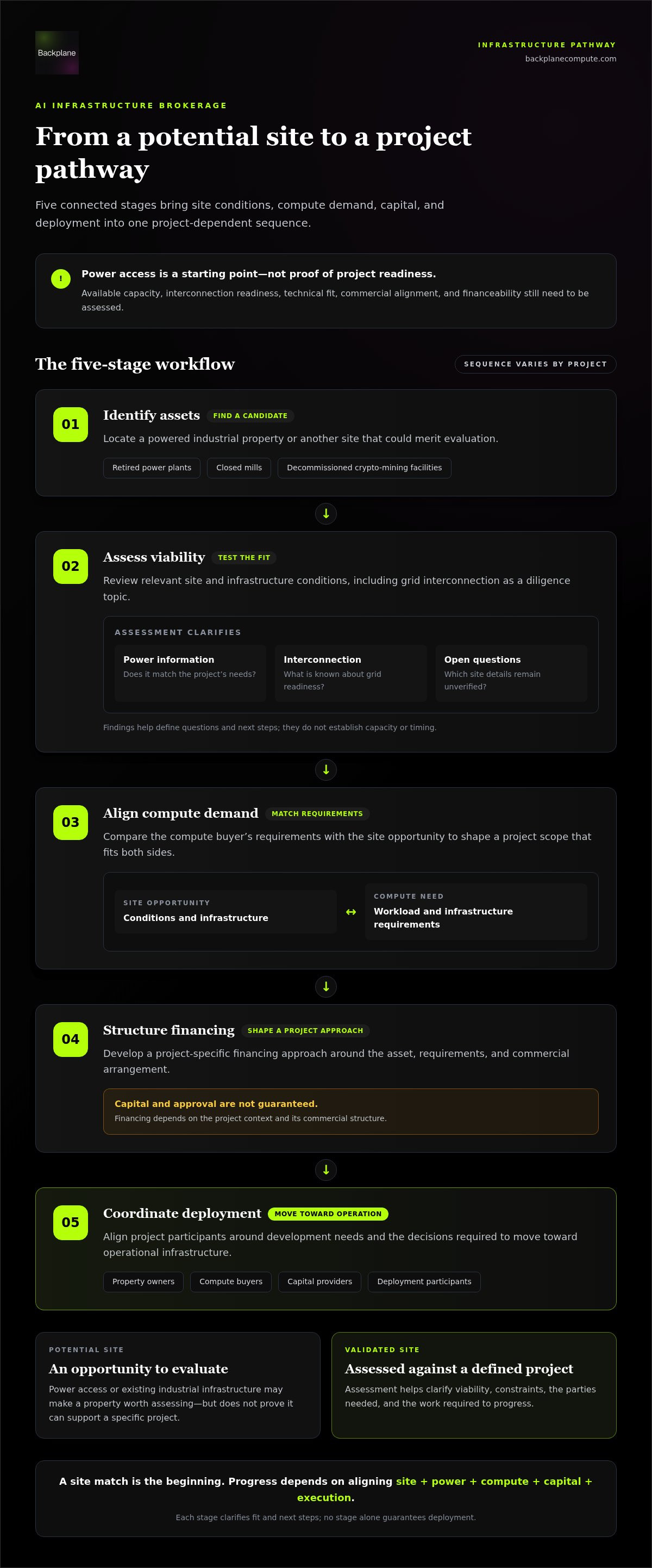
How an AI Infrastructure Brokerage Project Moves from Assessment to Deployment
An AI infrastructure brokerage project advances through a series of decisions, not a fixed approval sequence. Early screening tests whether the site and compute requirement appear worth exploring. Deeper diligence helps clarify constraints, refine scope, and shape financing and deployment discussions. Findings guide the next decision; they don’t guarantee project approval or completion.
What happens during initial project screening?
The property owner contributes information about the asset and its power context. The compute buyer defines the intended use and relevant requirements. The brokerage brings those inputs together to identify apparent fit and missing information. Gaps in site details, power context, or workload requirements may change project viability, scope, or sequencing.
Screening is not a substitute for diligence. The findings and work required to evaluate them vary by site and transaction.
Project checklist: screening to diligence
- Early screening: Summarize the property, known power context, intended compute use, buyer requirements, and obvious information gaps.
- Deeper technical diligence: Examine site and infrastructure conditions against the project’s needs, including relevant power and interconnection questions.
- Deeper commercial diligence: Clarify project scope, stakeholder roles, demand alignment, and financing considerations.
- Decision point: Identify constraints, further work, or changes needed before deciding whether and how to advance.
What changes as a project advances toward deployment?
As assessment findings develop, the parties can make more informed decisions about project scope. Property owners contribute site information and decisions about the asset. Compute buyers clarify requirements and commercial priorities. Capital providers consider the project-specific financing structure, while deployment participants coordinate relevant development work.
The sequence and timing depend on the project. Some findings may require additional diligence or a revised scope before financing and deployment discussions can progress. A dedicated site pathway may suit a project that calls for infrastructure aligned to a specific compute need; explore the dedicated AI compute sites guide for more context.
Backplane connects powered industrial properties with compute demand across assessment, financing structuring, and infrastructure deployment. Backplane’s project pathway brings these stages together.
When AI Infrastructure Brokerage Makes Sense, and How Backplane Fits
AI infrastructure brokerage is most relevant when a project involves a powered industrial asset, a defined compute requirement, or a need to connect both sides. It helps owners and compute buyers move beyond separate questions about property, power, and hardware toward a shared view of project fit and next steps.
It’s less relevant if the need is limited to a generic property listing or a standalone hardware purchase. Those needs don’t necessarily require coordination across site viability, compute demand, financing, and development. Brokerage adds value when the challenge is connecting these elements, not simply locating a building or equipment.
What should property owners and compute buyers clarify first?
Property owners can summarize the site’s characteristics and known power or infrastructure context. Compute buyers can outline intended workloads, capacity needs, and project objectives. These inputs help frame an initial assessment and reveal where more information may be needed. They don’t predetermine feasibility or guarantee that the two sides will align.
- For property owners: Describe the asset and relevant existing infrastructure.
- For compute buyers: Define the intended use, compute requirements, and objectives.
- For both: Identify known constraints and key questions to resolve as the project is assessed.
How does Backplane connect the project pathway?
Backplane connects powered industrial properties with AI compute demand. Its work brings property viability assessment, financing structuring, and deployment coordination into one project pathway. Assessment frames the site’s relevance to a defined requirement. Financing structuring considers the project context, while coordination aligns the parties involved as development moves forward.
The route depends on the asset, the buyer’s requirements, and the project structure. An early assessment helps clarify fit and next decisions; it isn’t a promise of approval, capital, or deployment. The objective is a clearer path from an industrial property or compute requirement to a project that can be evaluated and advanced on its merits.
If you’re assessing a powered site or planning an AI compute project, explore Backplane’s AI infrastructure brokerage.
Move from Infrastructure Potential to a Defined Project Path
AI infrastructure brokerage connects more than a property and a compute buyer. It aligns site viability, power context, defined demand, financing, and deployment coordination so participants can evaluate a project as a whole. Power access may make a site worth assessing, but it doesn’t establish technical fit or commercial and financial viability.
The distinction matters. A listing presents an asset; brokerage helps connect that asset to a specific compute need and the decisions required to advance. Assessment can surface constraints early. Financing structuring and deployment coordination can then support a project pathway shaped around what the site and buyer actually require.
Backplane connects powered industrial properties with AI compute demand. Its project work spans site assessment, financing structuring, and infrastructure deployment, bringing those considerations into a coordinated process.
If you’re evaluating a powered property or defining a compute project, explore Backplane’s AI infrastructure brokerage. Start with a clear picture of the site or compute requirement to define informed next steps.
Frequently Asked Questions
What is AI infrastructure brokerage?
AI infrastructure brokerage connects property owners with compute buyers and coordinates the commercial pathway between them. Depending on the project, that can involve assessing a powered industrial site, aligning it with compute demand, structuring financing, and coordinating development toward deployment. It goes beyond marketing a property, but it doesn’t make every site suitable or mean every project follows the same transaction structure. Each opportunity depends on its assets, requirements, and diligence findings.
How does AI infrastructure brokerage work?
The process generally starts with a site, a compute requirement, or both. Participants share relevant information, assess potential fit, and clarify infrastructure constraints, commercial needs, and project scope. If a workable pathway emerges, financing structuring and deployment coordination may follow. The sequence varies by asset and transaction. Brokerage connects the parties and decisions; it doesn’t replace the technical, commercial, and financial diligence needed to evaluate a project.
Who uses an AI infrastructure broker?
Property owners may use a broker to assess whether an underused powered industrial asset could support AI compute infrastructure. Compute buyers may need help connecting workload requirements with a potential site and project pathway. Capital providers may also participate when a project requires structured financing. The parties and their roles vary. The central task is to align the property, compute demand, capital considerations, and execution needs around a project.
What makes a site suitable for AI infrastructure?
Suitability depends on how a property and its infrastructure align with a defined compute project. Assessment may consider the site, electrical infrastructure, grid interconnection context, intended workload, development requirements, and commercial viability. A former industrial use or apparent power access can make a property worth investigating, but neither establishes readiness. Project-specific diligence helps surface constraints and determine whether the site can support the proposed infrastructure.
Is AI infrastructure brokerage the same as a data center property listing?
No. A property listing presents an asset to prospective buyers or tenants. Infrastructure brokerage can connect that asset to defined compute demand, coordinate relevant counterparties, and support financing and deployment discussions. Its scope depends on the transaction, and not every broker performs the same diligence or development work. The key distinction is the focus on advancing a compute project, rather than simply marketing real estate.
How is AI infrastructure brokerage different from GPUs-as-a-Service?
AI infrastructure brokerage coordinates assets, compute demand, and project execution. GPUs-as-a-Service provides access to GPU compute capacity through a service arrangement. The two can relate within a broader infrastructure strategy, but they describe different roles. A buyer with an immediate need for compute access may consider a service model, while a buyer pursuing a dedicated site may need a broader project pathway. The right structure depends on requirements and project fit.
Can a retired power plant or closed mill become an AI data center?
It may be a candidate, but its previous industrial use doesn’t prove it’s ready for AI infrastructure. Assessment considers the property and power context against the proposed project, including infrastructure, interconnection, compute requirements, development needs, and commercial viability. Brokerage can connect a potential site with compute demand and help coordinate next steps. Whether the project can advance depends on diligence findings and the scope required for that asset.


