

What does “available capacity” mean if the power isn’t committed, the cooling can’t support your rack, or the site won’t be ready on schedule? Securing high density compute starts with testing those claims against your workload, not relying on a headline availability figure.
AI infrastructure decisions involve more than technology risk. Power, thermal design, security controls, procurement terms, and delivery dependencies all affect whether capacity will be usable when you need it. Cloud, colocation, and dedicated infrastructure each involve different trade-offs in control, commitment, and readiness.
This checklist helps technical and commercial teams qualify capacity before committing. Use it to examine power and cooling, confirm security and operating requirements, compare procurement models, and identify dependencies that could affect delivery. The aim is evidence-backed capacity, aligned stakeholders, and a defensible next step. When a powered industrial site may be a fit, property viability assessment and infrastructure financing structuring can bring site readiness, compute demand, and capital requirements into the same diligence process.
Key Takeaways
- Define workload scale, duration, and utilization before assessing GPU counts or capacity claims.
- For securing high density compute, require site-specific evidence for power, cooling, networking, and security.
- Compare cloud or GPU services, colocation, and dedicated sites by control, operating responsibilities, and commercial commitments.
- Assign owners across engineering, security, procurement, finance, and deployment so diligence questions have clear answers.
- Consider powered industrial sites when existing capacity and buyer requirements may align, subject to site assessment and verified terms.
What securing high-density compute actually requires
Securing high density compute means more than reserving a GPU count or finding a facility with dense racks. Confirm that the compute matches the workload, the site can support it, access and operating controls meet requirements, and there is a credible path to delivery. If any one of these conditions is unverified, capacity may exist on paper without being ready for your deployment.
High-density compute capacity is workload-ready compute supported by verified power, cooling, connectivity, controls, and a deliverable timeline. It is not simply a large number of GPUs in a small footprint. Rack density describes how much equipment can fit in a rack. It does not establish whether the facility can run that equipment or whether your team can use it as required.
Translate the workload into a capacity requirement
Start with the work, not a provider’s inventory. Specify whether the deployment supports training, inference, or both, then map the expected phases and utilization assumptions. Record the accelerator type, interconnect requirements, storage profile, and software dependencies. These requirements shape both the configuration and the infrastructure needed to run it.
Separate minimum viable capacity from preferred headroom and future expansion. This helps prevent two common mistakes: counting planned growth as capacity available today, or committing to more capacity than the initial deployment needs.
Identify the evidence behind a capacity claim
Ask providers to distinguish what is installed, contracted, energized, and available for your required use period. These are different states. A powered site or equipment order does not prove that the complete configuration is ready for your workload.
Request site-specific evidence for usable power, cooling, network paths, and operational readiness. Consider how equipment such as blade servers shares power, cooling, and networking within an enclosure, then confirm the facility can support the proposed configuration. Assess security and operating controls alongside the technical design, including how access is managed and which party is responsible for each task.
Separate verified conditions from dependencies. Future construction, utility work, or unconfirmed equipment can affect delivery. For each dependency, ask who owns it, what must happen before service can begin, and what evidence will confirm completion. Record assumptions rather than treating them as commitments.
The result should be a capacity brief that engineering, security, procurement, and finance can assess against the same facts. That shared record is the foundation for securing high density compute with a realistic view of workload fit, infrastructure readiness, and delivery risk.
The high-density compute readiness checks: power, cooling, network, and security
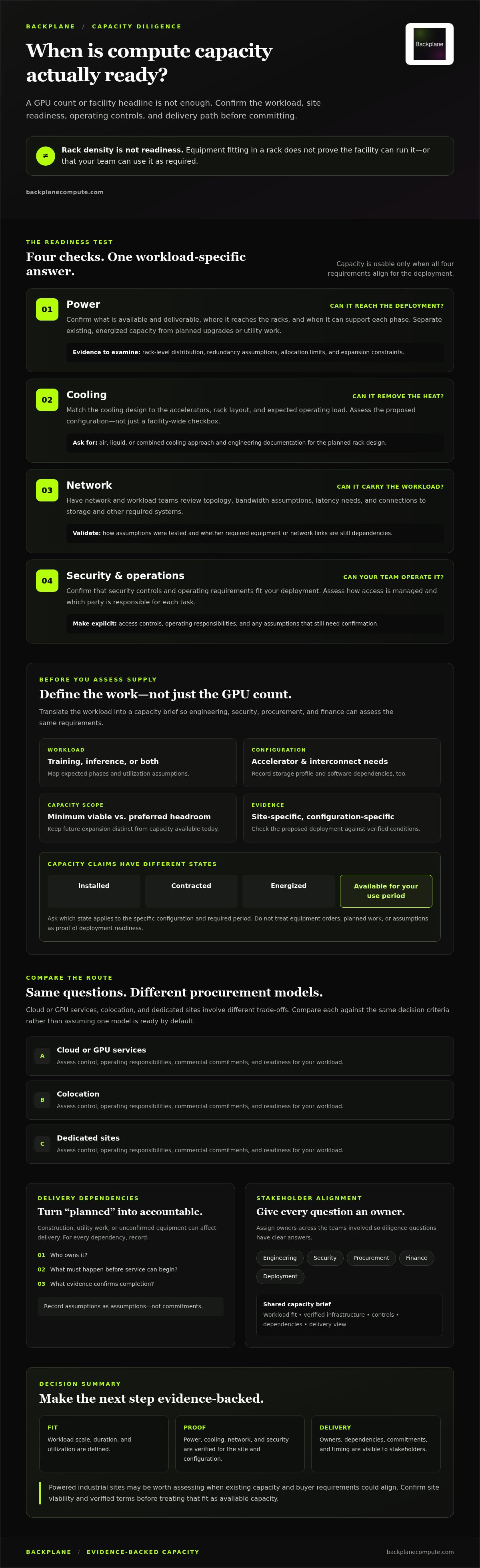
Capacity is usable only when four requirements align: power can reach the deployment, cooling can remove its heat, the network can carry the workload, and security controls meet your operating requirements. A headline capacity figure does not establish any of these conditions. Request site-specific engineering evidence and check it against the accelerator configuration and deployment phase you have in mind.
Readiness checklist: verify power, cooling, network, and security together for the specific workload and deployment.
Verify power and cooling at the required density
Confirm what power is available and deliverable at the facility, where it reaches the deployment, and when it can support each phase. Review rack-level distribution, redundancy assumptions, and limits on expansion. Ask the provider to separate existing, energized capacity from planned upgrades or utility work. A facility’s total power figure may not show how much can be allocated to your racks.
Match the cooling design to the accelerators, rack layout, and expected operating load. Ask whether the proposal relies on air cooling, liquid cooling, or a combination, and request engineering documentation for the proposed configuration. Changes to rack design can affect heat-removal requirements, so assess the full deployment rather than treating cooling as a facility-wide checkbox. For additional context, review liquid-cooled GPU cluster design decisions.
Validate connectivity, access, and operational controls
Have network and workload teams review the proposed topology, bandwidth assumptions, latency needs, and connections to storage and other required systems. Ask how those assumptions were validated, and identify dependencies on network equipment or links that are not yet in place. A cluster that cannot exchange data at the performance your workload needs may not be suitable.
Security diligence should cover facility access and system operations. Review physical access policies, network segmentation, incident response, and change-management responsibilities. Use the NIST Cybersecurity Framework as a reference for organizing cybersecurity risk questions, then map relevant controls to your organization’s requirements. Clarify who owns monitoring, escalation, maintenance windows, and service reporting. Document these responsibilities rather than assuming your team and the provider have the same operating model.
For each readiness requirement, record the evidence reviewed, unresolved assumptions, accountable owner, and any condition that could block deployment. This creates a decision record for technical and commercial teams. If a powered industrial site is under consideration, a property viability assessment can help evaluate its fit with compute demand and site requirements.
Compare routes to securing high-density compute capacity
Cloud or GPU services, colocation, and dedicated sites can each provide a path to capacity. They differ in control, operating responsibility, and what “available” means in practice. Compare each option against the same workload brief, then check its claims against confirmed allocation, deployment dependencies, security scope, and contract terms. The right route depends on your workload, risk tolerance, delivery evidence, and ability to operate infrastructure.
Use this comparison to frame diligence, not to replace provider-specific evidence. For a technical reference on facility requirements, review Intel’s guidance on data center facility design.
| Route | Control | Time-to-capacity evidence | Scalability | Operating responsibilities | Commercial commitment |
|---|---|---|---|---|---|
| Cloud or GPU service | Typically focused on compute access rather than facility control. Confirm configuration and access boundaries. | Verify allocation, start conditions, and dependencies for the required period. | Check how capacity can expand or change, and whether that expansion is confirmed. | Clarify which infrastructure and security tasks the provider handles and which remain yours. | Review the term, usage commitments, and conditions that affect continued access. |
| Colocation | You generally specify and manage equipment. Confirm the provider’s facility and access scope. | Verify space, power, cooling, connectivity, and any equipment or deployment dependencies. | Assess available expansion capacity and the steps required to secure it. | Define the division of responsibility between your hardware operations and the facility. | Confirm contracted power, term, and charges or obligations in the agreement. |
| Dedicated site | Can support a more defined infrastructure plan. Establish control and responsibilities in the proposed structure. | Require site-specific evidence for readiness, delivery dependencies, and deployment schedule. | Evaluate verified site capacity and documented constraints on expansion. | Assign facility, equipment, security, and ongoing operating responsibilities. | Review the commitment, financing structure if applicable, and conditions before proceeding. |
When managed GPU capacity or colocation may fit
Managed GPU capacity may suit buyers who prioritize compute access over facility operations. Colocation may fit teams with defined equipment that need an appropriate hosting environment. For either route, verify allocation, deployment dependencies, security scope, and contractual availability. The procurement model alone does not guarantee readiness. For more on managed access, see the enterprise GPUs-as-a-Service guide.
When a dedicated site merits evaluation
A dedicated site may warrant consideration when control, capacity alignment, or a specific deployment plan drives the decision. Check power delivery, cooling, connectivity, site readiness, and operating responsibilities against documented evidence. Backplane’s dedicated AI compute sites enterprise guide outlines considerations for this route. When a powered industrial site may fit, Backplane can support property viability assessment and infrastructure financing structuring. A dedicated site assessment may be relevant after initial diligence.
Use this diligence checklist before committing to capacity
Turn the proposed deployment into a decision record, not a collection of disconnected provider claims. For securing high density compute, each technical conclusion should connect to a documented requirement, a named owner, and evidence your team can review. Keep a shared diligence log that distinguishes verified facts, provider representations, and unresolved dependencies.
- Write the workload brief. Document workload type, deployment phases, accelerator configuration, network and storage needs, software dependencies, expected utilization, and required capacity period.
- Assign accountable owners. Name leads for engineering, security, procurement, finance, and deployment. Give each owner specific questions to resolve and evidence to approve.
- Match the technical proposal. Check the GPU configuration and network design against the workload brief. Review site-specific evidence for power, cooling, commissioning, monitoring, and expansion for the relevant phase.
- Define operating boundaries. Record who manages physical and system security, maintenance, monitoring, escalation, incident response, and changes. Flag assumptions that depend on work neither your team nor the provider has accepted.
- Review commercial terms and dependencies. Confirm reservation mechanics, availability conditions, contract duration, and remedies with qualified counsel. Identify dependencies on utility service, construction, equipment procurement, permits, or customer actions.
- Issue a decision with open items visible. Summarize technical fit, commercial review, unresolved risks, owners, and the evidence needed to close each gap. Do not treat an unverified assumption as an approved schedule or commitment.
Run a technical and operational evidence review
Evidence should match the proposed deployment, not just describe a generic facility. Check that the configuration can be commissioned as planned and that operating responsibilities are explicit. Site-focused diligence can also include the AI data center site selection checklist, particularly when evaluating a powered industrial property alongside compute demand and infrastructure requirements.
Review commercial terms and delivery dependencies
Verify capacity figures, schedules, deployment status, and financing terms for the specific project before committing. A target date does not prove that utility work, construction, or equipment will be complete. Track each dependency, its owner, and the evidence required to clear it. Consult qualified counsel on contractual interpretation, especially when availability conditions or remedies affect your exposure.
When site viability and capital structure are part of the decision, consider whether a property viability assessment and infrastructure financing structuring belong in the diligence process. Base the next step on verified project needs, not an untested capacity claim.
Turn verified capacity into an executable compute plan
Diligence informs a decision, but it does not automatically mean a project is ready to proceed. Move forward only when the workload fits the proposed compute, infrastructure evidence supports the deployment, operating responsibilities are assigned, and commercial terms are understood. If a condition remains open, record it as a dependency with an owner and a path to resolution.
This standard matters when an existing powered site appears to offer a route to capacity. Power alone does not establish readiness. Review the site’s cooling, connectivity, operating model, deployment pathway, and fit with buyer requirements before describing it as available or suitable.
Match compute demand with a viable powered site
Committed compute demand gives a site assessment a defined target. Teams can compare the workload, required configuration, and deployment plan with the site’s actual characteristics. That assessment can help distinguish infrastructure that may be adaptable from capacity that is only nominally present.
Check whether the site’s power delivery, cooling design, and connectivity can support the defined workload and deployment phase. Confirm what remains to be completed, who owns each dependency, and what evidence will demonstrate readiness. Technical specifications, site capacity, and delivery schedules must be checked for the specific project. A general site description cannot replace that verification.
Align financing, deployment, and the next decision
Financing structure depends on project scope, counterparties, diligence findings, and agreed transaction terms. Consider it alongside committed compute demand and site viability, not as a standalone assumption. The decision record should connect technical fit, delivery dependencies, responsibilities, and commercial structure.
Backplane connects powered industrial sites with AI compute demand. Its support includes property viability assessment, infrastructure financing structuring, and coordination of infrastructure deployment. Buyers can also evaluate GPUs-as-a-Service or dedicated financed sites, subject to confirming the technical specifications, capacity, delivery schedule, and terms for the specific opportunity.
Before advancing, align the buyer, site stakeholders, and technical and commercial teams on the remaining diligence and the next decision. Qualified compute buyers and powered-site owners can discuss compute capacity and site options with Backplane, including whether site assessment or financing structuring may fit the project.
Make the next capacity decision with evidence
Securing high density compute means proving more than GPU availability. The workload must fit the proposed configuration, power and cooling must support the deployment, network and security requirements must be addressed, and delivery dependencies must be visible. Compare procurement routes against the same requirements, then proceed only when technical evidence, ownership, and commercial terms align.
For some buyers, a powered industrial site may merit assessment alongside managed GPU capacity or colocation. Backplane connects powered industrial properties with committed AI compute demand, with support for property viability assessment, infrastructure financing structuring, and deployment coordination. Site suitability, capacity, schedules, and terms still require project-specific verification.
Bring your workload requirements and diligence questions to the next discussion. Discuss compute capacity and site options with Backplane to explore whether a service or site-based route may fit your project.
Frequently Asked Questions
What does securing high-density compute mean for an enterprise?
Securing high-density compute means confirming that compute is usable for your workload, not simply that GPUs or rack space are listed as available. Verify the accelerator configuration, power, cooling, network connectivity, security controls, access terms, and delivery dependencies. A sound capacity decision connects these requirements to evidence and agreed responsibilities, so technical and commercial teams understand what is expected and what remains conditional.
How do you verify that a data center can support high-density GPU racks?
Request site-specific engineering evidence for the proposed rack configuration and deployment phase. Review available and deliverable power, rack-level distribution, redundancy assumptions, cooling design, network paths, and commissioning status. Confirm that the evidence applies to the equipment and expected workload, rather than relying on a general facility specification. Document open dependencies, such as construction, utility work, or equipment procurement, and identify who is responsible for resolving each one.
What power and cooling information should a compute provider disclose?
Ask what power is available to your deployment, how it will be delivered, when it can support each phase, and what limits expansion. Request rack-level distribution details and the assumptions behind redundancy claims. For cooling, establish whether the design uses air, liquid, or a combination, and how it supports the proposed accelerator configuration. Ask the provider to distinguish installed and energized infrastructure from planned upgrades or future capacity.
Is colocation or a dedicated site better for high-density compute?
Neither route is universally better. Colocation may fit an enterprise with defined equipment that needs a suitable hosting environment. A dedicated site may merit evaluation when control, capacity alignment, or a specific deployment plan is central. Compare both against workload fit, verified delivery evidence, security scope, operating responsibilities, scalability, and commercial commitment. Choose the option your team can validate and operate within its risk tolerance.
Can GPUs-as-a-Service support high-density AI workloads?
GPUs-as-a-Service can provide a route to high-density AI capacity when the offered configuration, allocation, access terms, and delivery conditions fit the workload. Confirm accelerator and interconnect requirements, storage and network connectivity, software dependencies, security responsibilities, and the capacity period. Do not infer suitability from the service model alone. Backplane offers GPUs-as-a-Service, but confirm technical specifications and availability for the specific opportunity and workload.
How much does it cost to secure high-density compute capacity?
There is no single reliable cost figure for securing high-density compute. Commercial terms depend on the procurement model, workload, capacity configuration, duration, site requirements, and project-specific commitments. Request an itemized proposal that separates compute access from applicable infrastructure or deployment obligations, and clarify what could change the total commitment. For a dedicated site, assess financing structure and transaction terms against the project scope and diligence rather than relying on a generic estimate.
What should an enterprise check before signing a compute capacity agreement?
Before signing, verify workload fit, capacity allocation, power and cooling evidence, network design, security scope, delivery dependencies, and named operating responsibilities. Review availability conditions, contract duration, remedies, and commercial commitments with qualified counsel. Record which statements are verified, which are provider representations, and which remain unresolved. Confirm project-specific schedules, capacity figures, and financing terms before treating them as commitments or basing deployment plans on them.


