

An AI data center can be built on schedule and still miss the date it can deliver usable compute. The AI data center development timeline depends on more than construction: power interconnection, permitting, equipment procurement, and commissioning can each shape the critical path.
It’s reasonable to want one clear answer to “How long will it take?” But a headline schedule may cover only part of the journey, while the full project depends on site-specific approvals and infrastructure readiness. Treating every project alike can obscure the difference between reusing an existing industrial property and starting from the ground up.
This guide maps the stages and decision gates from site control to operations. You’ll learn which schedule assumptions need validation, how to compare brownfield and greenfield delivery paths, and what evidence to seek before committing capacity or financing. We’ll follow the workstreams that determine whether a site can move from promising location to operational compute, with power readiness at the center of the schedule.
Key Takeaways
- Map each development stage to a decision, accountable owner, required evidence, and downstream dependency.
- Compare greenfield, brownfield, and phased delivery against the same readiness criteria rather than assuming one route is faster.
- Use project-specific evidence to identify the critical path and test schedule assumptions around power, approvals, equipment, capital, and compute.
- Build the AI data center development timeline around decision gates, not a single headline delivery date.
- Before committing, confirm what evidence supports each milestone and which unresolved dependency could shift the plan.
What Does an AI Data Center Development Timeline Include?
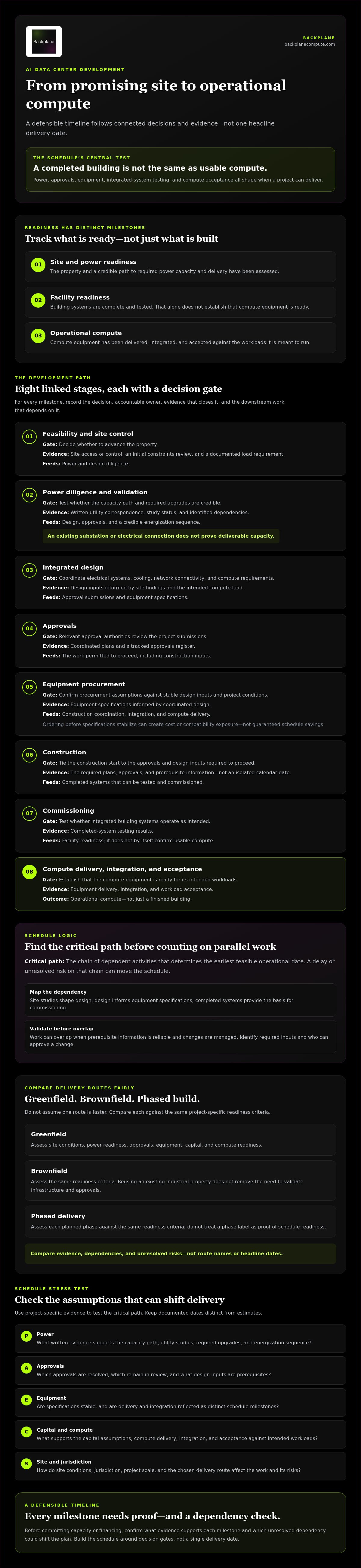
An AI data center development timeline is a sequence of linked milestones, not a countdown to the end of construction. It tracks development and delivery from site diligence through operational readiness, including power validation, design, approvals, procurement, construction, commissioning, and compute acceptance. A completed building is only one milestone. It doesn’t prove that the facility has the required power, that systems have passed testing, or that usable compute is ready.
A data center can take different forms, but AI projects add a demanding coordination layer: the property, electrical and cooling systems, compute equipment, and intended workloads must align. For every milestone, the schedule should state what evidence closes it, who makes the decision, and which work depends on that decision. For example, a construction start date should be tied to the approvals and design inputs required to proceed, rather than treated as an isolated calendar entry.
From site control to operational compute
Site diligence tests whether the property can support the intended project. Power validation examines whether the required capacity and delivery path are credible. Those findings inform design and approval submissions; approved plans then support procurement and construction. Commissioning tests whether integrated building systems operate as intended. Finally, compute equipment must be delivered, integrated, and accepted against the workloads it is meant to run.
Each stage produces inputs for the next: site studies shape design, design informs equipment specifications, and completed systems provide the basis for commissioning. Work can overlap, but only when prerequisite information is reliable and the team has a process for managing changes. Ordering equipment before specifications stabilize, for example, may create cost or compatibility exposure rather than save time. Before overlapping tasks, identify the information each one depends on and who can approve a change.
The critical path is the chain of dependent activities that determines the earliest feasible operational date; any delay or unresolved risk on that chain can move the schedule. Map dependencies before treating parallel work as schedule savings.
Why AI data center schedules differ from conventional projects
High-density compute affects electrical capacity, power distribution, cooling design, and equipment selection. Those requirements need to be defined early enough to guide facility decisions. A building designed for a different load profile may require changes before it can support the intended AI deployment.
Keep facility readiness separate from compute readiness. The site may pass building-system tests while GPUs are still pending delivery, integration, or workload acceptance. A credible schedule identifies these as distinct milestones, not a single “complete” date. Avoid applying one duration to every project: scale, jurisdiction, site conditions, utility dependencies, and the chosen delivery route all affect the work and its risks.
The AI Data Center Development Timeline, Stage by Stage
A useful AI data center development timeline connects each milestone to a decision, its accountable owner, the evidence required to proceed, and the work that depends on it. The sequence below is a planning framework, not a fixed-duration promise. Confirm assumptions against the site, utility process, jurisdiction, and procurement conditions, and distinguish documented dates from estimates.
Feasibility, site control, and power diligence
Start by defining the intended compute load and testing whether the site can support it. Site control, initial engineering, and utility engagement can progress together, but an existing substation or electrical connection is not proof of deliverable capacity. For a deeper diligence checklist, see AI data center site selection criteria.
- Feasibility and site control: The development lead decides whether to advance the property. Evidence includes site access or control, an initial constraints review, and a documented load requirement. These inputs inform power and design diligence.
- Power diligence: The utility-facing project lead, with engineering input, tests the capacity path and required upgrades. Seek written utility correspondence, study status, and a list of identified dependencies. These findings shape design, approvals, and the credible energization sequence.
- Design and approvals: Design leads coordinate electrical systems, cooling, network connectivity, and compute requirements; the relevant approval authorities determine review outcomes. Require coordinated plans and a tracked approvals register before relying on construction dates.
Power, permitting, and equipment can each become schedule-critical dependencies, depending on the project’s evidence and constraints. The Key Considerations for Data Center Development report also highlights the need to assess grid capacity, water resources, fiber connectivity, and permitting timelines together.
Design, procurement, construction, and commissioning
Once requirements are stable enough to specify, procurement and construction planning can advance alongside remaining design and approval work when interfaces are controlled. Overlap doesn’t eliminate the risk of a late approval, a changed specification, or a supplier delay. Verify equipment lead times and purchase approvals with project-specific supplier information, not generic assumptions. Check that the schedule also accounts for the reviews and decisions needed before orders can be placed.
- Procurement and construction: The procurement lead confirms specifications, approvals, and delivery evidence; the construction manager tracks installation against approved plans. Supplier commitments and installation records inform commissioning readiness.
- Commissioning and operations: Commissioning leads document tests of facility systems and resolve deficiencies. The compute operator then verifies equipment integration and workload acceptance. Passing facility tests is not the same as accepting usable compute.
Teams assessing existing powered industrial properties can use a property viability assessment to inform early diligence. It can support a decision, but it doesn’t establish power delivery, approvals, or a guaranteed schedule.
Greenfield, Brownfield, or Phased Build: Which Route Changes the Schedule?
The delivery route changes which work must happen first, not whether schedule risk exists. The right comparison for an AI data center development timeline is readiness against dependencies: what can be reused, what must be approved or upgraded, and what evidence is still missing. No route is inherently faster without site-specific diligence.
| Criteria | Greenfield | Brownfield reuse | Phased build |
|---|---|---|---|
| Starting condition | Undeveloped land; infrastructure and facility systems are planned for the project. | Existing industrial property or facility; condition and suitability vary. | Site and infrastructure plan divided into capacity phases. |
| Key dependencies | Site preparation, utility delivery, approvals, and new construction. | Building condition, electrical capacity, retrofit scope, and potential remediation. | Shared infrastructure, phase boundaries, approvals, and sequencing. |
| Main uncertainty to test | Whether land, power, approvals, and construction plans align. | Whether existing assets can support the intended load and design. | Whether an initial phase can operate without unfinished later work. |
Greenfield development versus industrial asset conversion
Greenfield offers design flexibility, but requires the team to establish site infrastructure and coordinate approvals from the ground up. Brownfield reuse may offer existing buildings or electrical assets, but retrofit, remediation, or approval needs can offset apparent readiness. Existing power infrastructure is not verified, deliverable capacity. It requires technical review and utility confirmation. See the brownfield data center development guide and conversion considerations for decommissioned facilities for deeper analysis.
Phased delivery and matching capacity to demand
Phasing can align infrastructure investment with committed compute demand. An early phase may become available before the full site is complete, but only if its power, cooling, network, approvals, and commissioning boundaries are independently workable. The trade-off is partial availability sooner versus added interfaces, sequencing, and possible rework as later phases connect. To compare options, define what each phase can operate independently and what shared systems or later work it relies on. Capacity sourcing should be planned alongside facility readiness; the enterprise GPUs-as-a-Service guide offers relevant context.
Compare risks across the full project lifecycle, not just construction. Marsh’s overview of data center risk across the lifecycle covers exposures from planning through operations. Teams evaluating an existing industrial property may also consider a property viability assessment as one input to route selection, not as confirmation of schedule or power delivery.
What Delays AI Data Center Development, and How to Test the Schedule
Construction pace is only one input to time-to-compute. A facility can reach substantial completion while power delivery, approvals, equipment, or workload acceptance remains unresolved. The AI data center development timeline is only as credible as its underlying dependencies, so rank risks by project evidence, not by a universal checklist of presumed bottlenecks.
Power, permits, equipment, and interconnection dependencies
Start with the conditions that could prevent the next milestone from proceeding. For power, distinguish utility studies and interconnection steps from confirmed deliverable capacity. Record the status of each milestone and the contractual or written evidence behind it. A site’s existing electrical infrastructure alone doesn’t establish that the required capacity can be delivered on the project’s schedule.
For permits, document the actual scope, reviewing authorities, submission status, and approval sequence for the specific jurisdiction. For equipment, ask suppliers for current lead-time information, order status, required approvals, and any limits on substitutions. A proposed alternative may affect design compatibility or require renewed review, so don’t treat it as interchangeable without technical confirmation.
Commissioning, integration, and schedule contingency
Keep readiness gates distinct. Mechanical completion confirms that construction work has reached a defined state; systems testing checks installed infrastructure; GPU integration brings compute equipment into the facility; customer acceptance confirms that the agreed workload can operate as required. Each gate needs an owner, acceptance criteria, and evidence. Combining them into one “ready” milestone obscures what remains.
Use a dependency register to make schedule assumptions visible. For every risk, record:
- Owner and status: Who is accountable, and what is complete, underway, or blocked?
- Evidence and decision date: Is the date supported by a utility document, approval record, supplier confirmation, or only a planning assumption? When must the next decision be made?
- Contingency and escalation trigger: What response is available if the milestone slips, and what change in status requires escalation or a revised forecast?
Build contingency around the dependencies that can move the operational date, not around a blanket allowance. If a date is preliminary, label it clearly and identify what evidence would convert it into a firmer planning input. This gives financing, property, and compute stakeholders a shared basis for deciding whether to proceed, adjust scope, or revisit sequencing.
For teams assessing a powered industrial property or testing project viability, Backplane’s property viability assessment can be one input to early planning. Assessment and coordination can inform decisions, but they don’t guarantee power delivery, approvals, financing, or a completion date.
Build a Defensible AI Data Center Timeline With Clear Decision Gates
A headline date becomes a project plan only when each milestone has an owner, a dependency, and evidence that supports the next decision. Build the AI data center development timeline backward from the required compute-ready date, then test every assumption against documentary proof. If a date rests on an estimate rather than a confirmed milestone, label it accordingly.
A schedule-validation checklist for owners, investors, and compute buyers
Use a shared milestone register. It should make gaps visible to property owners, capital partners, developers, and compute buyers before major commitments are made.
- Site: Confirm site control, diligence status, and any constraints that could affect intended use. Record the evidence and who must resolve open issues.
- Power: Separate existing infrastructure from confirmed capacity and a documented delivery path. Track utility studies, interconnection steps, responsible parties, and decision dates.
- Approvals: List required permits, the applicable authorities, submission status, review sequence, and outstanding decisions. Validate requirements for the project’s jurisdiction.
- Equipment: Match supplier-confirmed delivery information and procurement approvals to the design. Note which substitutions are technically acceptable and who must approve changes.
- Capital and compute: Document funding assumptions, approval gates, and the evidence supporting capital availability. Align capacity requirements and compute commitments with the facility’s planned readiness and acceptance criteria.
For each item, record the accountable party, current status, evidence source, decision date, downstream dependency, and contingency if it slips. Funding is on the critical path when later decisions or commitments depend on it. The financing AI infrastructure strategy offers further context for evaluating that workstream.
Where Backplane fits in the development sequence
Property owners and compute buyers can reduce disconnects by aligning site conditions, power evidence, required capacity, and capital assumptions before committing to a delivery path. Backplane connects powered industrial properties with AI compute demand and supports property viability assessment, infrastructure financing structuring, and deployment coordination. These services can help teams evaluate and coordinate project workstreams, but they don’t guarantee approvals, power delivery, financing, or a specific completion date.
Use the evidence register to identify what is ready, what remains conditional, and which decision could change the forecast. More information about project assessment and coordination is available from Backplane.
Turn the Schedule Into a Decision-Ready Plan
A credible AI data center development timeline is built on verified dependencies, not a headline date. Track each decision from site control through commissioning, and distinguish confirmed evidence from assumptions. Compare greenfield, brownfield, and phased routes by their actual readiness and constraints, not by a blanket promise of speed.
Power, approvals, equipment, capital, and compute commitments must align before a projected date can carry weight. Clear owners, decision gates, and contingencies give property stakeholders and compute buyers a shared basis for evaluating what can proceed and what still needs proof.
Backplane connects powered industrial properties with AI compute demand and supports property viability assessment, financing structuring, and infrastructure deployment. These capabilities can help teams coordinate project workstreams, without guaranteeing power, financing approval, or delivery dates. Discuss your AI infrastructure project with Backplane to review the evidence, decisions, and dependencies ahead.
Frequently Asked Questions
How long does it take to develop an AI data center?
There’s no reliable single duration for every project. The AI data center development timeline depends on site readiness, utility and interconnection milestones, approvals, equipment procurement, construction, and commissioning. A construction estimate may exclude earlier site diligence and permitting, or later GPU integration and workload acceptance. Compare schedules only after confirming what each date includes, which assumptions support it, and whether power and equipment milestones are documented.
What is the first step in AI data center development?
Start by defining the intended compute load and assessing whether a candidate site can support the project. Establish site control, identify property constraints, and begin power diligence with the relevant utility. These steps help determine whether further design and investment are justified. An early go/no-go decision should rely on evidence about the property and capacity path, not simply on available land or a preliminary project schedule.
Does an existing power connection make a data center project faster?
Not necessarily. An existing connection or electrical installation doesn’t prove that the required capacity is available and deliverable on the project’s schedule. Confirm the utility’s position, relevant study and interconnection status, required upgrades, and any conditions tied to delivery. Also check whether the existing systems match the project’s load and design. Treat the connection as a diligence lead, not as confirmation that power is secured.
Is converting an industrial site faster than building a new data center?
It depends on the condition and suitability of the specific property. Reuse may provide buildings or infrastructure, but technical upgrades, remediation, design changes, approvals, or power constraints can add work. A new site may offer more design flexibility while requiring new infrastructure and approvals. Compare both routes using the same evidence: site condition, deliverable power, retrofit or construction scope, permitting sequence, and equipment requirements.
What causes the biggest delays in AI data center development?
The leading delay varies by project. Utility studies, interconnection, permitting, equipment delivery, construction interfaces, and commissioning can each affect the operational date. Rank risks by their documented status and downstream impact rather than assuming one is always the bottleneck. For each dependency, record an owner, evidence source, decision date, and contingency. That register shows whether the AI data center development timeline rests on confirmed milestones or untested assumptions.
Can an AI data center be delivered in phases?
Yes, a project can be planned in phases, provided each phase has a workable path to readiness. Define the capacity and boundaries of each phase, then verify its power, cooling, network, approvals, equipment, and commissioning requirements. Phased delivery may allow an initial portion to become available before the entire site is complete, but it adds sequencing and interface risks. Confirm that later construction won’t undermine the first phase’s operation.
When is an AI data center ready for GPU workloads?
A data center is ready for GPU workloads when facility systems have passed their required tests, GPU equipment has been delivered and integrated, and the intended workloads have met agreed acceptance criteria. Mechanical completion alone isn’t enough. Track facility testing, compute integration, and workload acceptance as separate gates, each with an accountable owner and documented evidence. This distinguishes a finished building from operational compute that a buyer can actually use.


