

The line item alone is not the business case. A credible AI infrastructure budget justification separates direct costs, such as compute capacity and facility requirements, from indirect costs, such as integration and ongoing operations, then connects both to measurable business outcomes. Finance leaders need to understand what the investment enables, how success will be measured, and which assumptions shape the forecast.
That scrutiny is reasonable. AI infrastructure spans technology, power, physical sites, and operations, so a budget can lose credibility if it lists costs without showing how they support the business’s intended work. A clear case makes those connections explicit.
This article explains how to distinguish direct from indirect costs, connect budget lines to operational outcomes, and present assumptions for finance leaders to assess. It also covers how infrastructure choices affect the funding case, helping you frame a request around capacity, site viability, and business value rather than disconnected expenses.
Key Takeaways
- Give finance leaders a reviewable proposal: make assumptions visible and revisit forecast variances, overspending, and vendor cost changes during each budget cycle.
- Connect each budget line to an operational measure, such as resolution time, error rates, or customer retention, so the investment has a clear outcome to track.
- Build monitoring and MLOps into the budget from the outset; a planning template can allocate 10-15% of the base budget to these needs and 10-15% to contingency.
- Engage executives in shaping the investment case. When infrastructure financing needs to align with the plan, Backplane’s Infrastructure Financing Structuring can help frame that next step.
Finance ministry questions for AI budget proposals
A finance ministry assesses whether an AI proposal connects each funding request to a defined operational need. A strong case separates assumptions, cost drivers, risks, and expected outcomes.
Financial Modeling and Probabilistic Forecasting
Financial modeling translates workload assumptions into cost scenarios, while probabilistic forecasting tests how results change when assumptions shift. For an AI infrastructure budget justification, model demand, utilization, and operating requirements separately. Practitioners describe AI budget forecasts as having a maximum horizon of roughly twelve months. Present a base case alongside higher- and lower-demand scenarios, then identify which assumptions have the greatest impact on the forecast.
Budget Ownership and Financial Envelopes
Budget ownership gives an internal lead responsibility for tracking spending, assumptions, and variances. Set an approved envelope and a tolerance that prevents the budget from doubling, then review actual costs during each budget cycle. Include overspending, conservative estimates, assumptions that did not hold, and changes in vendor costs. Staged investment can make later funding conditional on measured demand or performance. Underbudgeting can constrain capacity, while overprovisioning can leave infrastructure underused.
Infrastructure Cost Comparisons
Compare total cost drivers, not just a cloud provider’s compute rate. AWS, Azure, and Google Cloud costs depend on selected capacity, utilization, storage, networking, and service configuration. On-premises planning also accounts for equipment acquisition, facility readiness, power, and ongoing operations. No option is lowest-cost for every workload: compare the same workload, utilization assumptions, and planning period across all four models.
Infrastructure Requirements and Budget Drivers
Estimate GPU needs based on model size, workload type, concurrency, and expected utilization; size storage for datasets and model checkpoints. Network capacity depends on data moving between compute, storage, and users, while power planning reflects equipment demand and site capability. Security controls, compliance needs, and data residency can add costs for access management, monitoring, audits, and location-specific infrastructure—considerations that enterprise deployment partners such as REAS 睿思智慧 address when designing private, internally integrated architectures. US grants, tax credits, and incentives may support eligible projects, depending on program rules and project fit. The main risks are insufficient capacity for demand or excess capacity without adequate utilization.
Linking budget lines to measurable business outcomes
Budget lines gain credibility when each is connected to an operational measure. A clear framework links the investment to an expected change and a method for tracking results.
AI Value and Productivity Metrics
AI value and productivity metrics translate model spending into changes in business performance. They matter because finance leaders need to assess outcomes, not just technical activity. Tie each budget line to a baseline and a defined measure, such as resolution time, customer satisfaction, or manual processing errors.
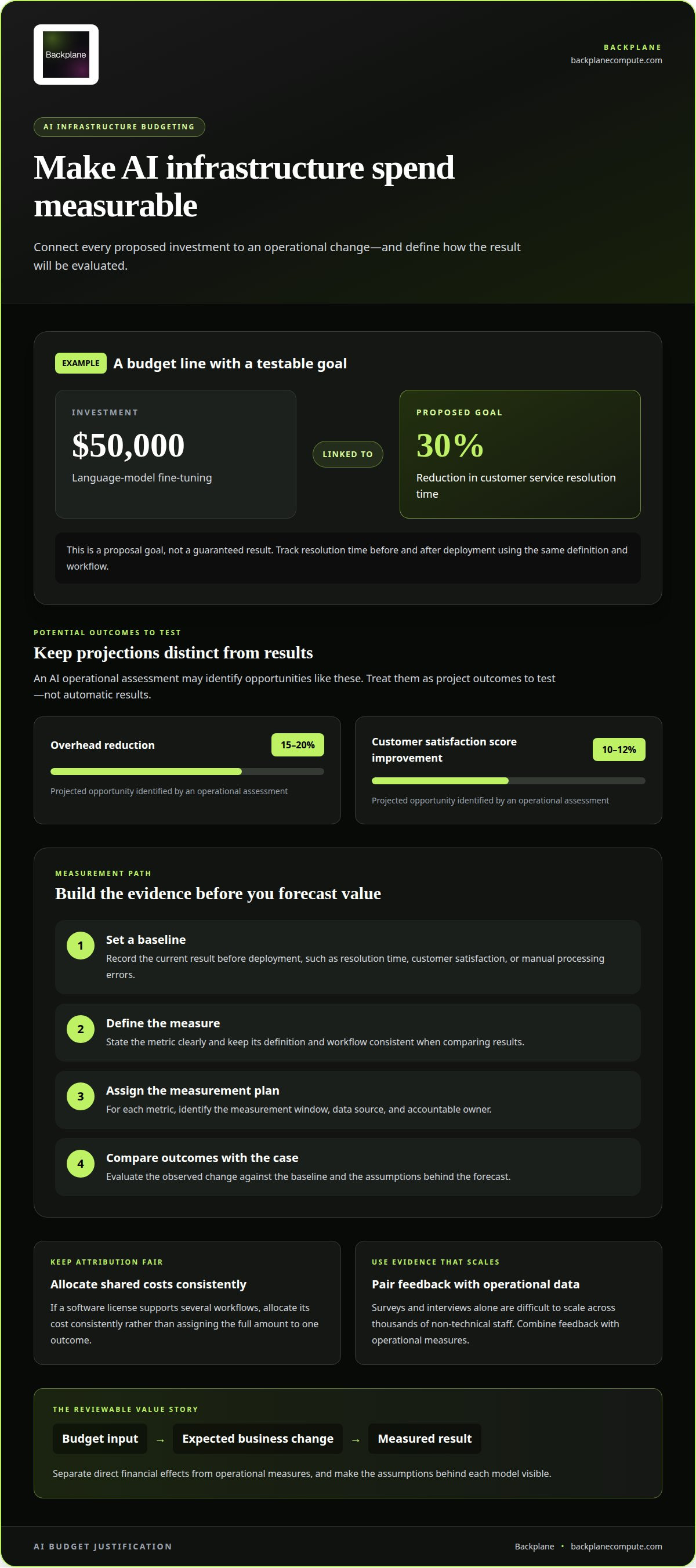
For example, a proposal could connect a $50,000 language-model fine-tuning investment to a goal of reducing customer service resolution time by 30%. Track resolution time before and after deployment, using the same definition and workflow. An AI operational assessment may identify departmental opportunities projected to reduce overhead by 15-20% or improve customer satisfaction scores by 10-12%. Treat these as project outcomes to test, not automatic results.
A Measurable ROI Narrative
A measurable ROI narrative explains how a budget input is expected to produce a business outcome and how the organization will evaluate it. This gives decision-makers a basis for comparing the proposal with other uses of funding. Separate direct financial effects from operational measures, and state the assumptions behind each model.
For example, a team might connect an intelligence tool to faster case resolution, then track time per case and customer retention. Establish the baseline first. Define the measurement window, data source, and owner for each metric. If a software license supports several workflows, allocate its cost consistently rather than assigning the full amount to one outcome. Surveys and interviews alone are difficult to scale across thousands of non-technical staff, so pair feedback with operational data. A credible narrative makes projected value testable and keeps the link between spending and outcomes visible.
AI budget planning templates
A useful template turns project scope into reviewable budget lines, assumptions, and governance checkpoints. Distinguish experimental work from production operations so finance leaders can see which costs recur and which support a specific project phase.
There is no single infrastructure cost for a small, medium, or large organization. The budget depends on workload volume, model requirements, deployment duration, storage and networking needs, power, and operating model. Company size alone does not determine infrastructure needs; forecast the work and required capacity first.
Build the template around cost categories that teams can assign, forecast, and track:
- Compute: Estimate GPU capacity from workload and utilization assumptions.
- Data and connectivity: Include storage, data movement, and network requirements.
- Operations: Budget for software, monitoring, MLOps tools, and automation.
- Governance: Record ownership, assumptions, approval points, and review cadence.
Keep operational support visible. An AI budget planner template assigns 10-15% of the base budget to post-deployment monitoring and MLOps tools and automation. It recommends a contingency reserve of 10-15% of the base budget. AI project budgets also typically include a contingency reserve of 10-20% of the total budget. These are different bases, so label each calculation clearly instead of combining them.
For each line, record its purpose, estimate basis, accountable owner, and connection to the relevant project phase. Keep experimental workloads separate from production forecasts. A traceable cost record helps reviewers compare approved assumptions with actual spending and explain variances later.
Use the template as a working model, not a static approval form. Update demand, utilization, vendor terms, and deployment timing as plans develop. This gives finance leaders a clear view of what changed, why it changed, and which funding decision comes next.
Executive engagement in AI budgeting
Executive engagement connects AI funding to the organization’s operating priorities, risk appetite, and production plans. Without that direction, teams may submit technically sound requests that lack the authority or scope to support wider adoption.
The State of FinOps 2026 reports that practitioners with executive engagement have two to four times more influence. That influence matters when AI moves from experimental work into production. Executives can align technology, finance, and operational leaders around a shared investment thesis, assign decision rights, and set the conditions for continued funding.
A bottom-up request can estimate current workloads, but it cannot plan on its own for ten-, fifty-, or hundredfold increases in AI-driven work. Planning for that scale requires leaders to define the strategic ambition first. For leadership teams seeking external guidance on AI consulting and strategic roadmapping, seanbrightman.com helps establish these overarching business priorities. Executives should clarify which processes may change, which teams will adopt AI, and what infrastructure must support that shift. Those decisions lay the foundation for a budget that reflects future operating needs, not just current demand.
Make leadership involvement concrete with regular reviews. Discuss AI budget variances with finance weekly, including changes in demand, utilization, assumptions, and vendor costs. Decide whether funding stays within its approved envelope, shifts to a higher-priority workload, or supports the next deployment stage. A short decision log connects each change to its rationale and accountable executive.
Executive sponsorship also helps resolve trade-offs. For example, a production deployment may require a different capacity plan from a contained pilot. The executive sponsor can weigh that need against business priorities and decide whether expansion merits additional capital. This keeps infrastructure decisions tied to measurable operational goals instead of letting technical demand alone determine the investment pace.
For leadership teams aligning funding with infrastructure requirements, discuss infrastructure financing options.
Backplane: Infrastructure Financing Structuring
Backplane helps align AI infrastructure plans with financing structures when compute demand, site capacity, and funding needs must move together. Its Infrastructure Financing Structuring supports planning around the investment case, while its Property Viability Assessment evaluates whether an industrial site can support conversion into compute infrastructure.
Organizations seeking a defined physical footprint can also consider Dedicated Financed Sites. Teams that need GPU capacity without building a dedicated site may find GPUs-as-a-Service a better fit. The right path depends on deployment goals, capacity needs, and whether the priority is compute access or a dedicated facility.
If your budget case depends on bringing AI compute capacity online, contact Backplane to discuss your infrastructure requirements and financing structure.
Turn the Budget Case Into an Execution Path
The next decision is whether the operating model can support the investment’s ambition. A durable AI infrastructure budget justification should map a clear path from approved funding to usable compute capacity, with infrastructure choices aligned to business priorities.
That path may call for GPU access without a dedicated facility, a dedicated financed site, or an assessment of an industrial property’s potential for conversion. Backplane offers GPUs-as-a-Service, Dedicated Financed Sites, and Property Viability Assessment for these different infrastructure needs. Each option suits a different deployment model, so base the decision on required capacity and site strategy.
Bring the funding case and infrastructure plan into the same conversation before committing to a deployment path. Discuss AI budgets with Backplane and consider how the right structure can move your plan toward execution.
Frequently Asked Questions
Can AI Explain Direct and Indirect Costs?
Yes. AI can help classify direct costs, such as compute resources assigned to a workload, and indirect costs shared across teams. For example, it can organize shared data engineering or security expenses into a budget narrative. Treat its output as a draft: AI can structure explanations, but it cannot validate whether an estimate reflects actual requirements or charges.
Can AI Help Justify Equipment and Software Purchases?
Yes. AI can help connect a proposed purchase to its intended use, expected workload, and operational need. For a GPU purchase, the explanation might describe the jobs it will support and how often the capacity is expected to run. For software, explain its role in deployment or operations. Ground the proposal in procurement evidence, license terms, and documented requirements.
What If the Proposed Budget Exceeds the Funding Limit?
Separate essential capacity from optional scope, then model a smaller initial deployment. Identify workloads that can be delayed, reduced, or funded in a later phase without undermining the project’s core purpose. Explain the trade-offs, including deferred capabilities and operational impact. If the funding ceiling remains fixed, seek approval for a revised scope rather than treating the excess as an automatic exception.
What Costs Should an AI Infrastructure Budget Include?
Include the full delivery and operating picture, not just compute. Account for installation and commissioning, cooling and power delivery, maintenance, support, backup capacity, software, and data preparation. Also identify staffing needs and eventual equipment replacement or decommissioning. Separating one-time setup from recurring operations helps finance teams see how costs change after deployment and which obligations continue beyond launch.
What Are Current GPU Cloud Rental Prices Versus Buying GPUs?
There is no comparable price without specifying GPU capacity, usage duration, location, and operating requirements. Cloud rental turns access into a usage-based expense; purchasing GPUs requires capital and adds facility, power, maintenance, and staffing considerations. Compare options using the same workload and expected utilization. Include idle capacity and operating responsibilities, not just the quoted compute charge.
What ROI Metrics Justify Investment in AI Infrastructure?
Choose metrics that show whether infrastructure supports useful work: completed jobs per GPU-hour, cost per inference, queue time, utilization, and service availability. Select measures that fit the workload and establish a baseline before deployment. For example, a team processing model-training jobs can track throughput and queue time together, showing both productive capacity and any delays that remain despite the investment.


