

In CBRE’s 2025 survey, 95% of surveyed investors planned to increase data center investment. AI data center joint venture financing gives developers and capital partners a way to fund capacity together, while allocating ownership, operating responsibilities, and risk. Demand is accelerating, but capital has to meet physical constraints: secured power, viable sites, construction timelines, and credible tenant commitments.
That tension is the central financing challenge. Strong demand can support investment, but it does not remove exposure to power delays, lease terms, changing technology, or uncertain asset value at exit. The structure must match the project’s stage and the risks each partner can take on.
This article explains how AI demand shapes joint venture capital deployment, how financing can evolve from development through stabilization, and where collateral, leases, power, and residual value create pressure. It also explains how Backplane’s Property Viability Assessment and Infrastructure Financing Structuring can help assess a powered site’s path from property to operating compute infrastructure.
Key Takeaways
- Match capital structure to the project’s stage, separating development needs from the financing options available after stabilization.
- Assess collateral beyond the building itself: lease strength, power delivery, and the facility’s potential for re-leasing all shape downside exposure.
- Align ownership, operating roles, and exit plans early so partners have a shared view of returns and risk.
- Evaluate site viability and financing structure together to identify whether an asset can move from available power and property to operating compute capacity.
Data center demand and AI-driven capital deployment
AI demand is directing capital toward facilities that can secure power, sites, and operating commitments. Joint ventures pair developers with capital partners, but the financing structure needs to fit the specific project.
Data Center Capital Requirements
Data center capital requirements are the funds needed to develop and operate facilities, and their scale shapes how sponsors share investment. A single data center can require billions of dollars. In CBRE’s 2025 survey, 95% of surveyed investors planned to increase data center investment; 41% planned to allocate USD 500 million or more, up from 30% in 2024. The five largest U.S. technology companies were projected to spend between $660 billion and $690 billion in 2026, with roughly $450 billion aimed directly at AI infrastructure. That demand makes capital partnerships a route to funding projects beyond one sponsor’s balance sheet.
Joint Ventures, Ownership, and Leasing
A joint venture shares ownership and project economics between partners; a wholly owned project concentrates control and exposure with one sponsor, while a lease provides facility access without the same ownership position. The choice affects capital needs, decision rights, and who bears development risk. Blackstone holds an 80% stake and Digital Realty a 20% stake in their development venture. Cross-border capital also enters the market: OpenAI and Sur Energy were reported to be considering a US$25 billion data center project in Argentina on October 10, 2025.
U.S. Incentives and Regulatory Approvals
Tax incentives and approvals depend on the project’s location, ownership, and power design, so no single package applies to every U.S. facility. Assess incentives alongside project economics because eligibility and value depend on the investment and jurisdiction. Power readiness also matters: a utility “will-serve” letter alone does not establish that land is powered. A project needs a contract for transmission capacity by a specified date or, for BYOP, air permits in hand and access to fuel supply.
Partner Revenue, Costs, and Returns
Joint venture documents define how project revenue, operating costs, and returns flow between partners, so allocation terms should match each party’s capital and responsibilities. The 80/20 Beignet Investor LLC ownership split between Blue Owl-managed funds and Meta illustrates an equity division, not necessarily the allocation of operating cash or costs. Agreements can specify expense priorities, distribution waterfalls, decision rights, and how overruns are handled. If a partner provides a guarantee, its scope and consequences should be explicit rather than assumed from its ownership share.
Collateral, lease, power, and residual-value risks
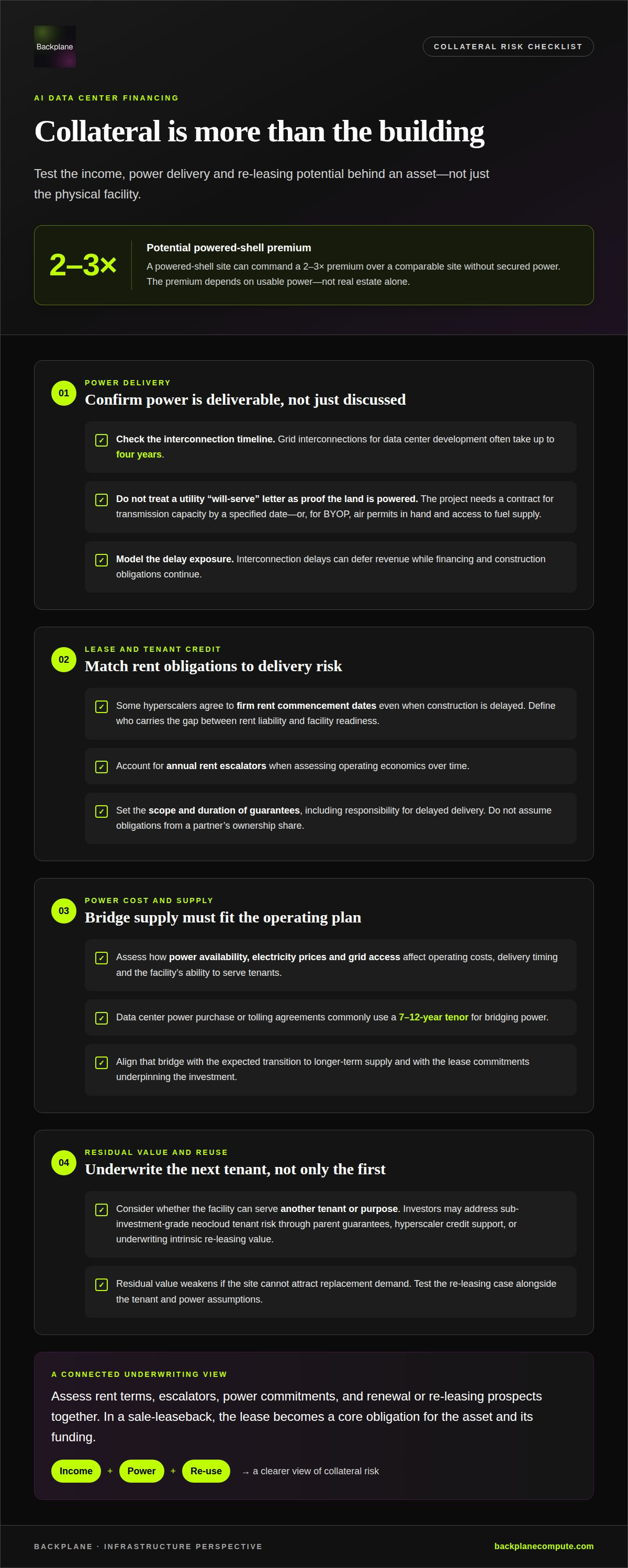
Collateral depends on income, power delivery, and potential reuse. Grid interconnections for data center development often take up to four years, making timing central to project economics.
Lease Commitments and Loan Guarantees
Lease commitments and loan guarantees can support project funding, but may also expose partners to obligations beyond construction. Some hyperscalers agree to firm rent commencement dates even when construction is delayed, creating a gap between rent liability and facility readiness. Annual rent escalators also affect operating economics over time. Partners should define the scope and duration of guarantees, as well as responsibility for delayed delivery, in their agreements.
Power Availability and Project Economics
Power availability, electricity prices, and grid access shape operating costs, delivery timing, and the facility’s ability to serve tenants. Interconnection delays can defer revenue while financing and construction obligations continue. Data center power purchase or tolling agreements commonly use a seven-to-12-year tenor for bridging power. That term needs to align with the expected transition to longer-term supply and the lease commitments underpinning the investment.
Collateral value also depends on whether a facility can serve another tenant or purpose. Investors may address sub-investment-grade neocloud tenant risk through parent guarantees, hyperscaler credit support, or underwriting intrinsic re-leasing value. A powered-shell site can command a 2-3x premium over a comparable site without secured power, but that premium depends on usable power, not real estate alone. Residual value weakens if a site cannot attract replacement demand.
A sale-leaseback converts owned facilities into capital while the seller remains a tenant; the lease then becomes a core obligation for the asset and its funding. Assess rent terms, escalators, power commitments, and renewal or re-leasing prospects together. For projects balancing asset viability and capital structure, infrastructure financing structuring can help connect those considerations.
Financing across the data center development lifecycle
AI infrastructure financing changes as a project moves from site preparation to construction and stabilized operations. The capital structure must reflect delivery risk, tenant commitments, and the facility’s operating profile.
Developer and Hyperscaler Joint Ventures
A developer-hyperscaler joint venture combines development execution with a large compute buyer’s capital or demand commitments. That alignment can support data center development while dividing ownership and project exposure. The Beignet financing combines construction financing with roughly 20 years of post-stabilization operations, linking early development to long-term asset performance. Programmatic ventures apply a shared structure across multiple projects, helping partners plan capital deployment and operating roles across a pipeline rather than negotiate each facility in isolation.
AI Infrastructure Financing Terms
Current rates and lending terms depend on borrower credit, lease support, collateral, and project stage. In the Meta-Blue Owl joint venture, debt was priced at a spread of +225 basis points for a borrower rated AA-. That transaction offers a concrete financing reference, not a universal rate. Lenders assess whether the tenant profile, power readiness, and projected cash flows support repayment through construction and operations.
Financing can shift as risk falls. Development capital funds site work and construction; after stabilization, sponsors may refinance through ABS facilities, CMBS, or 144A bond offerings. The Beignet structure illustrates one route, combining construction funding with long-term operations. A hybrid approach can match each component to an appropriate source of capital, including project finance for Bring-Your-Own-Power solutions and commercial real estate capital for data center components. For enterprises navigating commercial borrowing and structured capital needs, allencapfunding.com provides business lending and financial solutions to fund key stages of growth and execution.
Power developers and data center sponsors can also partner to coordinate generation with facility demand. Stargate offers a distinct infrastructure example: SoftBank announced its first US$10 billion in funding was expected to be borrowed from Mizuho and other lenders. For each partnership, the central question is how funding obligations, development milestones, and tenant commitments align. Those terms shape who bears delay risk and how later financing or an exit can proceed.
AI computing demand and data center capacity
AI compute demand expands the data center sector, but investment only produces value when capacity becomes operational. U.S. data center power demand could reach 35-45 GW by 2030, roughly double its 2024 level. For joint venture partners, that gap between projected need and delivered capacity shapes deployment decisions: prioritize sites where power, infrastructure, and tenant demand can align.
Cloud remains a major demand base, accounting for approximately 80% of data center demand. It is not expected to fall below 50% in the near or mid-term. AI adds pressure on top of that foundation. The compute required to train a transformer AI model increases 275 times every two years, while capacity needed for AI development is growing twice as fast as AI chip efficiency. Buildings, power systems, networking, and chips must scale together.
Geography affects where capital can translate into capacity. AI data center capacity in Asia-Pacific is projected to more than double by 2030. Cushman & Wakefield forecasts 60% growth in Latin American data centers by 2030. Those projections point to expanding regional markets, but partners still need to connect demand forecasts to a site’s power access, connectivity, and delivery profile. A large addressable market alone does not make a facility operational.
Financing should reflect that distinction. A joint venture can stage equity according to project readiness, directing development capital toward facilities with a credible path to service. Compare expected capacity with committed power and tenant requirements, then align funding milestones with construction and energization. This prevents projected demand from being treated as immediate revenue and clarifies which partner bears exposure if infrastructure delivery falls behind the market’s buildout.
Morgan Stanley estimated global data center spending of approximately $2.9 trillion from 2025 through 2028. That scale makes execution, not demand forecasts alone, the decisive test for individual projects. Partners evaluating powered sites can assess site-to-capacity alignment before committing capital to AI infrastructure.
Backplane: Infrastructure Financing Structuring
Backplane connects AI compute demand with powered industrial sites through Infrastructure Financing Structuring and Property Viability Assessment. These services are relevant when a site’s power, property, and financing need to be assessed as one development proposition. The aim is to determine whether an underused asset can support operational GPU infrastructure and how capital can be structured around its constraints.
For compute buyers, Backplane also offers GPUs-as-a-Service and Dedicated Financed Sites. These options serve different needs: access to GPU capacity or a dedicated site without waiting in hyperscaler queues. The right fit depends on whether the priority is compute access or a project tied to a specific property.
To discuss a site or compute requirement, contact Backplane.
Turn the Financing Strategy Into an Executable Plan
The next step is to translate the project’s demand case into a clear investment structure. Define each partner’s contributions, which decisions require shared approval, and how the venture will respond when delivery or market conditions change. A disciplined AI data center joint venture financing strategy builds these terms into the project from the outset.
Focus on the link between site viability and compute demand. A property supports the investment case only when its infrastructure, power pathway, and intended use underpin a credible operating plan. Set milestones that tie capital deployment to progress, and keep partner responsibilities aligned throughout development. This creates a sounder basis for evaluating opportunities without treating projected demand as delivered capacity.
Backplane can help assess site viability and structure infrastructure financing around the project. Contact Backplane about your financing to discuss the next step for your project. With a clear plan and aligned partners, you can move from opportunity toward execution with greater focus.
Frequently Asked Questions
What is an AI data center joint venture financing structure?
An AI data center joint venture is an arrangement in which partners share investment and project responsibilities to develop or operate data center capacity. The venture documents define ownership, contributions, decision-making authority, and cash flow distributions. For example, one partner may contribute a site while another provides capital or a tenant commitment. The agreement should clearly distinguish each contribution rather than assume every partner provides cash.
Who are the typical partners in AI data center joint ventures?
Typical partners include data center developers, hyperscalers or other compute buyers, infrastructure investors, and power developers. Roles vary by project: a developer may lead delivery, a compute buyer may anchor demand, and an investor may fund development. A power partner may coordinate generation or supply arrangements. The key is whether each partner’s capabilities address a project need and whether responsibilities are aligned.
How much does it cost to build an AI data center in the United States?
A single data center can require capital in the billions of dollars, but no single construction cost applies to every project. Total costs depend on site conditions, power infrastructure, facility design, networking, cooling, and computing equipment. Scope matters: adapting an existing industrial property differs from building a new facility. Assess these components together to establish a project-specific capital plan.
How are AI data center joint ventures financed and capital contributions divided?
Joint ventures can combine partner equity with debt and stage funding to meet development and operating needs. Contributions may include cash, property, power-related assets, or contracted demand, with terms set out in the venture agreement. There is no universal split. Partners negotiate ownership percentages, voting rights, cash distributions, and responsibility for additional funding together, so an equity share alone does not capture the full economics.
What are the main financial, construction, technology, and partner risks in AI data center joint ventures?
Financial risk includes weaker cash flow or collateral value; construction risk includes delays that disrupt commissioning and revenue. Technology risk stems from rapid change that can shorten equipment’s useful economic life. Partner risk arises when capital commitments, control rights, or operating priorities diverge. Tenant concentration creates exposure when a small number of buyers underpin project income. These risks interact: a delay can also affect financing and tenant confidence.
What steps are involved in forming and financing an AI data center joint venture?
Start by defining the project’s purpose, intended capacity, site, power pathway, and prospective tenant demand. Then assign partner roles and value contributions, and model development funding, operating cash flows, and downside scenarios. Negotiate ownership, governance, funding obligations, and exit provisions before committing capital. Finally, align financing milestones with delivery and operational readiness. This sequence helps reveal mismatches between the project’s demand case and its execution plan.


