

A powered site can still be a poor investment. AI data center investment models test whether power access, site conditions, capital costs, financing, and expected compute revenue support a viable asset. The key question isn’t simply how much capacity a project can deliver. It’s whether the infrastructure can be built, funded, and operated on terms that make the investment work.
Power availability and location shape the opportunity, but they don’t determine whether the numbers work. Construction costs, financing structure, operating expenses, lease or compute demand, and execution risks all affect projected returns. A strong model makes those connections clear.
This article explains what an AI data center underwriting model measures, how its assumptions fit together, and how investing directly in operating data centers differs from funding development. You’ll get a framework for assessing power and site selection, capital and financing, and risks that can change an asset’s value.
Key Takeaways
- Underwrite power delivery and site selection as core investment drivers, and test how changing demand assumptions affect project viability.
- Measure the full infrastructure behind AI compute, including the relationship between IT load, cooling, and facility power needs.
- Build capital and financing assumptions that expose how construction costs, reserves, and debt structure shape returns and risk.
- Assess operating data centers as direct investment opportunities, and understand when Backplane’s Property Viability Assessment or Infrastructure Financing Structuring can support the next step.
How Should You Underwrite Power Delivery and Site Selection?
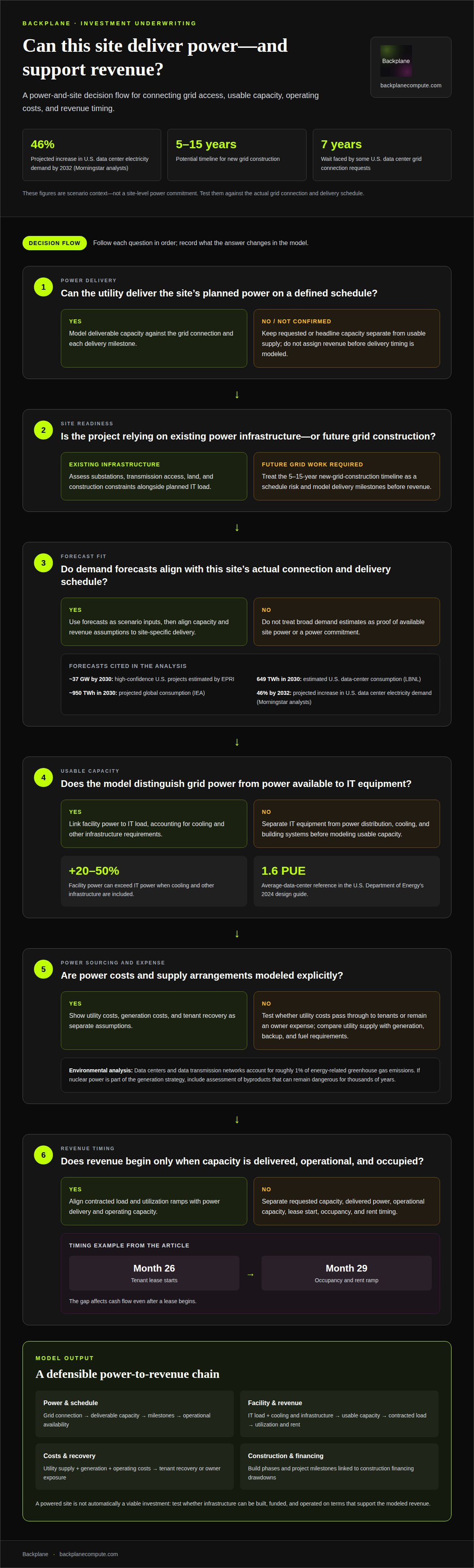
Underwriting starts with power that can actually be delivered, not a site’s headline capacity. Demand forecasts, grid timelines, and procurement terms determine whether planned capacity can support revenue.
Power Demand Scenarios
Power demand scenarios translate forecasts into alternative cases for a facility’s future load and available supply. Morningstar analysts project a 46% increase in U.S. data center electricity demand by 2032, while the Electric Power Research Institute estimates that high-confidence projects could add approximately 37 gigawatts by 2030. Treat these as scenario inputs, not a site-level power commitment. The Lawrence Berkeley National Laboratory estimates U.S. data-center consumption at 649 TWh in 2030; the International Energy Agency projects global consumption near 950 TWh that year. Compare forecasts with the site’s actual grid connection and delivery schedule.
Site selection turns those scenarios into execution tests. Assess existing substations, transmission access, land, and construction constraints alongside the planned IT load. New grid construction can take five to 15 years, so a site dependent on future transmission carries a different schedule risk from one with power infrastructure already in place. Model each delivery milestone before assigning revenue to capacity.
Power procurement and on-site generation affect both reliability and operating exposure. Compare utility supply terms with the cost and role of generation assets, including backup arrangements and fuel requirements. Nuclear power may form part of a generation strategy, but its environmental assessment must account for byproducts that can remain dangerous for thousands of years. Data centers and data transmission networks account for roughly 1% of energy-related greenhouse gas emissions, making the power source relevant to environmental analysis.
Power-Based Revenue Modeling
Power-based revenue modeling connects usable electrical capacity to the compute or facility capacity that can be contracted and billed. Separate grid capacity from the power delivered to IT equipment, since cooling and other infrastructure also consume electricity. Align revenue assumptions with delivery schedules, contracted load, and utilization ramps. A delayed or unavailable megawatt cannot generate revenue on the same schedule as operational capacity.
Model operating expense recovery based on the actual power arrangement. If lease terms pass utility costs through to tenants, distinguish recovered charges from the owner’s unrecovered exposure. If the owner bears the expense, test energy prices and consumption against projected revenue. Show utility costs, generation costs, and tenant recovery as separate assumptions.
What Should an AI Data Center Underwriting Model Measure?
Measure the physical infrastructure required to turn planned capacity into reliable, financeable compute. The model should link construction scope, grid access, delivery timing, and debt drawdowns.
Construction and Infrastructure Needs
AI data center construction combines specialized computing equipment with power distribution, cooling, and building systems. These costs and dependencies matter because facility power exceeds IT power by 20-50% when cooling and other infrastructure are included. Track equipment and infrastructure as separate assumptions, then test how they affect usable capacity. The U.S. Department of Energy’s 2024 design guide gives 1.6 as an average-data-center PUE reference. Materials and cooling choices should therefore appear in the model as physical design inputs, not incidental details.
Grid Capacity and Interconnection Constraints
Grid capacity is the power a utility connection can deliver; interconnection constraints are the limits or delays between a project request and usable service. Some U.S. data center grid connection requests face a seven-year wait. Model requested capacity separately from deliverable capacity, then align construction phases with the expected connection schedule. This shows whether an expansion can operate as planned or must wait for additional grid infrastructure.
Construction timing also shapes expansion and revenue. Model each phase independently, including when capacity becomes operational and when tenant occupancy and rent begin. One example places a tenant lease start in Month 26, with occupancy and rent ramping in Month 29. This timing gap affects cash flow even after a lease begins.
Construction loans fund development before an asset reaches operating status, so underwriting should connect financing drawdowns to the build schedule and project milestones. Industry reports often highlight how facility costs scale with capacity demands. For projects where financing structure is central, Infrastructure Financing Structuring can help connect capital to the development plan.
Capital expenditure and financing assumptions
Financing may include sponsor equity, construction loans, senior secured notes, or a capital stack without construction debt. Model each option against project costs, funding milestones, and expected operating cash flow.
Estimating AI Data Center Capital Costs
Capital-cost estimation translates planned IT power into development and equipment requirements. Epoch AI uses a general cost-per-watt model based on IT power, giving investors a consistent starting point for comparing projects. The model should separate servers from real estate, power systems, cooling, and other infrastructure. Servers account for 60% of the total cost of ownership of a one-gigawatt AI data center, so equipment assumptions can materially shift the capital requirement.
Show reserves and construction spending by phase. One approach allocates data center capital reserves on a per-kilowatt-per-month basis, aligning reserve needs with the construction schedule instead of treating the full amount as an upfront expense. Then test how delays or changes in computing equipment affect funding needs and deployment.
Available Financing Options
Financing options define how a project funds construction and how capital providers are repaid. Construction debt can support development, while senior secured notes provide another debt structure; a model can also test zero construction debt, shown as 0% LTC. Compare these structures by timing, repayment obligations, and their fit with expected asset cash flows. That comparison matters because financing changes the amount of equity required and the project’s exposure during construction.
Capital expenditure forecasts show the scale of demand competing for global supply. U.S. electric and gas utilities forecast US$212 billion in capital expenditure across 47 utilities in 2025. Eight hyperscalers expected combined spending on AI data centers and computing resources to reach US$371 billion in 2025. J.P. Morgan estimates the five largest U.S. hyperscalers will spend $697 billion on capex in 2026. These are sector-wide figures, not project budgets.
For a transaction example, J.P. Compare each financing case against construction timing, capital needs, and the asset’s path to operation.
Direct investment in operating data centers
The main AI data center investment models include direct ownership, joint ventures, and colocation exposure. Direct owners hold the asset and its operating risks; joint ventures share investment and control, while colocation investors gain exposure to facilities serving tenants.
Direct Ownership
Direct ownership means acquiring an operating facility or campus and holding its cash flows and asset-level risks. It gives investors more control over operations and expansion, but also places operating performance directly within the investment case. Anthropic-Amazon New Carlisle in Indiana has estimated IT power capacity of 1,037 MW, illustrating the scale an operating asset can reach. Underwrite its operational condition, tenant commitments, power access, and ability to expand.
Operating assets offer a different entry point from development: construction risk has advanced, but operating and tenant risks remain. A June 2026 Digital Realty transaction disclosed an expected stabilized capitalization rate above 6.5 percent. That figure describes one transaction, not a universal return target. Acquisition multiples also require context: data center platform deals ranged from 25x to 30x enterprise value to EBITDA over the last four years.
AI Data Center Investment Models
These structures differ in control, capital exposure, and connection to the operating network. Direct ownership concentrates decision-making and asset-level exposure with the owner. A joint venture shares capital and governance between partners, while colocation exposure centers on facilities providing space and power to tenants. Compare them based on whether the investor prioritizes control, shared commitments, or contracted facility operations.
For operating-asset diligence, assess stabilized cash flow alongside tenant concentration, facility condition, and expansion requirements. The largest campus may offer scale, but size alone doesn’t establish investment quality. Compare income stability and required follow-on capital before weighing valuation multiples or capitalization rates. To evaluate a site’s investment potential, assess operating data center viability.
Backplane
Backplane connects powered industrial sites with AI compute demand, helping move viable infrastructure toward operation. When an underused property has potential but needs a rigorous feasibility and capital plan, Backplane’s Property Viability Assessment and Infrastructure Financing Structuring address those investment questions.
For compute buyers, GPUs-as-a-Service provides access to GPU capacity, while Dedicated Financed Sites support organizations seeking dedicated infrastructure. The right path depends on whether the priority is securing compute or developing a site into an operating asset.
Contact Backplane to discuss your AI infrastructure investment needs.
Turn the Underwriting Case Into a Decision
Start by defining what the investment must deliver. Is the priority owning an operating asset, developing a site, or securing compute capacity? That choice sets the decision framework before capital is committed and clarifies which assumptions need the closest scrutiny as the project advances.
Use AI data center investment models to connect the investment thesis to an executable plan. Align key decision-makers on acceptable risk, operating objectives, and the conditions that would change the strategy. A disciplined process won’t remove uncertainty, but it can make trade-offs visible before they shape the outcome.
When your plans involve a powered site or AI compute demand, Backplane can help identify a practical path forward. Discuss your plans with Backplane and take the next step with a clear investment case.
Frequently Asked Questions
What are the largest risks in AI data center investment?
The largest risks include power delivery, construction execution, customer demand, operating costs, and equipment obsolescence. A site may have strong demand prospects but still face delays connecting to the grid. A completed facility can also underperform if compute utilization or tenant commitments fall short. Underwrite these risks separately, then test how they affect cash flow, financing needs, and the asset’s ability to operate competitively.
Can US infrastructure keep up with the AI economy?
U.S. infrastructure can support AI growth where power generation, transmission, interconnection, and construction capacity align with project schedules. National demand forecasts don’t establish whether a particular site can receive power on time. Local grid constraints and utility delivery plans matter more to an individual investment. Underwrite the specific connection path and project milestones instead of assuming broad infrastructure expansion guarantees service at the required location.
How Should You Build the Cost and Reinvestment Schedule?
Build the schedule by separating site preparation, building work, electrical systems, cooling, computing equipment, commissioning, and later replacements. Assign each cost to its expected phase so financing drawdowns and cash requirements follow the project timeline. Include reinvestment assumptions for equipment refreshes and infrastructure upkeep. For example, a phased campus expansion should show each phase’s spending and operating start separately.
How Should You Underwrite Returns and Financing?
Underwrite returns based on operating cash flow, not headline capacity alone. Link contracted tenant or compute revenue to occupancy, utilization, power expense, and operating costs. Compare cash flow with debt service and equity requirements under base and downside cases. A useful sensitivity test asks whether weaker utilization or delayed operations would change repayment capacity. This reveals how financing structure interacts with asset performance.
What are typical costs and returns for AI data center projects?
Project costs and returns vary with site scope, power infrastructure, equipment, financing, and operating commitments, so no single transaction is a universal benchmark. Evaluate returns against the specific project’s stabilized income, operating risks, and capital requirements.
How much does AI data center capacity cost per megawatt to build?
There isn’t one reliable per-megawatt figure for every project. Estimates change depending on whether the denominator is IT load or total facility power, and whether costs include land, buildings, grid connection, cooling, and computing equipment. For meaningful comparisons, define the capacity measure and included scope first, then apply consistent assumptions across projects.


