

U.S. data centers consumed 183 TWh of electricity in 2024, and consumption is projected to reach 426 TWh by 2030. The AI data center energy consumption trends behind that rise are reshaping the power requirements of computing infrastructure.
AI training concentrates demand in energy-intensive servers, while large data center campuses add substantial electricity loads in specific locations. That raises a practical question: can U.S. power infrastructure keep pace with the AI economy? This article explains how training workloads and campus development affect electricity demand, what that means for grid and site infrastructure, and how energy-efficiency standards help evaluate performance. You’ll get a clear view of the forces driving demand, the constraints shaping where capacity can be developed, and the standards used to assess data center resource efficiency.
Key Takeaways
- Understand why AI training can increase data center electricity demand faster than overall power use.
- Identify how concentrated campus loads make available power and site infrastructure central to development decisions.
- Use U.S. demand projections to frame the scale of the infrastructure challenge through 2030.
- Learn how energy-efficiency standards measure data center resource use and support more informed planning.
How much power will frontier AI training demand in 2030?
There is no single 2030 power figure for frontier training; forecasts depend on model growth, deployment, and efficiency. The demand signal is clear: AI infrastructure is scaling rapidly.
Data Center Demand Versus Overall Electricity Growth
Data center demand is rising quickly relative to the broader electricity system, making power access a strategic infrastructure constraint. Global data centers used 415 TWh in 2024, with electricity demand growing 12% per year over the five years leading up to 2024. In the United States, data centers accounted for more than 4% of electricity consumption in 2024. Virginia’s data centers used 26% of the state’s electricity supply in 2023, showing how a national trend can become a concentrated local load.
Global Electricity Demand Forecasts
Forecasts put global data center electricity use on a steep trajectory, though projections differ by scenario. A Base Case projects around 945 TWh in 2030, while Deloitte forecasts 1,065 TWh by 2030. The Base Case also projects growth of around 15% per year from 2024 to 2030. These estimates are not interchangeable: their differing assumptions matter when planning generation, transmission, and capacity for future demand.
AI Accelerators and Conventional Servers
AI accelerators shift the mix of server demand toward more power-intensive computing. Accelerated-server electricity consumption is projected to grow by 30% annually in the Base Case, mainly driven by AI adoption. These servers account for almost half of the projected net increase in global data center electricity use; conventional servers account for around 20%. Chips in AI-optimized servers require two to four times as many watts as traditional counterparts, so efficient hardware and workload planning both matter.
Training and Inference Electricity Requirements
Training consumes electricity across sustained compute runs; inference powers each model response and can accumulate through repeated use. Training large language models can involve thousands of GPUs running continuously for months. As of 2025, the power required to train frontier AI models was doubling annually. Anthropic estimated that training one frontier model would require five gigawatts by 2027. Inference demand depends on usage volume and model complexity. Scheduling flexible training or batch tasks outside peak periods can help reduce coincident demand, while preserving capacity for time-sensitive workloads.
Large-scale data center campuses and concentrated power loads
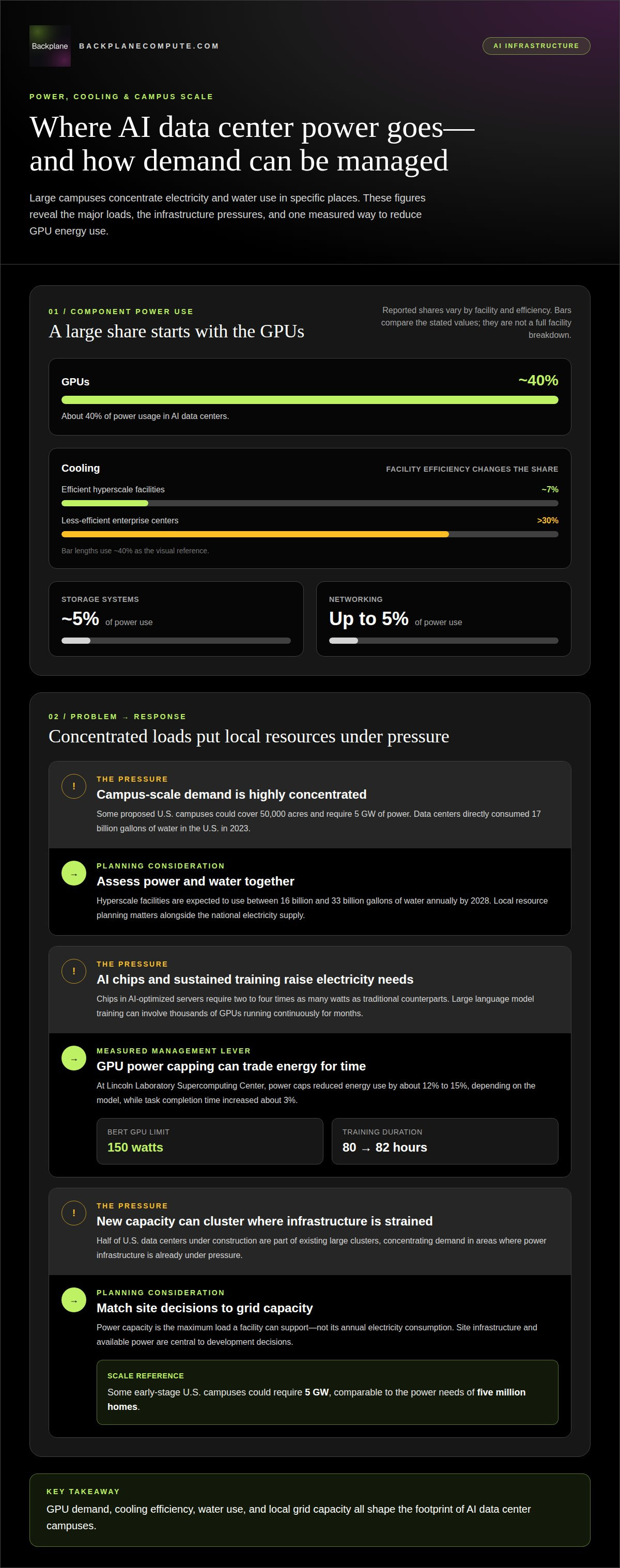
Large campuses concentrate computing demand, water use, and infrastructure needs in specific locations. Some proposed U.S. campuses could cover 50,000 acres and require 5 GW of power.
Power and Water Consumption
Power and water consumption rise together because facilities need electricity for computing and cooling. U.S. data centers directly consumed 17 billion gallons of water in 2023. Hyperscale facilities are expected to use between 16 billion and 33 billion gallons annually by 2028. For communities weighing new development, these demands affect local resource planning alongside the national electricity supply.
Data Center Component Power Use
Component power use shows where a campus’s electricity goes, from servers to cooling, storage, and networking. GPUs account for about 40% of power usage in AI data centers. Cooling represents about 7% of electricity in efficient hyperscale facilities, but over 30% in less-efficient enterprise centers. Storage systems account for around 5%, while networking can use up to 5%. These shares help operators identify where efficiency measures may matter most.
AI Data Center Power Capacity
Power capacity describes the maximum load a facility can support, rather than its annual electricity consumption. Global AI data center power capacity reached approximately 30 gigawatts in the last quarter of 2025. Some early-stage U.S. campuses could require 5 GW, comparable to the power needs of five million homes. Half of U.S. data centers under construction are part of existing large clusters, concentrating demand where power infrastructure is already under pressure.
GPU power capping offers one way to manage demand without changing the computing task. At Lincoln Laboratory Supercomputing Center, power caps reduced energy use by about 12% to 15%, depending on the model, while task completion time increased about 3%. In a BERT training experiment, limiting GPUs to 150 watts extended training from 80 to 82 hours.
U.S. data center electricity consumption and projections
AI data center energy consumption trends are shaping U.S. power planning, but national totals tell only part of the story. Grid and price effects depend on where facilities connect and how quickly local infrastructure can respond.
Effects on Electricity Bills and Grids
Data center demand can affect electricity markets when new loads increase the need for generation and grid capacity. That trend does not establish data centers as the cause, but it shows why local grid strain and power procurement matter. Following AI data center energy consumption trends can help decision-makers distinguish regional pressure from national demand.
Server and Hyperscaler Electricity Use
Servers are the central electricity load in large facilities, particularly hyperscalers optimized for AI computing. Servers account for around 75% of electricity use in larger AI-focused hyperscaler data centers. For context, the global Base Case projects data center electricity consumption of around 945 TWh in 2030, with demand growing around 15% per year from 2024 to 2030. Those projections frame the scale of equipment and capacity planning.
Data Center Component Electricity Use
A facility’s electricity use extends beyond computing equipment to cooling, storage, and networking. Servers process workloads, cooling removes heat, storage retains data, and networking moves it between systems. Together, these systems shape total energy demand and environmental impact. Their contribution varies with facility design and workload, so server demand alone cannot explain overall consumption. This matters when assessing how efficiently a facility turns electricity into computing capacity.
AI Workloads’ Share of U.S. Use
AI electricity use is a portion of total data center consumption, not a separate share of all U.S. electricity. U.S. data centers consumed 183 TWh in 2024, but that total includes AI and non-AI workloads. AI data center energy consumption trends depend on how facilities allocate electricity among model training, inference, and other computing services. As AI use expands, separating those workloads helps clarify demand without treating all data center consumption as AI-driven.
Data center energy and environmental standards
Energy standards help operators measure resource use as artificial intelligence drives data center expansion. The practical takeaway is to assess electricity, water, and renewable-energy indicators together, rather than treating computing performance as the entire environmental footprint.
U.S. data centers draw power from a mix of sources. Natural gas supplied over 40% of their electricity in 2024, while renewables supplied about 24%. These figures describe the sector’s electricity supply, not the source mix at every individual site. For a specific campus, location and procurement arrangements shape its energy profile.
The ISO/IEC 30134 series provides internationally agreed key performance indicators for data center resource efficiency. Operators can use these measures to track facility performance over time and assess how infrastructure changes affect resource use. For example, evaluating energy and water indicators together can reveal trade-offs that a power-only measure would miss.
The EU Energy Efficiency Directive includes energy, water, and renewable-energy KPIs for large data centers within the EU. These indicators provide a structured way to assess environmental performance across multiple resources. For U.S. projects, they can inform planning and comparisons, while their stated scope remains large data centers within the EU.
For AI facilities, a useful assessment connects site-level resource inputs with computing output. Processing units support model training and inference, while the wider facility uses energy for cooling and other operations. Tracking consistent indicators helps operators see whether expansion improves computing efficiency or increases the facility’s footprint without a corresponding gain.
Planning a facility around power access and resource performance? Evaluate data center infrastructure options alongside energy and environmental requirements.
Backplane
Backplane connects powered industrial sites with AI compute demand, helping turn infrastructure potential into practical capacity. When energy projections raise questions about site viability, compute access, or project financing, Backplane’s services support decisions across the development process.
Compute buyers can access GPUs-as-a-Service or pursue Dedicated Financed Sites. Property owners and project stakeholders assessing underused assets can use a Property Viability Assessment to evaluate their potential for data center use. Infrastructure Financing Structuring helps shape the financing needed to advance viable infrastructure projects.
These services connect energy-demand challenges to decisions about compute, sites, and capital. Contact Backplane to discuss your AI infrastructure needs.
Turn power constraints into a development decision
Planning around AI data center energy consumption trends means treating power as a core development variable, not a late-stage operating detail. The next step is to align computing requirements with site conditions, infrastructure readiness, and a workable capital strategy. That alignment helps decision-makers distinguish a promising concept from a project positioned to move forward.
Start with the intended workload and the capacity it requires. Then assess how the site can support that demand, where infrastructure needs investment, and whether the project structure supports execution. These decisions connect energy planning to real assets and operational goals. Clear priorities make it easier to direct time and capital toward viable opportunities.
For help translating data center demand into an infrastructure decision, contact Backplane about your data center. A focused discussion can help define the next move and bring the right considerations into view. The opportunity is substantial; disciplined planning is how you prepare to act on it.
Frequently Asked Questions
Can US infrastructure keep up with the AI economy?
U.S. infrastructure can support AI growth only if generation, transmission, and site development advance together. The constraint is often local: available power near a suitable site matters as much as national supply. Some U.S. grid-connection requests face waits of seven years. Phased development, flexible workloads, and locating projects near existing power infrastructure can help align computing demand with available capacity.
Could decentralized training solve AI’s power problem?
Decentralized training could distribute computing loads across sites, but it would not eliminate the electricity required for computation. Training across locations also depends on moving data and coordinating processing units, which can add operational complexity. This approach may help where suitable capacity exists across multiple sites. The best fit depends on the model, workload, network requirements, and power available at each location.
How can AI development become more sustainable?
AI development can reduce resource pressure by improving computing efficiency and matching workloads to available power. Teams can avoid continuing underperforming training runs, schedule flexible tasks outside peak periods, and use efficient hardware and cooling. Early stopping reduced training energy by 80% in the cited team’s studies. Tracking energy and water indicators also helps operators see whether efficiency gains persist as computing capacity expands.
What are the key environmental consequences of AI development?
AI development can increase electricity demand, water use for data center operations, and emissions associated with the power supply. Campus construction can also add demands on land and infrastructure in host communities. Impacts vary by location, cooling approach, and electricity sources. Assessing a project therefore means looking beyond processor efficiency to its full site footprint, including energy, water, and the resources needed to support operations.
What makes AI model training so resource-intensive?
Training adjusts billions of model parameters through repeated computations, often across thousands of GPUs operating continuously for weeks or months. Each processing unit draws power, and the facility must support the wider computing operation. Training runs are also repeated as teams refine models and test configurations. Efficient algorithms, appropriate hardware utilization, and stopping underperforming runs can reduce wasted computation without assuming every task has the same demands.
How much electricity do AI data centers consume in the United States, and how fast is demand growing?
U.S. data centers consumed 183 TWh of electricity in 2024, with total data center use projected to reach 426 TWh by 2030. Those figures cover all data center workloads, not AI alone, so they do not isolate AI facilities’ share. Demand growth reflects the combined effects of new capacity, server workloads, and facility operations, with local growth shaped by where projects connect.


