

A GPU is only one part of AI infrastructure. AI infrastructure project management coordinates the compute, storage, networking, facilities, power, and operating systems needed to run AI workloads. The aim is to bring these pieces online in an order that fits business needs, budgets, and delivery constraints.
That makes an AI infrastructure project more than a hardware decision. Site readiness, deployment model, component choices, data movement, and team handoffs all affect whether capacity arrives when needed and performs as intended. A strong plan makes these dependencies visible before they cause delays or operational risks.
This guide explains what AI infrastructure includes and how cloud, on-premises, and hybrid deployment choices shape delivery. It covers how to weigh time, cost, and risk; select compute, storage, and networking; and coordinate the teams responsible for execution. The focus is practical: connect infrastructure decisions to the workloads and business outcomes they need to support.
Key Takeaways
- Choose a cloud, on-premises, or hybrid model around workload needs and site readiness, then scale based on performance data.
- Make time, cost, and risk decisions together by tracking utilization, delivery dependencies, and business value.
- Plan compute, storage, and networking as one system so data can move reliably to the processing resources that need it.
- Give teams shared project records, clear handoffs, and aligned ownership to keep infrastructure decisions coordinated through delivery.
Cloud, on-premises, and hybrid deployment planning
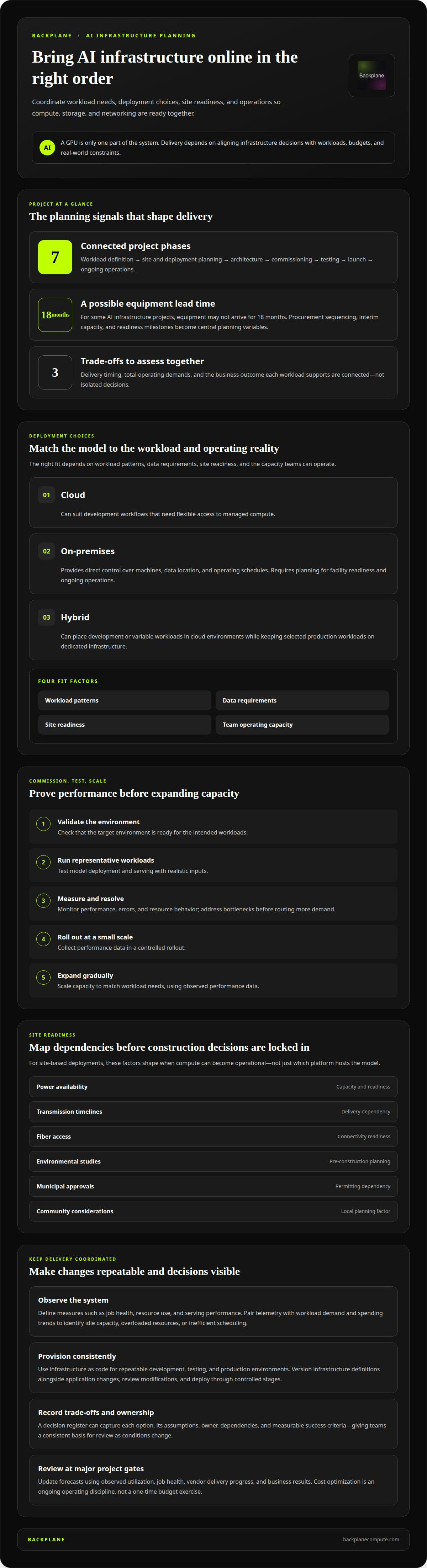
The key phases of an AI infrastructure project are workload definition, site and deployment planning, architecture, commissioning, testing, launch, and ongoing operations. AI infrastructure project management connects these phases so compute, storage, networking, and operating workflows are ready together.
Cloud deployment can suit development workflows that need flexible access to managed compute. On-premises infrastructure gives an organization direct control over machines, data location, and operating schedules, but requires planning for facility readiness and ongoing operations. A hybrid platform can place development or variable workloads in cloud environments while keeping selected production workloads on dedicated infrastructure. The right choice depends on workload patterns, data requirements, site readiness, and the capacity teams can operate.
Plan for observability and scalability before settling hardware specifications. Define what teams need to measure, such as job health, resource use, and serving performance, then map those measures to the target environment. Infrastructure as code helps provision repeatable environments across development, testing, and production. This reduces configuration drift when teams update machine images, drivers, or orchestration settings.
Commissioning, testing, and scaling start with validating the environment, then running representative workloads and measuring performance before expanding capacity. Test model deployment and serving with realistic inputs, monitor errors and resource behavior, and resolve bottlenecks before routing more demand. Roll out at a small scale, collect performance data, and expand gradually to match workload needs.
Continuous infrastructure deployment makes this sequence repeatable. Version infrastructure definitions alongside application changes, review modifications, and deploy them through controlled stages. For example, a team can validate a revised serving environment in testing before applying it to production. This approach supports traditional industries and machine-driven services, where reliability and traceable changes matter.
Lifecycle planning must extend beyond launch. Track funding, studies, permitting, procurement, construction, commissioning, operations, maintenance, upgrades, and eventual decommissioning. For a site-based deployment, map power availability, transmission timelines, fiber access, environmental studies, municipal approvals, and community considerations before construction decisions are locked in. These dependencies shape when compute can become operational, not just which platform hosts the model.
Decision support for time, cost, and risk trade-offs
Project decisions should connect delivery timing, total operating demands, and the business outcome each workload supports. AI infrastructure developers may plan projects whose equipment will not arrive for 18 months. That lead time makes procurement sequencing, interim capacity, and readiness milestones central planning variables, not administrative details.
When selecting vendors, compare proposed solutions with workload requirements, delivery dependencies, support responsibilities, and integration needs. Contracts should define deliverables, acceptance criteria, service responsibilities, change control, and how delays or scope changes are handled. Clear terms give project, finance, and technical teams a shared basis for decisions.
FinOps brings financial accountability into infrastructure operations. Connect cloud spending to business value through FinOps dashboards, then review consumption alongside workload performance. A training run that uses substantial capacity without improving model quality calls for a different decision than production serving tied to a critical business workflow. Cost control means funding useful capacity, not simply reducing usage.
Telemetry gives teams visibility into GPU utilization and job health. Pair those signals with workload demand, service performance, and spending trends to spot idle capacity, overloaded resources, or inefficient job scheduling. This evidence supports faster adjustments, while regular reviews turn operating data into lessons for future capacity decisions.
Time, cost, and risk rarely move independently. Delaying deployment may preserve capital but extend the time before a model supports business operations. Accelerating procurement may shorten that delay but increase exposure to equipment or site dependencies. A decision register can record each option, its assumptions, owner, dependencies, and measurable success criteria. Teams can then compare trade-offs consistently as conditions change.
Infrastructure financing structure also affects project sequencing and capital planning. Infrastructure financing structuring can be a relevant consideration when funding decisions shape the timing and viability of a deployment.
Review the decision model at each major project gate. Update forecasts using observed utilization, job health, vendor delivery progress, and business results. This makes cost optimization an ongoing operating discipline rather than a one-time budget exercise.
Hardware, compute, storage, and networking choices
Start architecture with the workload, not a hardware catalogue. Training a machine learning model, serving predictions, and running computer vision place different demands on compute and memory. Map each use case to its data volume, processing pattern, response needs, and operating schedule. Then select accelerators, general-purpose machines, and memory capacity to match those requirements. This helps avoid buying capacity that sits idle or constrains critical models.
Compute, storage, and networking must work as one system. Training workloads repeatedly move data from storage to processors, so storage throughput and network capacity can limit accelerator utilization. Where the architecture allows, separate frequently accessed training data from retained records, and plan high-bandwidth, low-latency connections between storage and processing. A dataset that loads slowly can leave expensive compute waiting, even when the accelerator has enough capacity.
Evaluate candidate configurations with representative workloads before committing to a production design. Run a sample training job and a model-serving workflow, then compare throughput, latency, utilization, and data movement. These observations reveal bottlenecks that component specifications alone may miss. They also provide a consistent basis for balancing hardware choices against operational needs, rather than treating a single benchmark as proof of fit.
Computer vision can support construction monitoring by analyzing site imagery for visible progress and changes. A project team might use image-based insights to compare completed work with planned milestones or flag areas for review. The workflow needs defined image sources, model evaluation, and a process for routing findings to the responsible construction team. Machine learning can assist monitoring, but project decisions should account for data quality and human review.
Communication and collaboration
AI infrastructure delivery involves engineering, facilities, finance, security, procurement, and operations. A project strategy needs clear decision ownership across these groups. For example, facilities may track power and site milestones, while engineering owns software readiness and operations defines service acceptance. A shared responsibility map shows who decides, who executes, and who needs to be consulted.
The most useful project management tools keep schedules, dependencies, risks, decisions, and technical records connected in a shared workflow. Use a common project platform with an issue register, decision log, milestone view, and document control. Pair it with version-controlled infrastructure definitions and operational dashboards. The method matters more than a particular software brand: teams need a reliable record of what changed, why, and who owns the next action.
Set a regular review cadence around delivery milestones rather than disconnected status reports. At each review, surface blocked dependencies, decisions awaiting approval, and changes affecting commissioning or service operations. A RACI responsibility matrix can clarify ownership for tasks such as approving a site change or accepting a model-serving environment. Record decisions and their rationale so later teams can understand the trade-offs.
Handoffs need more than a file and an email. Infrastructure lifecycle records can remain valuable to operators for decades, spanning funding, studies, construction, commissioning, operations, maintenance, and upgrades. Keep key project data, system configurations, approvals, and maintenance history accessible to the teams responsible for each stage. That continuity preserves context when personnel or vendors change.
AI projects also require collaboration between model developers and infrastructure operators. A model team may request a new serving configuration, for example, while operations assesses its effect on reliability and resource use. A controlled change process should capture the request, technical review, approval, deployment, and outcome. This creates a traceable path from development to production.
For projects where capital structure affects delivery responsibilities and coordination, explore infrastructure financing structuring as part of the planning process.
Backplane: Infrastructure Financing Structuring
Backplane aligns infrastructure financing with AI compute requirements and site viability. Its Infrastructure Financing Structuring service connects project capital decisions with the practical requirements of bringing compute capacity online.
Organizations that need compute access without developing a dedicated site can use GPUs-as-a-Service to access GPU capacity. Buyers seeking dedicated infrastructure can pursue Dedicated Financed Sites, a path to fully financed sites. A Property Viability Assessment evaluates underused industrial assets for potential AI infrastructure use.
The right path depends on the project’s compute needs, asset conditions, and financing structure. Contact Backplane to discuss how these factors fit your AI infrastructure plans.
Move from planning to a defined next step
The next decision is not simply whether to add AI capacity. It is how to align the deployment path with your organization’s demand, operating model, and investment priorities. Treat AI infrastructure project management as an ongoing capability: assumptions change, workloads evolve, and delivery decisions must stay connected to business outcomes.
Set the next move around the most important constraint. A compute requirement may call for access to GPU capacity; a site-based plan may depend on asset viability and financing structure. Identifying that constraint early turns a broad infrastructure strategy into a decision the right teams can evaluate and advance.
If you’re defining that path, discuss your AI infrastructure plans with Backplane. Bring the project’s compute needs, deployment direction, and key decision points into the conversation. A clear starting point can help you move forward with greater focus and confidence.
Frequently Asked Questions
What is AI infrastructure?
AI infrastructure is the connected physical and digital environment that supports developing, training, and running AI models. It includes compute resources such as GPUs, storage for datasets and model files, networks that move data, and the facilities and power behind those systems. Software and operational controls complete the stack. A constraint in one layer, such as slow data access, can limit performance elsewhere.
What does AI infrastructure project management involve?
AI infrastructure project management coordinates the technical, facility, financial, and operational decisions needed to deliver usable compute. It connects workload requirements to deployment choices, site readiness, procurement, commissioning, and ongoing operations. It also establishes decision ownership and records dependencies. For example, a model team’s capacity request may require coordinated action from infrastructure, facilities, finance, and operations before deployment.
How do you estimate costs for AI infrastructure projects in the United States?
Build the estimate from the project scope and its cost drivers rather than applying a generic figure. Account for compute capacity, storage, networking, site readiness, power delivery, cooling, construction, software, staffing, and operations. Separate one-time build costs from recurring expenses, then model expected utilization and changes in demand. Compare scenarios using the same workload assumptions so trade-offs stay visible.
How do AI infrastructure costs compare across cloud, colocation, and on-premises deployments?
Each deployment model changes the cost mix. Cloud spending is tied to consumed services and capacity; colocation adds facility and power arrangements alongside owned equipment; on-premises deployments require direct investment in equipment and site infrastructure. Compare them over the same operating horizon and workload profile. Include utilization, expansion needs, support responsibilities, and the cost of unused or unavailable capacity.
What are typical timelines and budgets for data center and AI infrastructure projects?
There is no single timeline or budget that fits every project. Delivery depends on site readiness, power and fiber access, approvals, construction scope, equipment procurement, and commissioning. AI infrastructure developers may plan projects whose equipment will not arrive for 18 months. Build a project schedule around actual dependencies, and structure budget scenarios around scope, deployment model, and operating requirements.
How should teams plan power, cooling, networking, and GPU capacity for AI infrastructure?
Start with the target workload and map its demand across GPU compute, power, heat removal, and data movement. Confirm that site power and cooling plans support the intended operating load, then size networking and storage paths to prevent data bottlenecks. Allow for expected workload growth without assuming every GPU runs continuously. After launch, track utilization and job performance to guide expansion decisions.


