

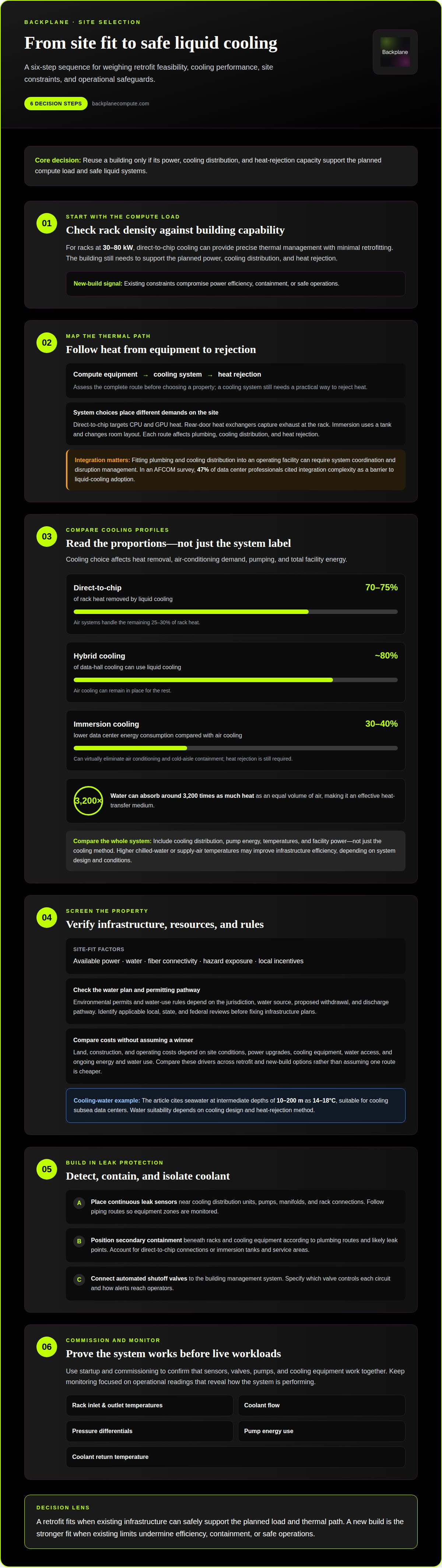
The better site may already be standing. In liquid cooled data center site selection, a retrofit can work when the building supports the planned power, cooling distribution, and heat rejection. For racks at 30-80 kW, direct-to-chip cooling can provide precise thermal management with minimal retrofitting. A new build makes more sense when existing constraints compromise power efficiency, containment, or safe operations.
Treat cooling as a facility-wide decision, not just a hardware choice. Liquid cooling changes how heat is captured and rejected, while power capacity, building layout, and supporting infrastructure determine how well the system can operate. The right approach depends on how those factors match the planned compute load.
This article explains how retrofit and new-build choices affect efficiency, leak protection, containment, and safety. It also identifies the site constraints to prioritize when deciding whether an existing property can support the plan or a purpose-built facility is a better fit.
Key Takeaways
- Weigh retrofit viability against the limits of the existing building, especially its power infrastructure, cooling layout, and ability to reject heat.
- Assess cooling efficiency against the planned rack load; the right system can affect both thermal control and the facility’s broader power use.
- Build leak detection and containment into the site decision, including sensor placement, secondary containment, and automated shutoff strategies.
- Match site power capacity and grid access to the compute plan, with reliability and operational risk controls treated as core requirements.
Retrofitting versus new-build facility considerations
A retrofit reuses existing infrastructure; a new build can integrate cooling, power, and layout from the start. Liquid cooled data center site selection hinges on whether an existing facility can support the planned computing density and safely accommodate liquid systems.
Permits and Water-Use Regulations
Environmental permits and water-use rules depend on the site’s jurisdiction and cooling-water plan. In the United States, requirements vary with the water source, proposed withdrawal, and discharge pathway. These factors can shape both site feasibility and operating design. Identify the applicable local, state, and federal review processes before fixing infrastructure plans.
Site Costs and Cooling-Water Suitability
Land, construction, and operating costs depend on site conditions, power upgrades, cooling equipment, water access, and ongoing energy and water use. Compare these cost drivers across retrofit and new-build options rather than assuming one route is cheaper. Suitable cooling-water sources and temperatures depend on the cooling design and heat-rejection method. According to the National Library of Medicine, at intermediate depths of 10-200 m, seawater is 14-18 degrees Celsius, making it suitable for cooling subsea data centers.
At an air-cooled facility, a retrofit may preserve usable space and infrastructure while adding liquid cooling for high-heat servers. Direct-to-chip systems, rear-door heat exchangers, and immersion cooling each place different demands on room layout, plumbing, and heat rejection. A new build can incorporate those routes from the outset. During liquid cooled data center site selection, map the full thermal path, from equipment to heat rejection, before choosing a property.
Integration challenges include fitting cooling distribution and plumbing into an operating facility, coordinating systems, and limiting disruption. Climate and natural hazards also shape cooling design and infrastructure resilience. Assess local heat, water availability, and severe-weather exposure when screening sites. No U.S. region is suitable based on its name alone. Compare each property’s available power, water, fiber connectivity, hazard exposure, and local incentives with the project’s requirements.
Energy efficiency and data center power use
Cooling efficiency affects more than server temperatures. It shapes the power required to move heat through a facility and determines how much existing infrastructure remains useful. Liquid cooling transfers heat close to the source, reducing reliance on air movement for high-density computing. Water can absorb around 3,200 times as much heat as an equal volume of air, making it an effective heat-transfer medium.
System choice changes the efficiency profile. Direct-to-chip cooling can remove about 70-75% of rack heat, while air systems handle the remaining 25-30%. A hybrid approach can use liquid cooling for about 80% of data-hall cooling and retain air cooling for the rest. That balance may suit a facility where operators want to implement liquid cooling without replacing every existing cooling system.
Immersion cooling takes a different route. It can reduce data center energy consumption by 30-40% compared with air cooling, while virtually eliminating air conditioning and cold-aisle containment. That changes the facility’s cooling load and layout, but the site still needs a practical path to reject heat. A heat exchanger, pumps, and the selected heat-rejection method all affect the total energy picture.
Compare cooling options against the planned computing load, not a generic efficiency claim. Direct-to-chip systems target heat from CPUs and GPUs; rear-door heat exchangers capture exhaust heat at the rack. For each design, assess cooling distribution, pump energy, temperatures, and facility power together. Depending on system design and conditions, operating at higher chilled-water or supply-air temperatures may improve infrastructure efficiency.
Adoption also depends on integration. In the 2025 AFCOM survey, 47% of data center professionals cited integration complexity as a barrier to liquid-cooling adoption. Model the retrofit’s additional pumping and heat rejection alongside reduced air-conditioning demand. Where infrastructure financing must account for these tradeoffs, infrastructure financing structuring can connect facility requirements with the investment plan.
Leak detection, containment, and safety
Liquid-cooling safety depends on detecting leaks and limiting where coolant can travel. Map vulnerable points, including cooling distribution units, pumps, manifolds, and rack connections. Place continuous leak sensors near these components, following the piping layout so that leaks in one equipment zone are not missed while sensors monitor another.
Containment provides a physical safeguard. Secondary trays beneath racks and cooling equipment can collect fluid before it spreads across a data hall. Position them according to plumbing routes and potential leak points. For direct-to-chip systems, consider rack connections and coolant distribution points. For immersion systems, account for the tank and its service area.
Automated shutoff valves add another layer of control. Connecting them to the building management system can link leak detection to fluid isolation. Specify which valve controls each circuit and how alerts reach operators. Pair this design with a clear startup and commissioning process to establish how sensors, valves, pumps, and cooling equipment work together before live workloads begin.
Monitoring should cover more than leak alarms. Track rack inlet and outlet temperatures, coolant flow, pressure differentials, pump energy use, and return temperature. These readings show whether fluid reaches the intended components and distribution remains balanced. Changes in pressure differential or unexpected return temperatures can prompt investigation before cooling performance shifts. Record normal operating patterns during commissioning and use them as a reference.
At site-selection stage, treat leak control as an infrastructure requirement, not a hardware accessory. Confirm there’s practical space for sensors, trays, valves, and accessible service routes around pumps and manifolds. These provisions support operational safety while preserving cooling efficiency and energy efficiency. A facility with constrained access may complicate maintenance; a planned layout can separate coolant routes from sensitive computing equipment and keep monitoring points visible.
What power capacity, grid access, and redundancy are needed for a liquid-cooled data center?
Start with the compute load, then test whether grid access can support it. Racks once commonly designed for 5 kW to 15 kW are now planned for 30 kW, 60 kW, and higher. Many AI deployments draw 40 kilowatts or more per rack, while the market is heading toward requirements of 50 kW or more. Site power must account for servers and cooling infrastructure together.
Grid access means more than having a transmission line nearby. Assess the utility service path, available capacity, connection infrastructure, and timing of required upgrades. Even a well-equipped building can face a power constraint if its grid connection cannot serve the planned load. Compare the rack deployment with utility capacity, then identify the additional infrastructure the project needs. This ties site viability directly to deployment scale.
Redundancy is the design that supports continued operation when a power component or supply path is unavailable. The required setup depends on reliability objectives and the consequences of interruption. Assess how power reaches critical equipment, where backup systems connect, and whether maintenance can happen without disrupting workloads. ASHRAE and industry guidance emphasize reliability, operability, and risk controls as data center power densities rise. Liquid cooling does not remove these requirements.
Power and cooling should be assessed as one operating system. Pumps and cooling distribution equipment draw power alongside IT hardware, so include them in capacity planning. Model the intended rack density, expected growth, cooling loads, and redundancy approach together. Then determine whether existing infrastructure can support that design or requires a new power strategy. For projects where site capacity and capital structure must align, structure infrastructure financing around the planned power requirements.
Backplane: Dedicated Financed Sites
Backplane connects powered properties with AI compute demand and helps structure financing for infrastructure build-outs. If your assessment points toward a new facility, Dedicated Financed Sites can link site planning with a financing path. Backplane’s Property Viability Assessment evaluates whether an underused industrial property suits conversion, and Infrastructure Financing Structuring addresses how the project is funded.
Choose the next step based on the outcome you need. A dedicated site suits projects requiring infrastructure built around specific compute requirements; GPUs-as-a-Service suits buyers whose priority is access to GPU capacity. Because these options serve different deployment needs, let the site, power, cooling, and operating plan guide your choice.
Contact Backplane to discuss your data center site and compute requirements.
Move the Site Decision Into Execution
Liquid cooled data center site selection comes down to whether a property can support the intended operating model. Turn that decision into a development path by defining the target compute use, assessing the asset’s fit, and aligning the project structure with the infrastructure required.
The path may start with an existing industrial property or a dedicated site. Make the site’s role clear before investment and deployment decisions are fixed. A focused viability assessment can show whether the asset fits the plan or a different approach better suits the project.
Backplane connects powered properties with AI compute demand through site assessment, financed-site, and GPU-capacity options. If you’re ready to discuss how a site could support your project, contact Backplane to discuss your site. A disciplined next step can turn a promising property into a more actionable infrastructure strategy.
Frequently Asked Questions
What site requirements are critical for liquid-cooled data centers?
Key requirements include power for the planned IT load, workable grid access, a heat-rejection pathway, and space for cooling equipment and service access. Fiber connectivity supports compute operations, while the building layout determines how equipment and fluid routes can be organized. Assess these elements together: strength in one area does not offset a constraint in another.
How much water and electricity does a liquid-cooled data center require?
Water and electricity needs depend on IT load, cooling design, heat-rejection method, and operating conditions. A closed-loop liquid system, for example, circulates coolant to carry heat, while servers, pumps, and supporting infrastructure also consume power. Model the planned computing load and complete cooling system to estimate demand, including water makeup or discharge needs where the design requires them.
What site-selection steps and feasibility studies are needed for a liquid-cooled data center?
Start by defining the planned compute load and deployment. Then assess utility capacity and grid access, the property’s physical condition, cooling and heat-rejection options, water availability, fiber connectivity, and environmental constraints. Bring the findings together in a feasibility assessment that identifies dependencies and potential infrastructure changes. Backplane’s Property Viability Assessment evaluates whether an underused powered property fits an AI compute project.
What risks arise from coolant leaks, water scarcity, and cooling-system failures?
A coolant leak can expose nearby equipment to fluid and interrupt cooling; water scarcity can constrain the heat-rejection approach. Cooling-system failures can also raise equipment temperatures and disrupt workloads. Address these risks with leak alarms, fluid isolation, containment, and operational monitoring. Site planning should also consider alternative water availability and how the facility will respond if a cooling component or supply path becomes unavailable.


