

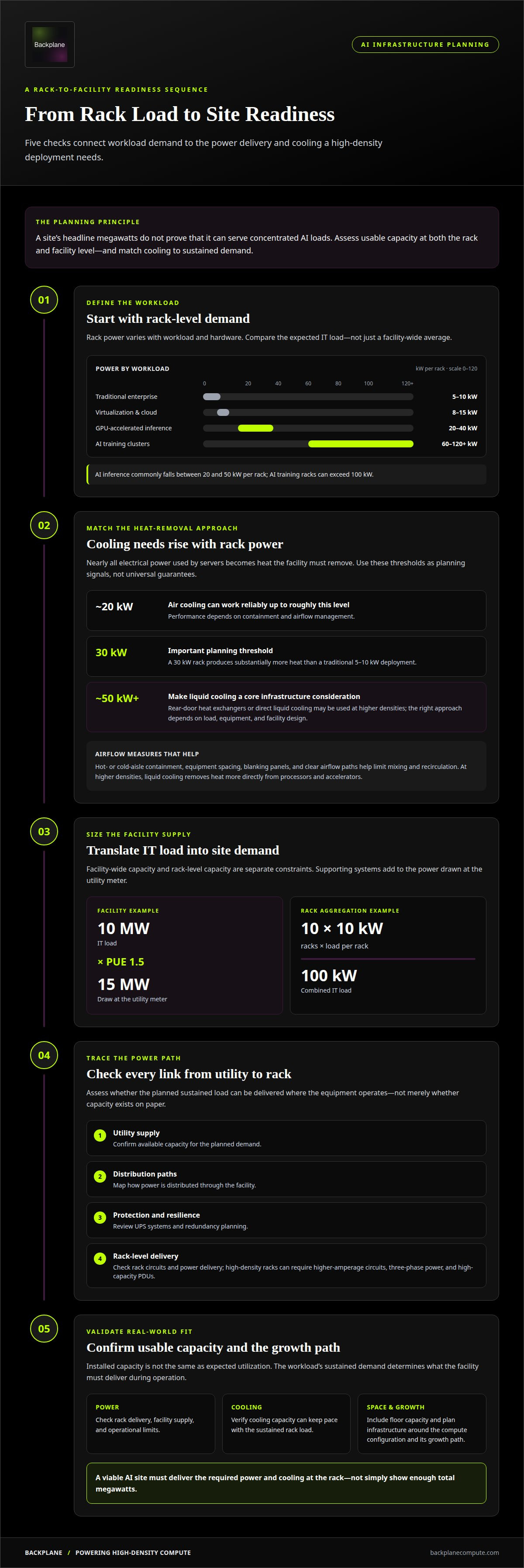
AI racks can draw from 20 kW to more than 100 kW, depending on the workload and hardware. The high density rack power requirements for inference commonly fall between 20 and 50 kW per rack, while AI training racks can exceed 100 kW. That shift changes the power and cooling infrastructure a site must support.
Rack density is only the starting point. A facility needs enough electrical capacity to supply the IT load, along with infrastructure to manage heat and deliver power reliably. A site with available megawatts may still be a poor fit if its distribution and cooling systems cannot serve concentrated AI loads.
This article explains how AI compute shapes rack-level demand, what high-density deployments require from electrical infrastructure, and how rack capacity affects wider data centre planning. It also shows why the difference between power on paper and usable capacity matters when assessing a site for AI workloads.
Key Takeaways
- Classify rack density by expected IT load, then match the cooling approach to the heat the equipment produces.
- AI training and inference create different demand profiles, so workload design matters when sizing a data centre.
- Assess power delivery at both rack and facility level; total site capacity alone doesn’t show whether it can serve concentrated loads.
- Plan electrical infrastructure around the compute configuration and its growth path to avoid capacity becoming a constraint.
What Is Considered a High-Density Rack?
A rack drawing more than 20 kilowatts is generally considered high density, with 30 kilowatts an important planning threshold. As rack power rises, cooling must remove more heat from the same footprint.
Air and Liquid Cooling Thresholds
Air cooling can work reliably up to roughly 20 kilowatts per rack, depending on containment and airflow management. Above that level, cooling performance depends increasingly on how effectively the facility directs air through equipment and removes hot exhaust. At densities approaching or exceeding 50 kilowatts, liquid cooling becomes a core infrastructure consideration.
Liquid cooling removes heat from processors and accelerators more directly than room-level air handling. In single-phase systems, the cooling fluid stays liquid as it absorbs and transfers heat. Two-phase systems use a fluid that changes phase, typically absorbing heat as it vaporizes and releasing it as it condenses. The choice affects system design and heat transfer.
The Link Between Rack Power and Cooling
Rack power density and cooling requirements rise together because nearly all electrical power used by servers becomes heat that the facility must remove. A 30-kilowatt rack therefore produces substantially more heat than a traditional 5-to-10-kilowatt deployment. If cooling capacity cannot keep pace, equipment temperatures can rise and limit reliable operation.
Containment helps manage heat by separating hot and cold airflow paths. Hot-aisle or cold-aisle containment, for example, reduces mixing between server exhaust and incoming air. Equipment spacing, blanking panels, and clear airflow paths also help prevent recirculation. These measures can support air cooling, but cooling capacity still needs to match the rack’s sustained load.
At higher densities, operators may use rear-door heat exchangers to remove heat near the rack, or direct liquid cooling to capture heat at processors and accelerators. The right approach depends on rack load, equipment configuration, and the facility’s cooling design. A 50-kilowatt deployment may require non-standard cooling, even where existing infrastructure can support lower-density racks.
What is a high-density data centre?
High-density racks commonly draw more than 20 kilowatts, while some definitions start at 7 or 10 kilowatts. For AI training, rack demand can reach 50-100+ kilowatts, so workload and hardware determine the facility’s power profile.
Workloads for High-Density Facilities
High-density facilities suit workloads that concentrate substantial computing demand in compact server cabinets. Examples include AI model training, high-performance computing, and GPU-intensive applications. Because processors run in parallel, power consumption rises within each rack. This density can support intensive computation in fewer cabinets, but only if the facility can deliver the required power and cooling where the equipment operates.
AI and High-Performance Computing
AI and high-performance computing use clusters of processors and accelerators to process demanding workloads. Training workloads can keep GPUs working at sustained high utilization, while inference serves model outputs in response to requests. The distinction matters: AI inference racks commonly require 20-50 kilowatts, while training racks can draw more than 100 kilowatts. A data centre’s design must reflect the intended computing pattern.
Rack Power Density by Workload
Rack demand varies with the workload, server configuration, and hardware installed in each cabinet. Traditional enterprise environments often operate at 5-10 kilowatts per rack; virtualization and cloud compute commonly use 8-15 kilowatts. GPU-accelerated inference typically draws 20-40 kilowatts per rack, while AI training clusters can require 60-120+ kilowatts. These ranges show why one facility-wide average can obscure rack-level demand.
Typical Power Needs of High-Density Racks
A rack drawing more than 20 kilowatts generally qualifies as high density, but AI deployments can require far more. Around 40 kilowatts per rack is increasingly common in AI and GPU-accelerated environments, while purpose-built systems may exceed 100 kilowatts. For planning, distinguish installed capacity from expected utilization: the workload’s sustained demand determines the power the facility must deliver during operation.
Electrical infrastructure for high-density racks
High-density deployments need electrical infrastructure sized for sustained rack loads, not merely a facility’s headline capacity. Assess readiness across the utility supply, distribution, backup systems, rack circuits, and operational limits.
Assessing Infrastructure Readiness
An infrastructure readiness assessment tests whether a data center can deliver the planned load at each rack and across the facility. Start with available utility capacity, then map distribution paths, UPS systems, redundancy, and rack-level power delivery. For example, ten racks drawing 10 kilowatts each create a combined IT load of 100 kilowatts. Floor capacity and cooling also affect whether a site can support the deployment.
Installation costs depend on site conditions, equipment, capacity upgrades, and the scope of electrical work. Costs vary with the project, so a specific estimate requires a quote.
Power Needs and Electrical Infrastructure
Electrical infrastructure converts incoming supply into usable, protected power at each rack. High-density racks can need higher-amperage circuits, three-phase power, high-capacity PDUs, UPS systems, and redundancy planning. Capacity must account for the IT load and supporting systems: a 10-megawatt IT load at a PUE of 1.5 draws 15 megawatts at the utility meter. Rack-level capacity and facility-wide energy supply are separate constraints.
Electrical Codes and Safety Requirements
In the United States, high-density rack installations must comply with applicable electrical codes and local approval requirements. The design needs to account for circuit ratings, equipment compatibility, grounding, protection, and safe installation. The right configuration depends on the facility’s electrical system and the rack’s load. Have a qualified electrical design establish these requirements before energizing equipment, rather than relying on a general rack-density figure.
Circuit Overloads and Power Limits
Overloading a rack circuit can trip protective devices and interrupt server operation. Exceeding a facility’s available capacity can also constrain deployments, even when individual rack circuits appear adequate. Intelligent PDUs help operators monitor consumption at rack or outlet level and balance circuit loads. N+1 or 2N redundancy can support continuity if a component fails, but neither model creates extra capacity beyond the infrastructure’s design.
Compute power requirements
Calculate a rack’s compute load by adding the input power requirements of its servers and other installed equipment. Start with each server’s specifications, then account for its workload and operating configuration. The result is the rack’s IT demand, not the facility’s total power draw.
For example, four GPU servers rated at 5 kilowatts each create a 20-kilowatt server load before adding other rack equipment. Modern GPU servers can require 5 kilowatts or more per chassis, depending on configuration. A specification-based estimate gives electrical planning a firmer basis than counting servers alone.
Chip demand helps explain the shift. Traditional CPU-based server chips draw 150-200 watts per chip, while modern AI GPUs draw 700 watts or more. Next-generation AI processors are expected to exceed 1,400 watts per chip. As more accelerators operate together, compute demand can rise sharply within one server rack.
Scale the same calculation across the deployment. A 50,000-GPU training cluster approaches 35 megawatts of sustained draw. That figure illustrates why rack-level estimates must connect to facility-wide distribution, power and cooling capacity. A site’s total supply is useful only if its infrastructure can deliver the required load to the right equipment.
In the planning model, distinguish peak specifications from expected operating demand. GPU utilization, server configuration, and the number of active systems all affect actual consumption. Compare the rack total with the capacity available through its circuits and distribution path. This distinction is critical: aggregate compute demand can exceed what a local power path can serve, even when the facility has substantial capacity overall.
The practical approach is to calculate load from installed equipment specifications, then aggregate it by rack and deployment. Revisit the estimate whenever hardware or workload assumptions change. A rack designed for one GPU configuration may need a different power provision if you add accelerators or servers.
Backplane
Backplane connects AI compute demand with powered industrial sites and infrastructure financing. If your rack requirements exceed a facility’s current capacity, Backplane’s Property Viability Assessment can evaluate whether an underused site could support a compute deployment. Infrastructure Financing Structuring helps shape the capital framework for turning a viable site into operational infrastructure.
Compute buyers can use GPUs-as-a-Service to access GPU capacity or pursue dedicated infrastructure through Dedicated Financed Sites. The right route depends on whether you need compute access, a dedicated site, or an assessment of a property’s potential for a high-density deployment.
Contact Backplane to discuss your compute requirements and infrastructure plans.
Turn power planning into a deployment path
The next decision is how to turn compute demand into a viable project. Treat high density rack power requirements as an input to site strategy, not an isolated equipment specification. The deployment plan should connect the intended workload, site capacity, and the capital structure behind the build.
That alignment matters before commitments limit your options. A clear assessment of high density rack power requirements can connect infrastructure needs with an appropriate project framework, whether you’re planning new capacity or evaluating an existing industrial asset. Keep the intended operating model in view as the project moves from technical requirements to execution.
Backplane can help connect AI compute demand with powered-site opportunities and infrastructure pathways. If you’re ready to explore how your requirements translate into a project, discuss rack power with Backplane. A focused conversation can help clarify the next move and keep your infrastructure strategy aligned with your compute ambitions.
Frequently Asked Questions
How Much Power Does an AI Rack Use?
An AI rack can draw 20-50 kW for inference, while training configurations can exceed 100 kW. The actual requirement depends on the number and type of accelerators, server configuration, and workload. For a project estimate, distinguish the rack’s expected sustained demand from its equipment’s rated capacity, then use that load to assess power distribution and cooling needs.
How Much Power Can a Cabinet Actually Deliver?
A cabinet’s usable power depends on its PDU rating, voltage, and electrical supply. For example, a 100A rack PDU operating at 208V can deliver approximately 28.8 kW; at 415V, it can deliver approximately 57.5 kW. These examples show why the cabinet’s physical size doesn’t determine its power capacity. The connected electrical system and distribution equipment set the practical limit.
What Are High Density Racks?
High-density racks concentrate substantial computing equipment and electrical demand within one server cabinet. A common classification treats deployments exceeding 20 kW per rack as high density, though some definitions start at lower thresholds. The distinction matters because the same floor area can contain very different loads. A cabinet for general enterprise servers and one for GPU computing can have sharply different infrastructure needs.
What Qualifies as High Density Today?
There isn’t one threshold used across every data centre. Some definitions begin at 7 or 10 kW per rack, while a common planning benchmark is more than 20 kW. AI workloads raise the practical bar: 40 kW racks are increasingly common in GPU environments, and purpose-built AI systems can exceed 100 kW. For planning, specify the workload and rack load, not just the label.
Why Do AI Racks Use So Much Power?
AI racks pack power-hungry accelerators and servers into a compact footprint to process workloads in parallel. Modern AI GPUs can draw 700 watts or more per chip, compared with 150-200 watts for traditional CPU-based server chips. A rack’s total demand also reflects how many accelerators operate together and their configuration. That concentrated compute load increases the need for suitable power delivery and heat removal.
What is the maximum rack power density supported by modern data centers?
There’s no single maximum that applies to every modern data centre; supported density depends on its electrical and cooling design. Reported deployments reach 130 kW per rack with liquid cooling, while a University of Göttingen reference site uses 100 kW per rack. These examples show that high loads are possible in purpose-designed environments, not that every facility can accommodate them.


