

The fastest route to GB300 compute may not be owning the rack. A GB300 financing decision comes down to comparing three paths: buying hardware, accessing capacity through a hyperscaler, or reserving capacity from a provider. Each shifts capital commitment, infrastructure responsibility, and control differently.
Buying outright demands substantial capital and a facility built for rack-scale, liquid-cooled AI infrastructure. A GB300 NVL72 rack contains 72 GPUs and 36 Grace CPUs, so the decision extends beyond the accelerators to the systems around them. Storage, networking, power, and cooling all shape whether ownership is viable.
This guide explains what each access model means, how to weigh the trade-offs, and why storage and network requirements belong in the comparison from the start. You’ll get a practical framework for matching compute access to deployment needs, capital constraints, and infrastructure readiness before deciding which route can move a project forward.
Key Takeaways
- Compare ownership, hyperscaler access, and reserved provider capacity by how each affects capital commitment, control, and infrastructure responsibility.
- Include storage and networking in the deployment plan; compute access alone does not define the full infrastructure requirement.
- Assess leasing and loan structures by how repayment, asset ownership, and project requirements shape their fit.
- Understand which factors drive financing terms, then consider infrastructure financing structuring when a project needs a coordinated path to deployment.
Buying hardware, hyperscaler access, or reserving provider capacity
GB300 access can come through hardware ownership, hyperscaler services, or reserved provider capacity. The right structure depends on capital availability, deployment control, and facility readiness.
Leasing, Loans, and Financing Providers
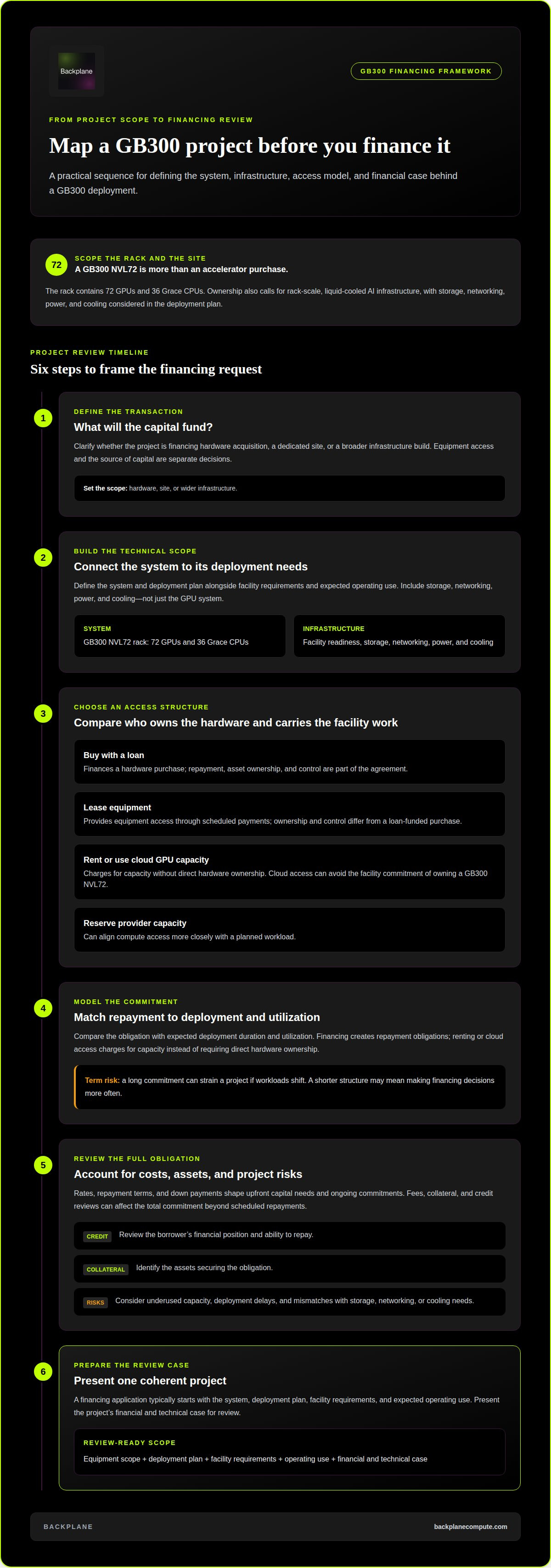
Leasing provides access to equipment through scheduled payments, while a loan finances a hardware purchase. The distinction matters because ownership, repayment obligations, and control over the assets differ. In the United States, financing structures for AI infrastructure are available through capital partners, while UK enterprises often work with commercial finance brokerages such as TMS Finance to explore tailored credit facilities and asset funding. An application typically starts by defining the system, deployment plan, facility requirements, and expected operating use, then presenting the project’s financial and technical case for review.
Financing Costs Versus Renting and Cloud Access
Financing converts hardware acquisition into a repayment obligation; renting or cloud GPU access charges for capacity without requiring direct hardware ownership. The comparison depends on deployment duration, utilization, and who carries facility responsibility. Buying a GB300 NVL72 requires significant capital expenditure and a facility capable of supporting rack-scale liquid-cooled AI infrastructure. Cloud access can avoid that facility commitment, while reserved capacity can align access more closely with a planned workload.
Rates, Terms, and Down Payments
Rates, repayment terms, and down payments define the commercial structure of a hardware financing agreement. They determine upfront capital needs and ongoing commitments. The terms depend on the transaction, financing structure, borrower profile, equipment value, and repayment capacity. Model the obligation against expected deployment and utilization. A long commitment can strain a project if workloads shift, while a shorter structure may mean making financing decisions more often.
Fees, Collateral, and Credit Checks
Fees, collateral, and credit reviews are part of a financing assessment and affect the total commitment beyond scheduled repayments. The project review should define the assets being financed, facility readiness, deployment timing, and operating plan. Credit review considers the borrower’s financial position and ability to repay; collateral terms identify assets securing the obligation. Key risks include underused capacity, deployment delays, and mismatches between hardware commitments and storage, networking, or cooling needs.
Who offers financing for NVIDIA GB300 systems in the United States?
For NVIDIA GB300 systems in the United States, the identified financing channel is capital partners. They can provide financing structures for AI infrastructure systems. That matters because equipment access and the source of capital are separate decisions. A hardware vendor, compute provider, and financing partner can play different roles in one deployment, so the transaction needs a clear division of responsibility.
Start by defining the transaction. Is capital intended for hardware acquisition, a dedicated site, or a broader infrastructure build? The answer determines which financing structure fits the project. A GB300 deployment is not only an equipment purchase. Its viability also depends on a suitable facility, power, cooling, storage, and networking. A proposal that treats the GPU system as the entire project can leave major infrastructure needs outside its financing plan.
Financing decisions depend on the project as a whole, not just the accelerator model. A useful discussion connects equipment scope to the site, deployment plan, and business case. For example, a buyer pursuing dedicated infrastructure should separate hardware requirements from facility requirements. This makes capital needs and asset responsibilities easier to assess together. The same discipline helps when a project combines owned equipment with separately sourced compute capacity.
There is no single named financing provider identified for every NVIDIA GB300 transaction in the United States. Instead, capital partners are the stated route for arranging financing structures. The structure can depend on project scale, borrower position, assets involved, and whether the plan centers on equipment or operational infrastructure. The practical first step is to frame those elements as one coherent project, rather than presenting a rack without its deployment context.
For projects that connect compute demand with suitable industrial property, explore AI infrastructure financing pathways.
Technical scope also matters when assessing the assets behind a financing request. An NVIDIA GB300 NVL72 system comprises 18 compute trays unified by NVLink into a 72-GPU coherence domain, and the NVIDIA GB300 NVL72 uses NVLink 5 with 130 TB/s of bandwidth. Each NVIDIA GB300 GPU has roughly 288GB of HBM3e memory, compared with about 186GB per GB200 GPU. IRESH Consultants says it is exploring supply opportunities for NVIDIA GB300-based AI infrastructure and chipsets, with up to 5 million units available.
What financing options are available for GB300 hardware, including leasing and loans?
GB300 hardware can be funded through a loan, an equipment lease, or a broader project financing structure. Each allocates ownership, upfront capital, and repayment differently. Capital partners can provide financing structures for AI infrastructure systems. The suitable route depends on whether the project centers on acquiring equipment or bringing an operational site online.
A loan funds a purchase, with repayment obligations set by the financing agreement. The borrower acquires the equipment and plans for its lifecycle, including deployment and eventual replacement. This can suit an operator seeking control over the hardware and its use. The trade-off is a direct repayment commitment, even if utilization or deployment timing changes.
An equipment lease structures access to hardware through agreed payments rather than a direct purchase. Ownership and end-of-term arrangements depend on the contract. Leasing can align equipment access with a defined deployment plan, but the agreement’s duration and asset terms matter. Compare the payment schedule with expected use, installation timing, and the system’s operational life.
Project-level financing can account for more than the GB300 system itself. A deployment may also involve a powered site, cooling infrastructure, storage, and networking. Separating these needs can leave critical project requirements outside the financing plan. A unified structure can instead consider equipment and infrastructure together, especially where site readiness determines when GPUs can begin operating.
- Loan: Consider it when equipment ownership and direct control are central to the plan.
- Lease: Assess it when scheduled access and contract-defined asset terms fit the deployment.
- Project structure: Evaluate it when hardware depends on site and infrastructure investment.
Before selecting a structure, define the assets to be financed, deployment sequence, and expected utilization. Then compare repayment commitments against the project’s operating plan. For example, a system arriving before its facility is ready can create financing obligations before productive use begins. Match capital timing to site readiness, storage, networking, and installation dependencies. That alignment is central to a workable GB300 financing plan.
What are typical GB300 financing rates, terms, and down payments?
GB300 financing rates, repayment terms, and down payments depend on the transaction. There is no single structure that fits every buyer. Lenders assess borrower credit, asset value, repayment capacity, and the project’s operating plan. A system intended for steady production presents a different financing case from equipment awaiting an unfinished site.
The interest rate determines borrowing costs over the agreement. Compare whether the rate is fixed or variable, how often payments are due, and whether fees affect total repayment. A lower quoted rate alone doesn’t make an offer better. The repayment schedule and total obligation must fit the deployment’s expected cash flow.
Term length sets how long the borrower repays the loan or lease. A longer term can spread payments but may extend obligations through changes in hardware needs. A shorter term can concentrate repayment demands. Match the term to the equipment’s expected useful life, deployment timing, and plans for future upgrades.
A down payment is the amount contributed upfront rather than covered by financing. Its size depends on the financing structure, borrower profile, equipment value, and lender assessment. Compare the upfront contribution with the capital needed for the rest of the deployment. A GB300 rack may require a facility, cooling, storage, and networking, so committing too much capital to equipment can constrain project readiness.
Build a side-by-side comparison before selecting a structure. Include:
- Rate: Identify the rate type and how it affects repayment.
- Term: Compare the repayment period with deployment and upgrade plans.
- Down payment: Measure upfront cash against remaining infrastructure needs.
- Total commitment: Account for repayment obligations and contract fees.
Then test the schedule against deployment milestones. If installation is delayed, repayment obligations may still begin under the agreement. Aligning capital timing with site readiness keeps financing decisions connected to operational reality. Discuss financing options for your GB300 project.
Backplane: Infrastructure Financing Structuring
Backplane structures financing around the full AI infrastructure project, not just the GB300 hardware. That matters when deployment depends on matching compute demand with a viable site, capital plan, and operating model. A project centered on direct capacity access may fit GPUs-as-a-Service; a buyer seeking dedicated infrastructure can consider Dedicated Financed Sites.
For sites that need evaluation before capital decisions, Backplane’s Property Viability Assessment helps establish whether a property fits the intended infrastructure use. Its Infrastructure Financing Structuring service addresses the project’s financing framework. These offerings connect the hardware decision to the physical and financial requirements that determine whether a deployment can move forward.
Contact Backplane to discuss the financing structure that fits your AI infrastructure project.
Move from capital plan to deployment
The next decision is how your financing structure supports execution, not simply how it funds equipment. A GB300 financing strategy should connect capital decisions with site readiness, procurement, and the point when compute demand becomes operational. This keeps the financial structure aligned with the project’s actual milestones.
Backplane can help frame that path around your infrastructure requirements. The right next step is a focused discussion of your project’s intended deployment, financing priorities, and operational constraints. Consider how GB300 financing can support the project’s direction while accounting for those needs.
Discuss GB300 plans with Backplane, and take the next step toward a deployment plan built around your needs.
Frequently Asked Questions
What is GB300 financing?
GB300 financing is a funding arrangement for acquiring or deploying NVIDIA GB300 compute infrastructure. It can structure capital for hardware through a loan or lease, or support a wider project where compute depends on site infrastructure. For example, an operator planning a dedicated deployment can assess equipment funding alongside facility readiness and operating plans. The structure determines repayment obligations, asset ownership, and how capital aligns with deployment needs.


