

A powered site is not financeable simply because demand is waiting. AI data center project finance works when capital matches the risks and cash flows of the assets, from land and construction to GPUs and contracted compute revenue. The structure must also account for operational control and how investors can exit.
That is the central tension: long-lived infrastructure must support rapidly changing technology, while power availability can determine whether a project moves forward at all. Funding construction is only part of the decision. The operating model, customer commitments, and allocation of control all shape the investment case.
This article explains how AI data centers are financed, how developers, operators, customers, and capital partners divide responsibilities, and how projects can reach a sale or another exit. It also explores how power constraints and hardware obsolescence affect financing choices, helping clarify which risks arise at each project stage.
Key Takeaways
- Match funding to the asset and its revenue profile; construction, property, and compute capacity can carry different financing risks.
- Define whether the project is built, operated, or used by your business, because that choice shapes control and exit options.
- Understand how securitization can connect operating assets and contract cash flows to capital markets.
- Assess power access alongside equipment replacement risk; both can materially affect a project’s financing case.
Financing data center acquisition and construction
U.S. data center construction is growing at a double-digit pace, a trend expected through 2030 and beyond. AI data center project finance must bridge land, construction, power delivery, and revenue commencement.
Tenant Contracts and the Construction Funding Gap
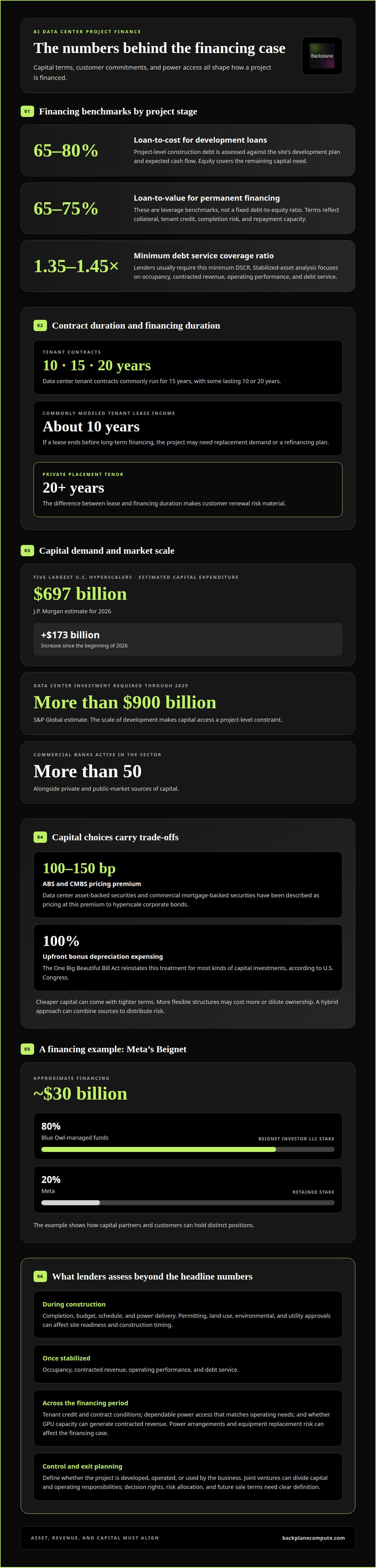
Tenant contracts turn future compute demand into potential project cash flow. The funding gap arises because construction spending starts before rent or service revenue begins. Data center tenant contracts commonly run for 15 years, with some lasting 10 or 20 years. Lenders assess tenant credit, contract conditions, and whether expected revenue supports the asset’s operating profile. A contract can strengthen the financing case, while its terms and timing shape exposure.
Construction and Stabilized-Asset Risk Analysis
Construction risk covers completion, budget, schedule, and power delivery; stabilized-asset analysis focuses on occupancy, contracted revenue, operating performance, and debt service. Lenders usually require a minimum debt service coverage ratio of 1.35x to 1.45x. The example ties construction funding to customer obligations and operating demands.
Project-Level Construction Debt
Project-level construction debt finances a defined site against its development plan and expected cash flow. Development loans typically use 65% to 80% loan-to-cost; permanent financing usually uses 65% to 75% loan-to-value. These are leverage benchmarks, not a fixed debt-to-equity ratio. Equity covers the remaining capital need, while loan terms reflect collateral, tenant credit, completion risk, and repayment capacity. Project debt makes those risks visible at the asset level.
Tax Incentives, Regulations, and Financing Due Diligence
The One Big Beautiful Bill Act reinstates 100 percent upfront bonus depreciation expensing for most kinds of capital investments, according to U.S. Congress. Applicable permitting, land-use, environmental, and utility approvals can affect site readiness and construction timing. Financing due diligence examines real estate control, power access, construction budgets and schedules, tenant credit, contract revenue, and projected cash flow. Together, these checks show whether delivery, stabilization, and debt repayment fit the project’s financing structure.
Control, operating roles and exit strategies
Control depends on a project’s chosen role: developer, operator, or customer. Developers deliver infrastructure and facilities; operators manage capacity and service delivery; customers secure compute for their workloads. A joint venture can divide capital and operating responsibilities, but decision rights, risk allocation, and future sale terms need to be clearly defined.
Lenders assess GPU capacity based on its ability to generate contracted revenue and examine whether power agreements provide dependable access that matches operating needs. They also review lease duration, tenant credit, renewal terms, and cash flow available to meet obligations. The key question is whether infrastructure and customer commitments remain aligned throughout the financing period.
Contracted cash flows can extend beyond a single lease. Tenant lease income is commonly modeled over about 10 years, while private placements for data center financing often have tenors of 20 or more years. That mismatch makes customer renewal risk material: if a hyperscale lease, typically around 10 years, ends before long-term financing, the project may need replacement demand or a refinancing plan. GPU capacity and power arrangements also affect whether the facility can serve a new tenant.
Exit planning starts with the intended company profile over the next 10 years. A developer may sell a stabilized, leased facility to recycle capital, then repeat the development cycle through a YieldCo/DevCo structure. A joint venture offers another route, allowing ownership and operating roles to be divided. In Meta’s Beignet financing, Blue Owl-managed funds held an 80% stake in Beignet Investor LLC, while Meta retained 20%; the financing was approximately $30 billion. The example shows how capital partners and customers can hold distinct positions.
For projects where ownership, financing, and operating roles must align, Infrastructure Financing Structuring can help shape the capital framework around the asset and its contracted demand.
Data center securitization and capital markets
Financing can take several forms, including joint ventures, asset-backed loans, and securitizations. The right mix depends on the company’s growth plan and portfolio, as well as its appetite for control and repayment risk.
Capital Strategy and Financing Trade-Offs
A capital strategy aligns financing structures with the company’s intended position over the next 10 years. It matters because cheaper capital can come with tighter terms, while flexible structures may cost more or dilute ownership. Data center ABS and CMBS have been described as pricing at a 100 to 150 basis point premium to hyperscale corporate bonds. A hybrid approach can combine capital sources to distribute risk. Public markets may broaden access, while private capital can bring sovereign and infrastructure funds into large projects.
Capital Requirements and Hyperscaler Spending
Data center development can require billions of dollars, making capital access a project-level constraint. J.P. Morgan estimates the five largest U.S. hyperscalers will spend $697 billion in capital expenditure in 2026, up $173 billion since the beginning of 2026. S&P Global estimates more than $900 billion of data center investment will be required through 2029. This growing demand puts pressure on developers to match project scale and financing duration. More than 50 commercial banks are active in the sector, alongside private and public-market sources.
Joint Ventures and Asset-Backed Loans
Joint ventures pair capital partners with developers or customers, sharing ownership and project exposure. Asset-backed loans instead rely on defined assets and their cash flows as financing support. Data center ABS leverage often runs at roughly 65-70% loan-to-value, with securitizations typically expected to mature in five years. Extending maturities to seven or ten years is under debate. These structures answer the question of how projects can access capital: a joint venture shares risk and control, while asset-backed financing connects repayment to facility assets and revenue. The choice affects refinancing needs, investor exposure, and the company’s ability to grow its portfolio.
Power availability and technology obsolescence
Power access and equipment life affect when a data center can open and how long its assets can support revenue. Financing needs to account for both electricity delivery and the replacement cycle for computing hardware.
Equipment and Backup Power Financing
Equipment financing funds the computing assets and electrical systems required to deliver capacity. Electrical systems account for 40% to 45% of total data center development costs, while AI hardware typically has a maximum useful life of five years. That mismatch matters: long-lived real estate may remain operational while GPUs need replacement. Financing structures should reflect separate asset lives, operating cash flows, and the cost of maintaining usable capacity.
Power Availability and Time to Power
Time to power is the period between securing a site and obtaining usable electricity at the required capacity. Before large AI-era facilities, cloud deployments typically drew 5 to 10 megawatts; modern campuses can require hundreds of megawatts. The U.S. power market is projected to need an additional 150 to 250 terawatt hours by 2030. Power delivery, redundancy, and permitting can therefore shape execution schedules and the timing of expected tenant cash flows.
No U.S. region is automatically best across power availability, permitting, and financing prospects. Northern Virginia has more than 300 data centers, but an established cluster alone does not establish site-level power access or permitting speed. Financing depends on whether a specific estate can secure the power and approvals its tenant needs.
Backup power also affects operating continuity. Data centers need 2X redundancy for continuous operation, so lenders and investors consider whether the power design supports the facility’s obligations. In a leased facility, the tenant’s service requirements shape the infrastructure investment and the cash flows expected to repay it.
GPU depreciation is indicated at 3-6 years, creating a shorter replacement cycle than the underlying facility. A transaction must account for equipment refresh needs alongside long-term property value. For sites where power access and asset viability shape execution, structure financing around site viability.
Backplane: Dedicated Financed Sites
Backplane connects AI compute demand with powered industrial sites and arranges financing to convert underused assets into operational GPU farms. Dedicated Financed Sites can suit compute buyers seeking a dedicated facility without waiting in hyperscaler queues. Teams that need compute access rather than a site can use GPUs-as-a-Service.
Site selection and capital structure need to work together. A Property Viability Assessment evaluates whether an industrial asset can support conversion, while Infrastructure Financing Structuring addresses how project capital can be arranged. These services fit projects where power access, property potential, and financing need to align.
If you are evaluating a site or planning dedicated AI compute capacity, contact Backplane to discuss your project.
Turn the Financing Thesis Into an Executable Plan
The next step is to turn your project’s investment thesis into a structure that can withstand changing conditions. Decide what role your organization will hold, how much control it needs, and what operating flexibility will matter as compute requirements evolve. Those choices shape the financing path, ownership model, and potential exit.
For AI data center project finance, execution depends on connecting the physical site to a durable commercial plan. Power access, customer demand, asset life, and capital obligations need to fit together. Mapping these dependencies can help decision-makers identify gaps before they constrain development or operations.
Bring the project’s site, capacity needs, and financing objectives into the next discussion. Discuss your project with Backplane and define a practical path from infrastructure opportunity to execution.
Frequently Asked Questions
How are AI data center projects financed in the United States?
U.S. projects combine sponsor equity with debt raised against development plans, operating assets, or contracted revenue. Structures may include project-level construction loans, joint ventures, asset-backed loans, and securitizations. Capital is often staged to match development and stabilization. For example, a financing plan can separate the facility from GPU assets, aligning each tranche with its collateral, repayment source, and expected useful life.
What are typical costs per megawatt for building an AI data center?
There is no single representative cost per megawatt; estimates depend on what the project includes. Site acquisition, electrical infrastructure, backup systems, building specifications, and GPU deployment all affect the total. Start by defining the scope, then separate facility costs from compute equipment and other project expenses. This makes comparisons more useful than a headline figure that combines different asset types.
How do AI data center financing costs compare with traditional data center financing?
Financing costs depend on a project’s risk profile, not simply on whether it serves AI workloads. AI projects may combine long-lived real estate with compute equipment that needs more frequent replacement. Lenders assess the assets securing repayment, revenue reliability, customer credit, and refinancing exposure. A traditional facility with stable occupancy may have a different risk mix; an AI-focused project’s financing cost reflects its specific equipment, power, and contract structure.
How do electricity prices, grid interconnection, and power purchase agreements affect project bankability?
Electricity costs affect operating margins, while interconnection determines whether a facility can draw the required power. Both influence the cash flow available for debt service. Power purchase agreements, which often run 10 to 25 years, can establish a longer-term supply arrangement. Their terms matter alongside delivery timing, price exposure, and the project’s expected operating needs. A delay in usable power can defer revenue even after construction advances.
What are the main construction, technology obsolescence, tenant, and refinancing risks?
Construction delays can postpone revenue and increase funding needs. Technology may lose commercial value before the facility does, making equipment replacement compete with debt repayment for capital. Tenant risk includes vacancy, weaker credit, or nonrenewal; refinancing risk arises when debt matures before leases or replacement revenue can support repayment. For example, a delayed power connection could push operations beyond the expected start of a tenant contract.


