

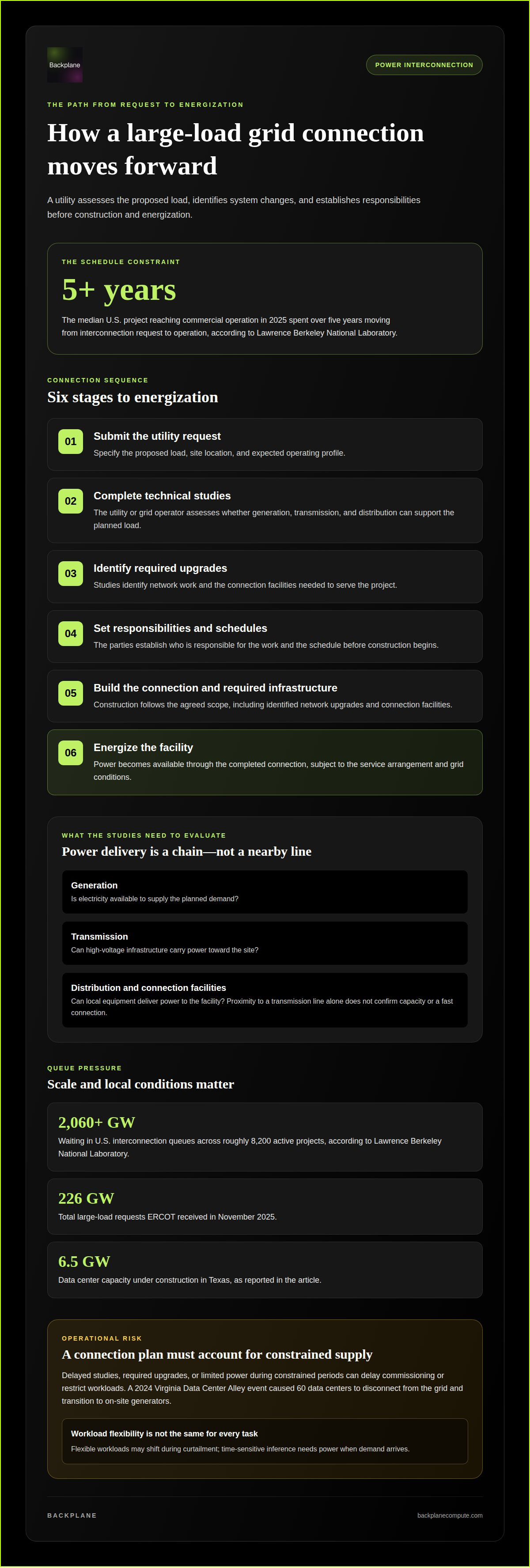
The median U.S. project that reached commercial operation in 2025 spent over five years moving from interconnection request to operation, according to Lawrence Berkeley National Laboratory. That’s the central constraint in power interconnection for AI compute: securing grid capacity can take longer than planning the facility itself.
The pressure is understandable. AI infrastructure needs substantial, dependable power, but a site’s proximity to a transmission line does not guarantee a fast connection or enough capacity. Queue position, grid upgrades, workload requirements, and cost allocation all shape the path forward.
This article explains how interconnection queues work, why generation, transmission, and on-site infrastructure affect timelines, and how training and inference workloads influence power needs. It also explains who may bear connection and upgrade costs, helping you assess the trade-offs involved in bringing compute infrastructure online.
Key Takeaways
- Lawrence Berkeley National Laboratory reports that more than 2,060 GW of capacity is waiting in U.S. interconnection queues across roughly 8,200 active projects. Queue position is only one part of assessing a site’s path to power.
- Separate generation, transmission, and distribution constraints to see where a project may face bottlenecks and infrastructure requirements.
- Distinguish training from inference needs: workload patterns and power density shape the facility’s demand profile.
- Map connection and grid-upgrade costs to the infrastructure they fund. The allocation can affect project economics and site viability.
Interconnection queue outcomes and wait times
Queue status can shape an AI project’s schedule as much as site construction. Lawrence Berkeley National Laboratory reports more than 2,060 GW waiting in U.S. interconnection queues across roughly 8,200 active projects.
Interconnection Delays and Wait Times
An interconnection queue is the process grid operators use to study proposed connections and determine required system changes. Lawrence Berkeley National Laboratory reports that the median U.S. project reaching commercial operation in 2025 spent over five years moving from request to operation. For AI developers, that interval can delay revenue, equipment deployment, and a planned facility’s capacity. Large-load requests add pressure: ERCOT received requests totaling 226 GW in November 2025, while 6.5 GW of data center capacity was under construction in Texas.
Regional and Utility Power Availability
The United States has three largely separate grids: the Eastern Interconnection, the Western Interconnection, and ERCOT. No region or utility can be ranked universally as the fastest for AI data centers; practical availability depends on local grid capacity, the proposed connection point, and upgrades identified in studies. A site near industrial power infrastructure may have useful assets, but proximity alone doesn’t establish that the grid can serve its planned load. Compare candidate sites by their specific utility process and constraints, not by regional labels.
Large-Load Utility Interconnection Steps
A large-load interconnection typically proceeds from a utility request to technical studies, an upgrade plan, an agreement, and construction before energization. The applicant specifies the load, location, and expected operating profile; the utility or grid operator assesses whether generation, transmission, and distribution can support it. The studies identify required network work and connection facilities. The parties then establish responsibilities and schedules before construction begins. Complete, consistent load details help studies proceed efficiently and reduce avoidable revisions.
Risks from Grid Constraints and Curtailment
Interconnection risk includes delayed studies, required grid upgrades, and limits on power available during constrained periods. For an AI data center, these can push back commissioning or restrict workloads that depend on continuous capacity. A 2024 Virginia Data Center Alley event caused 60 data centers to disconnect from the grid and transition to on-site generators. Curtailment arrangements can affect operations too: flexible workloads may shift, but time-sensitive inference needs power when demand arrives. Site plans should account for the operating consequences of constrained supply.
Electricity generation, transmission, and distribution
Electricity reaches a data center through a chain of generation, transmission, and local delivery. Each stage creates a distinct constraint, so a nearby power source alone doesn’t establish a usable connection.
Grid Power Delivery
Grid delivery moves electricity from generators across high-voltage transmission lines, then through distribution equipment to the facility. This physical chain matters because an AI data center needs both available generation and infrastructure capable of carrying its load. A data center drawing 20 MW or more connects at transmission level, typically at 69-230 kV. The connection design then determines the equipment needed to deliver power to campus systems.
Comparing Power Supply Arrangements
Grid supply relies on utility infrastructure; behind-the-meter generation produces electricity at or near the facility; dedicated power contracts establish a defined supply relationship with a generator. These options differ in how electricity is delivered and which infrastructure the project must coordinate. Grid supply depends on network capacity. On-site generation requires physical equipment and operational planning. A contract can set commercial terms, but it does not build transmission or guarantee that electricity can reach the data center.
Rules for Large-Load Interconnections
Large-load requirements vary with the state, utility, grid operator, and connection point. Utilities apply their service rules and technical requirements; state processes can govern siting and related approvals. FERC Order No. 2003 established standardized interconnection procedures for large generators greater than 20 megawatts, not a universal large-load application process. FERC Order No. 2023 and Order No. 2023-A address generator interconnection procedures, so they matter when a project also connects generation.
Securing Power Through Agreements and Co-Location
A utility agreement formalizes the connection and service arrangement, while a power purchase agreement sets commercial terms between a buyer and generator. Co-location places compute near a power plant, potentially shortening the physical distance between generation and use. None removes the need to address transmission access, utility requirements, and site infrastructure. Before committing capital to a dedicated supply strategy, align the contract, interconnection scope, and facility plan. A site viability assessment can help determine whether existing industrial infrastructure supports that approach.
Training and inference power requirements
AI training and inference create different electricity demand profiles, and that distinction shapes facility design. Training runs large computational jobs across GPU clusters, often sustaining high demand for extended periods. GPT-3 training is estimated to have consumed 1.29 GWh of electricity. One reported training run used 10,000 NVIDIA V100 GPUs for approximately 14.8 days. That concentrated load makes the utility connection and internal electrical systems central to project capacity. Planning power interconnection for AI compute starts with understanding this demand profile.
Rack density is a key constraint. AI data-center racks typically draw 30 kW to over 100 kW per rack, compared with 7 to 10 kW for traditional data-center racks. Higher density changes the facility’s power and cooling requirements. An enterprise data center typically has a power usage effectiveness, or PUE, of around 1.5 to 1.6. PUE compares total facility electricity with IT electricity, showing how much power supports cooling and other infrastructure.
Inference serves model outputs and can create a more variable pattern, especially as demand changes through the day. Latency-sensitive applications may need compute close to users or data sources, making network capacity and local power availability relevant. Training workloads can offer more flexibility: shifting eligible jobs to different times may reduce operational costs by up to 12% and carbon emissions by approximately 10%. This can align demand with available electricity, but it doesn’t remove grid constraints.
Define the expected load profile, peak requirements, and which workloads can move in time or location. Then match those needs to utility capacity and the site’s electrical design. AI data-center power demand is projected to add about 125 GW by 2030 from a 2025 base. That scale makes workload flexibility a practical planning lever. The interconnection remains the physical link between installed compute and usable power, so power interconnection for AI compute must reflect both present demand and the facility’s planned operating model.
Infrastructure costs and who pays
Interconnection economics extend beyond the line connecting a data center to the grid. Operators must account for connection equipment, required network upgrades, on-site electrical infrastructure, and electricity procurement. The interconnection study identifies the required work, while utility agreements and regulatory rules shape cost allocation. Responsibility may differ for project-specific facilities and broader grid improvements. For power interconnection for AI compute, the study and agreement help clarify which costs are assigned to the project.
System costs are already affecting large-load economics. The auction cost rose 833% from the prior year. These figures describe regional capacity costs, not an individual project’s connection bill. Virginia’s State Corporation Commission created a new pricing tier for customers consuming over 25 MW in 2025, illustrating how regulatory models can distinguish large users.
Cost models also affect who ultimately bears the expense of grid expansion. That is a system-wide estimate, not a facility quote. Whether operators face costs through direct upgrade obligations, utility charges, or power arrangements depends on the applicable process and project structure. Queues can increase exposure when delays extend land, equipment, or financing commitments.
Separate the project budget into connection assets, network upgrades, campus infrastructure, and ongoing power supply. Then map each item to the responsible party under the utility agreement and financing structure. This makes allocation visible before major commitments and helps assess whether an existing industrial site can reduce new infrastructure requirements. A financing structure for power interconnection for AI compute can bring those obligations and delivery schedules into one project model. Structure infrastructure financing around the assets, upgrade obligations, and delivery schedule.
Backplane
Backplane connects AI compute demand with powered industrial sites and financing pathways. When queue delays or infrastructure requirements complicate a project, its Property Viability Assessment helps evaluate whether an underused site can support compute infrastructure. Infrastructure Financing Structuring addresses how the conversion can be financed. Operators seeking capacity without developing a dedicated facility can access GPU capacity through GPUs-as-a-Service, while Dedicated Financed Sites offer a path to a dedicated site.
The right route depends on the workload, site requirements, power access, and delivery priorities. Backplane helps align those considerations with a practical infrastructure pathway. Contact Backplane to discuss your project.
Turn Power Strategy Into a Project Plan
The next step is to turn power assumptions into a decision-ready project structure. Align the site, workload, connection pathway, and financing plan before commitments are made. This gives stakeholders a shared basis for weighing trade-offs, assigning responsibilities, and sequencing development. A sound approach to power interconnection for AI compute treats electricity access as a core project input, not a late-stage utility task.
Use that framework to identify the choices that matter most: whether the location fits the intended workload, how power access shapes deployment, and which infrastructure obligations affect project viability. Backplane can help connect those considerations to an actionable compute strategy. Discuss your AI power project with Backplane and move the next decision forward with clarity.
Frequently Asked Questions
What does power interconnection mean for AI data centers and large compute facilities?
Power interconnection is the process of connecting a facility’s electrical systems to the utility grid under an approved service arrangement. It establishes how electricity reaches the campus, what connection equipment is required, and how the facility can draw power. It is distinct from buying electricity: a power contract sets supply terms, while interconnection covers the physical connection and its operating requirements.
How much electricity and what grid capacity does a large AI data center require?
There is no single electricity requirement for every AI data center; needed capacity depends on the facility’s planned IT load and operating profile. A GPU campus running intensive training may have a different peak pattern from one serving inference applications. Capacity planning also accounts for cooling, electrical losses, redundancy, and future phases. The utility evaluates the requested load and whether its network can serve it.
How long does utility interconnection take for a new data center in the United States?
Plan for a multi-year process. Lawrence Berkeley National Laboratory reports that the median U.S. project reaching commercial operation in 2025 spent over five years from interconnection request to operation. That interval covers more than queue review alone: studies can identify upgrades, which must be agreed, funded, and built before service begins. A project’s schedule depends on its connection scope and required grid work.
What are the typical costs and fees for connecting a data center to the power grid?
Connection costs can include utility connection facilities, transmission or distribution upgrades, substation equipment, and on-site electrical infrastructure. The utility study identifies the work needed to serve the load; the service agreement and applicable rate structures determine how costs are assigned. A constrained connection point may require more network work than one with suitable capacity. Separate these project costs from ongoing electricity charges when building a financial model.
What transmission, substation, and on-site infrastructure is needed to interconnect an AI compute campus?
A campus may need a transmission connection, a substation to transform voltage, and on-site equipment to distribute power to buildings and GPU systems. Protection, switching, and metering equipment support safe operation and utility coordination. The design follows the requested load and connection point. A 100 MW data center typically needs two independent utility feeds for redundancy, making feed routing and campus electrical design key planning considerations.


