

Can stranded power become a durable source of value, or is the site too constrained to support compute? Stranded power asset monetization starts with answering that question. Available capacity alone isn’t enough. Power availability, interconnection, site readiness, compute demand, and financing all shape whether idle infrastructure can support viable operations.
The uncertainty is real. A site may have power but no practical route to buyers, while AI compute brings technical and commercial requirements that may be new to an asset owner. The right route depends on the asset and its constraints, not on demand headlines alone.
This article explains how to assess whether a site can support compute, compare monetization routes against real-world constraints, and identify diligence that can surface gaps early. It also shows how property owners, compute buyers, and financing can align around a workable project. From retired power plants and closed mills to decommissioned crypto-mining facilities, the opportunity is specific: match usable power with credible demand and an executable infrastructure plan.
Key Takeaways
- Distinguish curtailed electricity, isolated generation, interconnection limits, and underused industrial power before assessing an asset’s potential.
- Trace the path from power source and site control to electrical delivery, compute infrastructure, and a credible buyer. Behind-the-meter use doesn’t eliminate every utility or permitting constraint.
- Screen the asset in a consistent sequence to separate deal-breaking limitations from issues that project design or transaction structure may address.
- Compare exporting power, serving onsite load, and supporting compute by power firmness, infrastructure needs, demand certainty, and execution complexity.
- Stranded power asset monetization depends on aligning the site, compute demand, and financing. Property viability assessment and buyer alignment can help advance a transaction.
What stranded power means for asset owners considering monetization
Power can exist without a practical route to a buyer. A generator may produce electricity that cannot be exported efficiently. A facility may have more electrical capacity than its current operations use. In either case, potential value is constrained by location, infrastructure, operating conditions, or demand. The broader concept of a stranded asset helps frame the issue, but power assets need their own operational assessment.
Stranded power is usable or potential electricity-generating capacity that cannot reach a valuable market or use under current physical, infrastructure, or commercial conditions. This distinction separates physical availability from project value. A site can have generation equipment or an available power supply and still lack the delivery path, reliability, or buyer needed to make monetization viable.
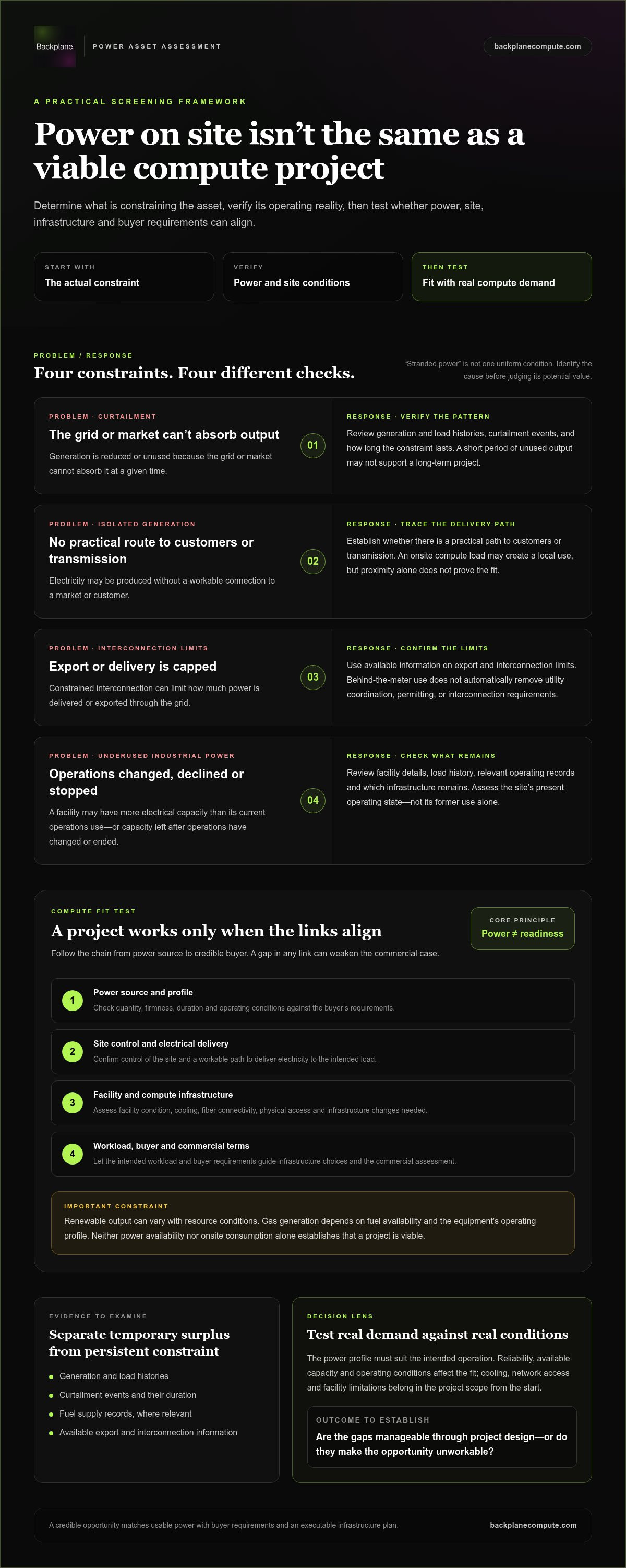
The causes differ. Curtailed electricity is generation reduced or unused because the grid or market cannot absorb it at a given time. Isolated generation lacks a practical connection to customers or transmission. Constrained interconnection limits how much power can be delivered or exported through the grid. Underused industrial power may reflect capacity left over after a facility’s operations have declined, changed, or stopped. These conditions aren’t interchangeable, and none means the electricity is free, continuous, or commercially available.
Which power constraints can create a stranded asset?
Transmission congestion can restrict delivery even when a generator is operating. Limited export access can leave a site with few routes to market, while local demand may not match the quantity or timing of available power. Renewable output can vary with resource conditions; gas generation depends on fuel availability and the equipment’s operating profile. Industrial capacity may depend on which infrastructure remains and the site’s present operating state.
Use asset-specific records to distinguish a temporary surplus from a persistent constraint. Review generation and load histories, curtailment events, fuel supply records where relevant, and available information on export or interconnection limits. A short period of unused output may not support a long-term project. A recurring constraint may justify deeper analysis, but only after its cause and duration are understood.
Why compute demand changes the monetization question
An onsite compute load can create a local use for power that is difficult to move elsewhere. But matching electricity to compute takes more than proximity. The power profile must suit the intended operation, and the site must support the necessary infrastructure and commercial arrangement. Reliability, available capacity, and operating conditions all affect the fit.
Compute isn’t an automatic answer. Intermittent or limited power may not meet a buyer’s requirements, and site or delivery constraints can remain even when electricity is consumed onsite. Effective stranded power asset monetization starts by testing the asset against actual demand, then determining whether gaps are manageable through project design or make the opportunity unworkable.
How stranded power becomes a compute infrastructure opportunity
Turning constrained power into compute takes more than placing servers beside a generator. The project must connect a power source and a controlled site to electrical delivery, suitable compute infrastructure, and a buyer whose requirements match what the site can support. A gap in any link can weaken the commercial case, even if the others look strong.
Power alone doesn’t make a site compute-ready. The power profile, physical facility, network access, workload, and commercial terms must work as one system. That alignment is central to stranded power asset monetization. The energy transition can also change the long-term value and use of existing assets, as discussed in the International Renewable Energy Agency’s perspective on energy transition and stranded power assets.
What must align between power and compute?
Start with the buyer’s requirements, then compare them with the site’s actual power quantity, firmness, duration, and operating profile. A supply that fluctuates or is available only under particular conditions may suit some workloads better than others. Let the intended workload guide infrastructure choices, rather than designing infrastructure before establishing what the buyer needs.
Power is only one dependency. The site also needs a workable approach to cooling, fiber connectivity, physical access, and facility condition. These factors affect whether compute equipment can be installed, connected, and operated as intended. Behind-the-meter use can create a local path from generation to load, but it doesn’t automatically remove utility coordination, permitting, or interconnection requirements that may apply to the project.
Build the concept around verified site constraints. If cooling, network access, or facility limitations require changes, include them in the project scope and commercial assessment from the start. Don’t leave them until after a buyer has been matched.
How the commercial parties fit together
The asset owner brings control of the site and information needed to assess it, including power records, facility details, and relevant operating conditions. The compute buyer brings workload requirements and needs confidence that the site can support deployment under workable operating terms. Neither side can evaluate the opportunity in isolation.
Project development and financing connect those interests. The parties must define responsibilities, required infrastructure, operating arrangements, and how investment will be structured. Financing feasibility depends on the project, the counterparties, and supporting diligence. Backplane’s two-sided brokerage model brings property owners and compute buyers into the same transaction process, with property viability assessment and infrastructure financing structuring to organize the opportunity.
For owners and buyers assessing a potential fit, Backplane’s powered-site and compute approach provides a starting point for aligning asset information, demand, and project structure.
How to assess whether a stranded power asset can be monetized
Screen the asset in sequence. Start with control: can the owner secure access to the site and the infrastructure needed for a project? Then establish the power profile, delivery constraints, site readiness, plausible demand, and financing requirements. Each step narrows the opportunity. A constraint may be fatal if it blocks access or dependable power. Other gaps, such as facility upgrades or a different project structure, may be addressable if the economics support them.
Screen power, site control, and infrastructure
Build the assessment from records, not nameplate capacity alone. Review generation and load history, curtailment records, fuel arrangements where relevant, and the expected operating profile. Confirm site control and document existing electrical infrastructure, facility condition, cooling potential, network access, and known physical limitations. For broader siting factors, use the AI data center site selection criteria as a companion framework.
Separate constraints into two categories. Lack of site control or power delivery that cannot meet the project’s needs may stop the opportunity. A facility condition that can be improved, or an infrastructure gap that design can address, may be manageable. Interconnection, permitting, and environmental diligence are project-specific workstreams. Don’t assume an onsite configuration removes them.
Test demand and commercial viability
Identify a plausible buyer and workload before treating available capacity as contracted demand. Compare buyer requirements with the site’s power quantity, firmness, duration, and operating profile. Then assess the infrastructure and operating arrangements that use would require. Model economics with verified inputs, including project scope, power costs, infrastructure needs, and commercial terms. Avoid universal returns or payback claims: outcomes depend on the asset and transaction.
Compare the main routes against the same constraints:
Power export
Tests whether transmission access and market demand can support delivery beyond the site.
Onsite industrial use
Fits power to an existing local load, subject to operating needs and facility conditions.
Compute hosting
Matches power with compute demand, while adding requirements for cooling, network access, and suitable infrastructure.
Use asset records and primary sources to verify market statistics, power availability, interconnection status, and other project-specific inputs. Treat any feasibility conclusion as provisional until the underlying evidence supports it. This is the core discipline of stranded power asset monetization: distinguish a theoretically available resource from a viable, financeable project.
Which monetization route fits a stranded power asset?
The strongest route is the one that matches the asset’s operating reality, not the one attracting the most attention. Compare power firmness, required infrastructure, demand certainty, and execution complexity across three options: exporting electricity, serving an existing onsite load, or supporting compute infrastructure. The same site may suit one route and fail another.
- Export power: A fit when the asset can deliver electricity to a market or buyer through available infrastructure. Export access and market demand are central dependencies.
- Serve onsite industrial use: A fit when an operating facility has a compatible local load. Existing infrastructure may help, but the load’s timing and operating requirements still matter.
- Host compute: A fit when power can support a credible buyer and the site can accommodate the required compute, cooling, and network infrastructure. It adds development and commercial coordination.
Evaluate each route against the same verified facts. A dependable power profile may support more options than intermittent availability, but it doesn’t establish demand or project economics by itself. Existing equipment or buildings may reduce some development needs without proving that a project is viable. Compare alternatives on their own merits before choosing a direction.
When compute may be a strong fit
Compute deserves deeper consideration when local power constraints coexist with credible buyer demand and site infrastructure that can support deployment. The commercial model should reflect the buyer’s needs: GPUs-as-a-Service can provide access to compute capacity, while a dedicated financed site may suit a buyer seeking a site structured around its project. Workload, deployment design, and contract structure determine the appropriate fit; neither model overrides site constraints.
Include financing in the comparison early. Capital structure, project responsibilities, and the relationship between the asset owner and compute buyer can shape whether a technically plausible site becomes commercially actionable. For more on those considerations, see this guide to financing AI infrastructure.
When another use may make more sense
Unstable power, weak connectivity, limited site control, or a lack of credible buyer demand can undermine a compute case. If an existing industrial load can use the power, or export access offers a clearer route to market, those alternatives may be more practical. Sunk infrastructure is not a reason to force a new use.
Compare project scope, required upgrades, demand evidence, operating requirements, and financing structure for each option. The result may be compute, another use, or no investable project under current conditions. That discipline keeps stranded power asset monetization grounded in asset-specific evidence rather than assumptions. Assess a powered site for compute viability as part of evaluating a potential fit.
How Backplane helps move a viable asset toward a transaction
A promising site still needs a path from physical potential to a workable transaction. Backplane connects powered industrial sites with AI compute demand, bringing asset owners and compute buyers into the same process. The sequence is practical: assemble site and power information, assess viability, identify relevant demand, and develop a project structure grounded in verified requirements.
This two-sided matching model matters because owners and compute buyers assess different risks. Owners need to understand how the asset could be used and what changes may be required. Buyers need confidence that a site’s power and infrastructure can support their intended deployment. AI infrastructure brokerage connects those perspectives while keeping the project’s physical and commercial constraints in view.
From site assessment to a financeable project
Backplane’s property viability assessment considers the site, its power constraints, existing infrastructure, and potential fit with compute demand. It helps distinguish a viable direction from a concept with material gaps and gives owners and buyers a clearer basis for discussing scope, responsibilities, and project requirements.
Where the fundamentals support further work, Backplane aligns the asset with relevant compute demand and helps structure infrastructure financing. Financing structure and deployment coordination depend on the specific site, buyer, and project requirements. They aren’t automatic outcomes of an initial assessment. Establish capacity, operating profile, interconnection status, and financing terms for the project rather than assuming them.
What asset owners can prepare for an initial assessment
Organized information makes it easier to identify both the opportunity and the open questions. Owners can gather materials such as:
- Site-control details and information about existing facilities or electrical infrastructure.
- Generation, load, and power availability records, along with relevant operating history.
- Existing technical or site studies and documentation of known constraints.
- A summary of current energy use, curtailment, export limitations, and fuel arrangements where relevant.
- Information on facility condition, cooling potential, and network access, if available.
These materials ground the assessment in the asset’s actual condition. Backplane tailors viability assessment, buyer alignment, and transaction structure to project details. The process applies whether the opportunity involves a retired power plant, a closed mill, or a decommissioned crypto-mining facility. Each asset presents a distinct combination of site control, power profile, infrastructure, and demand.
Move From Potential to a Defined Project
The next step is not to force a use case. It’s to establish what the asset can support, what a buyer needs, and whether those conditions can form a workable transaction. Treat stranded power asset monetization as an investment decision grounded in evidence, not a bet on demand alone.
Bringing the right parties and project questions together early helps clarify the path forward. Backplane connects powered industrial sites with AI compute buyers, using property viability assessment and infrastructure financing structuring to help owners evaluate a potential project. That creates a clearer basis for deciding whether to advance, reshape, or set aside an opportunity.
Frequently Asked Questions
Does stranded power mean the electricity is free?
No. “Stranded” describes a constraint, not a zero-cost supply. A useful first step is to estimate the power’s net value under each realistic use, accounting for generation and delivery costs, operating obligations, and the value of any use that would be displaced. Contract terms can also affect what the owner may do with the output. A compute case only holds if its power arrangement and expected demand work together under verified assumptions.
Can stranded power support AI compute if generation is intermittent?
Potentially, if the project’s operating design matches the supply pattern and the buyer’s reliability requirements. Compare the timing and variability of generation with the workload’s tolerance for interruptions. Flexible processing, storage, or complementary supply might help shape a workable design, but each introduces requirements that need assessment. For example, a workload that can pause or shift may fit a different supply profile than one requiring consistent availability.
Does behind-the-meter computing eliminate the need for grid interconnection?
Not necessarily. Using power locally doesn’t by itself resolve how the site imports electricity, exports surplus, or handles backup supply. Map the existing electrical arrangement, including who owns and operates relevant equipment and how power flows between generation, facility loads, and any grid connection. Utility coordination, permits, and other approvals remain specific to the project and its existing setup.
How do owners compare compute with selling surplus power?
Compare both routes using the same power profile, evaluation period, and documented assumptions. Include achievable export terms, compute buyer demand, infrastructure requirements, operating obligations, and financing needs. Then test how the result changes if generation varies, a buyer’s use ramps differently than planned, or required upgrades affect project scope. This makes the trade-offs visible without assuming that compute or power sales will always deliver greater value.
Can a retired power plant or closed mill become a compute site?
Yes, either may merit consideration, but its former use doesn’t prove present-day suitability. Start by locating current electrical drawings and records, then compare them with the equipment and structures that remain onsite. A retired plant may retain useful infrastructure, while a closed mill may have a different combination of power access and facility constraints. A project still needs a design that fits actual conditions and a buyer’s requirements.
What information should an asset owner assemble before exploring monetization?
Gather records that show how the site operates, not just a summary of its capacity. Include site-control documents, power and fuel agreements, generation and consumption histories, curtailment or export records, existing studies, and known operating constraints. Note each document’s date and the period it covers, and flag gaps or conflicting figures rather than resolving them by assumption. An organized record supports a more grounded stranded power asset monetization assessment.
To assess whether your powered site could align with compute demand and project financing, explore a project with Backplane.


