

At scale, GPU hosting isn’t a server purchase. It’s a capacity architecture decision. Large scale GPU hosting depends on more than securing enough accelerators: power, cooling, networking, and deployment readiness all shape whether a cluster can support production workloads.
If you’re weighing cloud, dedicated, and hosted infrastructure, compare how each model handles capacity access, control, operational responsibilities, and changing demand. A capacity figure alone doesn’t tell you whether the underlying site, delivery plan, or service boundary fits your workload. Start with the performance and control you need, then evaluate the infrastructure and commitments required to deliver them.
This article compares the main hosting models and the technical and commercial criteria that matter when evaluating GPU capacity. It also covers common delivery constraints, from power and cooling to timelines and operational responsibilities. Backplane connects compute demand with powered industrial sites and structures infrastructure financing, linking site viability assessment with the path to deployable capacity.
Key Takeaways
- Evaluate large scale GPU hosting as an integrated capacity decision, not just a choice of servers.
- Trace how power, cooling, and networking affect the usable GPU capacity your workload can rely on.
- Compare cloud, dedicated clusters, and hosted sites by elasticity, control, capacity access, operational scope, and commitment structure.
- Estimate demand using GPU hours, concurrency, growth assumptions, and utilization patterns before comparing models.
- Connect compute requirements with site viability and infrastructure financing to map a practical path toward deployment.
What Large-Scale GPU Hosting Means for Enterprise Workloads
Large-scale GPU hosting is GPU capacity delivered through cloud, dedicated-cluster, or site-based infrastructure, without requiring the workload owner to purchase and operate the underlying hardware. Buying a GPU server secures a machine. Hosting defines how compute is provisioned, connected, powered, cooled, and operated as a usable environment.
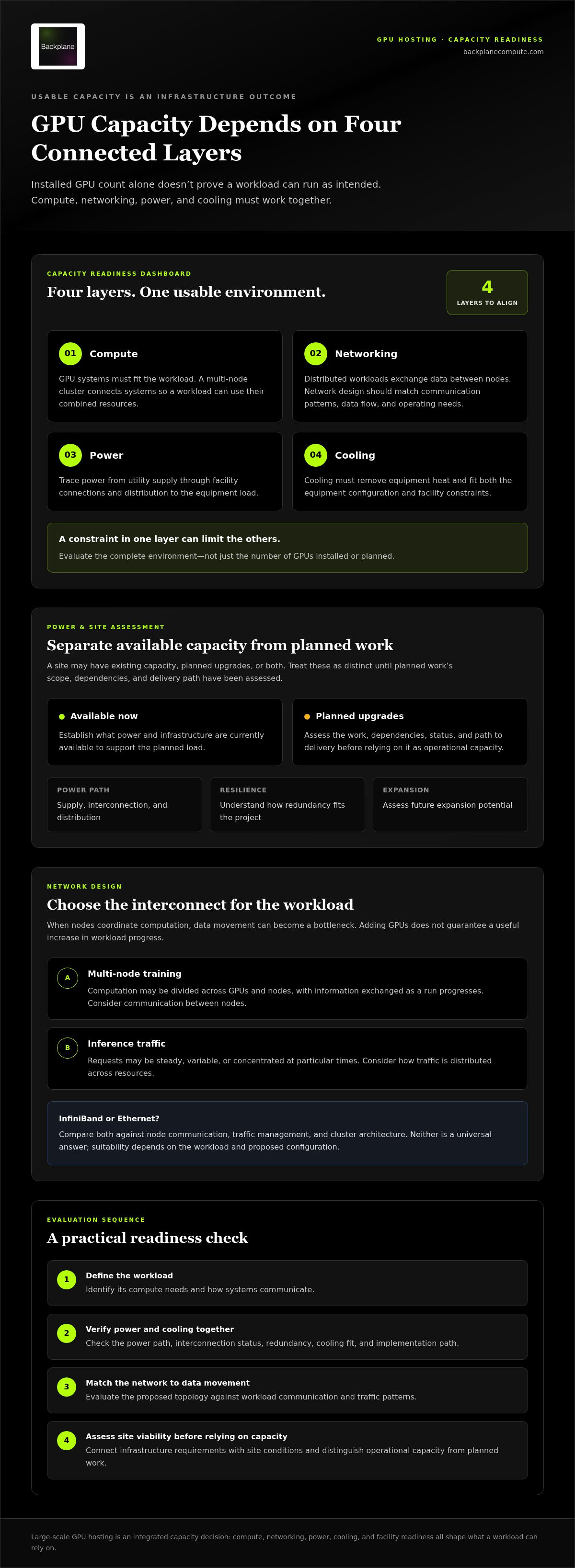
There’s no universal GPU count that defines a large deployment. A GPU server is a physical system; a multi-node cluster connects multiple systems so a workload can use their combined resources. The difference is architecture and workload fit, not a fixed threshold. When systems are distributed across nodes, the network becomes part of the compute design. A GPU cluster relies on coordinated components, not simply a larger inventory of accelerators.
That coordination extends beyond the rack. GPU capacity depends on how compute, cluster networking, available power, cooling, and facility operations fit together. A constraint in one layer can limit the others. For enterprise planning, the question isn’t only how many GPUs can be provisioned. It’s whether the complete environment can support the way those GPUs need to work.
Which workloads drive demand for large GPU clusters?
Multi-node model training can divide computation across GPUs and nodes, then exchange information as a run progresses. Adding GPUs alone doesn’t guarantee a useful increase in capacity: communication between nodes matters too. Model development and fine-tuning may involve repeated training runs, with demand shaped by model size, parallelism, and job scheduling.
Inference has a different profile. Production inference serves requests after a model is trained, and demand may be steady, variable, or concentrated at particular times. Capacity needs depend on factors such as request volume and response expectations. Training and inference can both require substantial GPU resources, but their concurrency and utilization patterns differ. Treating them as one demand profile can leave capacity poorly matched to actual use.
What does GPU hosting include beyond the hardware?
Hosting can bring together compute access, cluster networking, power, cooling, and facility operations. These infrastructure layers make GPU resources available, but their scope varies by arrangement. Cloud, dedicated, and site-based models can assign responsibility differently, so the service and contract define the hosting boundary.
Infrastructure provision is distinct from workload orchestration and model operations. Orchestration governs how jobs are scheduled and resources assigned; model operations cover the software and processes used to develop, deploy, and maintain models. Don’t assume hosted capacity includes these layers. Map the boundary explicitly: identify what the hosting arrangement provides, what your team operates, and where responsibilities meet. This clarity is essential when comparing large scale GPU hosting for multi-node workloads.
How Power, Cooling, and Networking Shape Hosted GPU Capacity
Usable GPU capacity starts upstream of the server. Utility power must reach the facility, connect to the required infrastructure, and support the planned load. Power distribution must then serve the equipment, while cooling removes the heat it produces. Only when these layers align can installed hardware operate as intended. Available power, interconnection status, redundancy, and expansion potential are separate considerations, not interchangeable signs of readiness.
Installed GPU count alone doesn’t prove usable capacity; power, cooling, and network design must sustain the workload together. A site may have existing capacity, planned upgrades, or both. Don’t count planned work as operational capacity until its scope, dependencies, and delivery path have been assessed. A property viability assessment can connect infrastructure requirements with site conditions before a hosting plan relies on assumed capacity.
How should buyers assess power and cooling readiness?
Start with the power path. Distinguish what is available now from what is proposed, establish the status of interconnection, and understand how redundancy and future expansion fit the project. Then assess cooling against the equipment configuration and facility constraints. Higher equipment density makes heat removal a more demanding design consideration, but no single cooling approach suits every site or deployment.
Evaluate power and cooling together. A power plan that supports the intended load still needs a compatible cooling design and a credible implementation path. For large scale GPU hosting, assessing powered industrial sites against committed compute demand helps surface these dependencies during infrastructure planning.
Why do interconnects matter in multi-node GPU hosting?
Distributed workloads move data between nodes as they coordinate computation. If data movement becomes a bottleneck, adding GPUs may not translate into proportionate workload progress. Training that frequently synchronizes across nodes places different demands on network throughput and latency than inference traffic distributed across resources. Choose a design based on the workload’s communication pattern, data flow, and operating needs rather than defaulting to a standard topology.
Compare InfiniBand and Ethernet against those requirements. Consider how nodes communicate, how traffic is managed, and how the network fits the cluster architecture. Neither technology is a universal answer; suitability depends on the workload and proposed configuration. A GPU cluster technical overview offers context on parallel computing and data organization across host and device memory, both relevant to understanding how infrastructure supports distributed work.
A practical review connects site and network questions to defined compute demand. Backplane connects AI compute buyers with powered industrial properties and structures financing for GPU infrastructure, bringing site viability and project requirements into the same assessment. GPU infrastructure site assessment is one part of translating compute needs into a deployable plan.
Cloud, Dedicated Clusters, or Hosted Sites: Compare the Models
The right model depends on how demand changes, how much control the workload needs, and who carries responsibility for infrastructure. Cloud, dedicated clusters, and hosted sites can all provide GPU access, but differ in how capacity is provisioned and what the buyer commits to. Compare the operating model, not just how GPUs are presented.
| Consideration | Cloud | Dedicated cluster | Hosted site |
|---|---|---|---|
| Elasticity | Often suited to workloads that change over time; provisioning depends on the provider and deployment. | Capacity is assigned to a defined deployment and may be less flexible to resize. | Expansion follows site infrastructure and project plans. |
| Control | Provider interfaces and service boundaries shape control. | Provides a defined environment for cluster-level planning. | Can align compute plans with a specific facility footprint. |
| Capacity access | Depends on current provider capacity and terms. | Organized around an allocated cluster. | Depends on site readiness and infrastructure delivery. |
| Operational scope | Provider services may cover parts of infrastructure management. | Responsibilities depend on the hosting arrangement. | Facility infrastructure and compute operations may have distinct owners. |
| Commitment | Set by the service and contract. | Structured around dedicated capacity and agreed terms. | May involve project-level infrastructure and financing commitments. |
GPU access isn’t the same as GPU ownership. A buyer may consume compute as a service, reserve a dedicated cluster, or align demand with a site-based infrastructure project. Financing and ownership are separate questions. In a hosted arrangement, responsibility for facility infrastructure, compute systems, and workload operations can sit with different parties. The contract defines those boundaries.
When does cloud-based GPU hosting fit?
Cloud can suit variable workloads that benefit from flexible provisioning and managed interfaces. Teams developing models, running experiments, or serving changing inference demand may value the ability to adjust how they access resources. Capacity access and commercial terms depend on the provider and deployment, so assess flexibility against workload concurrency, duration, and the need for predictable access. For a closer look at service structures, see the enterprise GPUs-as-a-Service guide.
When should buyers evaluate dedicated or site-based capacity?
Evaluate dedicated capacity when demand is sustained, control requirements are specific, or the workload needs a defined infrastructure footprint. A dedicated cluster can align compute access with a planned operating model; a hosted site adds facility viability and infrastructure delivery to the decision. Backplane connects compute buyers with powered industrial sites and structures infrastructure financing. Its property viability assessment relates site conditions to committed demand. Explore how dedicated AI compute sites fit broader private infrastructure planning.
For large scale GPU hosting, weigh elasticity against control, and compute access against delivery responsibility. The best fit is the model whose capacity and commitments match the workload’s actual operating pattern.
A Practical Framework for Sizing and Evaluating GPU Hosting
A sound hosting decision starts with workload evidence, not a target GPU count. Use the same assumptions to size demand, compare models, and test whether a proposed deployment can be delivered. This keeps technical requirements and commercial terms connected from the first estimate.
- 1. Define the workload. Separate model training, fine-tuning, and inference. Record what each workload does, how it runs, and when it needs capacity.
- 2. Estimate demand. Project GPU hours, concurrency, peak demand, expected utilization, and growth assumptions. Distinguish sustained requirements from temporary peaks instead of combining them into one estimate.
- 3. Map dependencies. Document model-specific GPU and memory assumptions for technical validation. Include network design, storage paths, power, cooling, security requirements, and operational ownership.
- 4. Compare hosting models. Assess cloud, dedicated clusters, and site-based capacity against the same workload, control needs, access expectations, and commitment structure.
- 5. Validate delivery. Separate existing infrastructure from planned work. Review dependencies, responsibilities, and the steps required to make capacity deployable.
How should teams translate workloads into capacity requirements?
Build a separate estimate for each workload type. Training and fine-tuning may run as scheduled jobs with specific resource demands, while inference may need capacity for concurrent requests. Capture expected and peak concurrency, utilization patterns, and forecast growth for each. Treat assumptions about model size, GPU memory, and parallel execution as inputs for technical validation, not settled specifications.
What should a hosting evaluation cover before commitment?
Evaluate capacity alongside networking, storage, security, operational support, and expansion plans. Then review service-level terms, scaling mechanisms, contract duration, and exit provisions. Use a documented assumptions register to compare proposals consistently. List each requirement, its source, and whether it is confirmed, estimated, or dependent on future delivery.
This record makes trade-offs visible. For example, it can show whether a model meets current demand but leaves limited room for forecast growth, or whether a planned infrastructure upgrade is central to the proposed capacity. For deployment-stage considerations, consult the HPC facility deployment guide.
For large scale GPU hosting, sizing is useful only when the delivery path is equally clear. Backplane connects compute demand with powered industrial sites, assesses property viability, and structures infrastructure financing. Discuss your GPU infrastructure requirements with Backplane to connect workload assumptions with a potential site and deployment path.
From GPU Demand to Deployable Hosting: Backplane's Infrastructure Path
GPU demand and infrastructure supply don’t automatically meet. Compute buyers need a hosting pathway that connects workload requirements to a viable powered site, a delivery plan, and a commercial structure. Backplane works across that gap by matching AI compute demand with powered industrial properties and structuring financing for GPU infrastructure.
The process starts with a clear demand profile: which workloads need capacity, how much they require, when they need it, and what infrastructure constraints shape the project. That demand can then be assessed against site characteristics and potential deployment routes. Backplane’s AI infrastructure brokerage model connects compute buyers, powered sites, and project financing within this process.
How does site viability connect to GPU hosting demand?
A property viability assessment relates compute requirements to a site’s power and infrastructure characteristics. It considers whether the configuration can support the proposed project and how expansion potential fits future demand. There is also an economic dimension: infrastructure requirements and financing structure need to work together. A powered property is a starting point, not proof that a specific deployment is ready. Assess existing conditions, dependencies, and planned work before moving toward implementation.
A demand-led approach treats each site in relation to a buyer’s defined workload and capacity plans, rather than as a generic facility. Delivery timing and outcomes are project-specific and depend on the site, infrastructure scope, and deployment pathway.
What are the next steps for compute buyers?
Prepare a concise project brief before evaluating a route. Include workload requirements, capacity assumptions, timing needs, growth expectations, and known infrastructure constraints. Identify which assumptions are firm and which need technical or commercial validation. This gives the assessment a clear basis and helps surface gaps between the compute plan and potential site conditions early.
From there, buyers can consider two distinct paths. GPUs-as-a-Service provides direct access to GPU compute without making facility ownership the center of the decision. Dedicated financed sites align a defined compute requirement with a specific infrastructure footprint and project financing structure. The right route depends on the buyer’s desired level of control, commitment, and responsibility for infrastructure.
For large scale GPU hosting, Backplane connects compute demand with powered industrial sites, assesses property viability, and structures infrastructure financing as part of the path toward deployment. Bring your workload and capacity assumptions into a project discussion to assess the fit between demand and infrastructure. Discuss a GPU hosting project.
Turn Your Capacity Plan Into a Deployable Project
Turn your compute forecast into a project brief that supports practical decisions. Clarify which requirements are fixed, where demand may grow, and what trade-offs your team can accept around control, access, and infrastructure responsibility. This gives technical and commercial planning a shared basis.
Large scale GPU hosting becomes actionable when demand is tied to a viable delivery path. Backplane connects compute buyers with powered industrial sites and brings property viability assessment and infrastructure financing structuring into the project discussion. This shifts the focus from a target GPU count to the conditions required to make capacity work for your operation.
Bring your requirements forward while the deployment model is taking shape. Discuss your GPU capacity requirements with Backplane and map a path from compute demand to infrastructure.
Frequently Asked Questions
How much does large-scale GPU hosting cost?
For large scale GPU hosting, total cost depends on capacity, duration, utilization, networking, storage, support, and contract structure. Usage-based charges generally track resources consumed, while dedicated-capacity commitments reserve an agreed level of access under defined terms. Compare the included services, data movement, storage, and support against the same workload. Don’t compare a GPU-hour figure alone, since it may omit costs or responsibilities elsewhere in the service scope.
Is large-scale GPU hosting secure for enterprise workloads?
Security for enterprise workloads depends on the architecture, access controls, data handling, isolation, and contractual responsibilities in the specific deployment. Separate facility protections, such as controls around the physical environment, from workload and application security across systems, accounts, and software. Create a requirements matrix covering identity, data retention, network boundaries, incident responsibilities, and audit evidence, then map each item to documented controls and service terms. Hosting arrangements don’t necessarily provide identical protections.
Can a team move existing AI workloads to a hosted GPU cluster?
Existing AI workloads can often be moved, but portability depends on software compatibility, data-transfer needs, storage paths, network design, orchestration, and testing. A model that runs in one environment may rely on specific drivers, libraries, or job-scheduling assumptions. Run a phased pilot with a representative workload: validate dependencies, measure data movement, test recovery procedures, and compare outputs before production cutover. This exposes operational work early without assuming providers or hardware configurations are interchangeable.
What happens if GPU demand changes after a hosting commitment?
What happens depends on the hosting model and contract, not just technical scalability. Cloud environments may offer scaling mechanisms that differ from reserved dedicated clusters or site-based deployments, where capacity changes can involve planning or infrastructure work. Model low, expected, and peak demand before committing, then review terms for expansion, reductions, notice periods, and unused capacity. Keep technical ability to scale separate from guaranteed access and commercial flexibility; they’re distinct commitments.
Do large GPU clusters require specialized networking?
Often, distributed workloads that exchange data between nodes need careful network design, but the requirements depend on the job. Training with frequent synchronization can stress throughput and latency differently from inference that distributes requests across nodes. Assess topology and interconnect options against parallelism, data movement, and cluster architecture with the workload team. InfiniBand or Ethernet may fit depending on those requirements; neither should be selected based on GPU count alone.
How long does it take to bring large-scale GPU hosting online?
There’s no universal timeline. Delivery depends on capacity access, site readiness, equipment procurement, power and cooling work, networking, and deployment scope. Accessing existing hosted capacity is a different path from developing infrastructure at a site, where diligence, upgrades, and coordination may be necessary. Build a project-specific schedule around dependencies and distinguish confirmed milestones from assumptions. A credible estimate identifies what must be ready before installation, testing, and workload handoff rather than relying on a generic hosting benchmark.


