

What if securing AI compute didn’t require funding an entire infrastructure build upfront? AI compute infrastructure without capex can preserve capital for core business priorities, but it doesn’t eliminate costs or commitments. It changes how capacity is secured, who operates the infrastructure, and where financial and deployment responsibilities sit.
That trade-off matters when compute demand is rising faster than deployment plans can keep pace. Renting GPU capacity can provide a route to compute without owning the hardware. A dedicated financed site offers another structure, with infrastructure organized around a buyer’s capacity and deployment requirements. Neither is universally right. The better fit depends on the workload, timeline, control needs, expected utilization, and commitments your organization can support.
This guide compares GPUs-as-a-Service with dedicated financed infrastructure, explains what replaces upfront capital in each model, and outlines the commercial and operational trade-offs to weigh before committing. It also shows how to move from a defined compute requirement to a practical capacity structure, connecting demand, powered sites, and financing without treating “no capex” as “no obligation.”
Key Takeaways
- Assess workload, capacity needs, deployment timing, and demand variability before choosing a compute structure.
- Compare GPUs-as-a-Service with dedicated financed sites by control, commitment, flexibility, and operational responsibility.
- Evaluate total contractual and operating obligations, not just whether the arrangement avoids upfront capital.
- For AI compute infrastructure without capex, committed demand helps connect buyers with viable powered sites and suitable financing structures.
- Map the route from buyer requirements through site assessment and financing structure to deployed capacity.
What AI Compute Infrastructure Without Capex Actually Means
AI compute infrastructure without capex means securing access to the capacity a workload needs without paying upfront for the full infrastructure build. The buyer avoids funding the entire build at the outset. That doesn’t make the infrastructure free, eliminate operating costs, or remove contractual obligations. It changes when costs are paid and how responsibilities and risks are allocated.
Infrastructure includes more than GPUs. Facilities, power, cooling, networking, and supporting systems all contribute to bringing compute online. Buyers can own and build these assets, access capacity through a service, or use a financed structure. The components and access models vary, as outlined in this overview of AI infrastructure.
The procurement distinction is between capital used to create capacity and charges for consuming it. A buyer may not finance a full site build upfront, yet still pay for ongoing access or accept obligations under an agreement. The commercial structure determines how costs are scheduled and who carries particular project responsibilities.
Which costs does a no-capex structure move or reshape?
A site build can require investment in the facility and infrastructure needed to support compute. Compute access charges, by contrast, arise from using capacity. In a service model, the buyer pays for access rather than purchasing the full infrastructure build. In a dedicated financed structure, financing can spread or reshape how infrastructure costs are funded, while leaving the underlying economic cost in place.
Payment timing and risk allocation depend on the agreement. One structure may prioritize access to capacity; another may connect a buyer’s requirements to a financed site and its development obligations. Compare total commitments, operating fees, and responsibilities over the full term. Looking only at the amount due upfront can obscure the real cost and obligations.
Who considers AI compute without upfront infrastructure investment?
This approach can suit enterprises that need to scale AI workloads while directing capital toward other business priorities. It can also suit AI companies with a defined near-term compute requirement that don’t want to own a full site build. In both cases, the goal is to match capacity to workload requirements, not simply minimize initial spending.
Consider a company with a production workload that needs compute before a dedicated infrastructure project is ready. GPUs-as-a-Service can provide a route to capacity without buying the full build. A dedicated financed site may better align with sustained demand and specific deployment requirements. Compare the workload’s expected duration, capacity profile, timing, and the organization’s appetite for operating and contractual commitments.
In practice, “no capex” describes the funding approach, not the total cost of use. Identify what capacity you need, what you commit to pay, and which infrastructure or project responsibilities remain with you. That is the starting point for comparing procurement structures on their actual commercial terms.
How No-Capex AI Compute Structures Connect Demand, Sites, and Financing
Moving from a compute requirement to deployed capacity takes more than choosing a funding structure. The workload must map to a viable site, and the project must align demand, power, infrastructure, and financing. A practical sequence keeps those dependencies visible:
- Define demand. Describe the workload, expected capacity, deployment window, and how demand may change.
- Assess powered sites. Evaluate whether a property and its power arrangements can support the project requirements.
- Structure financing. Align the funding approach with the site, project obligations, and committed demand.
- Deploy capacity. Advance the infrastructure project toward capacity suited to the buyer’s requirements.
Project feasibility depends on both committed compute demand and the availability of a powered site that can support it. Demand gives an infrastructure project a defined use case. Site and power constraints determine whether that use case can be translated into viable capacity.
From workload requirements to a viable infrastructure project
Start with a demand profile, not a general request for “more compute.” Describe the workload, capacity requirement, expected start window, and likely changes in demand. Separate requirements that need near-term GPU access from those that may justify developing dedicated infrastructure. A useful brief also distinguishes essential capacity from possible future growth, so the project is not sized around an untested forecast.
Then assess the property and its power context. A powered site is not automatically viable for every project. Available power, interconnection conditions, and the infrastructure needed to support the intended capacity all affect feasibility. Assessment can surface constraints early, but it doesn’t guarantee a particular deployment date. For a deeper diligence framework, review AI data center site-selection criteria.
Where financing and deployment fit in the sequence
Financing structuring connects project requirements to a funding approach. It doesn’t erase infrastructure costs. Instead, it helps shape how a project is funded and how obligations are allocated so development can progress toward deployment. Site assessment informs that work: location, power context, and capacity requirements all matter to the project structure.
Committed demand matters because infrastructure projects need a clear connection between planned capacity and intended use. When requirements are specific, site assessment and financing can be considered against a defined buyer need rather than an abstract forecast. The US Government AI Infrastructure Strategy provides broader policy context for the coordination involved in expanding AI infrastructure.
For buyers considering AI compute infrastructure without capex, the sequence is a decision tool: define demand, test site viability, shape financing, then advance deployment. Backplane connects committed compute requirements with powered industrial properties and financing structures. Explore Backplane’s compute infrastructure approach to see how these elements can come together in a project.
GPU-as-a-Service vs. Dedicated Financed Sites: What Buyers Trade
These structures solve different procurement problems. GPUs-as-a-Service provides access to GPU capacity without making the buyer the owner of the underlying infrastructure. A dedicated financed site connects defined compute demand to dedicated infrastructure through a project-specific financing structure. The choice is less about “rent or build” than about how much control, commitment, flexibility, and project responsibility the workload requires.
| Decision factor | GPUs-as-a-Service | Dedicated financed site |
|---|---|---|
| Control | Access GPU capacity; the buyer doesn’t own the infrastructure through the service model. | Organized around dedicated infrastructure requirements, with control and responsibilities set by the project structure. |
| Capacity commitment | Terms depend on the service arrangement and the capacity required. | Demand and project commitments need to align with the planned site and capacity. |
| Flexibility | May suit changing or time-bounded demand, depending on the agreement. | May better fit defined, sustained requirements, though the project structure shapes flexibility. |
| Buyer responsibilities | Define workload needs and manage obligations tied to capacity access. | Specify requirements and account for project-level commitments and coordination. |
Neither route removes costs. Each changes how infrastructure is accessed, funded, and managed. Compare the commercial commitment and operating responsibilities with the workload’s duration, demand variability, and need for dedicated infrastructure. For an AI compute infrastructure without capex decision, the better fit is the structure that matches operational requirements, not simply the one with the smallest upfront outlay.
When GPUs-as-a-Service may fit the buying requirement
GPUs-as-a-Service may fit buyers who prioritize access to GPU capacity over control of a dedicated site. It can be relevant when a team needs compute for a defined workload or expects demand to fluctuate, but flexibility depends on the service agreement. Before choosing, map expected duration and likely demand changes to the capacity commitment. The enterprise GPUs-as-a-Service guide covers the service model in more detail.
When a dedicated financed site may fit better
A dedicated financed site may suit buyers whose capacity, deployment, or infrastructure requirements call for a project built around dedicated capacity. The scope and commitments should reflect expected demand. Overbuilding can create obligations beyond the workload, while undersizing can constrain planned use. Align requirements with the infrastructure structure and consider how much demand is firm versus forecast. Explore the dedicated AI compute sites guide for further context.
A Buyer’s Checklist for Evaluating AI Compute Without Capex
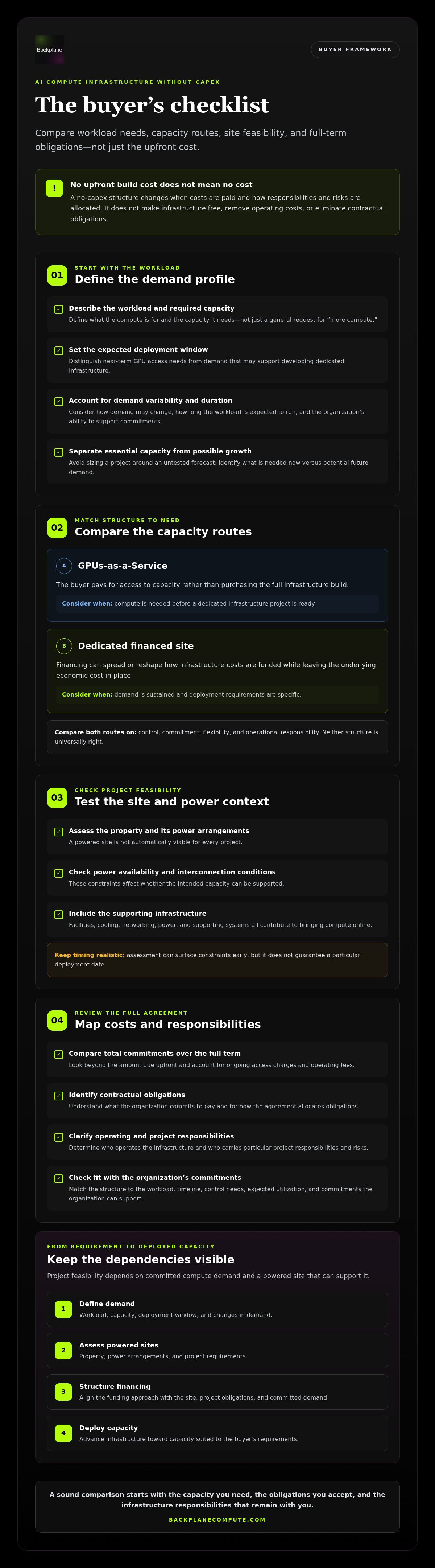
Start with the workload, not the financing label. Document what the compute must support, how much capacity it requires, when it needs to be available, and how demand could change. Then evaluate the commercial structure against that profile. A low upfront payment tells you little about the total commitment, operating responsibilities, or whether capacity can match the required deployment schedule.
- Workload: Identify the applications and whether their compute demand is predictable or variable.
- Capacity: State the expected requirement and how it may change as workloads scale.
- Delivery: Set the required deployment window and identify dependencies that could affect it.
- Control: Define how much influence operations teams need over infrastructure and capacity.
- Commitment: Understand contract duration, responsibilities, and how requirements can change.
For a dedicated site, test the schedule against site, power, and interconnection dependencies. These conditions can affect a project’s development path. Distinguish capacity needed by a target date from capacity that can arrive later, and ask for a clear description of the capacity scope, expected delivery milestones, and assumptions behind the schedule. Treat a target date as a planning input, not a certainty, unless the agreement makes that commitment.
Questions to resolve before selecting a structure
Separate workloads that need predictable capacity from those that can tolerate variation. Decide whether the operations team needs access to GPU capacity or greater involvement in dedicated infrastructure. Then set decision criteria for deployment timing, minimum commitments, and how the arrangement can respond to future demand changes. These answers help distinguish a service-based requirement from one that calls for a dedicated project.
How to compare the economics beyond upfront capex
Compare the full expected commitment over the relevant operating period, including access charges, contractual obligations, and responsibilities assigned to the buyer. Model utilization using your own demand forecast. If a workload ramps more slowly than planned, identify what happens to paid-for or committed capacity. If demand grows, understand whether the structure can accommodate a change and on what terms.
Use sensitivity analysis rather than assuming one forecast will hold. Compare lower, expected, and higher utilization scenarios, and show which assumptions drive the result. This makes the trade-off visible without relying on generic savings claims. A structure that appears least expensive at launch may not remain the best fit if demand, timing, or operational needs shift.
Match workload, control, commitment, and delivery requirements before comparing financing structures. That is the practical test for AI compute infrastructure without capex.
Use Backplane’s compute infrastructure structuring to align buyer requirements with site assessment and financing considerations.
How Backplane Helps Structure AI Compute Without Upfront Buildout
Turning a compute requirement into deployed infrastructure involves more than locating GPUs. The buyer’s workload must connect to a suitable capacity route, and a site-based project must be assessed and structured around real demand. Backplane connects AI compute buyers with powered industrial properties and manages the process across property viability assessment, infrastructure financing structuring, and deployment.
The objective is to match the structure to the project. Buyers seeking GPU capacity can access GPUs-as-a-Service. Buyers whose requirements call for dedicated infrastructure can pursue a dedicated financed site. These are distinct pathways, not interchangeable labels. The right route depends on capacity needs, deployment objectives, and the desired level of infrastructure control.
From compute requirements to a structured deployment
The process starts with the buyer’s requirements: workload, expected capacity, deployment objectives, and demand profile. Specific requirements create a basis for assessing whether a powered industrial property is viable for the intended project. Property and infrastructure considerations inform project scope, while committed compute demand connects planned capacity to an identified use.
Financing structure is considered alongside the site and project requirements. Financing can support the conversion of a suitable property into operational compute infrastructure, but it doesn’t eliminate the project’s economic cost or obligations. The structure is shaped around the buyer’s requirements and the project itself. Backplane bridges compute demand, powered sites, and financing through the path from assessment toward deployment, with project terms and timing shaped by the actual requirements.
Choose the next step based on your compute objective
If the priority is access to GPU capacity, GPUs-as-a-Service provides a route focused on compute access rather than ownership of a dedicated site. If the requirement calls for dedicated infrastructure, a financed site provides a project pathway built around that objective. In either case, clarify the capacity need, intended deployment window, and expected demand before determining which structure fits.
For AI compute infrastructure without capex, a useful first step is to turn the requirement into a concise project brief. Include the workload, capacity profile, timing objectives, and whether you need GPU access or dedicated infrastructure. That gives the assessment and structuring process a clear starting point, while allowing project-specific terms to reflect the actual requirements.
Outline your capacity needs and deployment objectives to discuss a compute structure with Backplane. Start with the workload and the infrastructure route you’re considering, then focus on how demand, site viability, and financing fit together.
Turn Compute Demand Into a Decision-Ready Plan
Turn your compute objective into a plan your technical, finance, and operations teams can assess together. Set out the workload, the capacity it requires, when it must be available, and the level of commitment your organization can support. A shared brief gives the infrastructure decision a clear basis and keeps discussion focused on execution.
AI compute infrastructure without capex is not a shortcut around commercial obligations. It is a way to consider how capacity can be secured while aligning deployment needs with capital priorities. The opportunity is to move forward with a structure grounded in your demand, not a generic infrastructure assumption.
Backplane can help translate project requirements into a path for site assessment, financing structuring, and deployment. Discuss an AI compute structure aligned with your deployment needs, and take the next step with a clearer view of the capacity your business is building toward.
Frequently Asked Questions
Can a business access AI compute without owning GPUs?
Yes. A business can access GPU capacity through a service arrangement without owning the GPUs. This can suit a team that needs compute for a particular workload but doesn’t want to purchase hardware. Access isn’t ownership, and the service remains subject to commercial terms and commitments. Before choosing this route, define how much capacity the workload needs, how long it may run, and whether your team requires control beyond access to compute.
Does AI compute infrastructure without capex mean there are no upfront or ongoing costs?
No. AI compute infrastructure without capex means avoiding the full upfront funding of an infrastructure build, not getting compute at no cost. Depending on the structure, costs or obligations may arise through recurring access fees, contractual commitments, or project responsibilities. Review the full expected commitment over the period you need capacity. A low initial payment, for example, may not reflect obligations that continue during a longer contract or infrastructure project.
Is GPUs-as-a-Service the same as a dedicated financed site?
No. GPUs-as-a-Service provides access to GPU capacity, while a dedicated financed site is organized around dedicated infrastructure. Both can offer a route to compute without the buyer funding an entire build upfront, but their control, responsibilities, and commitments differ. A team running a defined workload may prioritize capacity access; a buyer with specific infrastructure needs may assess a dedicated project. Compare the actual scope rather than assuming the structures are equivalent.
How do I decide between GPU-as-a-Service and a dedicated AI compute site?
Match the structure to how your team will use compute. A workload with changing demand may lead you to examine service access and the flexibility in its terms. A sustained requirement for dedicated infrastructure may point toward assessing a financed site. Also consider who needs to control infrastructure decisions, the deployment objective, and the commitments your business can support. A clear workload forecast helps expose mismatches before they become operational or commercial constraints.
What does a buyer need to assess before pursuing a financed AI compute site?
Define the workload, expected capacity, deployment objectives, and acceptable project commitments. Then assess whether a property’s power and infrastructure conditions can support those requirements. A site with existing power infrastructure still needs project-specific evaluation, including interconnection and the work required to serve the intended compute demand. Treat site suitability and delivery expectations as project-specific, not automatic. A property assessment connects buyer requirements to a viable project structure.
Can a powered industrial property be converted into AI compute infrastructure?
Some underused industrial properties may be candidates, but a powered site isn’t automatically suitable for AI compute. Feasibility depends on factors such as power availability, interconnection, site conditions, required infrastructure, and buyer demand. A retired facility, for example, may have useful existing assets yet still require assessment against a proposed project’s needs. Conversion scope and timing depend on those conditions, so don’t assume a universal schedule or outcome.
How does Backplane help a buyer secure AI compute without funding a full build upfront?
Backplane connects AI compute buyers with powered industrial sites and structures financing for infrastructure projects. The process can begin with the buyer’s workload and capacity requirements, then assess property viability and shape a financing structure around the project. Deployment is part of the broader process. Buyers seeking GPU capacity can access GPUs-as-a-Service; those requiring dedicated infrastructure can pursue a dedicated financed site. The suitable pathway depends on buyer and project requirements.


