

The fastest route to gigawatt-scale AI compute is not an empty greenfield site; it is a decommissioned industrial shell. While conventional developers sit trapped in utility interconnection queues stretching out past 2028, converting mills to data centers unlocks heavy, energized power capacity hiding in plain sight.
If you hold stranded industrial real estate or race to deploy high-density compute, you know the market friction firsthand. Multi-year substation backlogs paralyze new builds, capital remains frozen in dormant assets, and technical doubts regarding legacy floor loading and clear heights delay execution.
This guide breaks down how institutional operators repurpose closed paper and textile mills into gigawatt-ready compute facilities without the greenfield wait. You will learn the technical benchmarks to validate site viability, the engineering realities of high-density cooling retrofits, and the commercial frameworks required to finance and secure long-term compute offtake.
Key Takeaways
- Understand why converting mills to data centers circumvents multi-year grid interconnection delays by capitalizing on legacy, energized high-voltage substations.
- Evaluate core structural viability requirements, including reinforced slab capacities, clear ceiling heights, and direct-to-chip liquid cooling integration for up to 100 kW per rack.
- Review real-world industrial conversions to benchmark capital timelines, water discharge rights, and existing physical infrastructure reuse.
- Deploy a phased diligence framework that runs environmental audits, power capacity validation, and engineering retrofits concurrently to compress execution schedules.
- Learn how to structure institutional project capital by linking creditworthy enterprise compute offtake with dedicated site financing.
Why Closed Mills Are Becoming Prime AI Data Center Real Estate
AI compute clusters consume power at unprecedented volumes. Traditional greenfield development models cannot keep up. When hyper-scalers and institutional funds attempt to break ground on raw land, regional transmission operators hand them timelines extending past 2028. Modern computation requires immediate capacity, not multi-year promises. This dynamic is driving the aggressive shift toward adaptive reuse in heavy manufacturing real estate.
Converting mills to data centers solves this capital bottleneck. Pulp, paper, and textile facilities operated as massive energy sinks for decades, routinely drawing between 50 MW and upwards of 300 MW. When these plants shuttered, their physical shells went dark, but the high-voltage utility infrastructure remained behind. Repurposing these assets bypasses lengthy interconnection queues by reactivating existing power allocations, turning stranded industrial real estate into live, revenue-generating digital infrastructure.
The Grid Interconnection Bottleneck
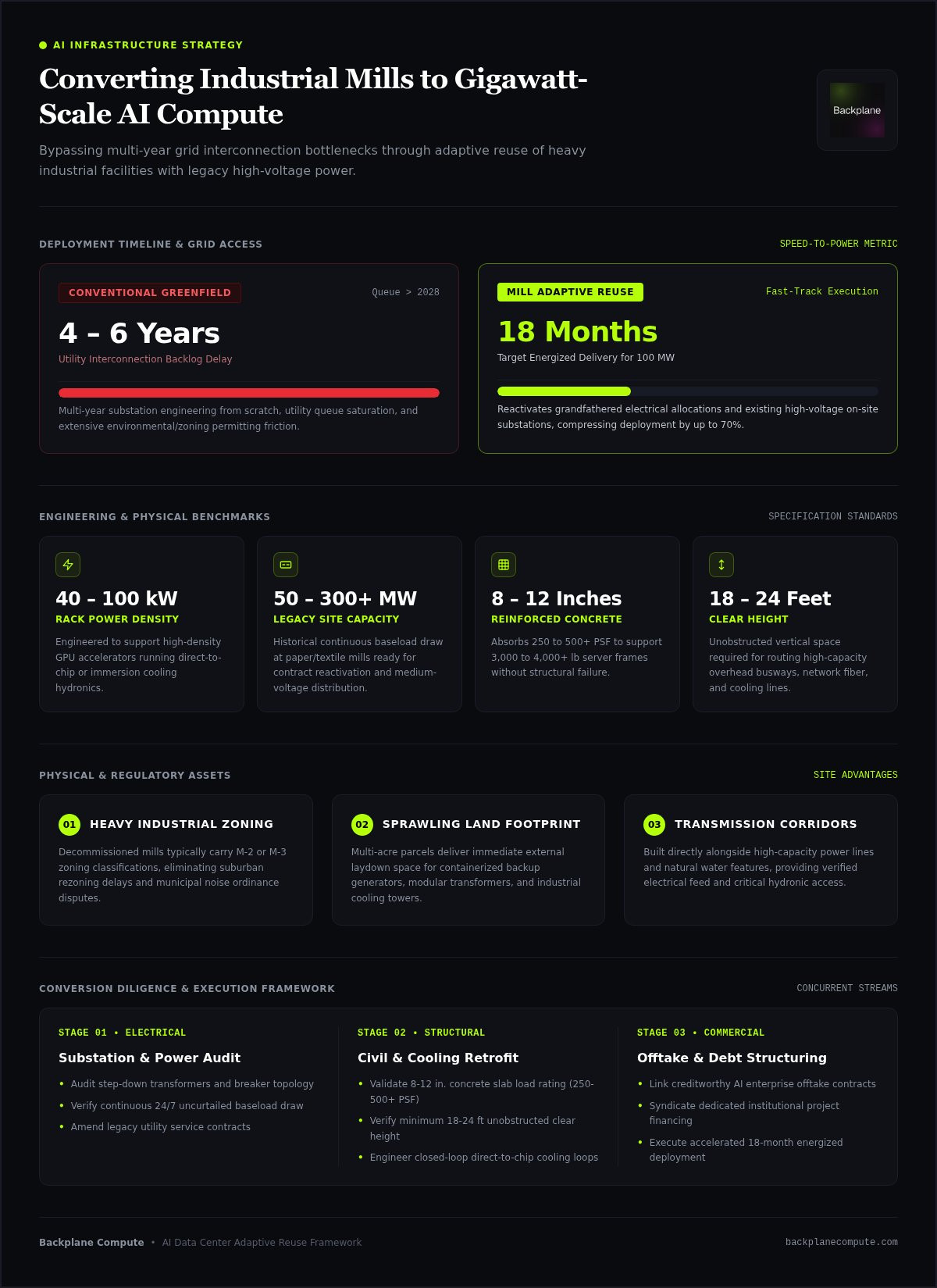
Grid saturation across major North American hubs has upended standard project timelines. Interconnection backlogs now stall utility interconnection studies for four to six years. For AI operators, that delay destroys equity returns. Capital requires deployment today.
Decommissioned mills present a decisive advantage: they often retain grandfathered electrical rights and existing high-voltage on-site substations. Instead of engineering a transmission tap from scratch, operators negotiate to reactivate or amend existing service agreements. Speed-to-power dictates overall returns; securing 100 MW of energized capacity within 18 months beats waiting six years for an unbuilt greenfield substation every time.
Anatomy of an Industrial Mill Asset
Converting mills to data centers capitalizes on physical and regulatory assets built specifically for heavy industry:
- Heavy Industrial Zoning: Mills already possess heavy industrial (M-2 or M-3) zoning designations, shielding developers from the protracted rezoning disputes and noise ordinance battles that derail suburban facilities.
- Substantial Land Footprints: Sprawling multi-acre parcels offer immediate laydown space for containerized generators, modular transformers, and specialized liquid-cooling equipment.
- Transmission Density: These facilities were constructed directly adjacent to high-capacity transmission corridors and natural water features, providing the vital electrical access needed to power dense GPU racks.
Technical Viability: Structural, Power, and Cooling Requirements
Generic real estate models evaluate warehouse assets on basic clear height and dock count. Those metrics fail completely when converting mills to data centers for modern artificial intelligence workloads. AI clusters running dense accelerator rows require between 40 kW and 100 kW per rack. Meeting these thermal and electrical loads demands rigorous engineering assessments across structural foundations, substation topology, and closed-loop hydronics.
Executing an early, structured industrial site assessment for AI protects capital by verifying live capacity before major debt syndication begins.
Electrical Infrastructure and Substation Capacity
On-site substations dictate immediate project viability. Engineering teams must audit legacy step-down transformers, existing breaker topology, and high-voltage switchgear integrity to confirm whether the equipment supports continuous, uncurtailed 24/7 baseload compute. Repurposing existing transmission interconnects requires amending legacy utility contracts to allow steady-state power draw, alongside dropping in medium-voltage distribution systems engineered specifically for high-amperage compute rows.
Structural Integrity and Floor Loading Tolerances
AI compute racks are dense. Fully loaded direct-to-chip or immersion server cabinets routinely exceed three to four thousand pounds per frame. Legacy timber flooring cannot handle this mechanical load:
- Slab Thickness: Heavy industrial pulp mills typically feature ground-level slabs of 8 to 12 inches of reinforced concrete, capable of absorbing 250 to 500+ pounds per square foot. Suspended floors require supplemental steel underpinning.
- Overhead Clear Heights: Converting mills to data centers requires a minimum of 18 to 24 feet of unobstructed vertical space to route high-capacity busways, network fiber trays, and rigid hydronic manifolds.
- Modular Skid Placement: Siting heavy backup batteries, UPS cabinets, and switchgear outside the main building envelope on dedicated exterior concrete pads preserves internal space for revenue-generating compute.
Water Rights and Closed-Loop Thermal Management
Traditional air cooling cannot dissipate heat at 50 kW per rack. Direct-to-chip liquid loops are mandatory. Former paper mills offer a unique operational advantage because they historically maintained substantial industrial water withdrawal permits. When redeveloping a brownfield site, deploying closed-loop chillers isolates process fluids from local waterways, safeguarding riparian assets while eliminating municipal water consumption.
If you control a dormant heavy manufacturing plant, ordering an institutional Property Viability Assessment provides the critical engineering clarity required to monetize your footprint.
Case Examples: Turning Legacy Manufacturing into High-Density Compute
Converting mills to data centers is no longer a speculative play. Institutional operators are bypassing slow greenfield cycles by acquiring closed manufacturing assets with established electrical backbones. Commercial real estate brokers often advise owners to turn these footprints into logistics warehouses. That guidance leaves millions in enterprise value on the table. Compute yields vastly superior valuation multiples, provided the asset matches high-density design parameters. Our framework for industrial asset repurposing highlights how legacy shells support modular AI infrastructure across varied regions.
The Rural Paper Mill Transformation
In rural Ohio, developers acquired a decommissioned paper plant to construct a dedicated high-performance compute campus. The transaction was driven by power and cooling infrastructure:
- Energetic Capacity: The site retained legacy transmission interconnection feeds capable of supporting hundreds of megawatts without triggering multi-year grid rebuilds.
- Natural Heat Rejection: Historical water rights enabled direct access to adjacent river flows, feeding closed-loop heat exchangers that slash mechanical cooling overhead.
- Cavernous Footprints: Expansive finishing halls were cleared of legacy pulp equipment, creating clear-span envelopes for multi-tier liquid-cooled server pods.
The Mid-Atlantic Textile Mill Retrofit
A closed textile complex in the Mid-Atlantic region demonstrated how historic structural shells accommodate cutting-edge silicon. The original masonry envelope stood intact, located within low-latency range of primary fiber routes. Operators reviewed the EPA guidelines on brownfield data center conversion to streamline environmental clearance, remediate historical run-off areas, and secure local development approvals. Instead of undertaking a full structural demolition, the developer dropped pre-fabricated, modular compute units directly inside the high-bay structural envelope while negotiating a re-energized rate tariff with the local utility.
The Heavy Steel Fabrication Yard Conversion
Heavy steel fabrication plants provide distinct advantages for accelerated deployments. These properties feature high-capacity overhead gantry cranes, massive open yard space, and reinforced concrete loading pads designed for hundred-ton manufacturing runs. Converting mills to data centers of this scale lets engineers use existing cranes to position forty-foot containerized compute pods and exterior liquid chillers in weeks rather than months. The existing substation switchgear, once dedicated to electric arc furnaces, translates directly into continuous high-amperage power distribution for enterprise training clusters.
The Mill Conversion Playbook: Due Diligence and Execution Roadmap
Linear project planning kills internal rates of return. Traditional real estate developers wait for full environmental sign-off before picking up the phone with the utility. When converting mills to data centers, that sequential workflow adds twelve to eighteen months of dead carry. Speed demands parallel processing. You run high-voltage utility capacity studies alongside Phase II environmental drilling and structural slab tests. This disciplined cadence is the exact operational framework institutional teams use for successful brownfield data center development.
Execution requires an uncompromising review against a rigorous data center site selection checklist, broken into three tightly orchestrated phases.
Phase 1: Power Allocation and Utility Verification
Never rely on a seller's historical electric bills. You must confirm that the serving transmission operator still credits that power to the specific parcel. This initial audit verifies:
- Capacity Confirmation: Formal verification of continuous megawatt availability from the utility, establishing firm transmission rights rather than interruptible service.
- Substation Health: Thorough physical inspections of existing transformers, insulators, and oil samples to identify metal fatigue or thermal degradation.
- Upgrade Timelines: Establishing procurement lead times for modern gas-insulated high-voltage breakers to protect capital deployment schedules.
Phase 2: Environmental Auditing and Structural Validation
Former manufacturing operations leave historical fingerprints. Phase I and Phase II environmental assessments pinpoint volatile organic compounds or heavy metals, mapping abatement straight into the demo program. Simultaneously, engineers take ultrasonic slab readings and core samples. Validating concrete compression metrics confirms whether the foundation can support sixty-kilowatt direct-to-chip server rows, or if specific zones require carbon-fiber wrapping and supplemental underpinning.
Phase 3: Design, Permitting, and Retrofit Execution
Speed depends on prefabrication. Instead of custom stick-built interior mechanical spaces, smart operators drop packaged power skids and modular chiller arrays onto external pads. This approach limits interior work to high-bay structural modifications, fiber entrances, and hydronic supply manifolds. Converting mills to data centers lets you build under established industrial zoning codes, drastically cutting municipal approval cycles and avoiding contentious public hearings.
If you need to compress this timeline and secure institutional capital, connect with Backplane to evaluate Dedicated Financed Sites tailored to enterprise compute profiles.
Financing and Offtake: Structuring the Conversion Deal
Engineering viability means nothing without institutional capital. While engineering teams focus on load bearing and conduit routing, the success of converting mills to data centers hinges entirely on underwriting mechanics. Traditional commercial real estate lenders don't understand high-density liquid cooling, nor will they underwrite multi-megawatt brownfield buildouts on speculative absorption. Securing capital requires a two-sided structure: pairing energized physical dirt with long-term, creditworthy enterprise compute commitments before capital expenditure begins.
This approach eliminates speculative vacancy. Property owners bypass balance-sheet debt, while enterprise buyers secure deterministic deployment schedules that avoid multi-year utility delays.
Aligning Industrial Landlords with Enterprise Compute Buyers
Industrial asset holders operate under long investment horizons. AI model developers operate under extreme speed-to-market constraints. Bridging this cultural divide requires tailored transaction architecture:
- Triple-Net (NNN) Ground Leases: The property owner leases energized acreage and substation rights to an infrastructure sponsor, securing steady coupon yield without taking on technical operating risk.
- Joint Venture Structures: Landowners contribute the physical shell and historical power allocations as equity, capturing direct upside alongside the compute operator.
- Dedicated Financed Sites: Underwriters bundle land, utility capacity, and buildout capital into a turn-key project backed by institutional GPU workloads, removing execution friction for the original owner.
Arranging Infrastructure Capital and Execution
Capital syndication for heavy brownfield compute moves through specialized infrastructure debt funds and private credit rather than conventional regional banks. These credit facilities disburse funds against two primary collateral pillars: verified utility interconnection agreements and binding high-density compute contracts. When compute offtake, utility power, and technical engineering are locked simultaneously, project risk compresses.
This coordinated model lets buyers skip hyperscaler allocation queues entirely. Instead of paying retail markups for shared compute slices or waiting years for greenfield campuses, enterprise tenants gain dedicated capacity engineered specifically for their model training and inference requirements.
Converting mills to data centers transforms dormant industrial energy into premier high-density AI infrastructure. If you hold a decommissioned manufacturing property or require dedicated powered capacity, connect with the team at Backplane to evaluate your industrial asset and structure the conversion path today.
Capitalize on the Industrial Power Advantage
The race for gigawatt-scale AI infrastructure belongs to operators who control energized capacity today, not those waiting out multi-year utility backlogs. Converting mills to data centers bridges this critical execution gap. By reactivating heavy transmission infrastructure, capitalizing on robust industrial envelopes, and bypassing suburban zoning friction, dormant manufacturing sites offer an immediate springboard for high-density compute.
Unlocking that value requires decisive execution. Success depends on validating structural and thermal constraints while simultaneously securing creditworthy compute offtake. Backplane provides an end-to-end Property Viability Assessment across electrical, floor loading, and cooling parameters. We bridge the capital stack, matching powered industrial footprints with enterprise GPU demand and specialized infrastructure financing.
Partner with Backplane to convert powered industrial assets into high-density AI infrastructure and deploy enterprise compute without waiting on the grid.
Frequently Asked Questions
Why are closed industrial mills ideal for AI data center conversions?
Closed mills offer immediate access to heavy, energized electrical infrastructure that greenfield sites lack. These facilities historically operated continuous manufacturing processes supported by dedicated high-voltage substations, robust utility transmission feeds, and heavy industrial zoning. Converting mills to data centers lets operators bypass multi-year utility interconnect queues and deploy high-density compute years ahead of traditional builds.
How much power can a converted paper or textile mill typically provide?
Most former paper and textile mills offer baseline capacities between 30 MW and 200 MW, with some large pulp complexes exceeding 300 MW. The exact available capacity depends on whether previous interconnection agreements remain active and the physical condition of the on-site step-down transformers. Validating these utility commitments early is vital for confirming steady-state capacity.
What are the biggest environmental risks when converting brownfield mill sites?
Historical industrial operations often leave chemical residues, including heavy metals, volatile organic compounds, or legacy boiler ash. Conducting comprehensive Phase I and Phase II environmental site assessments delineates contamination zones early. Leveraging federal frameworks like the EPA Brownfields Program provides developers with statutory liability protections and structured cleanup pathways that keep project schedules intact.
How long does it take to convert a closed mill into a functioning data center?
A typical brownfield conversion takes 12 to 24 months, compared to four to six years for a greenfield facility facing transmission interconnection backlogs. Utilizing pre-engineered modular power skids, exterior mechanical chiller yards, and the existing industrial envelope drastically cuts the civil engineering schedule and accelerates time-to-power.
Can existing mill structures support modern high-density liquid cooling racks?
Ground-floor concrete slabs in heavy manufacturing plants generally possess the compressive strength required for liquid-cooled server racks weighing over three thousand pounds. However, mezzanine levels, suspended floors, or wood-timber frameworks cannot handle these concentrated point loads. Facilities requiring high-density deployments often need targeted foundation underpinning or placement of compute rows exclusively on reinforced grade slabs.
What permits are required to convert an industrial mill to a data center?
Operators must secure amended utility interconnection agreements, local building and structural retrofit permits, environmental remediation sign-offs, and industrial water usage or discharge approvals. Because mills already carry heavy industrial zoning, developers generally avoid the contentious rezoning hearings, public variances, and municipal pushback typical of greenfield commercial projects.
How does mill conversion compare to greenfield data center construction in 2026?
Converting mills to data centers delivers an insurmountable speed advantage. Greenfield developments in primary markets are choked by utility interconnection queues extending past 2028. Repurposing brownfield manufacturing sites provides live substation hardware, lower civil site development risks, and immediate power access, giving compute operators a predictable, accelerated deployment path.


