

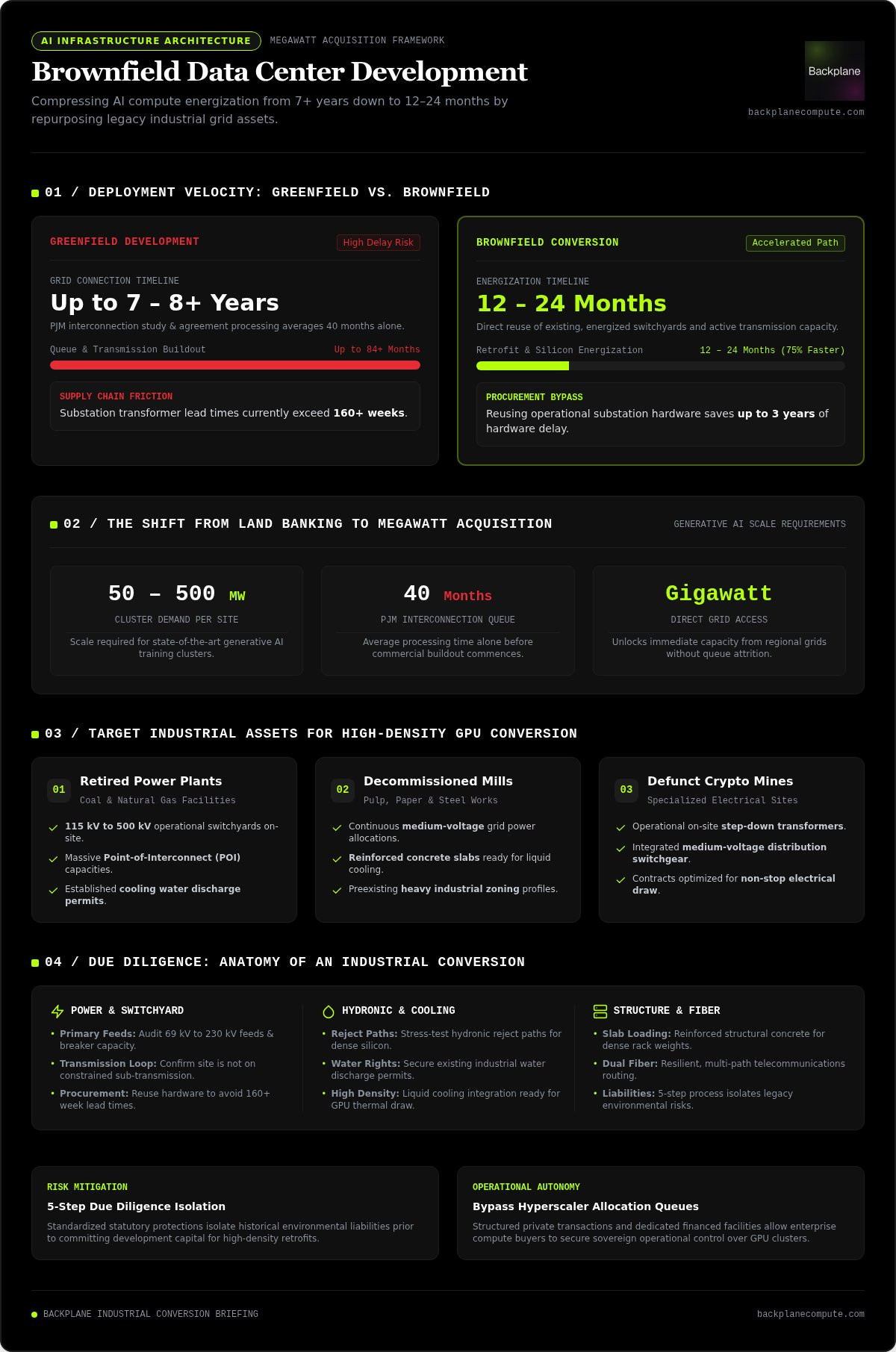
Brownfield sites are not standard real estate plays; they are power acquisitions disguised as redevelopments. In primary markets where securing a new 100-megawatt grid connection now averages up to seven years, sitting in speculative utility queues is a liability AI model schedules cannot afford. Brownfield data center development solves this bottleneck. By targeting decommissioned industrial assets with existing, energized electrical switchyards, operators compress commercial energization timelines from seven years down to just 12 to 24 months.
You already know that waiting on greenfield transmission upgrades or enduring substation transformer lead times exceeding 160 weeks stalls critical compute deployment. This guide breaks down how repurposing legacy industrial infrastructure lets you bypass grid logjams and secure immediate capacity. Ahead, we evaluate how to pinpoint viable facilities with energized substations, compare brownfield conversion capital expenditures against greenfield builds, and establish an actionable technical due diligence framework to de-risk high-density compute conversions.
Key Takeaways
- Brownfield data center development converts retired power plants, closed mills, and dormant industrial assets into operational high-density GPU hubs with preexisting utility infrastructure.
- Repurposing energized switchyards and substations compresses commercial timelines down to 12 to 24 months, avoiding multi-year transmission queue backlogs.
- Rigorous technical audits of substation breaker capacity, floor slab loading, and dual fiber routing prevent severe capital write-downs during liquid cooling retrofits.
- A standardized five-step due diligence process isolates legacy environmental liabilities under statutory protections before deploying development capital.
- Structured private transactions and dedicated financed sites allow compute buyers to bypass hyperscaler allocation queues and secure sovereign operational control.
What Is Brownfield Data Center Development in the AI Era?
Brownfield data center development is the practice of converting decommissioned or underutilized heavy industrial properties into high-density compute facilities to secure immediate energized power capacity. While traditional environmental frameworks define brownfield land redevelopment through the lens of remediation and statutory risk mitigation, the AI compute race fundamentally shifts this calculus. Operators no longer evaluate brownfields for their real estate footprint. They evaluate them as grid-connected power infrastructure assets carrying energized high-voltage substations, active utility rights-of-way, and industrial water allocations.
The Shift from Land Banking to Megawatt Acquisition
Conventional digital infrastructure relied on land banking. Hyperscalers secured hundreds of flat, shovel-ready agricultural acres in suburban corridors, submitted multi-hundred-megawatt interconnection requests, and built modular campuses at their own pace. That model is broken.
State-of-the-art generative AI training clusters demand between 50 and 500 megawatts per site. In major regional transmission organizations like PJM, processing an interconnection agreement now averages 40 months, with overall commercial operation timelines stretching past eight years. Land without energization is an operational dead end. Brownfield conversions discard speculative greenfield acreage in favor of active transmission rights, unlocking gigawatt-scale capacity directly from the regional utility grid without multi-year queue attrition.
Target Industrial Assets for High-Density Conversion
Not every legacy plant suits modern compute clusters. AI deployments require heavy structural foundations, high-volume cooling, and resilient dual-path power architectures. The most viable candidate sites include:
- Retired coal and natural gas plants: These assets feature existing 115 kV to 500 kV switchyards, massive point-of-interconnect capacities, and established cooling water discharge permits.
- Decommissioned pulp, paper, and steel mills: Legacy manufacturing facilities offer continuous medium-voltage allocations, reinforced concrete floor slabs capable of supporting liquid-cooled racks, and existing industrial zoning.
- Defunct crypto-mining facilities: These operations already house step-down transformers, medium-voltage distribution switchgear, and utility contracts optimized for continuous, non-stop electrical draw.
Executing an industrial asset repurposing for tech deployment allows infrastructure funds and compute buyers to turn stranded physical capital into high-performance GPU environments, compressing time-to-market when raw compute velocity dictates market survival.
Anatomy of an Industrial Conversion: Power, Fiber, and Water
Executing a viable industrial conversion requires looking past surface square footage. In high-density brownfield data center development, the physical plant matters only if its core utilities support high-performance silicon. As detailed in the IEA data centre energy analysis, surging AI adoption demands unprecedented power delivery and cooling capacity. Operators must stress-test three primary pillars before committing capital: high-voltage switchgear, hydronic reject paths, and structural slab engineering.
Substation Capacity and High-Voltage Interconnection
The switchyard dictates project viability. A site with 100 MW of retired transmission rights is useless if the step-down transformers cannot deliver medium voltage directly to the floor. Transformer procurement cycles now exceed 160 weeks. Reusing operational substation hardware saves up to three years of procurement friction.
Developers must audit breaker ratings, primary voltage feeds (typically 69 kV to 230 kV), and utility rights-of-way. If the asset sits downstream of a constrained sub-transmission loop, capacity expansion will trigger costly grid upgrades. To de-risk these assets early, operators often conduct a thorough Property Viability Assessment to ensure existing switchgear matches compute load requirements.
Cooling Topographies and Hydronic Infrastructure
Modern server densities have shattered legacy HVAC models. Standard air cooling tops out around 20 to 30 kW per rack. Advanced AI clusters, like the NVIDIA Blackwell NVL72 architectures, pull between 120 kW and 142 kW per cabinet. At this density, direct-to-chip liquid cooling systems become strictly mandatory.
Brownfield industrial sites offer a unique operational advantage here. Closed paper mills and generation facilities often retain grandfathered industrial water allocations and wastewater discharge permits. Operators can deploy closed-loop coolant distribution units (CDUs) paired with industrial cooling towers or heat exchangers. This retrofitted hydronic topography recirculates treated process water efficiently, eliminating the regional municipal permit battles that routinely paralyze greenfield builds.
Structural Floor Loading and Spatial Clearances
High-density hardware changes structural physics. Liquid manifolds, busways, and high-density compute cabinets weigh thousands of pounds. Traditional distribution warehouses designed for 150 to 250 pounds per square foot fail under modern compute loads.
- Floor loading: Brownfield GPU halls require concrete floor slabs capable of sustaining 350 to over 500 pounds per square foot. Heavy manufacturing foundations frequently meet this threshold without underpinning.
- Vertical clearances: Overhead clear heights must provide 18 to 24 feet of unobstructed space. This volume accommodates dual-path overhead busways, heavy structural cable trays, and secondary liquid piping headers.
- Fiber resilience: The site must access diverse, carrier-neutral dark fiber routes. Validating private rail or utility rights-of-way prevents single-point severance along legacy transit lines.
Brownfield vs. Greenfield: Speed, Cost, and Execution Risk
The core difference between greenfield and brownfield execution boils down to a single metric: time-to-power. While raw land permits clean-slate architectural designs, the regulatory logjam renders greenfield planning unpredictable. Brownfield data center development replaces speculative utility filings with energized real estate. Operators absorb targeted site preparation expenses to capture active electrical capacity years ahead of greenfield schedules.
| Evaluation Vector | Greenfield Development | Brownfield Conversion |
|---|---|---|
| Time-to-Power | 4 to 7+ years (queue backlogs) | 12 to 24 months (energized point of interconnect) |
| Interconnection Risk | High attrition (60% to 76% withdrawal rates in ERCOT/PJM) | Minimal (utilizes existing transmission rights) |
| Capital Expenditure Focus | Heavy substation civil works, transformer procurement | Demolition, structural reinforcement, remediation |
| Zoning & Permitting | Contentious agricultural rezoning, public pushback | Pre-zoned industrial (M-2), favorable municipal alignment |
Time-to-Power: Compressing the Utility Interconnection Timeline
Interconnection queues remain the primary friction point across regional transmission grids. ERCOT records project abandonment rates near 60%, while PJM attrition reaches 76%. In Tier 1 data center corridors, waiting for a greenfield 100 MW transmission interconnect routinely averages seven years. Repurposing brownfield assets bypasses this waiting cycle entirely. With existing utility feeds and substation footprints, conversions achieve commercial operation in 12 to 24 months, preserving enterprise training momentum.
Capital Allocation: Remediation Premiums vs. Delay Penalties
Brownfield sites require upfront capital outlays for hazardous material abatement, slab cutting, and concrete reinforcement. These costs, however, pale in comparison to greenfield energization delays. For an enterprise-scale 60 MW deployment, a stalled energization schedule burns an estimated $14.2 million per month in holding expenses and missed IT compute revenue. Brownfield conversions unlock active cash flow years earlier, generating superior return on invested capital.
Zoning, Permitting, and Local Community Alignment
Greenfield builds face fierce community opposition, agricultural rezoning battles, and local water moratoriums. Conversely, industrial brownfield properties already carry heavy industrial (M-2) zoning designations. Following the official EPA criteria for brownfield data center redevelopment provides access to statutory liability protections and local tax incentives. Municipalities actively welcome these conversions, viewing the transformation of dormant industrial blight into a modern digital revenue driver as an economic win. For a complete set of location metrics, consult our checklist on data center site selection criteria.
Due Diligence Framework: Assessing Industrial Sites for AI Conversion
Converting heavy industrial properties into high-density compute facilities demands a disciplined audit framework. Superficial evaluations lead to capital write-downs. In high-stakes brownfield data center development, technical diligence must run parallel with legal risk isolation. Operators must systematically eliminate non-viable sites across environmental baselines, high-voltage utility switchyards, and physical plant integrity before deploying capital.
Phase I Environmental Reviews and Statutory Safe Harbors
Dormant manufacturing sites carry historical operational baggage. Diligence begins with a Phase I Environmental Site Assessment conducted strictly under the ASTM E1527-21 standard to identify Recognized Environmental Conditions (RECs). Satisfying All Appropriate Inquiries (AAI) establishes the Bona Fide Prospective Purchaser (BFPP) defense under CERCLA, shielding operators from historical cleanup liability.
When baseline reviews detect heavy metals, volatile organic compounds, or legacy transformer fluids, operators must enroll the property in state voluntary cleanup programs. Enrolling caps statutory exposure and unlocks brownfield remediation tax credits. Pairing these protocols with dedicated environmental insurance policies protects capital against unexpected subsurface abatement during civil excavation.
Grid Interconnection and Power Infrastructure Verification
Never rely on historical billing statements to confirm available load. Diligence teams must audit existing utility interconnection agreements with the regional transmission operator to confirm capacity rights remain legally active. Dormant accounts face tariff de-rate risks if inactive for extended intervals.
Physical inspections must verify the health of on-site electrical assets. Technicians must execute dissolved gas analysis (DGA), dielectric breakdown tests, and thermographic imaging across all high-voltage step-down transformers and switchgear. Confirming operational integrity prevents unexpected multi-year lead times for replacement utility equipment.
Structural, Thermal, and Connectivity Audits
The internal facility footprint must support modern high-performance architectures. Engineering evaluations must validate:
- Core slab load limits: Structural engineers must pull concrete cores to confirm compressive strength ratings exceeding 500 lbs/sq. ft. for dense liquid-cooled cabinets.
- Atmospheric particulates: Ambient air sampling must confirm the absence of corrosive chemical vapors or sulfur compounds from legacy industrial neighbors that could corrode circuit assemblies.
- Fiber route diversity: Network surveys must establish two distinct, physically separated fiber pathways into the building, terminating at separate carrier hotels to prevent route severance.
To audit potential conversion sites against these stringent engineering baselines, request a targeted Property Viability Assessment to uncover hidden technical bottlenecks before closing acquisitions.
Structuring Capital and Securing Dedicated AI Infrastructure
Institutional capital requires structured development models to bridge the gap between heavy industrial real estate and high-density compute. Brownfield data center development succeeds when physical electrical capacity meets disciplined balance-sheet execution. Compute buyers are no longer willing to wait years in opaque hyperscaler allocation lines. Instead, enterprise AI operators are taking control of their supply chains by underwriting private, dedicated facilities backed by retrofitted industrial power.
The Infrastructure Brokerage Model for AI Capacity
Traditional commercial real estate brokers cannot underwrite high-voltage digital conversions. They price square footage, not breaker ampacity, transformer thermal limits, or hydronic heat dissipation. This disconnect stalls transactions and leaves valuable industrial power stranded.
Specialized infrastructure brokerages resolve this blind spot. By connecting industrial property owners holding energized substations with verified compute off-takers, this model aligns technical requirements with balance-sheet capacity. Conducting a formal Property Viability Assessment up front de-risks electrical, structural, and regulatory variables before transaction execution, turning dormant industrial sites into bankable development pipelines.
Financing Conversion: Combining Debt, Equity, and Compute Pre-Leases
Institutional debt syndicates require clear credit covenants to fund large-scale conversions. Matching heavy industrial assets with long-term compute pre-leases provides the exact underwriting foundation lenders require. Understanding modern financing for AI infrastructure allows sponsors to blend senior project debt, private equity, and equipment financing to cover capital upgrades, switchgear modernization, and direct-to-chip cooling loops.
This capital stack enables distinct compute delivery pathways. Enterprises that want operational flexibility without capital expenditure exposure can leverage GPU as a service for enterprise models. Conversely, organizations requiring dedicated physical sovereignty and full architectural control can execute through Dedicated Financed Sites with Backplane. By pairing institutional capital structuring directly with energized industrial assets, brownfield data center development bypasses hyperscaler delays and puts high-density compute on an accelerated path to production.
Securing Compute Velocity Through Industrial Power
The race for artificial intelligence supremacy won't be won in research labs alone; it's decided by the speed of physical power delivery. Lingering in multi-year transmission queues creates unacceptable strategic risk. Brownfield data center development provides the decisive operational shortcut. By repurposing heavy industrial assets with active substation interconnects, forward-looking operators compress multi-year development timelines into predictable, revenue-generating reality.
Capturing this advantage requires disciplined execution. Rigorous technical audits, statutory environmental safe harbors, and bespoke capital structuring turn dormant megawatts into institutional compute hubs. You don't have to let utility queues stall your training roadmaps. Bypass grid backlogs with Dedicated Financed Sites through Backplane to pair energized industrial real estate with committed compute demand, de-risk your deployment, and bring high-density AI infrastructure online years ahead of legacy builds.
Frequently Asked Questions
How much faster is brownfield data center development compared to greenfield construction?
Brownfield data center development typically delivers operational compute within 12 to 24 months, compared to four to seven years for greenfield construction. Greenfield projects are bottlenecked by multi-year utility interconnection queues and extended lead times for substation equipment. Brownfield retrofits leverage active points of interconnect and existing medium-voltage distribution gear. By cutting out transmission studies and equipment fabrication backlogs, operators bring AI clusters online years earlier.
What types of industrial assets make the best brownfield data center conversions?
Decommissioned coal and natural gas power generation plants, closed pulp or paper mills, and retired crypto-mining facilities offer the highest conversion viability. These properties already house high-voltage switchyards, robust transmission line interconnects, and heavy reinforced concrete slabs. Many industrial processing plants also feature grandfathered water intake and discharge rights, providing the hydronic infrastructure essential for high-density cooling retrofits.
Can brownfield data centers adequately support direct-to-chip liquid cooling systems?
Yes, brownfield industrial facilities are exceptionally well-suited for direct-to-chip liquid cooling retrofits. Heavy industrial plants provide structural slab foundations that easily handle the concentrated weight of coolant distribution units and high-density GPU cabinets. Their historical plumbing easements, wastewater discharge allowances, and industrial footprints accommodate external closed-loop cooling towers and fluid heat exchangers far more effectively than suburban office parks or lightweight warehouses.
How do developers handle environmental liabilities on contaminated industrial properties?
Developers isolate historic liabilities by conducting Phase I and Phase II Environmental Site Assessments compliant with the ASTM E1527-21 standard prior to closing. Fulfilling All Appropriate Inquiries establishes statutory Safe Harbor defenses under CERCLA. Sponsors then enroll the property in state-level voluntary cleanup programs to cap operational liability, claim remedial tax incentives, and secure specialized environmental insurance policies against unforeseen subsurface conditions.
What size power interconnection is required for a commercial AI brownfield facility?
A viable commercial AI brownfield facility generally requires an energized point of interconnect between 20 megawatts and 100 megawatts or more. Modern AI training clusters operate at high rack densities that pull 120 kW to 140 kW per cabinet. While edge inference deployments can function on 10 to 20 MW, large-scale training clusters and sovereign enterprise deployments demand at least 50 MW of continuous transmission capacity to scale efficiently.
Why are enterprise compute buyers choosing dedicated brownfield sites over public clouds?
Enterprise compute operators turn to dedicated brownfield sites to secure sovereign capacity, bypass hyperscaler allocation queues, and eliminate retail compute markups. Public cloud providers face severe power capacity limits, forcing multi-year waitlists for large GPU clusters. Executing a private brownfield data center development provides guaranteed rack availability, bespoke liquid-cooling architectures, and direct ownership over critical infrastructure timelines without competing against multi-tenant public workloads.


