

The AI race isn't a chip war; it's an energization war. While frontier compute models demand power today, greenfield utility interconnection queues now exceed five years, and hyperscaler wait times leave enterprise operators stalled for 18 to 24 months. Meanwhile, owners of shuttered mills, retired power plants, and decommissioned manufacturing sites face punishing carry costs on stranded concrete. Bridging this structural divide requires capital velocity and physical infrastructure execution. That is why industrial asset repurposing for tech has become the definitive shortcut to bypass grid congestion and deliver speed-to-market.
You already recognize that traditional data center development cycles are moving too slowly to keep pace with modern compute demands. In this guide, you will learn how to identify viable industrial footprints, structure programmatic infrastructure financing, and convert underutilized facilities into high-density GPU farms. We break down high-voltage electrical viability, liquid-cooling retrofits, and the commercial mechanics required to compress time-to-compute from years down to months.
Key Takeaways
- Learn how industrial asset repurposing for tech bypasses multi-year grid queues by converting legacy industrial power into live GPU clusters in 12 to 24 months.
- Identify non-negotiable physical viability criteria, from grandfathered high-voltage substation capacity to reinforced ground-slab load tolerances.
- Evaluate the engineering requirements for 120+ kW rack densities, including direct-to-chip liquid cooling retrofits and high-flow thermal loops.
- Structure institutional capital stacks that eliminate carry costs on stranded assets and accelerate conversion execution.
- Discover how dedicated infrastructure brokerage models bridge powered real estate with qualified compute off-takers and institutional capital.
The New Industrial Revolution: Why Repurposing is the Path to AI Scale
Most market commentary fundamentally misunderstands asset conversion, reducing it to IT hardware recycling or secondary server remarketing. True industrial asset repurposing for tech is physical, capital-intensive infrastructure execution. It means taking retired, power-dense industrial properties and re-engineering them into tier-grade compute environments. This shift is turning obsolete industrial manufacturing regions into an energized national "compute belt."
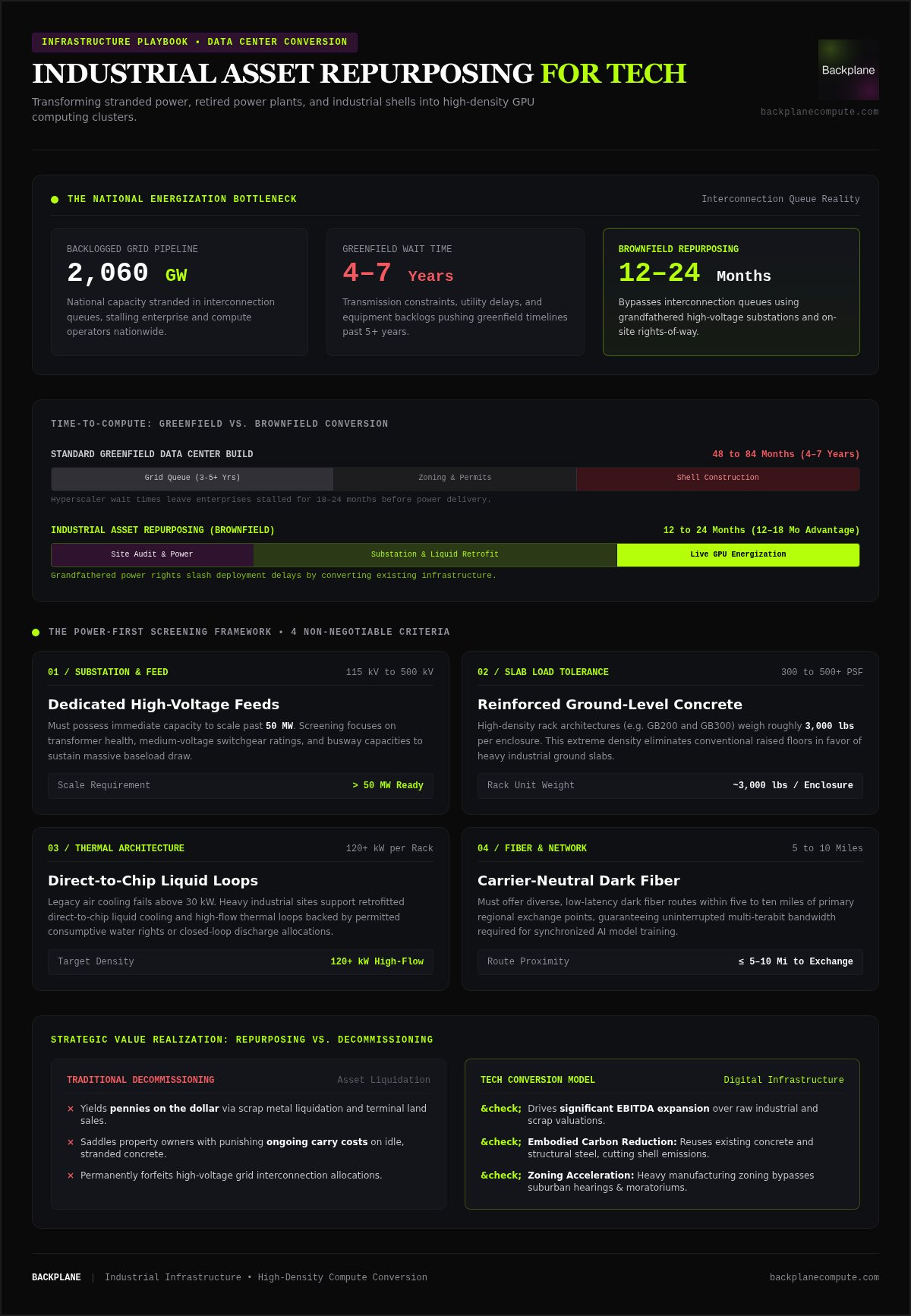
Greenfield data center construction has hit an unavoidable power wall. Transmission constraints and backlogged equipment supply chains now push typical greenfield timelines to four to seven years. Compute buyers cannot wait that long. Brownfield conversions deliver a massive 12 to 18 month lead-time advantage, slashing time-to-compute by energizing existing high-voltage assets in a fraction of the time.
The Grid Capacity Crisis
Hyperscalers and neocloud operators now face multi-year queues to secure new high-voltage grid connections. National interconnection pipelines hold over 2,060 gigawatts of backlogged capacity, turning greenfield site selection into an operational dead end. Shuttered coal plants, idled paper mills, and decommissioned manufacturing campuses bypass this bottleneck entirely because their heavy-power rights, on-site substations, and rights-of-way are already grandfathered into regional grids. In 2026, stranded power is no longer an idle liability; it is the single most valuable asset class in global technology.
Repurposing vs. Decommissioning
Traditional asset decommissioning yields pennies on the dollar through scrap metal liquidation and terminal land sales, all while saddling sponsors with carry costs. Executing industrial asset repurposing for tech transforms those idle megawatts into high-yield digital infrastructure, driving significant EBITDA expansions over raw industrial usage.
The operational and environmental advantages are equally decisive:
- Embodied Carbon Reduction: Reusing existing concrete slabs and structural steel bypasses new shell construction emissions, accelerating sustainability targets.
- Zoning Acceleration: Heavy industrial sites already possess heavy manufacturing or utility zoning, eliminating the suburban public hearings and permitting moratoriums that stall greenfield builds.
- Substructure Utility: Proven brownfield land redevelopment protocols allow developers to utilize grandfathered switchgear yards and large-volume cooling permits without clearing multi-year regulatory hurdles.
Identifying High-Viability Assets: Site Selection for AI Compute
Asset qualification separates viable real estate from expensive industrial stranded liabilities. While generic logistics brokers evaluate highway access and dock doors, industrial asset repurposing for tech demands a power-first screening framework. The site must handle massive continuous baseload draw, extreme structural loads, and high-volume fluid circulation. As documented in the International Energy Agency's Energy and AI report, data center power requirements are surging exponentially, making substation capacity and physical thermal readiness the non-negotiable baselines of conversion.
Four primary physical variables govern whether an industrial shell can support next-generation silicon:
- Interconnection and Substation Capacity: Dedicated high-voltage feeds (115 kV to 500 kV) with immediate capacity to scale past 50 MW.
- Slab Loading Thresholds: Reinforced ground-level concrete capable of supporting 300 to 500+ lbs per square foot. High-density rack architectures like the GB200 and GB300 weigh roughly 3,000 lbs per enclosure, immediately ruling out conventional raised floors.
- Industrial Water Permits: Permitted consumptive water rights or closed-loop wastewater discharge allocations to feed primary cooling loops.
- Carrier Neutrality and Fiber Proximity: Access to diverse, low-latency dark fiber routes within five to ten miles of major regional exchange points.
The Power-First Audit
Evaluating raw megawatts requires looking past nameplate utility allocations. Engineers must inspect transformer health, busway ratings, and switchgear protection curves. Upgrading medium-voltage switchgear to handle high-density transient surges requires capital and precise sequencing. Review our comprehensive data center site selection criteria to see the full technical grading matrix for utility interconnects.
From Crypto Mines to GPU Farms
Decommissioned digital currency sites represent fast conversion targets because their utility interconnects and high-voltage yards are already active. Yet their legacy architectures present a distinct technical hurdle. Most crypto mines rely on raw ambient air cooling and low-reliability sheds designed for disposable ASIC rigs. Converting these environments to support mission-critical enterprise AI workloads demands a complete mechanical transformation.
Upgrading a 20 MW crypto site into a dedicated large language model training hub means swapping air intake louvers for direct-to-chip liquid cooling manifolds, installing redundant backup generation, and integrating clean fire suppression systems. If you need to verify whether your industrial footprint can clear these engineering thresholds, ordering a Property Viability Assessment through Backplane provides rapid clarity on power viability and capital requirements.
Speed to Market: The Brownfield Conversion Framework
Executing an industrial conversion requires a phased execution discipline. Traditional development models drag on because engineering, regulatory approvals, and financing occur sequentially. Streamlining industrial asset repurposing for tech compresses these workflows through parallel execution paths. By tackling technical verification alongside financial structuring, sponsors convert dead concrete into energized high-density clusters without losing market windows.
The brownfield deployment framework follows four core phases:
- Phase 1: Technical and Economic Viability Evaluation: The Backplane approach benchmarks existing line drops, structural load capacity, and water intake limits against modern compute specifications.
- Phase 2: Structured Finance and Capital Stack Assembly: Our Infrastructure Financing Structuring pairs qualified industrial properties with institutional credit and compute off-takers.
- Phase 3: Shell Remediation and Structural Reinforcement: Contractors strip down interior clutter, reinforce ground slabs, and address historical environmental baselines using official EPA guidance on brownfield data center redevelopment.
- Phase 4: Infrastructure Deployment: High-density power distribution, closed-loop liquid cooling headers, and carrier-neutral fiber raceways go live simultaneously.
Greenfield vs. Repurposed Brownfield
Speed to energization dictates success. Greenfield developments crawl through 36 to 48 months of zoning battles, environmental impact studies, and long-lead utility transformer queues. Repurposed brownfields cut this timeline down to 12 to 24 months. Reusing on-site substations, transmission corridors, and building envelopes reduces capital expenditures by 30% to 50% per megawatt compared to starting from raw dirt. These savings directly expand margins for operators and yield higher residual value for asset owners.
Bypassing the Hyperscaler Queue
Frontier model developers cannot afford to park their software teams while public cloud providers build out multi-year capacity roadmaps. Waiting 18 to 24 months for an allocation locks capital and surrenders market share. Deploying private infrastructure on dedicated brownfield sites hands compute buyers complete control over their deployment roadmap. Organizations bypass the recurring cloud markup and secure long-term capacity on their own terms. Discover detailed operational tactics in our guide on how to bypass hyperscaler GPU queues.
The Technical Blueprint: Converting Heavy Industrial to GPU Tech
Converting heavy industrial envelopes into dense compute halls requires an integrated engineering workflow. Executing industrial asset repurposing for tech comes down to four synchronized steps:
- Step 1: Power Envelope Calibration: Benchmark continuous net dependable capacity against target cluster requirements. Every available megawatt must directly map to specific compute payloads, primary distribution loops, and uninterruptible power systems.
- Step 2: High-Density Thermal Architecture: Deploy closed-loop cooling distribution units (CDUs) configured for extreme heat rejection.
- Step 3: Network Hardening: Establish diverse, carrier-neutral dark fiber lateral routes that link the facility directly into primary regional internet exchange points.
- Step 4: Asset-Backed Capitalization: Structure the balance sheet by leveraging the energized physical shell and long-term utility agreements as primary collateral for tenant buildout costs.
Retrofitting for High-Density Cooling
Legacy air-handling systems fail when confronted with modern 100 kW to 130+ kW rack configurations. Air simply lacks the thermal capacity to evacuate that concentration of heat. Brownfield industrial halls provide the high bays and ground slabs required to install direct-to-chip liquid cooling manifolds paired with secondary Rear Door Heat Exchangers (RDHx). The cooling-to-compute ratio defines the continuous megawatts of thermal heat rejection capacity required to hold GPU junction temperatures within stable operational thresholds.
Infrastructure Financing and Transaction Structure
Capitalizing a heavy industrial retrofit requires a hybrid underwriting framework. Traditional mortgage lenders fail to comprehend the financial velocity of power infrastructure, while technology financiers often overlook physical plant mechanics. Dedicated infrastructure brokerages solve this disconnect by aligning property owners directly with qualified enterprise compute off-takers.
Structuring these transactions demands isolating real estate shell valuation from the accelerated amortization schedules of enterprise compute hardware. Explore our breakdown of financing for AI infrastructure to understand how modern capital stacks de-risk conversion milestones. If you are preparing to capitalize your facility, secure Dedicated Financed Sites through Backplane to accelerate conversion timelines.
Executing the Conversion: The Backplane Advantage
Industrial capacity without compute demand is a balance-sheet drain. Compute demand without energized power is an operational dead end. Backplane functions as the market-making bridge between these two pressures. By operating a specialized brokerage and capital deployment engine, we eliminate friction between industrial property owners and high-scale AI operators. We don't just analyze properties; we orchestrate transactions that transform dormant industrial shells into high-performance compute centers.
Execution models must match operational priorities. For enterprises requiring complete ownership over cluster topology and physical security, Backplane structures Dedicated Financed Sites built to custom thermal specifications. For teams prioritizing immediate execution velocity without massive hardware balance-sheet exposure, we provide seamless access to GPUs-as-a-Service across our repurposed properties. Through disciplined industrial asset repurposing for tech, we align physical megawatts with capital velocity.
Property Viability Assessments
Speed requires eliminating speculative diligence. Our Property Viability Assessment stress-tests transformer capacity, breaker ratings, slab load limits, and thermal discharge rights within days. We align our brokerage model directly with successful compute deployment, ensuring that property owners and compute buyers work toward an identical milestone: energized, operational compute clusters.
Securing Your Compute Future
Relying on multi-year utility queue filings or waiting on public cloud allocations is an untenable strategy. The window to lock down viable high-megawatt industrial footprints is closing rapidly as institutional funds and AI labs absorb available substation capacity nationwide. Owners of powered facilities cannot afford to carry idle megawatts, and technology leaders cannot risk falling behind their product roadmaps.
The solution is immediate execution. Structure your AI infrastructure project with Backplane to evaluate site suitability, secure turnkey financing, and deploy energized compute ahead of the market.
Capitalize on the Compute Shift: Build the Future of AI Infrastructure
The global AI expansion has outpaced the centralized power grid. Waiting on greenfield substation queues is no longer viable when execution velocity determines enterprise survival. By mastering industrial asset repurposing for tech, forward-thinking sponsors and technology leaders convert retired power plants, shuttered mills, and heavy industrial footprints into energized digital strongholds. Reclaiming these physical assets compresses multi-year utility delays into decisive speed-to-market advantages.
Backplane bridges the divide between stranded industrial real estate and high-scale compute demand. We specialize in distressed and retired industrial asset conversion, bringing proven capability in financing 50MW+ infrastructure projects to every engagement. Whether your roadmap requires custom turnkey campuses or direct access to H100 and B300 GPU clusters via GPUs-as-a-Service, the path to compute scale is already paved in existing steel and copper. Take command of your energization timeline. Accelerate your AI deployment with Backplane's industrial site brokerage and turn idle megawatts into high-yield compute today.
Frequently Asked Questions
What types of industrial assets are best for AI repurposing?
Decommissioned coal-fired power plants, shuttered pulp and paper mills, idled steel works, and retired digital currency mines make the best conversion candidates. These footprints already possess high-voltage substation connections, high utility capacity rights, heavy reinforced floor slabs, and large industrial water permits. In industrial asset repurposing for tech, properties with existing 115 kV or higher grid interconnections deliver the fastest, most reliable path to energization.
How much power is required to convert a building into a GPU farm?
Institutional AI clusters typically require a baseline of 10 MW to 20 MW, with frontier model campuses scaling past 50 MW to 100 MW. Each modern high-density compute rack draws between 120 kW and 140 kW. Your total continuous power envelope must support both compute silicon and high-volume cooling infrastructure, demanding dedicated utility feeds capable of absorbing rapid transient load spikes.
What is the typical cost per megawatt for an industrial conversion?
Capital costs vary based on substation condition and structural readiness, but brownfield retrofits routinely deliver a 30% to 50% CapEx reduction compared to greenfield developments. Reusing physical building envelopes, on-site transformer yards, and existing utility interconnections removes the most expensive elements of construction. Final outlays depend on environmental remediation scope, cooling system design, and backup power architecture.
How long does it take to repurpose a retired power plant for tech?
Repurposing a retired power plant averages 12 to 24 months from site acquisition to live compute commissioning. Greenfield developments now take four to seven years due to regional utility queue backlogs and extended transformer lead times. Because heavy power plants already feature energized substations and transmission corridors, conversion teams skip lengthy utility reviews and focus immediately on mechanical and electrical fit-outs.
Do I need special zoning to run a high-density data center in an old mill?
Most legacy industrial facilities already carry heavy industrial or utility zoning designations. These classifications generally permit high-voltage electrical equipment, exterior chiller yards, and backup generators by right. Unlike greenfield projects that trigger suburban moratoriums and public pushback, executing industrial asset repurposing for tech within established industrial districts typically bypasses zoning battles and speeds up local municipal permitting.
Can Backplane help with the financing of the GPU hardware itself?
Backplane structures turnkey capital solutions through our Infrastructure Financing Structuring and Dedicated Financed Sites offerings. We match industrial properties with institutional capital partners to fund electrical retrofits, mechanical loops, and compute hardware fit-outs. For organizations looking to secure high-density capacity without carrying hardware debt on their balance sheets, Backplane provides direct compute access through our GPUs-as-a-Service model.
What is the difference between air cooling and liquid cooling in repurposed sites?
Legacy air cooling circulates conditioned air across racks, which caps power density at roughly 15 kW to 30 kW per cabinet. Modern AI platforms running 120+ kW per rack make air cooling obsolete. Repurposed sites deploy direct-to-chip liquid cooling and rear-door heat exchangers, pumping liquid loops directly to the processors. Heavy industrial concrete slabs easily handle this dense hydraulic equipment.
How do I know if my industrial site has enough fiber connectivity?
Viability depends on direct proximity to long-haul fiber routes, regional dark fiber backbones, and carrier interconnection facilities. Sites located within five to ten miles of active telecom rights-of-way can run lateral trenches efficiently. Backplane evaluates network route diversity, carrier neutrality, and round-trip latency to major internet exchange points during our preliminary Property Viability Assessment.


