

Raw acreage is a vanity metric; energized speed to power is the only balance sheet reality that counts. With regional interconnection queues stretching past five to seven years and high-voltage transformer lead times exceeding 160 weeks, standard real estate playbooks are obsolete. Executing an institutional industrial site assessment for AI requires abandoning speculative land banking in favor of forensic electrical screening, structural vetting, and accelerated execution.
You already know that burning six-figure diligence budgets on sites that fail basic utility screening is unsustainable. Legacy facilities weren't engineered for direct-to-chip liquid cooling or rack densities surpassing 120 kW, and waiting on traditional hyperscaler buildouts stalls critical capital deployment. This guide delivers a definitive technical, structural, and electrical framework to evaluate industrial real estate assets for gigawatt-scale GPU deployment. Ahead, we break down the 30-day audit matrix required to validate energized capacity, secure operational brownfields, and connect verified property viability directly with high-density compute financing.
Key Takeaways
- Execute a disciplined industrial site assessment for AI to verify transmission capacity, dual-feed switchyards, and energized substation headroom before deploying capital.
- Audit industrial water rights, discharge permits, and ambient wet-bulb thresholds to determine whether legacy facilities can support direct-to-chip liquid cooling architectures.
- Compare industrial asset classes clinically, weighing the high-voltage electrical advantages of retired coal assets against the effluent and discharge utility of shuttered paper mills.
- De-risk acquisitions early across environmental baselines, air quality emissions permitting for generation, and municipal zoning hurdles to prevent conversion stalls.
- Bridge verified property viability assessment directly into infrastructure financing structuring and high-density GPU deployment to bypass traditional construction backlogs.
The 2026 Paradigm: Defining Industrial Site Assessment for AI Infrastructure
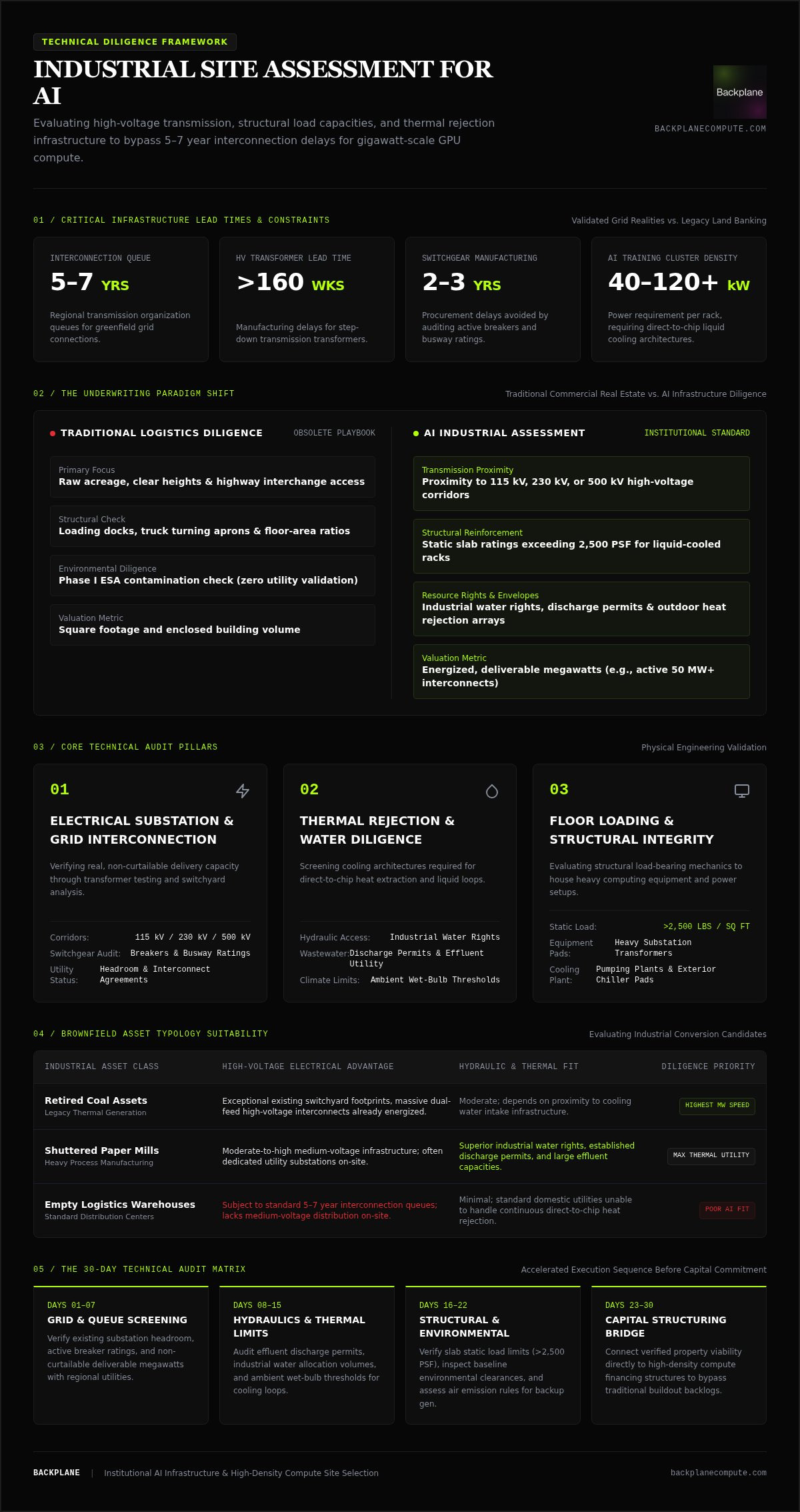
An industrial site assessment for AI evaluates a facility's capacity to host gigawatt-scale, high-density compute clusters. Traditional commercial real estate diligence stops at square footage, highway access, and ceiling clearances. That framework fails enterprise HPC operations. Modern artificial intelligence training clusters draw between 40 kW to well over 100 kW per rack, demanding an entirely different diligence model. Where standard logistics audits check loading docks, comprehensive data center site selection criteria prioritize energized substation capacity, industrial water rights, and structural slab reinforcement. Evaluating real estate through an environmental hygiene audit like a standard Phase I Environmental Site Assessment verifies baseline contamination, but it does nothing to confirm high-voltage transmission rights or switchyard headroom.
The Divergence from Traditional Commercial Real Estate Due Diligence
Logistics underwriting scrutinizes truck turning aprons, clear heights, and floor-area ratios. High-density compute sites ignore these baseline metrics. An institutional industrial site assessment for AI focuses squarely on physical and electrical fundamentals:
- Transmission proximity: Evaluating distance to 115 kV, 230 kV, or 500 kV transmission corridors rather than proximity to interstate interchanges.
- Switchgear readiness: Assessing existing breakers and busway ratings to avoid two-to-three-year manufacturing delays.
- Slab load limits: Verifying static load ratings exceeding 2,500 pounds per square foot to support liquid-cooled racks and heavy transformer pads.
- Mechanical envelopes: Ensuring zoning permits industrial-grade outdoor heat rejection arrays, pumping plants, and continuous prime generation.
The Time-to-Power Imperative: Why Energized Assets Dictate Valuation
Utility queues in major regional transmission organizations now span five to seven years for greenfield grid connections. Capital allocators cannot wait. Every month of delayed hardware energization compounds cloud spend and model obsolescence. Consequently, industrial real estate valuation has decoupled from physical building structures. Asset value now hinges almost exclusively on energized, deliverable megawatts. A retired manufacturing plant with an active 50 MW interconnect holds far greater enterprise compute utility than a pristine, empty warehouse requiring a six-year substation interconnect study. Securing speed-to-power via operational brownfield interconnects is the only viable path to executing deployment schedules on time.
The Core Technical Audit Pillars: Power, Cooling, and Structural Diligence
Transforming vintage manufacturing plants into high-density compute facilities demands exhaustive physical validation. Evaluating legacy assets requires looking past surface-level square footage and testing the structural and electrical backbone against the real demands of brownfield data center development. Federal initiatives reflect this urgency; the recent DOE AI infrastructure development program underlines how repurposing industrial power sites has become a national priority. An institutional industrial site assessment for AI grounds every acquisition in three non-negotiable engineering disciplines: medium-voltage power, thermal rejection physics, and floor loading mechanics.
Electrical Substation and Transmission Grid Interconnection Diligence
Substation capacity verification is the engineering audit of existing transformer ratings, switchyard bus configurations, and utility interconnect agreements to determine real, non-curtailable megawatt delivery. Auditors must inspect on-site primary step-down transformers and evaluate medium-voltage switchgear condition. With custom switchgear lead times running up to two to three years, existing operational gear is a primary value driver. Teams must also verify dual-feed redundancy from independent utility substations and check local utility tariffs for punitive demand charges or mandatory summer curtailment clauses.
Hydronic, Water, and Liquid-to-Chip Thermal Dissipation Analysis
Traditional air cooling cannot service modern AI clusters. Reference architectures for systems like the NVIDIA GB200 NVL72 demand 120 kW to 142 kW per rack, making closed-loop liquid-to-chip manifolds mandatory. Next-generation platforms are projected to top 200 kW per rack. Diligence teams must audit thermal infrastructure rigorously:
- Supply quotas: Confirming peak daily water allocations and continuous industrial delivery capacity.
- Discharge rights: Verifying municipal sewer discharge limits, National Pollutant Discharge Elimination System permits, and effluent temperature thresholds.
- Atmospheric envelopes: Modeling local 50-year maximum wet-bulb temperatures to size mechanical chillers, dry coolers, or fluid coolers accurately.
Structural Floor Loading, Clear Heights, and Physical Envelope Audits
Liquid-cooled compute racks dramatically shift structural parameters. Standard logistics floors handle 250 to 500 pounds per square foot. High-density compute racks loaded with coolant manifolds, internal pumps, and dense server chassis require reinforced slabs rated for 2,500 to 4,000 pounds per square foot. Engineers must pull core samples to verify concrete thickness and sub-base stability. Clear ceiling heights must clear at least 18 to 24 feet, leaving room for heavy liquid distribution piping manifolds, high-amp busways, and overhead cable routing without interfering with code-compliant fire suppression heads. Operators seeking to validate these complex structural variables can fast-track screening through a Backplane property viability assessment before committing diligence capital.
Comparative Assessment: Evaluating Industrial Asset Typologies for AI Suitability
Every industrial property brings distinct physical tradeoffs to compute conversion. Successful site acquisition requires matching existing physical assets against workload density requirements. As detailed in our framework on industrial asset repurposing for tech, brownfields are not uniform. A rigorous industrial site assessment for AI separates high-potential power envelopes from capital traps across four dominant facility classes.
Retired Coal Plants and Heavy Industrial Brownfields
Decommissioned thermal generation assets deliver unmatched electrical interconnects. Switchyards regularly provide immediate capacity between 100 MW and 500 MW, bypassing standard utility transmission queues entirely. However, the physical liabilities are extensive. Coal combustion residual ponds, heavy metal groundwater plumes, and legacy asbestos demand aggressive Phase II environmental auditing. Diligence teams must balance substantial site abatement and structural demolition costs against the tens of millions of dollars saved by acquiring operational high-voltage switchgear on site.
Decommissioned Paper, Pulp, and Steel Mills
Pulp and paper operations represent prime candidates for gigawatt-scale conversion due to their heavy utility footprints. These properties feature three distinct physical advantages:
- Water allocations: Established grandfathered intake permits and high-volume industrial discharge rights that fit closed-loop and evaporative cooling loops.
- Foundation engineering: Heavily reinforced concrete slabs originally engineered to carry multi-ton vibrating machinery and continuous chemical vats.
- Transmission access: Dedicated substation infrastructure built to feed continuous, energy-intensive industrial motors without grid disruption.
Operators must vet rural municipal dynamics, as converting legacy mills often requires amending local industrial zoning codes to permit modern technical infrastructure.
Former Crypto Mining Operations and Light Warehousing
Decommissioned cryptocurrency mining facilities offer fast-track energization. They feature existing transformers, switchgear line-ups, and active utility interconnects. Yet their physical envelopes rarely satisfy enterprise-grade artificial intelligence requirements. Most crypto facilities use pole-barn architecture with rudimentary roll-up doors, low acoustic mitigation, and zero particulate filtration. Upgrading these properties requires complete structural weatherproofing, adding concrete pads for liquid chillers, and installing Tier III redundant power distribution.
Light distribution warehouses present the opposite dilemma. They provide clean environmental baselines, high ceilings, and solid slab integrity. However, they almost universally lack high-voltage substation proximity. Bringing 50 MW to a standard logistics park generally triggers local grid capacity upgrades that delay commissioning by five years or more. A precise industrial site assessment for AI weeds out these power-starved logistics assets before diligence capital is lost.
De-Risking the Asset: Regulatory, Environmental, and Zoning Clearances
Physical infrastructure viability means nothing if municipal ordinances or environmental liabilities stall conversion. Institutional infrastructure capital requires complete regulatory clarity before funding execution. A comprehensive industrial site assessment for AI must extend beyond mechanical loads to evaluate local environmental baselines, emissions ceilings, and municipal zoning frameworks. Missing an acoustic boundary threshold or ignoring legacy ground plumes can freeze an otherwise prime asset in multi-year litigation.
Phase I and Phase II Environmental Site Assessments in Compute Repurposing
Brownfield conversions inherit historical liabilities. A standard historical review flags prior heavy industrial uses, underground storage tanks, and past chemical storage. Targeted soil and groundwater borings must immediately follow across transformer yards, maintenance pits, and boiler footprints to test for PCBs, solvents, and heavy metals. Institutional underwriting mandates transferring or capping these risks early. Operators must structure customized environmental insurance policies and statutory voluntary cleanup agreements before closing site acquisitions.
Air Quality Permitting and Backup Generation Compliance
Continuous compute operations require reliable backup power topologies. Deploying multi-megawatt generation arrays, whether diesel reciprocating engines or natural gas turbines, triggers strict air quality reviews:
- Emissions caps: Calculating localized run-time limits against Title V particulate matter and nitrogen oxide thresholds.
- Fuel infrastructure: Auditing pipeline pressure and volume for gas-fired generation, or obtaining permits for large-scale on-site diesel storage.
- Acoustic mitigation: Modeling noise pollution from continuous generator testing and rooftop heat rejection fans against local property-line decibel limits.
Zoning Reclassification and Utility Easement Approvals
Transforming heavy manufacturing or paper milling sites into digital infrastructure demands precise municipal alignment. Diligence teams must secure conditional use permits or rezone land specifically for mission-critical compute. Rights-of-way represent another frequent point of failure. Auditors must confirm recorded utility easements across private and public parcels for high-voltage transmission interconnects and diverse, redundant dark fiber routes. Engaging early with municipal leadership allows operators to negotiate clear payment-in-lieu-of-taxes frameworks and infrastructure development agreements. Before advancing speculative conversions, institutional sponsors can initiate a formal Property Viability Assessment to de-risk permitting, municipal, and zoning hurdles before capital commitment.
From Site Audit to Capital Deployment: The Backplane Execution Blueprint
Traditional engineering consultancies drop a compliance binder on your desk and walk away. That leaves a massive execution gap between physical feasibility and funded development. A forensic industrial site assessment for AI isn't an academic exercise; it's the financial baseline for institutional underwriting. Backplane eliminates this disconnect. By operating a two-sided compute infrastructure brokerage, we bridge powered industrial real estate directly with institutional capital and high-density compute buyers, bypassing multi-year hyperscaler backlogs.
Backplane Property Viability Assessment Methodology
Execution begins on the ground. Backplane deploys specialized electrical, structural, and civil engineering teams to conduct a rapid, institutional-grade Property Viability Assessment. We evaluate transmission availability, test switchgear integrity, inspect transformer health, and verify local discharge quotas within 30 days. We don't deliver generic real estate checklists. We deliver a comprehensive feasibility dossier engineered to qualify industrial brownfield assets directly for institutional debt and private equity underwriting.
Structuring Infrastructure Financing for Brownfield Conversions
A validated site without structured capital remains dormant concrete. Through our Infrastructure Financing Structuring capabilities, Backplane transforms technical engineering audits into bankable capital stacks. We package physical asset viability, power purchase agreements, and creditworthy off-take commitments into streamlined debt and equity vehicles. This bridges the capital valley between empty industrial facilities and energized, high-density data halls. Explore our detailed guide on institutional financing for AI infrastructure to see how modern capital stacks accelerate conversion.
Turnkey Delivery: Dedicated Financed Sites and GPUs-as-a-Service
Rigorous due diligence and structured capitalization pave a direct path to live compute deployment. We offer property owners and enterprise operators two distinct execution pathways:
- Dedicated Financed Sites: Fully funded, bespoke facility buildouts delivering energized capacity for sovereign AI architectures and massive frontier model training.
- GPUs-as-a-Service: Turnkey, operational compute clusters providing immediate enterprise access to dense, liquid-cooled accelerators without hardware procurement delays.
Industrial asset owners monetize stranded megawatts without managing complex technical builds. Compute buyers secure energized, gigawatt-scale capacity years ahead of the queue. Move from due diligence to live execution. Request an Institutional Property Viability Assessment today.
Execute the Shift From Stranded Megawatts to High-Density Compute
The era of speculative real estate development is over. In high-density artificial intelligence infrastructure, speed-to-power dictates market dominance. Performing a disciplined industrial site assessment for AI is the single most effective way to separate unviable shells from genuine, gigawatt-scale conversion opportunities. By verifying substation capacity, thermal discharge rights, and structural slab integrity within days instead of months, you de-risk institutional capital before breaking ground.
Backplane solves the execution bottleneck between physical real estate and funded compute. Our proven methodology pairs operational brownfields directly with qualified enterprise demand. We don't just vet site viability; our proprietary Infrastructure Financing Structuring transforms raw industrial power into institutional-grade compute assets. Whether your deployment strategy requires turnkey Dedicated Financed Sites or rapid enterprise GPUs-as-a-Service, the execution path starts now. Partner with Backplane to Assess and Capitalize Your Powered Industrial Site today.
Frequently Asked Questions
What makes an industrial site assessment for AI fundamentally different from a data center audit?
An industrial site assessment for AI focuses primarily on heavy electrical capacity and liquid thermal rejection rather than traditional building cosmetics or enterprise office layouts. Standard data center audits evaluate low-density enterprise workloads below 15 kW per rack. An AI-specific assessment audits high-voltage switchgear readiness, on-site transformer ratings, and concrete slab load ratings needed to support high-density clusters exceeding 100 kW per rack.
How much power capacity is required for an industrial site to be viable for AI compute?
Institutional AI clusters generally require a baseline of 20 MW to 50 MW of energized capacity for initial deployment, scaling to 100 MW or more for frontier model training campuses. Sites offering sub-10 MW allocations are typically viable only for specialized edge inference clusters, as large-scale liquid-cooled GPU deployments require massive power densities that lower-capacity feeds cannot sustain economically.
What are the primary electrical grid indicators evaluated during an AI site audit?
Auditors evaluate transmission voltage levels (preferably 115 kV to 500 kV), substation transformer capacity, available bus duct configurations, and dual-feed circuit redundancy. The assessment also examines regional transmission queue health, firm delivery contracts, and local utility tariff structures to confirm that deliverable megawatts aren't subject to peak-demand economic curtailment.
Can legacy paper mills and steel plants handle modern liquid-cooled AI server racks?
Yes, legacy industrial mills are often premier conversion targets because their foundations and utility profiles match high-density requirements. These facilities possess heavily reinforced slabs built to hold multi-ton machinery, satisfying the 2,500+ PSF requirements of liquid compute racks. They also retain grandfathered industrial water intake and discharge permits that dramatically simplify the engineering of closed-loop fluid cooling systems.
How long does a comprehensive property viability assessment take for a brownfield site?
A rigorous, institutional Property Viability Assessment typically takes 30 days to complete. This timeline encompasses physical on-site engineering inspections, utility interconnect filings analysis, environmental record audits, and structural load testing. That window delivers a complete technical feasibility dossier ready for infrastructure capital underwriting.
What environmental liabilities commonly derail industrial site conversions for data centers?
Uncapped historical ground contamination and restrictive municipal air quality permits are the most frequent deal-killers. Unremediated volatile organic compounds, heavy metals, or PCB leaks from antique transformers can halt site excavation. Additionally, tight local caps on NOx emissions can prevent operators from securing air permits required for multi-megawatt backup generation arrays.
How does Backplane accelerate the process from site assessment to live compute deployment?
Backplane operates a two-sided compute brokerage that unites technical diligence, infrastructure capital, and end-user demand. Instead of delivering static engineering binders, Backplane validates physical assets through its proprietary Property Viability Assessment, structures project capitalization via debt and equity vehicles, and matches energized brownfields directly with compute buyers through Dedicated Financed Sites or GPUs-as-a-Service.


