

The AI pivot is not a simple equipment swap. A crypto mine to AI compute transition can shift revenue from Bitcoin block rewards toward compute contracts, but it also demands a different level of infrastructure and execution. The 2024 halving cut the block reward from 6.25 to 3.125 coins, sharpening the pressure on miners to assess other uses for power and sites.
The shift is appealing: miners already operate energy-intensive facilities and know how to manage power, cooling, and hardware. But AI workloads have different requirements, and converting a site makes sense only when its capabilities match real customer demand.
This article explains how the revenue model changes, which mining assets may be reused, and how retrofits, financing, and customer commitments affect a crypto mine to AI compute transition. It also covers the opportunity to diversify as AI compute demand grows, and why execution and commercial viability remain central to the investment decision.
Key Takeaways
- Assess a mining site as a potential AI facility by comparing its power access, cooling, connectivity and infrastructure with the requirements of prospective workloads.
- Separate reusable operational capabilities from conversion needs; existing energy-intensive operations do not automatically make a site AI-ready.
- Compare variable mining revenue with the greater predictability of contracted hosting, while weighing the capacity commitments and retrofit demands those contracts can bring.
- Test the AI investment case against customer demand, capital requirements and the risk that market enthusiasm outpaces durable compute needs.
- When evaluating a site or compute strategy, consider whether Backplane’s Property Viability Assessment, Infrastructure Financing Structuring, GPUs-as-a-Service or Dedicated Financed Sites fit the project.
How does pivoting to AI change the business model for miners?
The crypto mine to AI compute transition shifts a miner’s revenue from Bitcoin rewards toward computing capacity and customer contracts. AI data centers require denser power delivery, advanced cooling, and low-latency fiber connections. Bitcoin mining can operate with satellite internet and can shut down within seconds when the power grid is stressed. The site’s priorities therefore change: AI customers need reliable, connected compute, while miners can curtail loads in response to grid conditions.
The distinction is commercial as well as technical. Bitcoin mining uses SHA-256 hashing to compete for block rewards, while AI training uses transformer models on GPUs. The 2024 halving reduced the block reward to 3.125 coins, making revenue more sensitive to Bitcoin’s price and network competition. By contrast, AI hosting can rely on contracted workloads, though those commitments require suitable infrastructure and customers.
Power economics shape the conversion decision. Schwab’s comparison of bitcoin mining and high-performance computing used an estimated U.S. baseline to contrast traditional power usage with modern computing demands. For a 100-megawatt operation, operators can compare continued mining with alternative uses for that power. That gap makes reuse attractive, but it does not eliminate the need for substantial upgrades.
Existing sites can help address a real bottleneck: time to power. Mining facilities already manage large electrical loads and energy-intensive hardware, capabilities that can support AI data centers where grid access is difficult to secure. However, a powered site is not automatically AI-ready. Cooling capacity, fiber connectivity, power quality, and customer requirements determine whether conversion is viable. Assess these constraints before committing capacity or financing construction.
Mining and AI demand also affect Bitcoin’s network differently. Bitcoin’s hashrate fell from approximately 1,160 exahashes per second in early October 2025 to roughly 920 EH/s. CoinShares forecast 1.8 zetahashes by the end of 2026, indicating that continued network growth can coexist with individual miners exiting or repurposing capacity. Public Bitcoin miners had announced more than $70 billion in cumulative AI and high-performance computing contracts. Those announcements signal investor interest, not guaranteed execution. The deciding factors remain delivery, customer demand, and the cost of making each site operational.
Shared operational capabilities of crypto mining and AI data centers
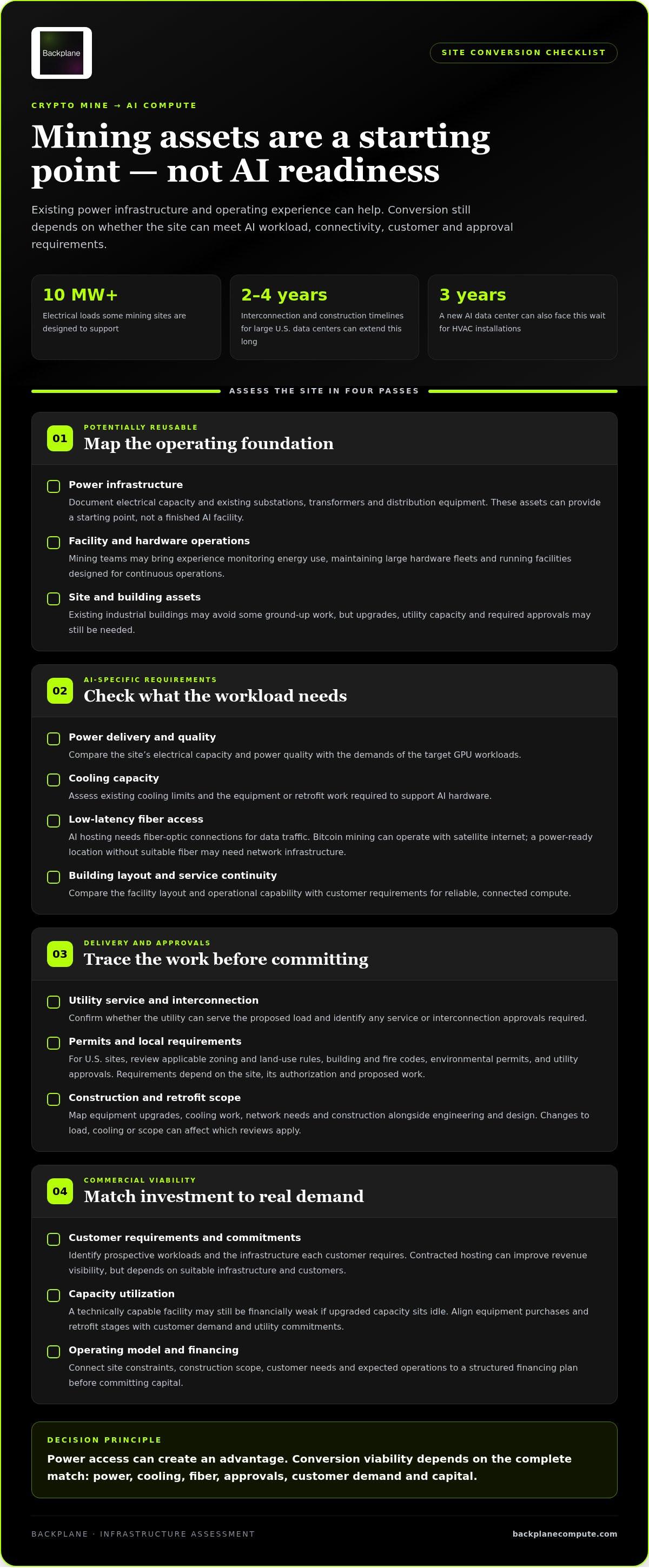
Mining and AI data centers both depend on power infrastructure, facility operations, and hardware management. A Bitcoin mining site designed for electrical loads of 10 MW or more may already have substations, transformers, and distribution equipment. Those assets create a starting point, not a completed AI facility. GPU workloads place different demands on power delivery, cooling, network capacity, and service continuity.
Operators can also carry over practical experience. Mining teams monitor energy use, maintain large hardware fleets, and manage facilities designed for continuous operations. That experience can support AI operations, where hardware deployment and cooling must be closely coordinated. A technical assessment is still essential: compare the site’s electrical capacity, cooling systems, fiber access, and building layout with the target workloads.
Construction schedules make existing sites valuable. Interconnection and construction timelines for large U.S. data center facilities can extend 2-4 years. A new AI data center can also face a three-year wait for HVAC installations. Repurposing an existing mining facility may avoid some ground-up work, but it does not remove the need to upgrade equipment, secure utility capacity, or complete required approvals.
In the United States, conversion approvals depend on the site, its existing authorization, and the proposed work. Review local zoning and land-use rules, building and fire-code requirements, applicable environmental permits, and utility interconnection or service approvals. Changes to the load, cooling equipment, or construction scope can affect which reviews apply, so map requirements alongside engineering and design.
Rural sites may offer access to power and industrial buildings, while new development faces constraints. Their value depends on whether the utility can serve the proposed load and whether fiber networks can support AI data traffic. Bitcoin mining can operate with satellite internet, but AI hosting requires low-latency fiber-optic connections. A power-ready location without suitable connectivity may need additional network infrastructure before it can serve customers.
Capital discipline matters as much as physical reuse. A facility may be technically capable but financially weak if upgraded capacity sits idle. Align equipment purchases and retrofit stages with customer demand, utility commitments, and the expected operating model. Contracts can improve revenue visibility, but utilization still depends on delivering the required compute, connectivity, and cooling.
Before committing capital, map each site’s existing assets against the work required to make them usable. That means documenting power capacity, cooling limits, fiber access, permit pathways, construction scope, and customer requirements. A structured financing plan can connect those inputs to a conversion strategy. For a project-specific capital framework, explore site conversion capital planning.
Is switching from Bitcoin mining to AI computing a simple process?
No. The revenue model, equipment strategy, and power commitments all change. Bitcoin miners earn block rewards and transaction fees, so revenue varies with Bitcoin’s price, network competition, and operating costs. AI hosting contracts can set payment terms for reserved compute capacity, but operators must deliver the agreed workloads and service levels. Contracts can improve revenue visibility, but they do not remove hardware, customer, or operating risks.
Mining profitability can also depend on keeping hardware competitive. The equipment replacement cycle that once ran 18 months has accelerated, while the traditional 18-month return-on-investment cycle is described as no longer viable. For a miner weighing a pivot, compare the remaining useful life of its machines with the cost and timing of deploying AI hardware. A site’s power access may carry forward, but its computing hardware may need to change for AI workloads. Conversion means replacing the core computing equipment and adapting facility operations.
Scale affects the decision. Larger listed miners can pursue AI contracts and infrastructure investment across substantial sites, while smaller operators may face tighter access to capital and fewer ways to spread project risk. A conversion plan should separate reusable site assets from new spending, then test whether customer demand supports each phase. Publicly listed Bitcoin miners could derive as much as 70% of their revenue from AI by the end of 2026. That projection signals a major strategic shift, not a universal outcome for every operator.
Capacity is another constraint. A five-year AI hosting contract can commit a miner’s power capacity for half a decade, limiting the ability to return that capacity to mining if Bitcoin economics improve. Before signing, compare the contract term with utility arrangements, site upgrades, and alternative uses for power. Then assess how much hashrate the operation would retire or redirect. Customer commitments directly affect mining output.
Some capabilities do transfer. Bitcoin mining and AI/HPC both require teams to operate energy-intensive hardware, manage power systems, and maintain facilities. But AI workloads bring different cooling demands, including potential liquid-cooling retrofits, and more demanding service expectations. AI data-center workloads are described as requiring 99.99% uptime. That standard changes maintenance planning and failure response compared with interruptible mining operations. Treat shared skills as an operating advantage, not proof that conversion is simple. The workable path depends on matching contracts, infrastructure, and capacity before retiring mining revenue.
AI infrastructure investment and bubble risk
AI infrastructure investment is accelerating, but spending alone doesn’t establish durable returns. Goldman Sachs Research estimates U.S. data center demand will grow at a 15% CAGR from 2023 to 2030. JP Morgan Asset Management projects hyperscaler AI capital expenditure will reach $370bn by 2038. Those forecasts point to sustained buildout, while leaving individual projects exposed to utilization, financing, and customer-concentration risk.
Hyperscaler commitments strengthen the demand case. They have committed to invest over $100 billion in AI-focused data centers over the next 10 years. JP Morgan Asset Management estimated that $163 billion would be invested in expanding hyperscaler businesses by the end of 2024, a 28% year-over-year increase. Meta Platforms also announced 10% employee layoffs while continuing AI capital expenditure. These examples show why investors must distinguish large spending plans from evidence that a specific site will earn attractive returns.
How much does conversion cost? These are infrastructure benchmarks, not a fixed conversion quote. GPU deployment, electrical upgrades, cooling, fiber, and site conditions shape project capital requirements.
Financing, leases, and customer contracts can each support an AI buildout. A customer contract can underpin projected utilization, while equipment leases can spread hardware payments across an agreed term. Project debt or equity can fund site work, and utility commitments help establish whether planned capacity can be delivered. Match the financing structure to construction milestones, contract duration, and revenue timing. A long-term commitment made before customer demand is clear can leave capital tied up in underused infrastructure.
Bubble risk becomes tangible when projected demand fails to turn into paid workloads. Training a large language model can consume millions of dollars in GPU time, but that does not guarantee future occupancy for a facility. Investors can test a project by separating signed customer commitments from market forecasts, then stress-testing utilization, power availability, and operating costs. They should also assess whether credit exposure depends heavily on one customer or funding source.
For miners, the investment case is strongest when conversion spending follows evidence of demand. Compare phased upgrades with the capacity customers will use, and align financing maturities with contract terms. A sound capital plan identifies which assets can be reused, which need replacement, and which returns depend on assumptions rather than contracted workloads. This discipline limits exposure if AI investment slows or customer plans change.
AI compute demand and investor diversification
Artificial intelligence demand is creating a new investment case for power-intensive sites. Goldman Sachs Research estimates U.S. data center demand will reach 21 GW in 2024, after increasing 31% year over year. It projects demand will reach 45 GW by 2030. For investors, the consequence is clear: compute capacity may become a distinct revenue driver, but demand forecasts alone don’t prove a specific facility will secure customers.
The workload mix matters. AI inference could account for more than 50% of data center demand by 2030. Inference runs models after training, so demand can come from ongoing use rather than model development alone. That creates a different utilization opportunity for facilities able to serve customer workloads. It does not make margins stable by default. Power costs, hardware availability, cooling performance, and contract terms still shape operating returns.
Connection requests show the scale of the infrastructure challenge. The U.S. Department of Energy reports a sharp rise in data center requests for facilities ranging from 300 MW to 1,000 MW or more. Such large projects can absorb substantial capital and take time to develop. Smaller mining sites may enter the market at a different scale, but their investment case still depends on usable power, fiber access, and customer demand. Capacity on paper is not the same as productive compute.
Investor activity adds context, not certainty. PitchBook reports more than $680 billion invested in AI and machine-learning startups since 2016, including $120 billion in 2024. Those figures indicate significant capital flowing toward artificial intelligence businesses. They don’t establish which models, companies, or data center locations will capture lasting revenue. Investors assessing a miner’s pivot should distinguish broad sector momentum from contracted workloads and a credible path to utilization.
Diversification can reduce reliance on Bitcoin mining revenue, but it adds exposure to a different market. Compare expected cash flow from AI contracts with mining revenue under changing Bitcoin conditions. Then consider customer concentration, contract duration, power commitments, and the capital needed to make the site operational. A project dependent on one customer or uninterrupted expansion may not provide the balanced risk profile investors expect.
The practical takeaway is to underwrite demand at the site level. Match available capacity to customer requirements, then test whether projected utilization supports the investment plan. If you’re evaluating a powered property for AI workloads, assess its AI compute viability before committing capital.
Backplane: GPUs-as-a-Service
Backplane connects powered industrial sites with AI compute demand and structures financing for infrastructure build-outs. Buyers seeking GPU capacity without building a dedicated facility can access GPUs-as-a-Service. Operators assessing a mining-site conversion can use a Property Viability Assessment to evaluate the site, then consider Infrastructure Financing Structuring for the capital plan. Dedicated Financed Sites offer compute buyers a route to dedicated infrastructure without waiting in hyperscaler queues.
The right route depends on your role and objective: access GPU capacity, assess a powered property, or structure a dedicated site. These options connect infrastructure decisions with compute demand. Visit Backplane’s compute infrastructure site to explore the next step, or contact Backplane to discuss your project.
Make the Next Infrastructure Decision Deliberately
The next phase of a crypto mine to AI compute transition is a sequence of investment decisions, not a simple equipment swap. First, define the objective: access GPU capacity, assess a powered property, or develop a dedicated compute site. That choice determines which commitments to prioritize and where to direct capital.
Backplane connects these needs with relevant options. GPUs-as-a-Service gives compute buyers access to GPU capacity. A Property Viability Assessment helps evaluate a site’s conversion potential, while Dedicated Financed Sites provide a path to dedicated infrastructure. Each option serves a different stage of the decision.
Start with the requirement that matters most to your project, then align the next step with it. Discuss AI compute with Backplane to explore the right path for your site or capacity needs. A deliberate plan can turn an infrastructure decision into a focused move toward the next opportunity.
Frequently Asked Questions
How would capital constraint impact mining and high-performance computing (HPC) economics?
Limited capital means operators must choose which capacity to convert first, rather than upgrading an entire site at once. For example, a miner might prioritize a building area where electrical distribution, cooling modifications, and customer demand align. Delaying GPU purchases can preserve cash, but it may also delay revenue from HPC workloads. The decision depends on project sequencing, financing, and whether each upgrade unlocks usable, revenue-generating capacity.
What is the AI Data Center Opportunity?
The opportunity is to turn access to power and industrial property into infrastructure that supports artificial intelligence workloads. Demand forecasts provide context: Goldman Sachs Research projects U.S. data center demand will reach 45 GW by 2030, while the U.S. Department of Energy reports requests for facilities from 300 MW to 1,000 MW or more. For a site owner, the practical question is whether location, utility service, and connectivity can meet a buyer’s needs.
Will miners eventually stop mining entirely?
There’s no reason to assume every miner will exit Bitcoin mining. Operators make decisions site by site, weighing mining economics against customer demand for AI or HPC capacity. A company may keep some facilities mining while converting another property, or shift capacity as contracts and infrastructure evolve. For investors, the key distinction is between diversifying revenue and abandoning mining altogether. Those strategies create different exposures to Bitcoin and compute markets.
How are crypto mining facilities transitioning to AI and high-performance computing?
Operators typically begin by matching a site’s usable power and building layout to a specific compute workload. They then identify the changes needed to electrical distribution, cooling, network connectivity, and GPU deployment. For example, a facility with power infrastructure but limited fiber may need network upgrades before it can serve AI customers. Conversion planning also aligns construction milestones with customer commitments, directing capital toward defined operating requirements.
Which crypto miners have announced AI data center conversions or partnerships?
Publicly listed Bitcoin miners have announced AI and high-performance computing contracts and partnerships, including plans to repurpose mining infrastructure for compute workloads. These announcements show that the shift extends beyond one operator, but they do not all represent completed conversions or live facilities. Evaluate each announcement by what it describes: a partnership, a customer contract, a construction plan, or operational capacity already serving workloads.
What equipment and infrastructure upgrades do mining sites need for AI compute?
Most conversions require GPU systems and an assessment of existing electrical distribution, cooling, and network capacity. AI workloads can produce heat densities that call for liquid-cooling retrofits, while serving customers requires low-latency fiber connections. Map each requirement to the site’s current equipment and building design. A power connection alone is not enough: the facility must deliver usable compute, maintain appropriate cooling, and connect reliably to customer workloads.
What are the economics of AI hosting compared with Bitcoin mining revenue?
Mining revenue fluctuates with Bitcoin’s price, network competition, and operating costs. AI hosting revenue depends instead on customer contracts, delivered compute, and facility utilization. A contract can make expected cash flows easier to model, but it also commits capacity to the agreement’s requirements and duration. Compare both models using site-specific power costs, equipment investment, operating needs, and customer demand. The stronger case supports durable utilization with manageable capital exposure.
How long does a crypto mine-to-AI compute conversion typically take?
Conversion timing depends on the site’s starting condition and the scope of work required. A facility with suitable power distribution, cooling potential, and fiber access has different construction needs from one requiring major upgrades or new utility arrangements. GPU procurement, permitting, construction, and customer readiness also affect sequencing. Build a project schedule around these workstreams and dependencies, rather than treating conversion as a simple equipment replacement or relying on a generic timeline.


