

The AI infrastructure race is constrained by power access, not just computing equipment. Repurposing power plants for AI can put data centers beside existing generation and electrical infrastructure, helping address the need for reliable, high-capacity electricity 24 hours a day. At Sweden’s former Kvarnsveden paper mill, the site had its own 400-kV electricity infrastructure.
The logic is clear: a site with generation, grid connections, and industrial infrastructure may be a stronger starting point than building everything from scratch. But existing assets are not automatically ready for new demand. Grid capacity, equipment condition, and the ability to support flexible loads all shape what a project can deliver.
This article explains why data centers co-locate with power generation and how grid access, flexible loads, and microgrids affect project viability. It also explores how reclaimed coal-mine and power infrastructure can be reused, why remediation and site constraints matter, and what current plant-conversion projects reveal about capacity and development timelines.
Key Takeaways
- Assess a site’s grid connection and existing electrical infrastructure before judging its potential for data-center use.
- Understand how flexible computing loads and microgrids can help align energy supply with data-center demand.
- Evaluate reclaimed coal infrastructure for both its reuse potential and the remediation work a brownfield site may require.
- Compare plant-conversion projects by their generation plans, grid access, and development timelines, not by nameplate capacity alone.
- Use the article’s project examples to see how retired or underused power assets can become part of AI infrastructure.
Grid access, flexible loads, and microgrids
AI data centers need reliable, high-capacity electricity access 24 hours a day. A former power plant can offer a strategic starting point because generation equipment, substations, transmission lines, and industrial land may already sit together. That infrastructure still needs a close technical assessment. Its age, condition, operating status, and available capacity determine how useful it is to a new facility.
Power-plant conversions may reuse existing grid connections, while new connections require a separate interconnection process and supporting infrastructure. On-site generation adds another supply option, but projects still need to assess transmission access, backup arrangements, and operational resilience.
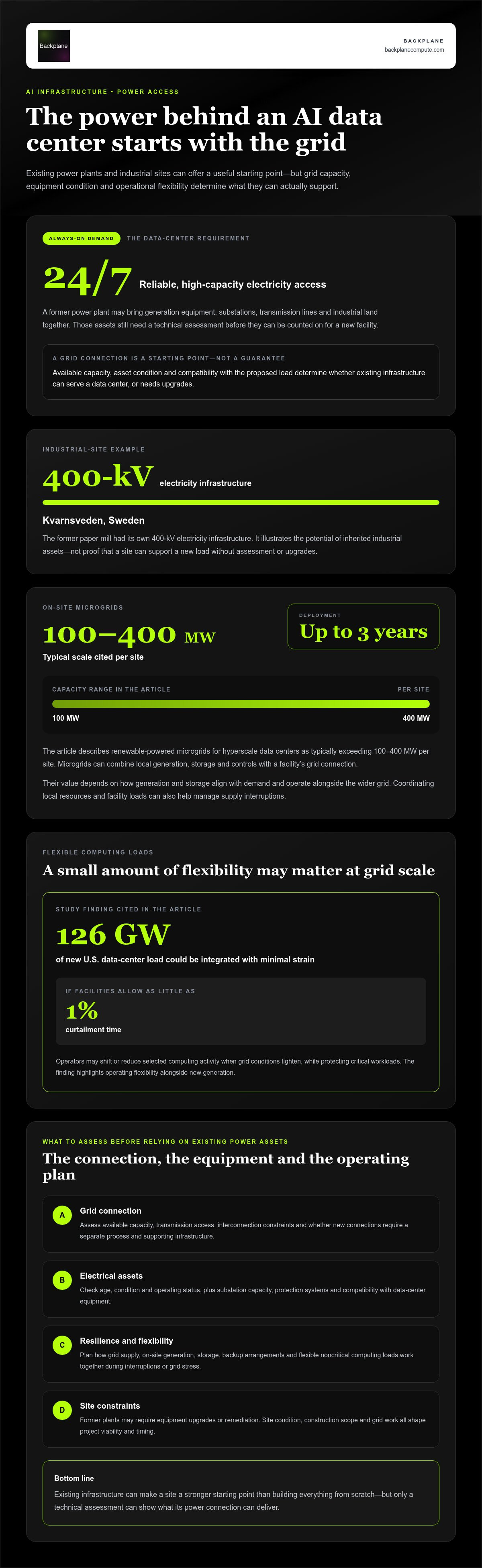
Substations and high-voltage lines are valuable only if they can serve the proposed load. Engineers must assess the connection’s capacity, condition, protection systems, and compatibility with data-center equipment. Sweden’s former Kvarnsveden paper mill had its own 400-kV electricity infrastructure, illustrating how an industrial site can inherit substantial electrical assets. The site’s connection is a starting point, not proof that it can support a new load without upgrades.
On-site microgrids can combine local generation, storage, and controls with a facility’s grid connection. Renewable-powered on-site microgrids for hyperscale data centers typically exceed 100-400 MW per site and can take up to three years to deploy. Their value depends on how generation and storage align with demand, and how the system operates alongside the wider grid. A microgrid can also help manage supply interruptions by coordinating local resources and facility loads.
Flexible loads can strengthen that coordination. Data-center operators may shift or reduce selected computing activity when grid conditions tighten, while protecting critical workloads. A study cited in the market suggests that up to 126 GW of new U.S. data-center load could be integrated with minimal strain if facilities allow as little as 1% curtailment time. That finding highlights how operating flexibility can matter alongside new generation.
Risks when repurposing former power plants include aging electrical equipment, insufficient grid capacity, interconnection constraints, and remediation needs. A project must also plan for supply interruptions and coordinate backup generation, storage, and grid services to support continuous operations.
Grid stability depends on the balance between a facility’s electricity demand and available supply. A data center able to adjust noncritical computing loads gives operators more flexibility when the power system is under stress. A microgrid can coordinate local resources, while a grid connection provides access to the wider electricity system. Neither replaces sound electrical design.
Suitable U.S. locations have usable transmission access, substations, and room to serve new demand. There is no single favored region or utility: each project depends on its specific grid connection and available capacity. PJM, a regional transmission organization covering the mid-Atlantic, including Pennsylvania, is one relevant grid area.
Repurposing reclaimed coal mines and power infrastructure
Coal sites may offer land and electrical assets, but reuse depends on remediation, permits, and infrastructure condition. An industrial legacy can shorten some parts of the development process while creating work that a new site may not require.
Permits and Regulations
In the U.S., permits depend on the site’s environmental condition, planned construction, changes to power generation, and grid work. Federal, state, and local approvals are determined by the activities proposed, so the project scope shapes the permitting path.
According to United States Congress, the Abandoned Mine Land Reclamation Program was created under the Surface Mining Control and Reclamation Act of 1977. According to the Office of Surface Mining Reclamation and Enforcement, the Abandoned Mine Land Economic Revitalization Program was established by Congress in 2016. These programs provide a framework for reclamation and economic reuse, but they do not remove the need to address a site’s specific conditions.
Conversion Costs and Timelines
Conversion costs depend on remediation, electrical upgrades, how much existing infrastructure can be reused, and the work needed to adapt the site for data-center operations. Building equivalent electrical infrastructure from scratch would cost companies millions, making existing substations and transmission connections potentially valuable.
That advantage is not automatic. At Homer City in Pennsylvania, the brownfield site requires remediation, creating a distinct workstream alongside power and facility development. The timeline depends on infrastructure condition, remediation requirements, construction scope, and the process for connecting the new load. A former plant’s presence alone does not determine when a site can provide power.
Repurposing Plants and Infrastructure
Repurposing can preserve useful site infrastructure while changing how a property supports power generation and computing. Environmental impacts include legacy conditions that remediation must address, as well as effects from new construction. Operational impacts also depend on the generation source serving the data center.
Homer City illustrates the complexity: the former coal-plant site requires remediation and is planned for conversion to gas generation. Reusing industrial land does not erase its environmental history, and adapting power infrastructure still requires development work. The Abandoned Mine Land programs link reclamation with potential economic reuse, giving communities a framework for addressing legacy mine conditions as sites are redeveloped.
Site Capacity and Conversion Candidates
Conversion candidates include former plants and industrial sites with power infrastructure suited to a new load, but capacity and readiness differ by project. The planned Homer City Energy Campus in Pennsylvania has a nameplate capacity of 4.5 gigawatts and is expected to produce power by 2027.
Other examples show different stages of reuse. A hyperscale data center at a former coal plant in Ohio is set to launch by 2026. Indiana’s Merom Generating Station is a 40-year-old coal-fired plant that was slated to go offline in 2023. These cases show why site capacity alone is not enough: remediation, equipment, generation plans, and development timing all shape conversion potential.
How are existing power plants being repurposed to power AI data centers?
Power-plant reuse can mean restarting generation, changing the fuel source, or connecting a data center to a site’s power infrastructure. The right approach depends on the plant’s equipment, operating status, and role in the electricity system. These are distinct development paths, not interchangeable labels: restarting a retired nuclear facility differs fundamentally from converting a coal plant to gas.
Two retired U.S. nuclear power plants, Palisades in Michigan and Three Mile Island in Pennsylvania, are being brought back from retirement. In both cases, the existing generation site is central to the plan. The challenge is to align plant operations and electricity delivery with data-center demand while managing the separate work needed to bring generation back online.
Another pathway changes the generation technology. Homer City Generating Station in Pennsylvania was the state’s largest coal-fired power plant before its planned conversion to gas generation. The shift preserves the site as a place for power generation while changing its fuel and generating equipment. The data-center project must still coordinate the generation plan with facility construction and grid connection.
Some facilities remain in service rather than retiring, creating a different way to meet rising demand. Two Georgia coal plants slated for closure are staying online. Continued operation can maintain generation at an existing site, but it does not mean a nearby data center has secured power. The project still depends on how generation, transmission, and the new load connect.
These examples show the main ways repurposing power plants for AI can work:
- Restart: Return retired generation assets to operation, as with Palisades and Three Mile Island.
- Convert: Change the generation source, as planned at Homer City.
- Retain: Keep existing generation online, as with the two Georgia plants.
- Co-locate: Develop data-center facilities at or near an energy site, coordinating electrical delivery with computing demand.
Each pathway creates a different project profile. Restarting means returning an idle facility to service. Conversion changes the generation setup. Continued operation keeps existing assets available. Co-location connects a power site with data-center development, but the arrangements for connection and electricity delivery still matter.
For operators, the practical distinction is between available generation and usable power at the data-center boundary. A plant’s status, technology, and grid connection determine what work remains before it can serve computing loads. The Palisades and Three Mile Island restarts, Homer City’s planned gas conversion, and Georgia’s continued coal generation show a market using multiple reuse strategies, not one standard template.
Which retired or underused U.S. power plants are being converted for AI data centers?
U.S. projects show different routes from legacy generation to data-center power. Homer City in Pennsylvania is planned for conversion from coal generation to gas, while a former Ohio coal plant is slated to host a hyperscale data center by 2026. These projects connect industrial power sites with AI demand, but they represent different development approaches.
Homer City stands out for its planned scale. The Pennsylvania site is planned as an energy campus, with generation converted to gas and power intended to support new demand. Its history as Pennsylvania’s largest coal-fired power plant gives the project a substantial industrial setting. But a former plant’s identity does not establish how much electricity will be available to a specific data center.
The Ohio example takes a direct site-reuse approach. A new hyperscale data center at a former coal plant is set to launch by 2026. The conversion places computing infrastructure on a former generation property, rather than treating the site only as a source of electricity. This distinction matters: projects can reuse power infrastructure, industrial land, or both, depending on their design.
Indiana’s Merom Generating Station illustrates how retirement plans can change. The 40-year-old coal-fired plant was slated to go offline in 2023. Its retirement was announced in 2020, then reversed in 2022. That sequence makes Merom an example of an underused asset whose generation status shifted, not proof that every proposed closure creates a data-center conversion opportunity.
Two retired nuclear plants, Palisades in Michigan and Three Mile Island in Pennsylvania, are being brought back from retirement. Their cases differ from former coal sites: the central strategy is restarting nuclear generation, rather than replacing a coal plant or developing a data center at its location. Together, these projects show how existing generation can return to the supply mix for large new loads.
Use these examples to distinguish a project’s actual pathway:
- Generation conversion: Homer City is planned to change from coal to gas.
- Data-center redevelopment: The Ohio project targets a former coal-plant property.
- Retirement reversal: Merom’s planned 2023 closure was reversed in 2022.
- Generation restart: Palisades and Three Mile Island are returning from retirement.
These cases are not interchangeable. For each U.S. site, identify whether the development reuses the property, restarts generation, changes fuel, or combines these approaches. Then distinguish announced plans from operating facilities. Homer City, the Ohio site, Merom, Palisades, and Three Mile Island illustrate the range of paths, while each project’s stage determines what it can contribute to AI infrastructure.
What power capacity and timeline can repurposed power plants provide to AI data centers?
Capacity depends on what a site can generate, transmit, and deliver to the data center. The planned Homer City Energy Campus in Pennsylvania has a nameplate capacity of 4.5 gigawatts and is expected to produce power by 2027. Nameplate capacity describes the planned campus output, not the amount available to a particular computing load at every moment.
That distinction matters for development decisions. A site’s generation capacity must be considered alongside transmission access, substation capability, facility demand, and the schedule for construction and connection. At Homer City, the 2027 power target provides a project milestone. It does not by itself define when every component of a data-center campus will be ready.
On-site generation can complement a grid connection, while a microgrid can coordinate local generation, storage, and facility demand. Renewable-powered on-site microgrids for hyperscale data centers typically exceed 100-400 MW per site and can take up to three years to deploy. That deployment horizon makes project sequencing important: power systems and data-center construction must advance in coordination.
Timelines depend on the work required at each property. Reusing existing electrical infrastructure may avoid building equivalent assets from scratch, but equipment condition and necessary upgrades still affect readiness. Homer City is also a brownfield site requiring remediation, so site work is part of development alongside generation and campus plans. A headline capacity figure cannot remove these dependencies.
For a project assessment, break the capacity question into three parts:
- Generation: What output is planned, and when is the power expected?
- Delivery: Can the site’s electrical infrastructure move that power to the intended load?
- Schedule: How do remediation, construction, generation, and connection milestones align?
This framework also clarifies why the nameplate figure is only one measure of project scale. A 4.5-gigawatt campus plan signals substantial intended generation, while a data center’s usable power depends on delivery infrastructure and the timing of each development phase. At a microgrid project, the generation mix, storage, control systems, and facility demand shape the design and deployment sequence.
For projects repurposing power plants for AI, align compute deployment with the power schedule rather than treating capacity as immediately available. Compare the expected generation date with site readiness, grid delivery, and data-center construction milestones. This turns a headline capacity figure into a practical development timeline and shows where infrastructure sequencing could affect the path to operation.
Planning a powered-site project? Assess the viability of an industrial site against its capacity and development timeline.
Backplane: GPUs-as-a-Service
Backplane connects AI compute demand with powered industrial sites, helping turn infrastructure potential into practical access to computing capacity. If you need GPU capacity without developing a dedicated facility, GPUs-as-a-Service offers a direct route. If you need control of a site, Dedicated Financed Sites can support a project built around dedicated infrastructure.
For owners assessing a retired plant or industrial property, a Property Viability Assessment helps evaluate its potential for compute use. Infrastructure Financing Structuring supports the capital planning needed to advance a conversion. These options serve different needs: access to GPU capacity, a dedicated site, or a way to assess and finance infrastructure.
To discuss a powered-site or compute requirement, visit Backplane’s website.
Turn Site Potential Into an Executable Plan
The key decision is not simply whether an industrial property can host computing. It is whether the site, power strategy, and financing can come together in a viable project. Repurposing power plants for AI requires a clear view of what the asset can support and what development will involve.
Backplane can support different stages of that process. Its Property Viability Assessment evaluates an industrial site’s potential for computing. Operators seeking GPU capacity can use Backplane’s GPUs-as-a-Service. For projects that need a dedicated facility, Dedicated Financed Sites offer another path.
The right next step depends on your role. Site owners can explore a property’s potential. Compute buyers can consider GPU capacity or a dedicated site. A focused discussion with Backplane can help clarify which route fits your project and what information should guide the decision.
Contact Backplane about AI power and take the next step toward putting infrastructure to work.
Frequently Asked Questions
Why collocate energy generation with data centers?
Co-location can bring power supply closer to computing demand and simplify coordination of electricity delivery. It can also link data-center development with an existing industrial energy site. For example, a campus can plan its electrical layout around generation equipment and transmission access instead of treating power as a separate, later-stage issue. The key is matching the plant’s operating profile to the facility’s continuous computing needs.
Why do Brownfields make sense for data centers?
Brownfields can offer large, previously developed properties with industrial access and existing infrastructure. That can make them relevant for data centers needing space for buildings, electrical equipment, and supporting operations. But a project must account for the property’s history: remediation is part of redevelopment at Homer City. The practical value comes from assessing usable assets and site constraints together, rather than assuming industrial land is ready for construction.
What upgrades are needed to connect a former power plant to an AI data center?
Required upgrades depend on the plant’s equipment and the data center’s electrical design. A project may need transformer capacity, modern switchgear, protective relays, breakers, and cabling suited to the planned load. Engineers also coordinate grid interconnection, metering, backup power, and redundancy so a fault in one component does not interrupt critical operations. A load study and equipment-condition assessment help determine what can be reused and what needs replacement.
What are the environmental impacts of converting coal or gas plants to serve AI data centers?
Converting a coal site does not erase its environmental legacy. Brownfield remediation may be required, alongside measures to address the impacts of new construction. Operational impacts depend on the generation source, as with Homer City’s planned conversion from coal to gas.
Which U.S. regions and utilities are most suitable for power plant-to-data-center conversions?
Suitable locations have usable transmission access, substations, and room to serve new demand. Suitability depends on each site’s grid connection and available capacity, not on a single favored region or utility. PJM, which covers the mid-Atlantic, including Pennsylvania, is one relevant grid area.


