

The costly decision may not be whether to lease a GPU cluster, but whether the capacity will match your workload. Enterprise GPU cluster leasing can bridge the gap between variable cloud demand and the capital commitment of ownership, but it makes sense only when the workload and infrastructure requirements support it.
The trade-off is real. Uncertain demand makes a large, dedicated deployment difficult to justify. Sustained, predictable workloads may be harder to serve through flexible cloud capacity or pricing. GPU selection is only one part of the equation: power, networking, deployment, and utilization all affect whether the infrastructure works in practice.
This guide explains how to match capacity and commitment to workload patterns, compare leasing with cloud and ownership on total cost and operational fit, and move from compute demand to deployed capacity. It also compares GPU-as-a-Service with dedicated financed sites, where property viability and financing shape what can be deployed. Start with the workload, then work through the infrastructure it requires.
Key Takeaways
- Use workload duration, predictability, and capacity needs to judge whether enterprise GPU cluster leasing fits better than flexible cloud access or hardware ownership.
- Compare deployment models by commitment, capacity control, operational responsibility, and flexibility, not by compute access alone.
- Measure total cost per completed workload, accounting for utilization alongside networking, storage, energy, and operations.
- Follow a practical diligence sequence: define workload requirements, map infrastructure needs, and assess operational readiness before committing to capacity.
- Use the demand profile to compare GPUs-as-a-Service with a dedicated financed site, and assess property viability and financing as part of deployment planning.
Enterprise GPU cluster leasing: why the commitment model matters
Enterprise workloads need dependable compute. Buying hardware before demand is proven can tie up capital in infrastructure that sits idle. Relying only on hourly cloud capacity can make sustained workloads more exposed to changes in capacity and pricing. The decision is not simply lease or buy. Consider how much capacity the workload can use, for how long, and how much control the team needs.
Enterprise GPU cluster leasing is contracted access to dedicated GPU infrastructure for an agreed period or under defined terms, rather than purchasing the hardware outright or drawing isolated GPUs on demand. It can provide a more stable capacity base, but lease structures differ. Ownership, maintenance, site operations, and deployment responsibilities depend on the arrangement.
What enterprise GPU cluster leasing means
A cluster combines multiple GPUs with the systems that connect them, allowing a workload to coordinate compute across devices or nodes. An isolated GPU instance provides a discrete unit of capacity and can suit tasks with limited coordination needs. For a foundational overview of cluster architecture, see What is a GPU Cluster?
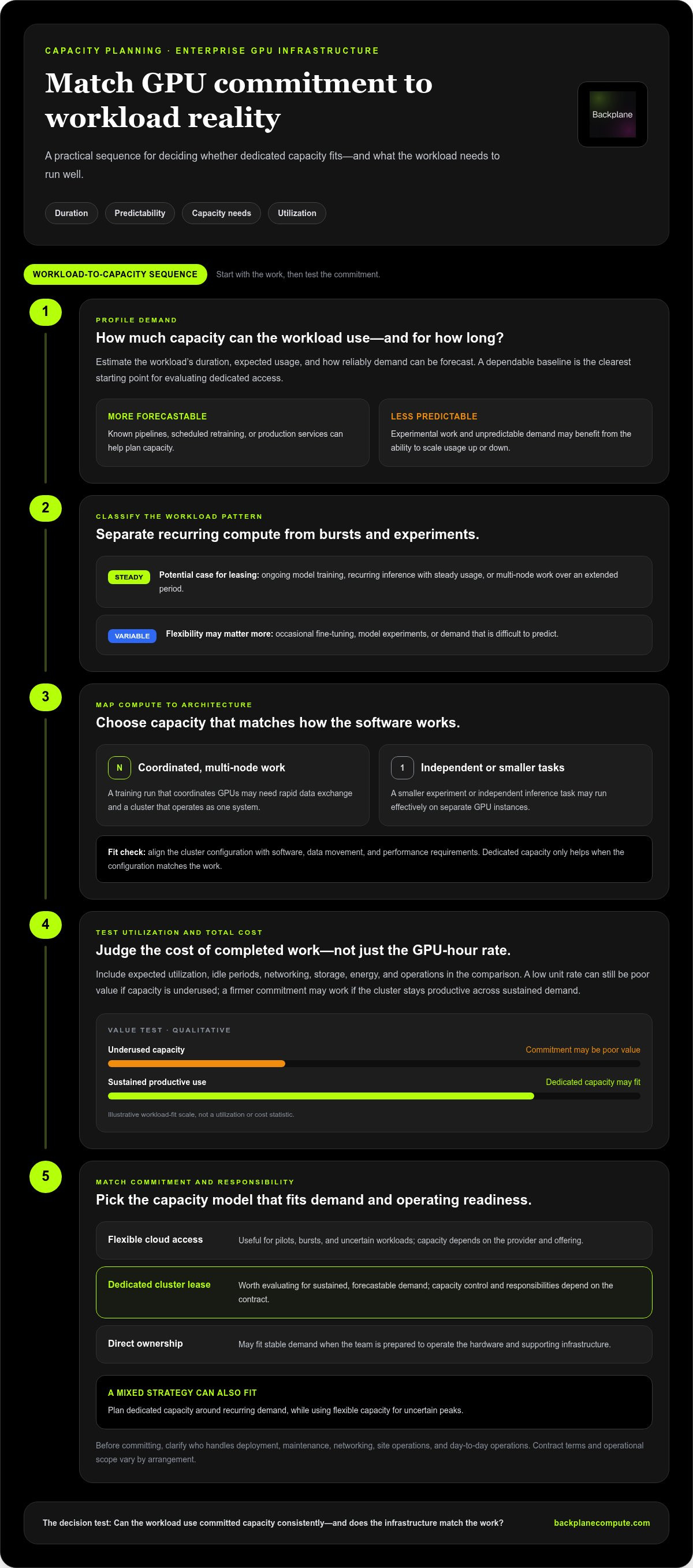
The difference matters when you map a workload to infrastructure. A multi-node training run may need GPUs to exchange data rapidly and work together as one system. A smaller experiment or independent inference task may run effectively on separate instances. Dedicated capacity is valuable only when the cluster configuration matches the software, data movement, and performance requirements.
Contracted access does not automatically mean the customer owns the equipment or operates the facility. One arrangement may place more responsibility with the infrastructure operator; another may give the customer more control and operating duties. Before comparing commitments, clarify who handles deployment, maintenance, networking, and day-to-day operations. Those responsibilities affect both the operating burden and the control the team gains.
Which enterprise workloads create a case for leasing?
Leasing is most compelling when demand has a dependable baseline. Examples include ongoing model training, recurring inference with steady usage, and multi-node workloads that need coordinated compute over an extended period. A known pipeline, scheduled retraining cycle, or production service can help forecast capacity needs and plan around dedicated access.
Experimental research and bursty workloads present a different case. Teams testing model approaches, running occasional fine-tuning jobs, or facing unpredictable demand may value the ability to scale usage up or down without carrying reserved capacity between projects. A mixed strategy can also work: use flexible capacity for uncertain peaks while planning a dedicated base around recurring demand.
Measure utilization and expected duration, not just the headline GPU-hour rate. A low unit rate can still represent poor value if capacity is underused. A firmer commitment may be viable if the cluster stays productive across a sustained workload. Compare the compute needed to complete jobs, including idle periods and operating needs, with the flexibility you give up. That is the core test of enterprise GPU cluster leasing: does the workload justify committed capacity, and can the organization use it consistently?
GPU cluster leasing versus cloud, GPUaaS, and buying hardware
These models solve different capacity problems. On-demand cloud prioritizes flexible access. GPU-as-a-Service (GPUaaS) provides access to GPU compute, while ownership and infrastructure arrangements vary by service. Cluster leasing centers on contracted access to dedicated capacity. Direct ownership gives the buyer the hardware and the responsibilities that come with it. Compare the models by operational fit rather than assuming one is best for every workload.
| Model | Commitment | Capacity control | Operational responsibility | Flexibility and fit |
|---|---|---|---|---|
| On-demand cloud | Typically usage-based; terms vary | Capacity depends on the provider and offering | Provider operates the underlying infrastructure | Useful for pilots, bursts, and uncertain workloads |
| GPUaaS | Service model and commitment vary | Compute access through a service arrangement | Provider responsibilities depend on the service | Can provide GPU access without direct hardware ownership |
| Cluster leasing | Defined by the contract | Dedicated capacity may offer greater allocation control | Responsibilities depend on the arrangement | Worth evaluating for sustained, forecastable demand |
| Direct ownership | Capital committed to hardware and supporting infrastructure | Buyer controls the owned equipment | Buyer must plan for operations and infrastructure | May fit stable demand and teams prepared to operate capacity |
These are general distinctions, not universal service specifications. Providers differ in billing, isolation, provisioning, and operational scope. A GPUaaS arrangement may abstract infrastructure operations, while another service may leave more decisions to the customer. Read the service model as carefully as the compute allocation.
For a closer look at service structures and enterprise considerations, see this enterprise guide to GPUs-as-a-Service.
When on-demand cloud or GPUaaS fits better
Flexible access can suit pilots, short experiments, burst demand, and workloads whose duration or scale remains unclear. Teams can match usage more closely to changing requirements instead of planning around a fixed cluster. The trade-off is less control over dedicated capacity: access, configuration, and provisioning depend on the offering. Compare its operating model with the workload’s actual needs.
When leasing or ownership deserves closer analysis
Stable demand makes dedicated capacity and defined commitments worth evaluating. Ownership may also merit analysis when usage is sustained, but the buyer must account for capital as well as power, cooling, networking, maintenance, and deployment. Neither route is automatically cheaper. Compare the complete cost of each option per completed workload, including unproductive capacity and the operating effort required to deliver results.
For organizations weighing GPU access against a dedicated site, Backplane connects compute demand with powered industrial properties and structures infrastructure financing. Explore GPU capacity and financed-site pathways as part of your deployment analysis.
The economics of leasing a GPU cluster: utilization, commitment, and risk
A committed cluster can underperform when reserved capacity continues to carry obligations even as workloads fall short. The financial case depends on what the GPUs complete, not just whether capacity is available. Before committing, model demand across the contract period and test what happens if deployment, adoption, or workload volume falls short of the forecast.
Utilization can matter more than the nominal GPU-hour rate because idle capacity contributes cost without completing useful work. Compare options using total cost per completed workload. Include compute, networking, storage, energy, deployment, support, and internal engineering and operations. Apply the same accounting boundary to every model so a lower compute rate doesn’t conceal costs elsewhere.
Model utilization before committing capacity
Build a forecast by workload and operating period. Separate recurring baseline demand from seasonal peaks, experiments, and projects that may not proceed. Compare forecasted GPU hours with observed usage, noting which jobs can run concurrently and which require capacity at particular times. If historical demand is limited, treat the forecast as a scenario rather than a commitment-ready fact.
Stress-test the plan. What if deployment takes longer than expected? What if a product attracts fewer users, or a research project is delayed? Model a lower-demand case alongside the expected case, and identify whether capacity can be reallocated, resized, or supported by other workloads. This exposes downside before it becomes a fixed operating burden.
Account for the full cost and commitment profile
Compute is only one part of the operating picture. Include power and cooling, network capacity, storage, data movement, deployment work, support, and the staff time needed to manage the environment. Then examine the agreement’s practical flexibility: how capacity changes are handled, when renewal decisions occur, and what exit terms apply. These details determine how much risk remains if demand shifts.
Financing structure also affects how an infrastructure commitment fits the organization’s capital plan and deployment strategy. The financing AI infrastructure strategy guide provides additional context for evaluating that dimension.
Use a qualitative sensitivity check before modeling detailed scenarios:
| Factor | Lower-risk signal | Exposure to examine |
|---|---|---|
| Utilization | Recurring workloads use capacity consistently | Reserved GPUs sit idle between jobs |
| Workload duration | Demand persists across the commitment period | Projects may end or pause early |
| Scaling needs | Capacity requirements are reasonably stable | Demand swings beyond the agreed allocation |
| Capacity growth | Expansion needs are forecastable | Growth could outpace available infrastructure |
Compare value by completed work, not GPU-hour alone
Choose an output that reflects business value: completed training runs, inference throughput at a defined service level, or another measurable workload result. Include idle time, queueing, data movement, and engineering overhead consistently. A cluster with a higher nominal rate may still deliver better economics if it completes more work with less waiting or coordination friction.
For teams assessing how demand maps to compute access or infrastructure, explore Backplane’s compute and infrastructure pathways.
A practical enterprise checklist before leasing a GPU cluster
A sound commitment starts with a written requirements brief, not a hardware shortlist. Work through these checks in sequence. Each answer narrows the capacity model, operating responsibilities, and site requirements that enterprise GPU cluster leasing must accommodate.
- Define the workload. Record model type, training or inference pattern, concurrency, data volume, expected run frequency, and anticipated growth. Separate production demand from experiments and projects that may not proceed. Note how workloads change across operating periods so a peak requirement doesn’t become the assumed baseline.
- Translate demand into capacity and performance measures. Specify the GPU memory, storage throughput, and software environments the workload requires without locking the assessment to a particular hardware model. Define how success will be measured, such as training completion time, inference throughput, or another workload-specific output. Include expected concurrency and acceptable queueing.
- Map cluster and data movement requirements. Identify whether jobs need multi-node coordination and what interconnect performance they depend on. Document how data enters and leaves the environment, where it is stored, and how frequently it moves. A compute plan that ignores network and storage bottlenecks can misstate the capacity the workload actually needs.
- Set commercial and operational boundaries. Document the committed capacity, how it can scale, and what happens at renewal or termination. Clarify responsibilities for deployment, maintenance, support, and service issues. Assess underutilization exposure and have appropriate commercial or legal advisors review contract duration, renewal, and exit terms.
- Assign security and service ownership. Establish who controls access, handles data, monitors the environment, maintains infrastructure, and manages incidents. Define support expectations and escalation responsibilities in practical terms. Security and access control should be part of the operating design, not left as assumptions between the infrastructure and workload teams.
- Validate infrastructure and deployment dependencies. Assess power availability, cooling approach, connectivity, physical security, and the work needed to commission the environment. Map dependencies and milestones, including who owns each task, without assuming a standard delivery timeline. If physical-site viability affects the decision, use this AI data center site selection checklist to structure the assessment.
Then test alignment across the brief. Can the site support the required power and connectivity? Can the operating model meet security and support needs? Do the commercial terms fit the workload forecast? A gap in any one area can undermine the rest. Backplane connects compute demand with powered industrial sites and supports property viability assessment and infrastructure financing structuring as part of deployment planning.
Use your requirements brief to assess compute and infrastructure pathways with Backplane.
How Backplane connects enterprise GPU demand with financed capacity
Compute demand and infrastructure supply have to meet on the same project plan. Backplane connects enterprise AI workloads with powered industrial sites and structures financing for infrastructure deployment. The goal is to translate a defined compute requirement into a viable capacity pathway, whether that means GPU access through a service model or dedicated infrastructure developed around the project.
For buyers researching enterprise GPU cluster leasing, the practical route depends on workload scale, expected demand, and how much infrastructure control the project requires. Backplane connects those requirements to GPUs-as-a-Service or dedicated, fully financed sites. The right pathway depends on the project rather than a single standard contract structure.
From compute requirement to viable infrastructure
Start with the demand case: workload scale, required capacity, expected usage patterns, and deployment constraints. These details help establish what the infrastructure needs to support, including power, connectivity, property characteristics, and deployment coordination. A property viability assessment examines whether an industrial site can support the proposed AI infrastructure. The site is evaluated against the compute project, not treated as a generic real estate opportunity.
This alignment helps teams avoid planning compute and physical infrastructure in isolation. Demand informs site requirements, and site conditions inform the deployment plan. The assessment can identify how power availability, property readiness, or other dependencies shape the project before capacity is developed.
Choose an access pathway aligned with the project
For buyers seeking GPU access without developing a dedicated site, GPUs-as-a-Service provides a service-based pathway to high-performance GPU clusters. Buyers seeking dedicated infrastructure can pursue a fully financed site structured around the project’s requirements. The appropriate model depends on demand profile, control needs, and infrastructure objectives. This dedicated AI compute sites guide explains the private-site model in more detail.
Neither route should be reduced to a generic lease template. Infrastructure scope, financing, and operating responsibilities must align with the specific project. The aim is to match a credible compute requirement with suitable capacity and a viable deployment structure.
Move from diligence to deployment
The path is methodical: define requirements, assess property viability, structure project financing, and coordinate deployment. Each stage connects a different decision. Workload requirements shape infrastructure needs. Site diligence tests physical viability. Financing structuring supports the deployment plan. Coordination brings the linked pieces into execution, with project-specific dependencies determining the sequence and timing.
For enterprise teams with defined compute demand, Backplane provides a bridge between capacity requirements, powered properties, and infrastructure financing.
Turn your capacity plan into a deployment decision
Convert GPU demand into a decision brief your technical and finance teams can act on. State what capacity is needed, when it must be available, how demand may change, and which responsibilities your organization is prepared to own. Mark the assumptions that still need validation. This gives stakeholders a shared basis for assessing enterprise GPU cluster leasing and helps prevent a preliminary forecast from becoming an unsupported commitment.
Use the brief to frame a project discussion around the infrastructure, property, and financing requirements behind your workload. Backplane connects compute demand with powered industrial sites and supports the assessment and deployment planning that can move a project toward viable capacity.
Discuss your enterprise compute requirements with Backplane. A clear demand profile is a practical starting point for identifying a suitable deployment path.
Frequently Asked Questions
What is enterprise GPU cluster leasing?
Enterprise GPU cluster leasing is contracted access to dedicated GPU capacity without purchasing the hardware. On-demand cloud, by comparison, provides compute as needed under the provider’s offering. The arrangement may assign infrastructure ownership, operations, and support differently, so “leased” doesn’t automatically mean the customer runs the cluster. Workload duration, expected utilization, required control, and capacity needs determine whether this model merits evaluation.
Is leasing a GPU cluster cheaper than using cloud GPUs?
There’s no universal cost winner. A dedicated commitment may suit sustained, predictable usage, while on-demand cloud can fit experiments or demand that changes sharply. Compare the cost of delivering the same business output, such as a completed training run, under each model. Include idle capacity, power, networking, storage, and operations where applicable. Use your workload history and forecast rather than relying on a generic rate comparison.
How long should an enterprise lease a GPU cluster?
Choose a commitment period based on how far ahead the workload can be forecast and how quickly its requirements may change. For example, a team with a defined production rollout can model demand differently from one awaiting approval for a research program. Build conservative, expected, and growth scenarios, then review renewal, scaling, and exit provisions against each. Contract structures vary, so there’s no standard term that suits every enterprise project.
Can a leased GPU cluster scale as demand grows?
Scaling depends on available capacity, infrastructure headroom, and the agreement’s expansion provisions. Map expected growth and temporary demand spikes, then identify dependencies such as power, networking, deployment work, and procurement. A planned expansion is different from guaranteed immediate capacity; avoid basing a launch plan on an assumption that more GPUs can be added instantly. Define how a capacity change is requested, evaluated, and incorporated into the project plan.
Who is responsible for maintaining a leased GPU cluster?
Responsibility depends on the arrangement and may be split across infrastructure operations, hardware maintenance, software environments, and the customer’s applications and workloads. Before deployment, document who monitors performance, handles maintenance, responds to incidents, and provides support. For example, clarify whether an issue in the software stack or underlying infrastructure belongs to the customer’s team or the operator. Leasing alone doesn’t establish managed operations or a particular service level.
What happens when a GPU cluster lease ends?
End-of-term outcomes depend on the agreement. The parties may renew, extend, transition workloads, or follow another agreed disposition; ownership transfer or a purchase option shouldn’t be assumed. Before committing, plan how data will be migrated or retained, how production workloads will continue during transition, and who handles equipment and access at exit. Clear responsibilities and timing reduce the risk of a contract end disrupting essential compute operations.


