

What if the right site matters as much as the right GPU? Sovereign AI infrastructure development starts with more than a policy commitment or a data center within national borders. It requires clear decisions about jurisdiction, operational control, compute demand, power, facilities, and capital. Data residency alone may not deliver the legal or strategic control an organization needs.
The challenge is coordinating these decisions. A site can meet location requirements but lack viable power or a financing path. Compute capacity may be available without committed demand to support development. Moving ahead before resolving these constraints can put capital at risk, while waiting for perfect independence can delay capacity that is urgently needed.
This article explains how to turn sovereignty goals into buildable requirements, assess sites and delivery constraints before committing capital, and align compute, power, facilities, and financing. It also compares development paths that balance local control with operational scale. Backplane connects powered industrial properties with AI compute demand, assesses site viability, and structures infrastructure financing to help turn a development plan into an executable project.
Key Takeaways
- Translate sovereignty objectives into defined workload, jurisdiction, and operational-control requirements before selecting infrastructure.
- Use workload type to shape capacity planning: training, inference, and sensitive-data use cases can place different demands on infrastructure.
- Compare new-build facilities, existing data centers, and repurposed industrial assets against control, power readiness, expansion potential, and project viability.
- Make sovereign AI infrastructure development more executable by validating compute demand and power availability together before committing capital.
- Connect property viability assessment, committed compute demand, and financing to evaluate whether a powered industrial site can support deployable AI capacity.
What Sovereign AI Infrastructure Development Actually Requires
Sovereignty is a strategic objective. Infrastructure development is the work of making that objective operational. Sovereign AI infrastructure is the systems, people, and dependencies required to run AI under the level of control an organization needs within a chosen jurisdiction. That control can cover data, models, compute, software, administration, and the ability to keep services operating.
Putting servers inside national borders is only one possible requirement. A locally hosted system may still depend on external ownership, administrators, software, or supply chains. An organization may also have a specific reason to keep sensitive inference local while using other infrastructure for less sensitive workloads. The right scope depends on the organization, workload, jurisdiction, and risk tolerance. Understanding AI Sovereignty provides broader context on how sovereignty can extend across AI technologies, governance, and talent.
That distinction matters for sovereign AI infrastructure development. A policy ambition must become a defined control boundary before it can guide site selection, capacity planning, or investment. Identify what must remain under local control, what can be shared, and which dependencies are acceptable.
Which parts of the AI stack need sovereign control?
Map the AI stack against the workload rather than assuming every component needs identical treatment. Training may involve large datasets and model development. Inference may prioritize controlled access and dependable operations. Data handling can create separate requirements for storage, movement, and retention. Classify essential controls separately from preferences.
- Data and storage: Define where sensitive inputs, training data, and outputs may be stored or processed.
- Models and software: Identify which models, code, and supporting tools require local governance or controlled access.
- Accelerators and compute: Set capacity and operational requirements for training or inference, then consider hardware and supply dependencies.
- Operations and access: Specify who can administer systems, manage credentials, maintain infrastructure, and access workloads.
This map turns a broad sovereignty goal into requirements that can be tested during project planning. It can also prevent overbuilding: a workload with limited sensitivity may not need the same controls as one handling highly sensitive data.
Sovereignty, residency, and control are not interchangeable
Data residency describes where data is located. By itself, it doesn’t establish who owns the infrastructure, controls administration, can access the system, or supplies critical components. Document location requirements alongside ownership, operator access, software dependencies, and continuity risks to understand the project’s practical control boundaries.
Legal definitions and obligations vary by jurisdiction and by the activities involved. Don’t assume that a location requirement settles questions of authority or compliance. Verify applicable regulatory, data-residency, and procurement requirements for the specific jurisdiction before turning them into infrastructure specifications. The goal is a clear control boundary, not an assumption that geography alone delivers sovereignty.
How to Translate Sovereignty Goals into Infrastructure Requirements
A sovereignty objective becomes useful when it changes a project decision. For example, “keep sensitive inference under local control” can guide where workloads run, who operates them, and what capacity a facility must support. Start with requirements, not a preferred site or preselected technology. Specify sovereignty requirements before site selection so infrastructure can be tested against the controls the organization actually needs.
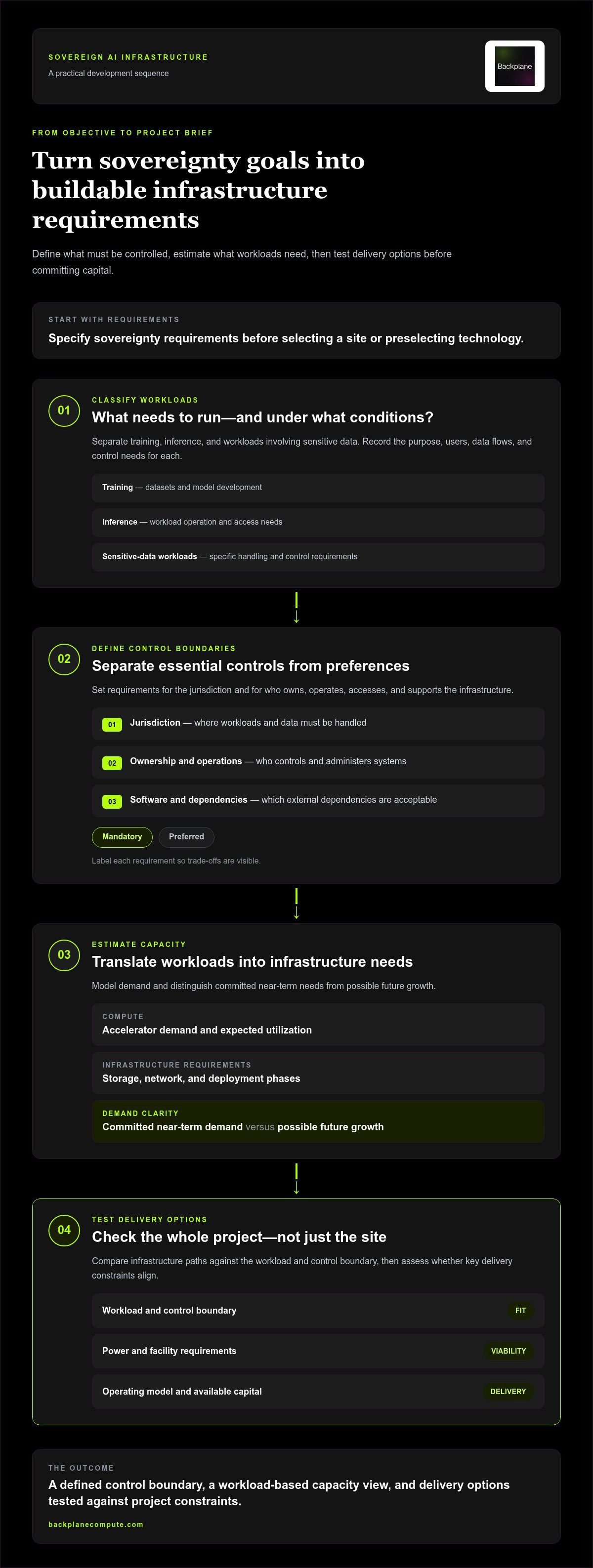
Use a defined sequence. Each step narrows the development brief and surfaces trade-offs before they become costly design assumptions.
- Classify workloads. Separate training, inference, and workloads involving sensitive data. Record their purpose, users, data flows, and control needs.
- Define control boundaries. Set requirements for jurisdiction, ownership, operational access, software, and external dependencies. Mark each as mandatory or preferred.
- Estimate capacity. Model accelerator demand, expected utilization, storage, network requirements, and deployment phases. Distinguish committed near-term demand from possible future growth.
- Test delivery options. Compare infrastructure paths against the workload, control boundary, power needs, facility requirements, operating model, and available capital.
Start with workloads, data, and jurisdictional boundaries
Trace data through its lifecycle: where it is created, processed, stored, and accessed. Training may require controlled access to datasets and model development; inference may need a different operating location or administration boundary. Identify which workloads must run locally or in restricted environments, and record the reason for each requirement. Have qualified legal counsel assess jurisdiction-specific rules rather than applying one country’s interpretation across projects.
Convert requirements into measurable capacity needs
Translate workload profiles into a capacity model. Estimate the accelerator resources each workload needs, when they’ll be used, and how demand may change. Include storage for data and models, network capacity between systems, and the sequence in which infrastructure must be deployed. These inputs shape facility design, power requirements, cooling approach, operations, and capital planning. Keep forecast expansion separate from validated demand: a growth assumption is not a committed requirement.
Design follows workload. A deployment focused on inference may have different utilization patterns and timing from one intended for training. Those differences can affect how much capacity is needed at launch and how the facility can expand. No single design satisfies every sovereignty objective.
Turn the requirements into a development brief
Capture acceptable ownership structures, operational access, location boundaries, resilience objectives, and dependencies in a brief that decision-makers can evaluate. Record the trade-offs they will accept across cost, speed, and control. Use the brief to screen delivery options and sites, including powered industrial properties where relevant. An AI data center site selection criteria guide can help structure the screening, but each site still needs to be measured against the project’s specific requirements.
The brief also helps align compute demand with power and facility viability before capital is committed. Backplane’s AI infrastructure development capabilities connect powered industrial sites with AI compute demand and project financing.
Compare Sovereign AI Development Paths and Their Trade-Offs
No delivery route is automatically faster, more controllable, or more viable. New construction offers a purpose-built design but introduces development dependencies. Existing facilities may reduce some build requirements, yet their power, layout, and operating arrangements may not suit the workload. Repurposed industrial assets can offer another route to capacity, but conversion complexity must be assessed rather than assumed away. The right comparison is specific to the project.
New-build, existing facility, or repurposed industrial site?
Assess each option against the same criteria: control, power readiness, delivery dependencies, expansion potential, and overall project viability. A retired power plant, closed mill, or decommissioned mining facility may be worth investigating, but its history alone doesn’t establish that it can support AI infrastructure. Site condition, interconnection needs, conversion scope, and compute demand all matter.
| Development path | Trade-offs to assess | May fit when |
|---|---|---|
| New-build facility | A purpose-built design can align closely with operational and control requirements. Delivery depends on site readiness, power arrangements, construction, and project financing. | Requirements are defined, demand supports a dedicated development, and the project can accommodate a ground-up delivery process. |
| Existing data center | An operating facility may provide infrastructure to build from, but available capacity, access arrangements, and expansion options may constrain the project. | Existing capabilities align with the workload and control boundary, and the facility can support required capacity and operations. |
| Repurposed industrial asset | Underused powered properties may offer development potential. Facility condition, interconnection, conversion complexity, and infrastructure fit require careful assessment. | The property’s characteristics align with compute demand, and conversion and expansion can support a viable project. |
Local infrastructure can involve more delivery steps or dependencies than a ready-to-use option, but that isn’t always the case. Schedule and economics depend on the specific site, power pathway, conversion scope, control requirements, demand, and financing structure. Compare the complete development case, not just the time it takes to occupy a building.
Balance control with resilience and supply dependencies
Local operation doesn’t remove every external dependency. Accelerators, software, maintenance capabilities, and other supply-chain inputs may remain outside direct local control. Map those dependencies and decide which need alternatives or continuity plans. Geographic concentration also doesn’t guarantee resilience. Determine what redundancy the workload needs, where it belongs, and whether the project scope supports it.
Choose an operating and access model
Service-based access and dedicated infrastructure address different buyer needs. GPUs-as-a-Service can provide compute access without requiring the buyer to develop a dedicated site. A dedicated site can align capacity and control more directly with a defined project. Compare expected demand, operating responsibilities, and control boundaries. The enterprise guide to GPUs-as-a-Service can support evaluation of the service model, while a dedicated financed site may suit buyers with committed demand for purpose-aligned capacity.
For sovereign AI infrastructure development, the strongest path is the one that matches control requirements to an executable site, credible demand, and a viable project structure.
A Practical Development Sequence for Sovereign AI Infrastructure
Move from requirements to deployment through explicit decision gates. Each gate should resolve a different question: Is demand defined? Can a site support it? Can the project be financed and operated within the required control boundary? Analyze compute demand and power availability together. Compute without a viable power pathway cannot run; power without credible demand may not support a viable development.
A viable project aligns committed compute demand, site capability, power, and capital. Treat each as a connected input, not as a separate workstream to reconcile at the end.
- Define the operating case. Document workloads, capacity needs, deployment phases, required controls, and the intended operating model. Separate committed demand from forecasts so the project’s initial scope rests on evidence rather than an expansion assumption.
- Validate demand against power. Match the compute profile to the power required to support it and identify dependencies that could constrain delivery. Review expected capacity use alongside the site’s power access and the path to making that capacity available.
- Assess the property. Examine site suitability, existing facilities, power infrastructure, interconnection needs, and conversion work. A focused industrial site assessment for AI viability connects property characteristics to the proposed workload instead of treating the asset in isolation.
- Structure the project. Bring facility scope, compute requirements, counterparties, and development stages into the financing plan. The capital structure should reflect what must be delivered, who is involved, and how the project will progress. A deeper review of financing AI infrastructure can help frame the capital strategy.
- Advance through readiness gates. Confirm technical fit, commercial alignment, and operational planning before moving into deployment. Identify open dependencies, assign responsibility, and resolve material gaps before they become construction or operating constraints.
Structure power, facilities, and financing together
Power, facility work, and financing are interdependent. A property may require upgrades or conversion before it can support the intended compute deployment. Those requirements affect project scope, counterparties, and funding needs. Build them into one development case, with each assumption tied to a diligence finding or a defined decision. A site assessment is an input to project planning, not a financing commitment or a guarantee of capacity.
Move from diligence to deployment
Deployment requires coordination among property owners, compute buyers, infrastructure teams, and financing parties. Give each workstream a clear decision gate. Technical readiness establishes whether the site and infrastructure can support the use case. Commercial readiness aligns demand and project commitments. Operational readiness addresses who will run and access the infrastructure. If a gate exposes a mismatch, revise the scope or pause progression until it’s resolved.
Backplane connects powered industrial sites with AI compute buyers, assesses property viability, and structures infrastructure financing. Its powered industrial site assessment for AI viability can inform a coordinated development case.
How Backplane Connects Sovereignty Goals to Deployable AI Infrastructure
A defined sovereignty requirement still needs a delivery path: a suitable site, credible compute demand, an infrastructure scope, and a financing structure that align. Backplane works across these connected requirements. It assesses underused powered industrial properties for AI infrastructure viability, connects powered sites with AI compute buyers, and arranges infrastructure financing. This brings separate assets and requirements together so the project can be evaluated as a whole.
Not every powered property is suitable for AI infrastructure, and not every compute requirement calls for a dedicated facility. Site characteristics, buyer demand, operational needs, and project structure shape the assessment. Let the evidence guide the development route.
For powered-site owners: assess potential AI infrastructure use
An underused industrial property may be a starting point for AI compute development, but power access alone doesn’t establish viability. Facility characteristics, infrastructure requirements, conversion needs, and potential buyer demand all matter. Backplane’s property viability assessment considers whether a powered industrial asset can align with AI infrastructure requirements. It helps frame the opportunity and the diligence needed to evaluate it, rather than treating the property as ready for conversion.
For compute buyers: align demand with delivery options
Compute buyers can explore GPUs-as-a-Service or pursue dedicated, financed sites, depending on capacity objectives and the level of dedicated infrastructure required. These are different development paths. A buyer’s workload, demand profile, control requirements, and deployment objectives inform which path merits evaluation. Backplane connects compute buyers with powered sites and structures project financing around the development case, bringing demand and physical infrastructure into the same conversation.
For example, a buyer with a defined need for dedicated capacity can consider a site-based approach, while a buyer seeking access to GPUs can evaluate GPUs-as-a-Service. In either case, the requirements must connect to viable infrastructure and a credible project structure. Capacity objectives don’t replace site and financing diligence.
Move the project into a structured assessment
Bring the project inputs together: site information for property owners, or workload and capacity objectives for compute buyers. Backplane assesses powered industrial properties for AI viability, connects sites with committed compute demand, and structures infrastructure financing. These workstreams support project evaluation by identifying the issues and alignments decision-makers need to address.
For sovereign AI infrastructure development, execution depends on connecting control objectives to the physical and commercial conditions of a viable project. Share a site, compute requirement, or infrastructure development objective to discuss the opportunity.
Discuss an AI infrastructure project
Turn the Infrastructure Case into a Next Move
Sovereign AI infrastructure development advances when strategic control becomes a decision-ready project case. Start by identifying the asset or compute requirement that can anchor the case, then determine what evidence is needed to move it forward. A site owner may begin with property viability. A compute buyer may begin with a defined capacity objective. Either path needs a clear view of demand, delivery requirements, and project structure.
Backplane brings these inputs together by connecting powered industrial sites with AI compute demand and structuring financing to support development from site assessment toward deployment. This coordination helps owners and buyers evaluate an opportunity as one infrastructure project rather than as disconnected property, compute, and capital decisions.
If you’re ready to shape a site opportunity or capacity requirement into a development pathway, start an AI infrastructure project assessment. Build the project case around the requirements that matter most to your organization.
Frequently Asked Questions
What is sovereign AI infrastructure development?
Sovereign AI infrastructure development is the process of turning an organization’s AI control objectives into an operating infrastructure project. It covers where workloads run, who governs them, and which technical or operational dependencies are acceptable. For example, an organization might design a controlled environment for a sensitive application while using a different operating model for internal experimentation. The scope should reflect the organization’s use case and risk priorities.
How is sovereign AI different from data sovereignty?
Data sovereignty concerns the authority and rules associated with data, while sovereign AI considers control across the AI system that uses it. A data team might meet a storage-location requirement, yet the organization may still need to consider model governance, system administration, or application access. Treat the concepts as related but distinct: meeting a data requirement doesn’t automatically settle how an AI service is operated.
Does sovereign AI require open-source models?
No. Open-source models can offer greater visibility or flexibility for some deployment choices, but they aren’t a universal prerequisite for sovereign AI. An organization can evaluate model access, licensing, update processes, operational control, and the ability to meet its governance requirements. For instance, a team may prioritize controlled access and a documented update process over whether the model’s code is open. The choice depends on the intended use and control objectives.
Can sovereign AI infrastructure use hardware made outside its jurisdiction?
Yes, potentially. Hardware origin and sovereign control are separate considerations, though supply dependencies can affect risk. An organization might use accelerators manufactured abroad while setting requirements for local operation, administration, access, maintenance, or continuity planning. Whether that arrangement satisfies its objectives depends on workload sensitivity and applicable jurisdictional rules. Assess procurement and regulatory requirements for the specific project rather than assuming foreign-made equipment either disqualifies the system or poses no concern.
Can an organization build sovereign AI across multiple countries?
Yes. A multi-country design can allocate different workloads or functions across jurisdictions rather than forcing every capability into one location. For example, an organization might keep a regulated workload within one jurisdiction while coordinating less sensitive processing elsewhere. The design needs clear boundaries for access, data movement, operations, and accountability. Evaluate each jurisdiction’s applicable requirements and define how cross-border dependencies will be governed before treating the overall system as sovereign.
What is the difference between sovereign AI and sovereign cloud?
Sovereign cloud generally describes cloud infrastructure and services designed to meet specified sovereignty controls. Sovereign AI is broader: it concerns the governance and dependencies of AI workloads, including models, data, compute, and operations. A sovereign cloud may provide part of an AI deployment, but its label alone doesn’t establish that every AI component meets an organization’s requirements. Assess the actual workload, service boundaries, and control arrangements.
How should an organization balance sovereign control with resilience?
Set resilience requirements according to the consequences of interruption, then determine which controls must remain local and which dependencies can be diversified. A highly critical service may need a documented recovery approach and alternative operating arrangements; a lower-impact workload may justify a simpler design. Test whether resilience measures introduce new jurisdictional or access dependencies. The goal isn’t maximum isolation at any cost, but continuity that fits the workload and sovereignty objectives.


