

AI infrastructure doesn’t move forward on powered land alone. It needs a viable site, credible compute demand, and a financeable path to deployment, aligned in one transaction. That’s the work of a specialized AI data center brokerage, not a conventional real estate deal focused only on the property.
Owners may see new potential in a powered industrial asset, while compute buyers face the challenge of securing capacity. But when diligence, technical requirements, commercial terms, and financing are handled in separate workstreams, projects can lose momentum before deployment begins.
This article explains how specialist brokerage connects those moving parts. You’ll learn what the role covers, how to assess whether a site or compute requirement is ready for a transaction, and how the process moves from property viability assessment and demand matching to financing and deployment. It also compares two distinct paths: access to GPU capacity and dedicated financed sites. The objective is clear: turn potential into an executable project.
Key Takeaways
- A specialized AI data center brokerage aligns property, power, compute demand, and capital beyond a conventional lease-or-sale mandate.
- Use a staged workflow to assess an asset, define compute needs, test fit, structure financing, and coordinate deployment.
- Compare direct leasing, owner-led development, specialist brokerage, and GPU-as-a-Service to identify the right balance of control and coordination.
- Prepare for a transaction by clarifying site information and goals, or by defining workload needs, capacity expectations, timing, and access preferences.
- Backplane connects powered industrial sites with compute demand through viability assessment, financing structuring, diligence, and deployment coordination.
What Makes Specialized AI Data Center Brokerage Different?
A powered industrial site is not automatically an AI infrastructure project. It must align with a real compute requirement, a viable property, and a financing structure that can support development. A specialized AI data center brokerage works across those interests, bringing asset owners, compute buyers, and capital partners into a coordinated transaction.
Definition: Specialized AI data center brokerage connects viable industrial properties and power access with committed AI compute demand and project capital, coordinating the transaction toward deployment.
That mandate goes beyond matching a property with a tenant. An AI facility has distinct infrastructure needs, as outlined in this overview of an AI data center. A site’s power profile and physical characteristics must be assessed against the buyer’s intended workload. The project also needs commercial alignment: the parties must understand what is being developed, who will use the capacity, and how the project will be financed. If these questions are handled in isolation, a promising asset or compute requirement can remain stalled.
How Is AI Infrastructure Brokerage Different from Commercial Real Estate Brokerage?
Conventional commercial real estate brokerage generally centers on a property transaction: leasing or selling space, negotiating terms, and bringing a landlord and tenant or buyer and seller together. Specialist AI infrastructure brokerage adds a technical and commercial matching function. It considers the property alongside power availability, the buyer’s compute demand, project viability, and capital requirements.
Power shapes a site’s commercial relevance because its location or industrial history alone doesn’t establish suitability for compute infrastructure. The available power profile must be assessed in relation to the project’s needs. The broker coordinates diligence and transaction work across parties, but the role has boundaries. Brokerage isn’t property ownership, GPU manufacturing, or utility service. It’s the execution-oriented bridge that helps align those separate inputs.
Who Uses a Specialized AI Data Center Broker?
Industrial owners may hold underused or retired facilities with power access and want to understand whether an asset could support AI infrastructure. A property viability assessment helps frame the site’s potential and identify information relevant to diligence. The goal is to evaluate the asset in relation to an actual compute use, rather than treating power access as a standalone promise of value.
Enterprises and compute buyers may need GPU capacity without taking on a dedicated site, or may be evaluating dedicated infrastructure for their requirements. Their workload expectations and preferred access model help define what a viable property match looks like. Capacity access and a dedicated site are distinct paths, with different implications for control and project coordination.
Investors and financing partners need a clear view of the asset, demand, and project structure to assess viability. Bringing these parties into the same transaction connects property diligence with commercial demand and infrastructure financing. Backplane coordinates this work from assessment and diligence through deployment, with each participant contributing to alignment on the project.
How a Specialist Connects Industrial Assets, Compute Demand, and Capital
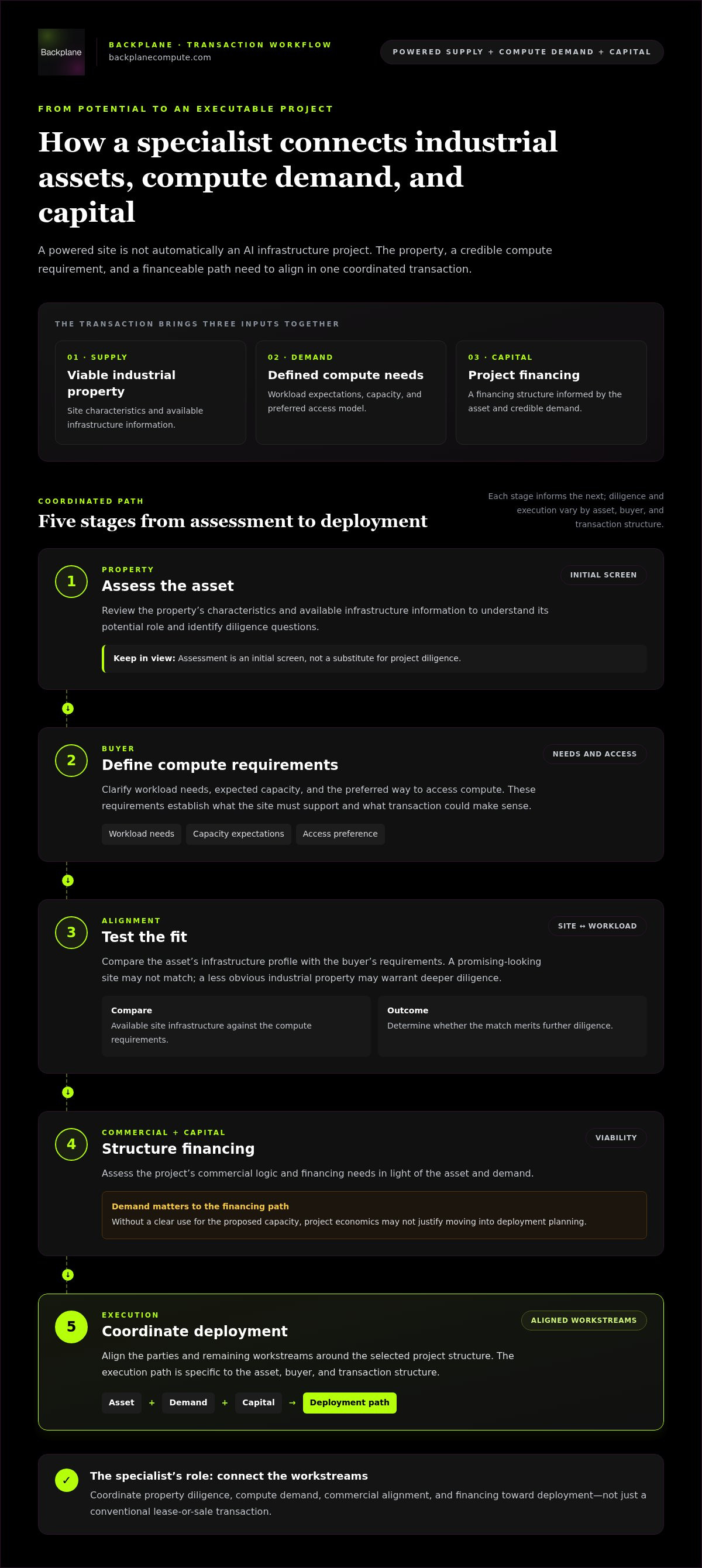
A viable transaction starts with fit, not assumptions. The property must suit the buyer’s compute requirements, demand must be credible enough to inform project planning, and the financing structure must reflect the opportunity. A specialized AI data center brokerage coordinates these workstreams so decisions about the site, commercial arrangement, and capital can progress together.
The broker links powered supply, qualified compute demand, and project capital into a coordinated path toward deployment.
- Assess the asset. Review the property’s characteristics and available infrastructure information to understand its potential role and identify diligence questions. An AI data center site selection criteria checklist can help owners organize site-screening information.
- Define compute requirements. Clarify the buyer’s workload needs, expected capacity, and preferred way to access compute. These requirements establish what the site must support and what kind of transaction could make sense.
- Test the fit. Compare the asset’s infrastructure profile with the buyer’s requirements. A site that looks promising in isolation may prove mismatched, while a less obvious industrial property may warrant deeper diligence.
- Structure financing. Assess the project’s commercial logic and financing needs in light of the asset and demand. Credible demand matters: without a clear use for the proposed capacity, project economics may not justify advancing into deployment planning.
- Coordinate deployment. Align the parties and remaining workstreams around the selected project structure. The sequence and depth of diligence vary by asset, buyer, and transaction structure, so each project needs its own execution path.
What Happens During Property Viability Assessment?
Assessment is an initial screen, not a substitute for project diligence. It considers site characteristics and infrastructure readiness at a high level, then identifies questions the parties need to resolve before committing to a transaction structure. That early clarity helps owners and compute buyers focus diligence on the match itself: whether the property’s profile aligns with a defined use and what information is needed to evaluate its viability.
How Does Compute Demand Shape the Transaction?
A buyer’s requirements determine which capacity and deployment model are relevant. GPU capacity access can meet a need for compute without the same project focus as a dedicated site. A dedicated-site pathway ties the buyer’s requirements more directly to a specific infrastructure project. This distinction informs both the matching process and the financing conversation. For more on the access model, see this enterprise guide to GPUs-as-a-Service.
At Backplane, property viability assessment and infrastructure financing structuring are part of the broader process, from diligence through deployment. Owners and buyers can use Backplane’s infrastructure brokerage to bring asset, demand, and capital into one transaction conversation.
Specialist Brokerage Compared with Direct Leasing, Development, and Compute Services
These routes solve different problems. A lease can secure space. Owner-led development can give an owner direct control of a project. GPU-as-a-Service provides access to GPU capacity. Specialist brokerage addresses the gaps between them when a viable asset, a defined compute requirement, and project capital need to be aligned. The right model depends on who needs control and which workstreams are already in place.
| Route | Asset control | Coordination burden | Financing role | Access to compute |
|---|---|---|---|---|
| Direct leasing | Owner retains the property; tenant occupies under lease terms. | Parties coordinate lease terms and any project requirements themselves. | Financing is arranged separately by the parties. | A lease alone doesn’t provide GPU capacity. |
| Owner-led development | Owner leads the site and project decisions. | Owner coordinates the development workstreams and buyer relationships. | Owner arranges or structures project capital. | Compute access depends on project delivery and an operating arrangement. |
| Specialist brokerage | Asset ownership remains with the relevant owner or project structure. | Broker coordinates asset, buyer, diligence, and financing workstreams. | Financing structure is coordinated around project viability and demand. | Connects the buyer to a capacity or dedicated-site pathway; it isn’t itself a compute service. |
| GPU-as-a-Service | Buyer accesses capacity through a service arrangement rather than controlling the underlying site. | Buyer defines its compute needs and works within the service model. | Access is structured as a service, distinct from financing a dedicated site. | Provides access to GPU capacity. |
When Does a Broker-Led Transaction Make Sense?
Brokerage can add value when an industrial owner has a potentially relevant asset but needs to connect it with credible compute demand and a workable deal structure. It can also suit a buyer seeking a dedicated site or capacity without assembling every workstream independently. The central test is coordination: do property, demand, diligence, and capital need to be brought together?
If the owner already has a suitable asset, the buyer’s requirements are clear, and the parties have aligned on capital and project responsibilities, direct execution may be more straightforward. Brokerage isn’t automatically superior. It is most relevant when one or more connections remain unresolved and that gap is holding the transaction back.
Brokerage, GPUs-as-a-Service, and Dedicated Sites Are Different Paths
Keep the categories distinct. Brokerage coordinates a transaction; it does not deliver compute by itself. GPUs-as-a-Service is an access model for GPU capacity. Dedicated financed sites provide a pathway for buyers pursuing dedicated infrastructure, with project financing structured around that route. A specialized AI data center brokerage can help align the parties and project work required for a suitable path, without treating each model as interchangeable.
Backplane connects powered industrial properties with AI compute demand and coordinates work from property assessment and diligence through financing structuring and deployment. For owners and buyers weighing a coordinated transaction, Backplane’s AI infrastructure brokerage brings those interests into the same project conversation.
A Readiness Framework for Asset Owners and AI Compute Buyers
A productive first conversation starts with usable information and clear decision-makers. Asset owners should be able to describe the site and their transaction objectives. Compute buyers should be able to explain the workload and access model they need. Not every technical detail must be resolved before an initial screen. Both sides should be able to identify what is known, what remains open, and who can move the next decision forward.
What Should Industrial Asset Owners Prepare?
Bring together available documentation before assessing a potential match. A concise, organized record helps surface information gaps early and makes project-specific diligence more focused.
- Site control: Clarify ownership, control of the property, and who has authority to discuss a transaction.
- Infrastructure information: Gather existing records on power and site infrastructure. Separate documented facts from assumptions.
- Diligence access: Identify which information or site access can be shared, and the process for arranging further review.
- Transaction goals: State whether the priority is a lease, sale, partnership, or another project structure, along with any relevant constraints.
The purpose at this stage is screening, not a verdict. A project-specific assessment determines which technical, legal, and financial diligence questions matter. Early review can surface issues, but it doesn’t guarantee site viability or replace formal diligence.
What Should Compute Buyers Define Before Engaging?
Buyers can make matching more precise by documenting workload needs, capacity expectations, and preferred access arrangement. Identify whether GPU capacity through a service model may fit or whether dedicated infrastructure is the objective. This choice informs what kind of asset and project structure may be relevant.
- Workload: Describe the intended use and requirements that shape infrastructure fit.
- Capacity and timing: Set out expected capacity needs and the decision window, without treating an initial discussion as a delivery commitment.
- Access model: Distinguish service-based GPU capacity from a dedicated-site pathway.
- Decision team: Name the technical, commercial, and financing stakeholders who will assess the opportunity.
Alignment matters. If technical requirements, commercial priorities, and financing decisions sit with different teams, identify how those groups will exchange information and reach decisions. A specialized AI data center brokerage can help coordinate that process, but momentum depends on credible demand, responsive participants, and defined next steps from both sides.
Keep early screening separate from formal diligence. Screening helps establish whether an opportunity merits deeper review. Technical, legal, and financial diligence examines the project in detail; neither stage should be treated as a guarantee of viability. The scope and sequence depend on the asset, buyer, and proposed structure.
For a closer look at how the parties and workstreams connect, explore Backplane’s AI infrastructure brokerage model. If you’re preparing an asset or compute requirement, discuss your project with Backplane.
How Backplane Advances Specialized AI Data Center Brokerage
Backplane connects powered industrial properties with AI compute demand, bringing asset owners and buyers into one coordinated project discussion. The goal is to evaluate whether the site, requirements, and transaction structure align, then organize the work needed to advance the opportunity. This is the practical role of specialized AI data center brokerage: make the connections between property, demand, and capital visible, then coordinate the process across them.
The work combines property viability assessment, diligence coordination, infrastructure financing structuring, and deployment coordination. Each informs the next. Assessment helps frame the site’s potential; diligence develops the project picture; demand and project requirements help shape a financing structure. Backplane coordinates these workstreams, while project participants retain their respective ownership, technical, commercial, and investment decisions. The structure is shaped around the project rather than assumed in advance.
A Transaction Path for Property Owners and Compute Buyers
For an owner, the starting point is an industrial property and the information available about its infrastructure. For a compute buyer, it is a defined requirement and preferred access model. Backplane brings those inputs together, identifies areas that need further diligence, and coordinates discussion of a potential project structure. Assessment and diligence inform the next steps, while financing structures reflect the project’s requirements rather than a universal template.
- Property owners can bring forward an asset for viability assessment and a discussion of transaction objectives.
- Compute buyers can define whether GPU capacity access or a dedicated infrastructure pathway better fits their needs.
- Project participants can use assessment and diligence findings to inform commercial alignment, financing structure, and deployment coordination.
This process is project-specific. The scope of diligence and the way parties coordinate depend on the asset, the compute requirement, and the proposed structure. Assessment helps organize the questions; it doesn’t guarantee viability, capacity, financing terms, or a deployment outcome.
Choose the Next Step That Fits Your Position
If you control an industrial site, begin with the property information available and the objective you want the transaction to serve. Backplane’s property viability assessment helps frame the asset in relation to AI compute demand and identify relevant areas for diligence. If you’re a compute buyer, define the workload and whether you’re pursuing GPU capacity through GPUs-as-a-Service or a dedicated financed site. Those are distinct pathways, with different project considerations.
Financing also needs to reflect the project, not just the property or the demand in isolation. Backplane structures infrastructure financing around the requirements of the opportunity. For further context on the considerations involved, see this AI infrastructure financing strategy.
Bring an asset, a compute requirement, or an infrastructure project to Backplane to discuss a coordinated path forward. Discuss your AI infrastructure project with Backplane.
Turn Project Potential Into a Decision-Ready Opportunity
The next step isn’t to force a transaction. It’s to make the opportunity clear enough for a decision: what is established, what remains unresolved, and what evidence would change the project’s direction. That discipline helps owners, compute buyers, and capital partners focus on material questions before commitments are made.
For a powered site, that means linking its documented characteristics to a real infrastructure objective. For a compute requirement, it means expressing demand in terms that can inform a viable project path. A specialized AI data center brokerage can bring both sides into the same decision process, connecting project assessment, financing structure, and deployment coordination rather than treating them as separate conversations.
Backplane’s two-sided model is built around that alignment. The aim is not simply to identify potential, but to help participants understand the next practical decision and the work required to reach it. Each project depends on its own diligence, requirements, and structure. Clear inputs create a stronger basis for moving forward.
If you’re ready to advance an asset, compute requirement, or infrastructure concept, map your project’s next step with Backplane. A well-defined opportunity is a stronger starting point for deployment.
Frequently Asked Questions
What is a specialized AI data center brokerage?
A specialized AI data center brokerage connects powered industrial assets with compute demand and project financing. Unlike a conventional property listing transaction, it coordinates the parties and project considerations involved in assessing whether an asset could support an AI infrastructure project. For example, an owner may bring forward an underused facility while a buyer defines a compute requirement. Project-specific diligence determines whether the proposed match is viable.
How is AI data center brokerage different from a commercial real estate broker?
A commercial real estate broker typically focuses on a property sale or lease, while AI infrastructure transactions can require coordination among asset owners, compute buyers, infrastructure diligence, and capital partners. This is a different transaction focus, not a claim that conventional brokers lack relevant expertise. A specialist connects property characteristics to a buyer’s compute requirements and helps organize project discussions around the information and decisions those parties need.
Who should use an AI data center brokerage?
Industrial property owners, enterprises seeking GPU capacity or dedicated sites, and capital partners evaluating infrastructure projects may all use an AI data center brokerage. It is most relevant when no single party has already aligned the property, compute requirement, and financing path. For instance, an owner may have a site to assess while a buyer is still defining whether service-based capacity or dedicated infrastructure fits its plans.
Can a retired power plant or closed industrial facility become an AI data center?
It may merit assessment, but a facility’s former use doesn’t establish that it can support an AI data center. Site characteristics and available infrastructure must be considered against a buyer’s requirements. Diligence then examines the specific project, and its economics inform whether it can advance. A retired power plant, closed mill, or decommissioned compute facility is a candidate for evaluation, not proof of suitability or a guaranteed conversion.
What does a property viability assessment examine for an AI data center?
A property viability assessment reviews available site and infrastructure information against the requirements of a proposed project. For example, it can help identify which records are available and what questions require deeper review before parties settle on a transaction structure. The assessment supports decision-making and helps frame further diligence. It isn’t a guarantee of technical suitability, commercial viability, financing, or successful deployment.
Does an AI data center broker provide GPUs-as-a-Service?
Brokerage and compute access are distinct, and Backplane offers both as separate pathways. Its GPUs-as-a-Service offering gives buyers a way to access GPU capacity through a service arrangement. Dedicated financed sites are another route for buyers seeking dedicated infrastructure. The appropriate path depends on the buyer’s requirements and project objectives. Neither model should be confused with simply leasing a property or purchasing GPUs from a hardware manufacturer.
How does financing fit into an AI data center brokerage transaction?
Financing structure connects the project’s requirements with the resources needed to advance infrastructure deployment. A financing discussion can consider the proposed asset, the buyer’s compute demand, and how the project is organized, rather than treating property or demand in isolation. The structure depends on the specific project and its participants. Brokerage can coordinate this work, but it doesn’t guarantee approval, particular terms, or a completed project.


