

A site can have power and still be a poor fit for the AI workload you need. That gap is where turnkey AI data center deployment gets complicated. Power capacity alone doesn’t establish whether a property can meet a project’s compute, cooling, and infrastructure requirements. And when site owners, compute buyers, equipment providers, and financing parties work on separate tracks, responsibilities and dependencies become harder to manage.
The answer isn’t simply to procure servers. Deployment depends on aligning a viable site with a defined compute requirement and a financeable project plan. This guide explains the workstreams involved, how to compare delivery models by readiness and accountability, and what decisions can move a project from site identification toward live compute.
You’ll also see how GPUs-as-a-Service and dedicated financed sites offer distinct ways to access compute. Backplane connects powered industrial properties with AI compute demand, assesses property viability, structures infrastructure financing, and coordinates deployment. The goal is a clear execution path: match real site constraints to real demand, then organize the project around that fit.
Key Takeaways
- Turnkey AI data center deployment can range from bundled equipment to coordination across site, power, compute requirements, and financing. Define the scope before comparing delivery approaches.
- Assess a powered property against the intended workload, including electrical infrastructure, cooling, and network connectivity, before treating it as deployment-ready.
- Compare vertically integrated delivery, component-led procurement, and coordinated brokerage by scope ownership, interface management, financing coordination, flexibility, and buyer responsibilities.
- Use stage gates to turn a project thesis into clear decisions on workload, site fit, diligence, financing, and deployment readiness.
- Backplane connects powered industrial properties with AI compute demand through property viability assessment, financing structuring, and deployment coordination.
What turnkey AI data center deployment actually covers
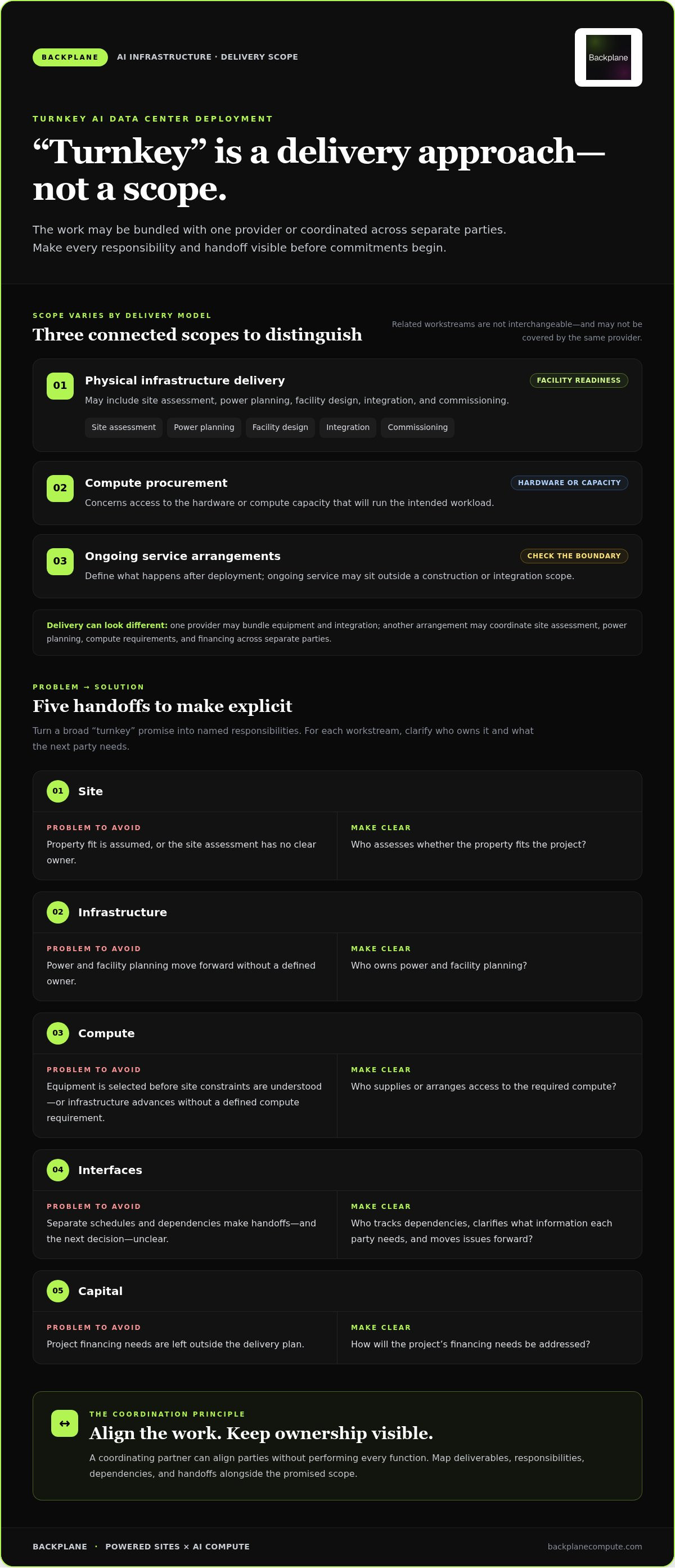
Turnkey AI data center deployment is a delivery approach that coordinates defined project workstreams so a facility can support an intended compute workload. The scope depends on the model. One provider may bundle equipment and integration; another arrangement may coordinate site assessment, power planning, compute requirements, and financing across separate parties. The label alone doesn’t tell you who owns each task or handoff.
That distinction matters because an AI data center must align specialized compute with the facility and infrastructure that support it. A project can involve real estate, electrical systems, cooling, networking, equipment, capital, and operational decisions. Treating “turnkey” as a complete scope description can leave gaps undiscovered until procurement or deployment is underway.
What can a turnkey AI data center project include?
Depending on the delivery model, work may cover site assessment, power planning, facility design, equipment procurement, integration, and commissioning. These workstreams are related, but they aren’t interchangeable. Physical infrastructure delivery addresses whether the facility can be prepared and equipped. Compute procurement concerns access to the hardware or capacity that will run the workload. Ongoing service arrangements define what happens after deployment and may sit outside a construction or integration scope.
Responsibility can sit with one integrated provider or be divided among the owner, engineering and construction parties, equipment suppliers, compute providers, and financing participants. A coordinating partner can align parties without performing every function itself. Before making commitments, map the scope and answer practical questions such as:
- Site: Who assesses whether the property fits the project?
- Infrastructure: Who owns power and facility planning?
- Compute: Who supplies or arranges access to the required compute?
- Interfaces: Who tracks dependencies between parties and resolves handoffs?
- Capital: How are project financing needs addressed?
This map turns a broad promise into visible responsibilities. It also distinguishes a bundled equipment offer from coordination across the full project, including the site and financing.
Why does deployment coordination matter to compute buyers?
AI buyers start with a workload, not a generic facility. Its requirements shape decisions about compute, power, cooling, and connectivity. If those decisions happen in isolation, equipment may be selected before the site’s constraints are understood, or infrastructure plans may advance without a defined compute requirement. Either mismatch can lead to redesign, stalled decisions, or uncertainty about who needs to act next.
Separate schedules create another challenge. A property assessment, power plan, equipment order, and financing process may each involve different decision-makers and dependencies. Coordination makes those interfaces explicit: what information each party needs, which decisions depend on earlier work, and who is responsible for moving an issue forward. It doesn’t mean one party builds and operates everything.
Turnkey describes a delivery approach, not one universal scope. Buyers should review responsibility boundaries alongside promised deliverables. Backplane connects powered industrial properties with AI compute demand, assesses property viability, structures infrastructure financing, and coordinates deployment. This helps align the project thesis with site realities and a route to compute, while keeping delivery responsibilities clear.
How site, power, cooling, and compute requirements shape deployment
A powered property is a starting point, not a readiness verdict. The key question is whether its infrastructure can support the specific compute configuration the project intends to deploy. That calls for a joined-up assessment of workload requirements, available power, electrical systems, cooling, and network connectivity. Reviewing these factors together helps distinguish a plausible site from one whose constraints could undermine the project.
For turnkey AI data center deployment, compare the workload’s requirements with the site’s capabilities before committing to equipment or financing decisions. A property may have power on-site, for example, but that alone doesn’t establish how much capacity can serve the intended configuration or whether the electrical infrastructure can deliver it as required. Technical and commercial diligence both matter: evaluate infrastructure fit alongside project demand and financing structure.
How do power and interconnection affect AI site readiness?
Keep three questions distinct: what utility capacity is available, what is the interconnection status, and what electrical infrastructure exists at the property? A site’s stated or nominal power capacity isn’t the same as usable capacity for a particular compute deployment. Utility coordination, connection conditions, and dependencies in the power chain all affect the assessment. Evaluate each in relation to the workload and facility plan.
Capacity can also be constrained between the power source and the compute equipment. Assess whether the power path and electrical systems can support the planned configuration instead of assuming that a headline capacity number settles the question. Record what is established, what remains a diligence item, and which decisions depend on utility or infrastructure information. Backplane’s AI data center site selection checklist can guide a systematic review of site criteria.
How should cooling and networking fit the workload?
Cooling design must match the intended equipment density and operating requirements. A facility suited to one configuration may need a different approach for another. Evaluate the building and cooling concept against the actual workload rather than treating cooling as a later fit-out detail. Network connectivity also belongs in the design discussion: it shapes how compute resources communicate and serve the workload, but strong networking can’t compensate for insufficient power or an unsuitable facility.
For more technical context, the high-performance computing infrastructure reference can help frame how compute, networking, and supporting systems interact. The practical test is alignment: the site, power delivery, cooling approach, and network design must all serve the defined compute demand. Starting with a property alone risks designing around what happens to be available rather than establishing whether that asset fits the buyer’s needs.
Backplane connects powered industrial properties with AI compute demand and assesses property viability as part of project diligence. For buyers and site owners aligning a real property with a defined workload and financing path, explore Backplane’s project coordination.
Which turnkey delivery model fits an AI infrastructure project?
The right turnkey AI data center deployment model depends on what the project already has and what the buyer needs to control. A buyer with a defined site and capital strategy may need a different structure from one seeking compute access or a route to develop an underused powered property. Compare who owns the work, who manages the interfaces, and how financing fits before judging a model by its label.
The framework below highlights typical differences. Actual scopes vary by project and agreement, so use the comparison to locate responsibilities, not as a guarantee of what any provider includes.
| Delivery model | Scope ownership | Interface management | Financing coordination | Flexibility and buyer responsibilities |
|---|---|---|---|---|
| Vertically integrated delivery | One provider owns or manages several connected workstreams. | Fewer organizational handoffs may simplify coordination within the provider’s scope. | May be separate from the delivery package; clarify how capital needs are addressed. | Can suit buyers seeking consolidated execution. Buyers still need to understand exclusions, decisions retained, and ongoing responsibilities. |
| Component-led procurement | The buyer sources site, infrastructure, equipment, and services from separate parties. | The buyer or its appointed lead coordinates dependencies and interfaces. | The buyer typically aligns project capital with separate contracts and commitments. | Offers control over component selection, but places greater integration and coordination responsibility on the buyer. |
| Coordinated brokerage | A coordinating partner connects site, compute demand, and project participants without necessarily delivering every component. | Coordination focuses on alignment among parties, requirements, and project decisions. | Financing structuring can be part of aligning the project’s needs and participants. | Can fit projects built around an existing asset or a specific compute requirement. The buyer remains involved in key scope and investment decisions. |
When can integrated delivery reduce project handoffs?
Integrated delivery can be useful when one provider owns several interdependent workstreams. A single delivery structure may reduce the number of separate interfaces the buyer must manage within that scope. Giga Energy, for example, presents a vendor-led approach spanning multiple delivery stages. That illustrates one model, not a universal benchmark for readiness, accountability, or speed. Buyers still need a clear boundary map: what the provider owns, what the buyer retains, and which services sit outside the package.
When does a coordinated site-and-financing model make sense?
A coordination-led approach can make sense when an existing powered industrial asset may align with committed compute demand. The work begins by assessing whether the property is viable for the intended project, then connecting that assessment to diligence, financing structuring, and the compute access route. Backplane connects powered properties with AI compute buyers and coordinates across those project interfaces. Its AI infrastructure brokerage model describes this role.
No model is automatically faster. Integrated delivery may consolidate scope; component procurement may preserve buyer control; brokerage can connect an asset, demand, and financing pathway. The right fit depends on project readiness, available assets, capital strategy, and how much coordination the buyer can own.
A practical stage-gate path from project thesis to deployment
A project moves forward when each stage resolves a decision, not simply when another task is complete. In turnkey AI data center deployment, stage gates connect the buyer’s workload to site fit, commercial structure, and operational readiness. They also expose assumptions early. If a technical constraint or financing question changes the project thesis, revise the scope before carrying that uncertainty into later commitments.
What should the project define before site diligence?
Start with a usable project brief. Define the workload, desired compute access model, capacity objectives, and constraints that shape decisions. Identify who supplies site, power, compute, and financing inputs. Separate established facts from assumptions, such as a property’s usable power capacity or the fit between the planned workload and proposed infrastructure. Turn those assumptions into explicit diligence items rather than hidden commitments.
Which decisions move a viable project toward deployment?
Use the gates below to determine whether to advance, revise, or pause. Record and share each decision output across project participants.
- Define demand. Specify the workload, compute access model, capacity objectives, and buyer constraints. Output: an agreed project thesis that can guide site screening.
- Screen sites. Compare potential assets with the project’s core requirements, including power context, facility suitability, and location considerations. Output: a shortlist of candidates for deeper review, not a declaration of readiness.
- Test viability. Assess the selected property and its infrastructure against the intended compute requirement. Record findings, open questions, and dependencies. Output: a viability view that identifies whether the project fits, needs scope changes, or should not advance on its current assumptions.
- Align project structure. Match the asset and buyer requirements to an access model, such as GPUs-as-a-Service or a dedicated financed site. Output: a defined delivery approach, clear participant responsibilities, and a list of remaining commercial decisions.
- Structure financing. Use the project scope and diligence findings to inform financing structuring. Output: a financing approach tied to the project’s actual requirements, with unresolved assumptions made visible rather than treated as settled.
- Advance deployment and commissioning. Move into deployment against agreed scope, ownership, and commissioning criteria. Output: evidence that the defined acceptance conditions have been addressed before the project is treated as operationally ready.
These gates aren’t a universal checklist or a promise of a fixed schedule. They are a control system for decisions. If diligence reveals that a site’s usable capacity, infrastructure requirements, or commercial structure doesn’t match the original thesis, return to the relevant gate. Adjust the workload, site choice, project scope, or financing approach before proceeding.
Demand defines the thesis; diligence tests the asset; financing aligns the structure; commissioning tests readiness. Backplane connects powered industrial properties with AI compute demand and supports projects through property viability assessment, diligence, financing structuring, and deployment coordination. Assess a site and structure your project around the compute requirement.
How Backplane connects powered sites, compute demand, and financing
AI infrastructure projects often begin with two separate realities: an industrial property with power-related potential and a buyer with a defined need for compute. Backplane works across that divide. It connects powered industrial properties with AI compute demand, bringing property viability assessment, project diligence, infrastructure financing structuring, and deployment coordination into the project conversation.
This is a transaction and development process, not a property listing. The objective is to assess whether a real asset fits a buyer’s requirements and whether the project can be structured around that fit. A powered property isn’t automatically suitable. Consider site characteristics alongside the intended workload, infrastructure needs, commercial requirements, and financing pathway.
How does Backplane bring asset owners and compute buyers together?
Potential assets can include retired power plants, closed mills, and decommissioned mining facilities. Their histories may point to relevant infrastructure, but each property needs assessment against the project’s actual requirements. Backplane connects these site opportunities with committed AI compute buyers and supports diligence to establish whether the asset and demand align.
The match is practical, not abstract. Assess site characteristics in the context of a defined compute requirement. Findings can inform whether to advance, refine the project scope, or reconsider the fit. This links physical readiness to buyer demand and gives financing structuring a project basis, rather than treating site, compute, and capital as disconnected workstreams.
Backplane’s role is brokerage, assessment, financing structuring, and coordination across project participants. That doesn’t mean Backplane manufactures hardware or vertically integrates construction and operations. Instead, it connects the relevant parties and decisions so the route from asset to compute is grounded in diligence and a financeable project structure.
Which Backplane route aligns with the buyer’s compute objective?
The right route depends on whether the priority is access to GPU capacity or dedicated infrastructure. These are distinct ways to address compute demand, not interchangeable labels.
- GPUs-as-a-Service: A route to access GPU capacity without framing the project around a buyer’s dedicated site.
- Dedicated financed sites: A route for buyers seeking dedicated infrastructure, connected to a project structure and financing approach.
That distinction helps focus the next decision. A buyer prioritizing compute access can consider GPUs-as-a-Service. A buyer seeking a dedicated site can assess the property, demand, and financing structure together. In either case, turnkey AI data center deployment starts by matching a defined compute objective to viable infrastructure, then coordinating the diligence and project decisions that follow.
Have a powered asset, a defined compute requirement, or both? Discuss a turnkey AI infrastructure project with Backplane and explore how site viability, compute demand, and financing can align.
Move your project from possibility to a clear next step
Turn interest into a defined project thesis. Bring together what you know about the compute requirement, the property, and the capital strategy. Clear inputs make it easier to identify open questions and focus diligence on the decisions that shape deployment.
Backplane matches powered industrial properties with AI compute demand, with property viability assessment and infrastructure financing structuring supporting project evaluation. That gives owners and buyers a practical starting point for determining whether an asset and a compute objective can align. Turnkey AI data center deployment becomes actionable when the project’s requirements, responsibilities, and financing path are considered together.
Discuss a turnkey AI infrastructure project with Backplane and take the next step toward a project grounded in real demand and viable infrastructure.
Frequently Asked Questions
What does turnkey AI data center deployment include?
Turnkey AI data center deployment coordinates project work needed to move defined requirements toward operational compute, but the exact scope depends on the delivery model. A package might cover equipment integration, while a broader project may also address site assessment, power and facility planning, financing coordination, deployment, and commissioning. Clarify whether network integration or post-commissioning support is included. Confirm deliverables, handoffs, and decision ownership before treating the scope as complete.
How long does it take to deploy an AI data center?
There’s no universal deployment timeline; it depends on the project’s constraints and dependencies. An existing industrial property may need different diligence from a greenfield project, while utility requirements, permitting, cooling design, equipment availability, financing, and commissioning can each affect the schedule. Build a project-specific timeline from validated milestones. For instance, distinguish confirmed site information from pending utility decisions, then update dependent milestones as those decisions are resolved.
Can an existing industrial site be converted into an AI data center?
Yes, an existing industrial property can be a candidate if its physical and commercial conditions align with the intended compute use. A retired power plant or closed mill may warrant assessment, but its former purpose doesn’t establish readiness. Review power access, interconnection, building condition, cooling potential, connectivity, and project economics against the buyer’s requirements. Identify constraints and potential upgrades before committing to a development plan.
What is the difference between turnkey data center deployment and colocation?
Turnkey deployment refers to coordinating or delivering infrastructure development for a project; colocation generally means placing equipment in an existing data center and using its facility services. The distinction affects control and responsibility. A buyer developing a dedicated facility may need to address site and infrastructure decisions, while a colocation customer typically focuses on the hosted environment and its service terms. Compare capacity, equipment control, responsibilities, and commercial structure against the workload.
Does turnkey AI data center deployment include GPU financing?
Not necessarily. “Turnkey” doesn’t define whether GPU costs or financing are part of a project scope. Some arrangements focus on facility delivery; others coordinate infrastructure financing or offer a separate route to compute access. Backplane structures financing for infrastructure projects and connects buyers with GPUs-as-a-Service or dedicated financed sites. Distinguish access to GPU capacity from financing a site or broader infrastructure buildout when evaluating project options.
How do I know if a powered site is ready for AI compute?
A powered site is ready only if its infrastructure and commercial conditions fit the intended workload. Consider whether stated power capacity can serve the planned configuration, and assess interconnection, electrical systems, cooling, connectivity, facility condition, and project economics. For example, a property’s power information may need further validation before it can support a deployment decision. Backplane’s property viability assessment relates site characteristics to compute demand and project considerations.
Is a turnkey deployment always faster than building a data center independently?
No. Coordination may reduce handoffs when scope and accountability are clear, but it doesn’t remove dependencies such as site readiness, utility decisions, permitting, equipment, financing, or commissioning. Compare the work included and identify who owns each open decision. For example, a consolidated equipment package may still leave site and power coordination with the buyer. A credible schedule should follow validated milestones and dependencies, not the turnkey label alone.


