

A GPU commitment is not an infrastructure plan. Enterprise AI infrastructure procurement works when compute access, power, facilities, financing, and deployment timing align. The challenge is securing capacity that can support your workloads without letting delivery assumptions or site constraints derail the plan.
Teams may know which accelerator profile they need and still face uncertain allocation, insufficient power, or a facility that cannot support deployment. When technical, finance, and operations decisions proceed on separate tracks, risk builds before the infrastructure is operational.
This framework shows how to turn workload requirements into an actionable procurement decision. You’ll learn to compare access models, assess infrastructure risks, and connect capacity needs to a funded deployment path. The key question isn’t simply whether to rent GPUs or build dedicated capacity. It’s which option fits your utilization, control, capital, and site requirements.
We’ll follow the decision from workload definition and compute access through property viability and financing. Backplane connects compute buyers with powered industrial sites, bringing these decisions into one procurement path rather than leaving them fragmented across teams.
Key Takeaways
- Anchor enterprise AI infrastructure procurement in workload needs, then define capacity, access, timing, and operating requirements.
- Treat power access and facility suitability as feasibility tests, not details to resolve after choosing compute.
- Compare cloud access, GPUs-as-a-Service, and dedicated financed sites against consistent criteria, including control, commitment, capital, and flexibility.
- Move from demand definition to deployment authorization in clear stages, with technical, finance, procurement, and operations teams accountable for their evidence.
- Use property viability assessment and financing structuring to connect compute demand with powered industrial sites and a practical deployment path.
What Enterprise AI Infrastructure Procurement Actually Covers
Enterprise AI infrastructure procurement secures usable compute capacity and the physical, operational, and financial resources needed to put it to work. The decision goes beyond choosing GPUs. It connects workload requirements to capacity access, deployment timing, power, facility suitability, operating responsibilities, and capital structure.
Hardware specifications describe components, not an executable deployment. A GPU model and count do not establish whether capacity will be accessible on the required schedule, whether a site can support it, or how the infrastructure will be funded and operated. Test these dependencies together before turning a technical preference into a commercial commitment.
How infrastructure procurement differs from AI software procurement
Software procurement typically evaluates licenses, integrations, data handling, user access, and workflow controls. Physical infrastructure procurement must also resolve where compute will run, how capacity will be accessed, what power and facility resources are required, and who is responsible for operations. The decision therefore spans technical, finance, procurement, and operations teams. A software RFP can inform the process, but it cannot replace an infrastructure framework.
Which enterprise requirements belong in the initial brief?
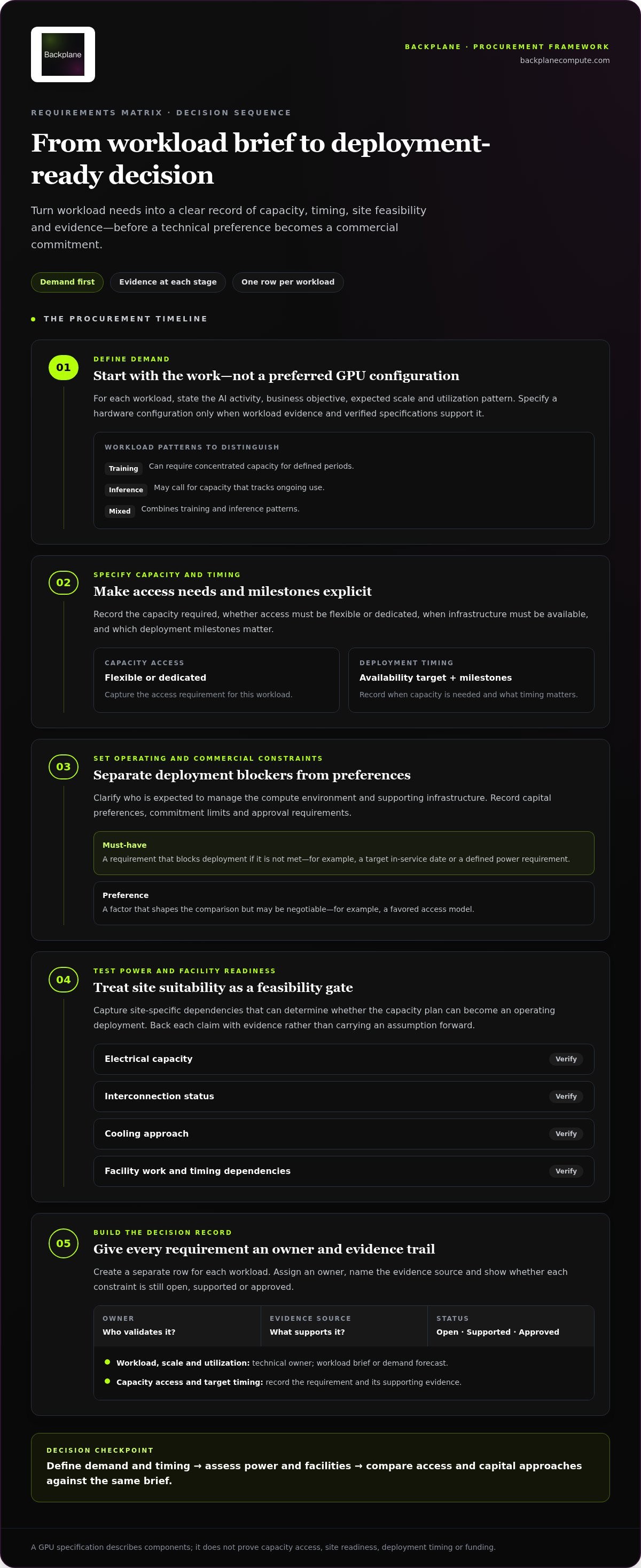
Start with the work the infrastructure must support, not a preferred hardware configuration. Describe the workload, expected scale, deployment objective, and whether demand is steady, variable, or tied to a defined project. Then specify the capacity required, target timing, operating model, and commercial constraints. These inputs make comparisons meaningful and surface feasibility questions early.
- Workload and objective: Identify the AI activity and the business outcome the deployment must support.
- Capacity and access: Specify the capacity needed and whether access must be flexible or dedicated.
- Timing: Define when the infrastructure must be available and which deployment milestones matter.
- Operating model: Clarify who is expected to manage the compute environment and supporting infrastructure.
- Commercial constraints: Record capital preferences, commitment limits, and approval requirements.
Use these requirements to sequence the decision. Define demand and timing first. Then assess whether power and facilities can support the intended deployment. Finally, compare access models and capital approaches against the same brief. This prevents teams from treating a GPU specification as proof of capacity or advancing a preferred configuration before understanding its site and financing assumptions.
Infrastructure procurement is an end-to-end capacity decision that aligns workload demand with compute access, deployment timing, operating requirements, power, facilities, and capital. A clear brief gives stakeholders a shared basis for assessing feasibility and deciding what evidence they need before authorizing deployment.
Build an Enterprise AI Infrastructure Procurement Requirements Matrix
A requirements matrix turns enterprise AI infrastructure procurement from a set of preferences into a decision record. Give each workload its own row, and assign an owner, evidence source, and status to each constraint. This makes gaps visible before teams commit to a capacity model or site assumption.
Separate must-haves from preferences. A must-have blocks deployment if it is not met, such as a target in-service date or a defined power requirement. A preference can shape the comparison but may be negotiable, such as a favored access model. For every assumption, record its basis, the person responsible for validating it, and whether it is open, supported, or approved.
Translate AI workloads into compute requirements
Training workloads can require concentrated capacity for defined periods. Inference may call for capacity that tracks ongoing use, while mixed workloads combine both patterns. These distinctions affect access, utilization expectations, operating needs, and deployment horizon. Capture the business objective and expected scale first. Specify a GPU configuration only when workload evidence and verified specifications support it. Grid Dynamics’ overview of enterprise AI infrastructure solutions also illustrates why hardware needs to be considered alongside software, data systems, and operational tooling.
Treat power and facility readiness as gating criteria
Power and site suitability determine whether a capacity plan can become an operating deployment. Record electrical capacity, interconnection status, cooling approach, and any facility work or dependencies that could affect timing. Treat each site-specific claim as a diligence item backed by evidence, not as an assumption carried forward in a proposal. For a deeper site review, use these AI data center site selection criteria.
Keep the matrix compact while preserving accountability:
| Requirement | Owner | Evidence source | Status |
|---|---|---|---|
| Workload, scale, utilization | Technical | Workload brief or demand forecast | Open / supported / approved |
| Capacity access and target timing | Procurement | Access proposal and delivery assumptions | Open / supported / approved |
| Power and interconnection | Operations | Site and power diligence records | Open / supported / approved |
| Facility suitability and dependencies | Operations | Property assessment and readiness review | Open / supported / approved |
| Capital limits and commitments | Finance | Approved commercial parameters | Open / supported / approved |
Use the status field to distinguish verified facts from estimates and unresolved items. A proposed site may appear suitable while its power evidence is incomplete. Keep that requirement open rather than letting an attractive compute specification obscure a deployment blocker. Backplane connects compute demand with powered industrial sites and financing structuring, bringing those considerations into one procurement path.
Compare Enterprise AI Infrastructure Procurement Models
Enterprise AI infrastructure procurement is a decision about access, control, capital, and responsibility, not simply where GPUs run. Compare cloud access, GPUs-as-a-Service, and dedicated financed sites against the same workload and deployment requirements. No model is universally faster, cheaper, or better performing. The right fit depends on demand, site needs, commercial limits, and operating capacity.
| Model | Control and commitment | Capital and responsibility | May suit buyers who |
|---|---|---|---|
| Cloud access | Uses a cloud provider’s environment and commercial terms; access and commitment depend on the selected arrangement. | Typically purchased as a service rather than through a buyer-developed site; operating responsibilities depend on the service scope. | Need adjustable access or want to avoid developing dedicated physical infrastructure. |
| GPUs-as-a-Service | Provides compute access as a service without requiring the buyer to pursue a dedicated site. | Commercial commitment and operating scope are defined by the service arrangement. | Want access to GPU capacity while keeping site development outside the immediate procurement decision. |
| Dedicated financed sites | Connects defined compute demand to dedicated infrastructure and a financed site structure. | Requires coordinated consideration of site, financing, deployment, and operating responsibilities. | Have sustained, defined demand and are prepared to evaluate dedicated infrastructure and its associated commitments. |
When shared or service-based GPU access may fit
Cloud access or GPUs-as-a-Service may fit workloads with variable demand, an uncertain utilization profile, or a need for compute without pursuing a dedicated site. The models differ in control, commitment, and operational scope, so compare those terms directly rather than assuming service arrangements are alike. Backplane’s enterprise GPUs-as-a-Service guide provides a focused framework for evaluating this access model.
When dedicated, financed infrastructure merits evaluation
Defined, sustained demand may justify assessing dedicated infrastructure, particularly when site control and deployment planning are central to the requirement. Include capital allocation, facility viability, financing structure, and responsibility for each project task in that assessment. Dedicated capacity is not automatically less costly or more suitable. Compare its full obligations and assumptions with service-based alternatives. The AI infrastructure financing strategy guide outlines financing considerations to include.
Score each option against the same criteria: workload fit, capacity access, control, commitment, capital treatment, operational responsibility, site dependency, and flexibility as demand changes. Separate assumptions from documented terms. An option that looks attractive for compute access may still be unsuitable if its power, facility, financing, or deployment requirements do not align.
Backplane connects compute buyers with powered industrial sites and helps structure financing and deployment. For projects evaluating dedicated capacity, Backplane’s infrastructure financing structuring can help assess how demand, site, and capital fit together.
Run Procurement Diligence From RFP to Deployment Decision
A strong RFP is more than a list of technical questions. It creates an evidence trail from demand definition to deployment approval. In enterprise AI infrastructure procurement, each stage should resolve a specific decision before the next advances. This sequence surfaces gaps early and prevents unverified assumptions from becoming commitments.
Procurement evidence must connect capacity claims to site and operating realities.
- Define demand. The technical owner documents workload type, expected scale, capacity needs, and deployment objectives. The demand brief should distinguish confirmed requirements from estimates.
- Assess feasibility. Operations leads review site suitability, power access, facility design, deployment dependencies, and operating responsibilities. Record supporting documents and open diligence items.
- Compare models. Procurement evaluates cloud access, GPUs-as-a-Service, and dedicated infrastructure against the same workload, timing, control, and commitment criteria. Keep the comparison tied to project requirements.
- Structure terms. Finance and procurement align capital treatment, commitment periods, deliverables, and project dependencies. Operations and technical teams validate that proposed obligations fit the deployment plan.
- Authorize deployment. Decision-makers review the evidence, unresolved risks, and owners for outstanding actions. Approve the next commitment only when its dependencies and decision conditions are clear.
Build an evidence-based infrastructure RFP
Ask respondents to distinguish contractual commitments from forecasts, assumptions, and illustrative scenarios. Request supporting evidence for capacity access, power, facility design, deployment dependencies, and operational responsibility. Specify applicable requirements for data handling, compliance, service responsibilities, and change control. Assign an internal owner to each response area: technical for workload fit, operations for site and readiness evidence, procurement for commercial terms, and finance for capital assumptions. Organizations managing complex sourcing cycles can also benefit from specialized RFP management and negotiation assistance to vet proposals and secure optimal commercial terms.
Maintain a diligence register alongside the RFP. For each item, record the claim, evidence source, accountable owner, status, and consequence if it remains unresolved. A forecasted capacity date, for example, is not the same as a contractual delivery commitment. This distinction shows decision-makers which elements are evidenced, which depend on future actions, and which still carry risk.
Align commercial terms with project dependencies
Connect proposed payment and commitment milestones to defined deliverables and dependencies, rather than treating the contract as separate from deployment. Map responsibility for property diligence, financing structure, deployment coordination, and ongoing operations. If a site assessment or power-related dependency remains open, make its effect on the decision visible before approval. Backplane’s AI infrastructure brokerage model connects compute demand, powered sites, and infrastructure within a procurement path.
Bring compute demand, powered industrial sites, and financing considerations together in a procurement decision. Explore Backplane’s infrastructure procurement support.
How Backplane Connects Enterprise Compute Demand to Infrastructure
Enterprise AI infrastructure procurement reaches a critical point when a compute requirement must connect to a real site, power, capital, and a deployment path. Backplane works between compute buyers and powered industrial property, aligning demand with infrastructure possibilities and financing structures. This brings interdependent decisions into view together instead of treating compute access as a standalone purchase.
Connect compute requirements with viable powered sites
Backplane connects compute demand with powered industrial sites. On the buyer side, workload needs and deployment objectives help define the infrastructure sought. On the property side, site characteristics help determine whether an asset merits further assessment for AI infrastructure use. Both sides matter. An industrial property, including a retired facility, may be a potential asset, but its suitability depends on project-specific diligence.
A property viability assessment examines whether an asset warrants consideration for AI infrastructure development. Bringing the site into the procurement conversation early allows requirements and assumptions to inform the decision. When a capacity plan depends on a powered location, evaluate the site in relation to its intended use rather than treating it as available space.
This creates a more connected view of compute, powered property, and deployment dependencies. Buyer requirements provide context for assessing a site, while site characteristics help define which infrastructure paths merit consideration. Neither demand nor property should be evaluated in isolation.
Structure the next procurement decision with Backplane
Once requirements and a potential site are considered together, the next decision is which access and capital structure fits the project. GPUs-as-a-Service offers a service-based route to compute access. Dedicated financed sites offer a separate route for buyers evaluating dedicated infrastructure and its site and financing requirements. These paths are not interchangeable. The appropriate one depends on the buyer’s requirements and appetite for commitment, control, and project responsibility.
Backplane connects these choices to property viability assessment, infrastructure financing structuring, and deployment planning. This provides a practical way to examine whether demand, site considerations, and capital structure align before advancing a procurement decision. Project-specific diligence is still essential. The benefit is a clearer view of how these workstreams relate.
- For compute buyers: Define the workload, capacity need, and deployment objective that should guide the infrastructure assessment.
- For site stakeholders: Assess whether an industrial asset merits consideration for AI compute use.
- For finance teams: Evaluate financing structure alongside site and deployment requirements, not after them.
Use that alignment to frame the next decision: service-based compute access or a dedicated, financed site. Start with the project’s requirements and supporting evidence, not assumptions about availability, timing, or financial outcomes.
Discuss your enterprise AI infrastructure requirements and bring compute demand, site considerations, and financing into the same conversation.
Turn the Procurement Decision Into an Executable Plan
Move from requirements on paper to a decision your teams can advance. Focus on what must be true for deployment to proceed, who owns each open dependency, and what evidence will support the next commitment. That discipline gives enterprise AI infrastructure procurement a clear path from capacity need to operational reality.
Backplane’s two-sided brokerage connects AI compute buyers with powered industrial sites. Site assessment, financing structuring, and deployment support bring physical and capital considerations into the same process. Start with the project’s actual demand, constraints, and decision horizon, not an assumed configuration or outcome.
Bring your requirements into a focused discussion and identify which procurement path merits evaluation. Discuss your compute and infrastructure requirements with Backplane. A clear mandate helps technical, finance, and operations teams move infrastructure decisions forward together.
Frequently Asked Questions
What does enterprise AI infrastructure procurement include?
Enterprise AI infrastructure procurement covers the resources needed to make AI compute usable: physical compute capacity, power, facilities, financing, and operations. A buyer planning model training, for example, must consider not only GPU access but also where the GPUs will run, how the site will support deployment, and who will manage the infrastructure. The scope depends on the workload and access model.
How is AI infrastructure procurement different from AI software procurement?
AI infrastructure procurement secures physical capacity and the conditions required to operate it. Software procurement focuses on licenses, applications, and controls over AI-related tools and spend. A company buying an AI platform might assess user permissions and data workflows. A company procuring infrastructure must also resolve capacity access, site readiness, operating responsibilities, and capital commitments. The processes can coordinate, but software governance alone will not establish deployable compute.
What should an enterprise AI infrastructure RFP include?
An infrastructure RFP should define workload objectives, expected scale, capacity needs, and target timing, then request evidence for compute access, power, facility suitability, and operations. Include relevant data handling and compliance requirements, along with commercial terms and responsibility boundaries. Ask respondents to distinguish firm commitments from projections or assumptions. This gives evaluators a basis for comparing proposals and identifying unresolved dependencies before selecting a path.
Should an enterprise use GPUs-as-a-Service or dedicated AI infrastructure?
Choose based on demand variability, control needs, commitment tolerance, and capital priorities. GPUs-as-a-Service may suit a buyer seeking compute access without pursuing a dedicated site. Dedicated infrastructure may merit evaluation when demand is sustained and defined, and the buyer is prepared to assess site and financing responsibilities. Compare the full project obligations, not just the access model. Neither option guarantees a better cost or performance outcome.
How do power constraints affect AI infrastructure procurement?
Power can determine whether a proposed site supports the intended deployment and whether additional dependencies affect readiness. Distinguish documented electrical capacity and interconnection status from estimates or assumptions. A site may appear suitable but still require further power diligence before it can be treated as deployment-ready. Record the evidence, responsible owner, and unresolved dependencies before approving commitments tied to that location.
Can a retired industrial site be converted into AI infrastructure?
Potentially, but a retired industrial site is not automatically suitable for AI compute. Viability depends on site-specific power conditions, facility characteristics, the intended infrastructure, and project diligence. A former mill or decommissioned industrial facility may warrant assessment because of its existing assets, but its suitability must be established against buyer requirements. Property viability assessment helps determine whether further consideration for AI infrastructure development is warranted.
How does infrastructure financing fit into enterprise AI procurement?
Infrastructure financing connects capital planning with the site, capacity, and deployment approach. Finance teams can assess how a proposed commitment aligns with organizational priorities and project milestones, while procurement and operations clarify deliverables and responsibilities. Consider financing before finalizing the infrastructure path, not as a separate step after site and capacity decisions. Terms depend on the project structure.


