

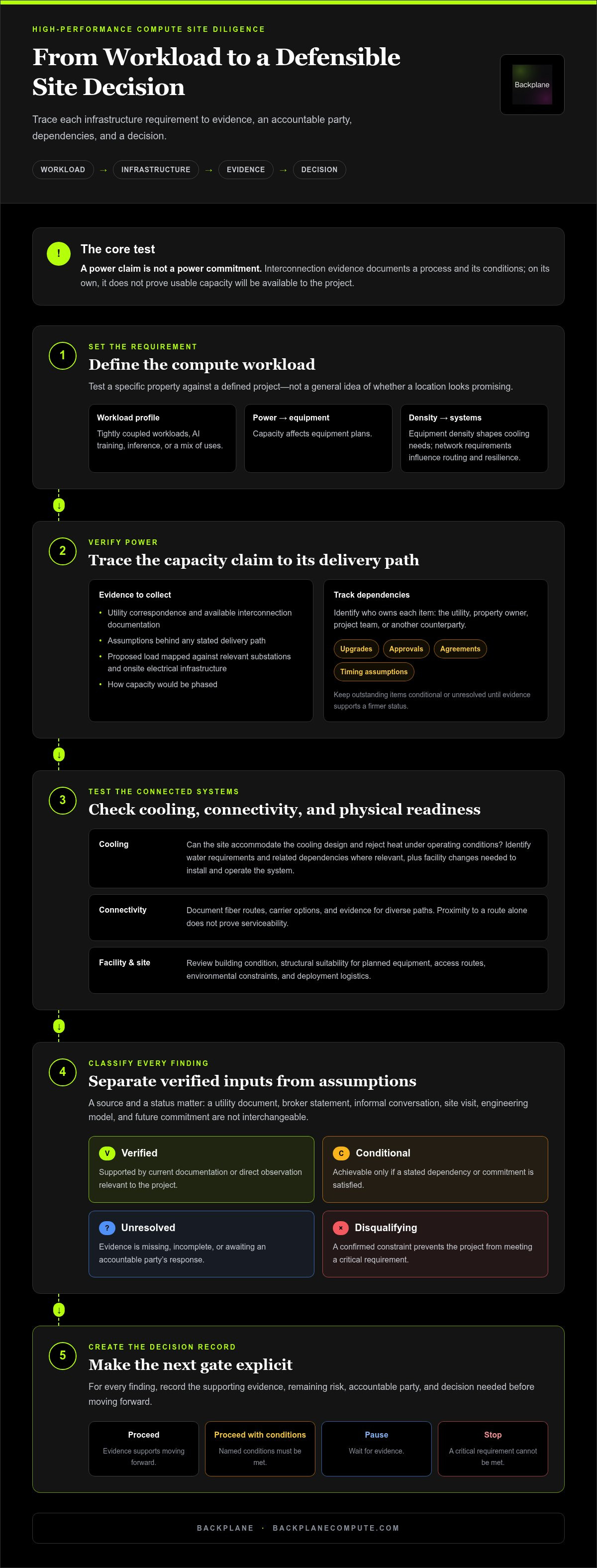
A power claim is not a power commitment. High performance compute site diligence starts by separating documented capacity from assumptions, then testing whether power, cooling, network, and facility systems can support the intended workloads together. A site can look ready on paper and still have constraints that put its schedule, capital plan, or commercial case at risk.
That scrutiny matters. Compute buyers need infrastructure that performs in practice, while investors need evidence that a project can move from potential to execution. Land alone proves neither. The case must connect physical readiness to credible demand and a financeable path forward.
This guide shows how to assess a site’s power evidence, cooling and connectivity requirements, facility readiness, commercial assumptions, and execution risks before committing capital or workloads. You’ll learn how to identify critical constraints early and build a defensible view of readiness. The core test is alignment: site capability, buyer demand, and financing must support the same credible deployment plan.
Key Takeaways
- Define the compute project first, then test whether the candidate site can support its specific workload rather than ranking locations in the abstract.
- For power, cooling, connectivity, buildings, and site conditions, map the evidence, responsible party, dependencies, and unresolved questions.
- Use high performance compute site diligence to distinguish verified inputs from assumptions and assess whether technical feasibility matches credible compute demand.
- Follow a staged diligence sequence with a defined output and decision gate at each step, from initial screen to investment decision.
- Align viable site infrastructure, committed compute demand, and financing to build a credible path toward deployment.
What High-Performance Compute Site Diligence Must Prove
High performance compute site diligence tests whether a specific property can support a defined compute project. It uses evidence to establish what is ready, what depends on further work, and what could stop investment. This is not a general judgment that a location is promising. The question is whether this site can support this workload, at the required scale, through a credible delivery path.
Start with the compute requirement. High-performance computing can involve tightly coupled workloads, AI training, inference, or a mix of uses. The High-Performance Computing (HPC) Overview describes the broader field, but the project’s workload profile determines what the site must deliver. Power capacity affects equipment plans; equipment density shapes cooling needs; network requirements influence routing and resilience. Each dependency can change the project scope and readiness.
A powered property has access to an energy claim; a deployable compute site has evidence that power, cooling, connectivity, facilities, and delivery plans work together for a defined workload. Keep that distinction at the center of every investment gate. For each finding, record the supporting evidence, remaining risk, accountable party, and decision needed before moving forward.
What counts as evidence in a compute site review?
Evidence has a source and a status. A utility document is not interchangeable with a broker’s statement or an informal conversation. A site visit records observable conditions, while an engineering model may depend on assumptions. A future commitment is different again: it should identify who is responsible and what conditions still apply.
Use four consistent labels for each finding:
- Verified: supported by current documentation or direct observation relevant to the project.
- Conditional: achievable only if a stated dependency or commitment is satisfied.
- Unresolved: evidence is missing, incomplete, or awaiting an accountable party’s response.
- Disqualifying: a confirmed constraint prevents the project from meeting a critical requirement.
For every item, note the source document, responsible party, dependencies, and open questions. This turns a data room into a decision record. It also prevents an unresolved assumption from quietly becoming a “fact” as the project moves from screening to capital review.
How diligence differs from general data center site selection
Site selection compares geographies and candidates. Diligence tests one candidate against one project. Keep broad location ranking outside the core review; focus instead on whether the property’s demonstrated capabilities match the workload’s requirements. A broader AI data center site-selection checklist can support early geographic screening, while diligence resolves the investment case for a specific site.
The outcome is not a vague readiness score. It is a documented decision: proceed, proceed only when named conditions are met, pause for evidence, or stop. That gives investors and compute buyers a shared basis for evaluating risk before committing capital or workloads.
How to Validate Power, Cooling, Connectivity, and Facility Readiness
Review each infrastructure domain against the proposed workload, then trace its evidence to a source, an accountable party, dependencies, and open questions. A capacity figure alone is not a delivery plan. Nominal electrical capacity may depend on utility work, onsite upgrades, approvals, or phasing. Cooling may require building adaptations and a workable heat-rejection approach. Network routes and equipment logistics can introduce their own constraints.
Interconnection evidence documents the process and conditions for connecting to the grid; it does not, by itself, prove that usable capacity will be available to the project. Keep that distinction explicit in the diligence record. The U.S. Government Accountability Office’s National Strategy for High-Performance Computing offers broader context on the strategic importance of HPC, while the site review must establish the practical case for this specific deployment.
What power evidence should a diligence file contain?
Collect utility correspondence, available interconnection documentation, and the assumptions behind any stated delivery path. Map the proposed load against relevant substations and onsite electrical infrastructure, including how capacity would be phased. Record who owns each dependency: the utility, property owner, project team, or another counterparty. List outstanding upgrades, approvals, agreements, and timing assumptions as conditional or unresolved until evidence supports a firmer status.
Can the facility support cooling, network, and physical deployment?
Evaluate whether the site can accommodate the project’s cooling design and reject heat under its operating conditions. Identify water requirements and related dependencies where relevant, along with the facility changes needed to install and operate the system. For connectivity, document fiber routes, carrier options, and evidence for diverse paths. Proximity to a route alone does not prove serviceability.
Apply the same discipline to the physical asset. Review building condition, structural suitability for planned equipment, access routes, environmental constraints, and deployment logistics. Capture the evidence and unresolved items by domain:
- Cooling: design basis, heat-rejection approach, water dependencies, and required modifications.
- Network: route evidence, carrier availability, path diversity, and connection dependencies.
- Buildings and site: inspection findings, access constraints, equipment movement, and site conditions.
For each item, name the source document, responsible party, dependencies, and open questions. A route map without a confirmed service path, for example, is not equivalent to a documented connectivity plan.
How do workload requirements change the diligence scope?
Translate the workload into design inputs before deciding whether infrastructure fits. Training, inference, and mixed workloads can place different demands on power density, redundancy, cooling, network performance, and deployment plans. Don’t apply a universal threshold. Document the project’s assumptions and test each infrastructure domain against them. The High-Performance Computing overview provides broader technical context, but the workload specification should anchor the site assessment.
When a candidate’s physical potential needs to be tested against a defined compute project, a property viability assessment can structure the review around evidence and dependencies.
Site Feasibility, Compute Demand, and Project Economics
A site can pass technical review and still fail the investment case. Feasibility matters only in relation to credible demand: the buyer’s workload, required capacity, deployment needs, and operating expectations must fit the site’s capabilities and delivery path. High performance compute site diligence connects those pieces before capital is committed.
Does committed compute demand match the proposed site?
Separate demand by evidence strength. A signed commitment is not the same as a forecast, an expression of interest, or an internal plan. For each buyer, document the workload, capacity profile, expected deployment stages, and operating requirements. Then compare those requirements with the site’s evidenced capability and outstanding dependencies. If the buyer needs capacity before a critical infrastructure upgrade can be delivered, that mismatch belongs in the investment decision, not in a footnote.
Which assumptions shape the project’s commercial case?
Map how infrastructure scope, financing needs, deployment phases, and operating responsibilities connect. A phased deployment may let initial buyer requirements inform the first infrastructure scope, with later phases tied to additional demand and readiness. Each phase still needs clear dependencies and accountable parties. Stress-test material assumptions, such as a change in deployment sequence or a delay in a required approval, without presenting an illustrative case as a promised outcome.
Use a comparison table to keep evidence separate from what the project still depends on:
| Input | Evidence status | Dependency or assumption | Decision implication |
|---|---|---|---|
| Buyer demand | Signed commitment, forecast, or interest | Workload scope and deployment conditions | Establishes how much demand supports each phase |
| Site capability | Documented infrastructure and engineering basis | Required upgrades, approvals, or delivery conditions | Shows whether the project can meet buyer requirements |
| Project structure | Defined scope and responsibility map | Financing alignment and counterparty obligations | Clarifies what must be resolved before capital advances |
Keep project-specific economics distinct from general market commentary. Don’t state returns, costs, or financial thresholds without verified evidence for the project. A financing AI infrastructure guide can help frame how capital structure should align with the project’s staged scope and funding needs.
How should diligence findings change the investment decision?
Translate findings into an explicit decision: proceed, proceed subject to conditions, redesign, defer, or stop. Tie each outcome to evidence quality, unresolved constraints, and the counterparty accountable for resolution. A condition should specify what evidence or action would clear it. If a material dependency has no accountable party or credible resolution path, proceeding on optimistic assumptions only transfers uncertainty into execution.
The investment case is strongest when buyer requirements, site capability, delivery responsibilities, and financing structure support the same sequence. That alignment turns technical feasibility into a decision-ready project while keeping unresolved risks visible to every party.
A Practical Diligence Sequence: From Initial Screen to Investment Gate
A disciplined sequence keeps early optimism from turning into an unsupported build plan. Start with the workload, buyer requirements, and evidence already available for the candidate site. Advance only when each stage produces a clear record and the next decision is justified. High performance compute site diligence reduces decision uncertainty; it cannot guarantee utility approvals, permits, construction delivery, or operating performance.
What are the core stages of high-performance compute site diligence?
Use ordered gates. Each stage should produce an output that the investment team can review before proceeding.
- Define the project. Document the workload, buyer requirements, candidate-site boundaries, and decision criteria. Output: an agreed project brief. Gate: pause if the buyer’s needs or critical requirements remain undefined.
- Assemble site evidence. Gather available property, utility, engineering, network, environmental, and permitting records. Mark each item by evidence status and source. Output: an indexed diligence file. Gate: identify missing evidence and assign an owner before relying on it.
- Test fit and dependencies. Reconcile technical findings with buyer requirements, infrastructure scope, financing needs, and delivery responsibilities. Identify dependencies that affect phasing or readiness. Output: a project-specific fit and risk assessment. Gate: continue only if critical requirements have a credible resolution path.
- Resolve or contain material gaps. Escalate significant uncertainties to named owners, with deadlines and documented criteria for resolution. Revisit the assessment if scope, buyer requirements, or utility assumptions change. Output: an updated risk register. Gate: do not let unresolved critical items disappear into a summary.
- Issue the investment recommendation. Record a proceed, conditional proceed, redesign, defer, or stop decision, with the evidence and rationale behind it. Output: a decision record for investors, owners, and compute buyers. Gate: advance only on the conditions the decision explicitly accepts.
How should teams manage diligence gaps and changing assumptions?
Maintain one risk register that tracks each gap’s evidence status, severity, owner, next action, deadline, and resolution criteria. Distinguish fatal constraints from remediable gaps and items that simply need more evidence. If a proposed workload change alters infrastructure scope, reopen the affected findings rather than carrying forward assumptions from the prior design.
When should a site fail diligence or return for redesign?
Stop or redesign when a critical project requirement lacks a credible route to resolution, or when new evidence invalidates the basis for proceeding. A conditional finding is not a fatal flaw, but it needs an accountable owner and a decision gate. Preserve the supporting documents and rationale so each party can see what was established, what remains open, and why the recommendation follows.
For a structured review of a candidate property’s fit for compute use, explore Backplane’s property viability assessment.
How Backplane Connects Viable Sites, Compute Buyers, and Financing
Diligence establishes what a site can support. Execution depends on connecting that evidence to a buyer’s requirements and a capital structure that reflects the project’s scope and risks. Backplane assesses powered industrial properties for AI compute use and matches viable opportunities with compute demand. The objective is not to market property in isolation. It is to determine whether site, buyer, and financing can align around a credible development path.
How does Backplane align site evidence with compute demand?
The model connects industrial property supply with AI compute demand. Property viability findings help clarify what a candidate site can support, what infrastructure conversion may require, and where constraints remain. Buyer requirements then give those findings a project-specific reference point. A site’s potential matters only if it fits a defined workload and its delivery needs. Backplane brings property evidence and compute requirements into the same assessment rather than treating them as separate opportunities.
This approach builds on high performance compute site diligence. Evidence about a property can inform its fit with a particular buyer, while buyer requirements help define the infrastructure scope to assess and finance.
What happens when a site and project are ready to advance?
As a project develops, Backplane’s work spans property assessment, infrastructure financing structuring, and project development through infrastructure deployment. Financing structuring aligns capital with a defined scope and delivery plan; it does not promise funding or a particular project outcome. The appropriate path depends on the project’s requirements and structure.
Compute access can take different forms. GPUs-as-a-Service provides direct access to GPU compute services. Dedicated Financed Sites provide a path centered on dedicated infrastructure. These are distinct options, not interchangeable labels. The diligence record helps inform which route fits the buyer’s needs, site readiness, and execution plan.
What should owners and compute buyers bring to an initial discussion?
A focused discussion starts with the facts each party can contribute. Owners can summarize the property, existing infrastructure, available power documentation, known constraints, and any work already completed. Compute buyers can outline the workload, capacity profile, deployment requirements, and demand assumptions. The purpose is to identify what is known, what must be tested, and whether there may be a financeable path forward.
- Property owners: share site conditions, infrastructure records, power evidence, and known dependencies.
- Compute buyers: define workload needs, required capacity, deployment expectations, and demand basis.
When the buyer, owner, and financing approach align around the same evidence-backed scope, a viable property can move toward an executable compute project. Bring your site or compute requirements to Backplane for a focused discussion about the project path.
Move from Site Potential to a Decision-Ready Project
Turn diligence findings into a working project brief. Bring together the requirements that matter most, the evidence available, the open dependencies, and the decisions that cannot wait. This gives owners, compute buyers, and capital partners a shared basis for moving forward or changing course.
Strong high performance compute site diligence doesn’t eliminate uncertainty. It makes uncertainty visible, assigns responsibility, and keeps assumptions from driving investment decisions unchecked. The result is a clearer path to action, whether that means advancing a viable project, resolving a critical gap, or stepping back before committing more resources.
Backplane can bring site and compute requirements into a focused project discussion. Discuss a compute site or project with Backplane to take the next step with a clearer view of what the opportunity requires.
Frequently Asked Questions
What is high-performance compute site diligence?
High performance compute site diligence is a structured test of whether a particular property can support a defined compute project. It considers infrastructure evidence alongside buyer needs and project dependencies. If a buyer plans to deploy in phases, for example, the review should establish whether each stage has a workable path, not just whether the site might support the final build. Keep findings tied to the project version they assess.
How is compute site diligence different from data center site selection?
Site selection compares possible locations; diligence examines whether a chosen candidate can support a specific transaction. A site may rank well for access or land characteristics but still have unresolved infrastructure obligations. Keep separate records: one for why the location entered consideration, another for evidence supporting the proposed project. This prevents an early screening advantage from being mistaken for proof of readiness.
What power documents are useful during data center site diligence?
Useful records can include utility correspondence, interconnection materials, available capacity information, electrical infrastructure records, and descriptions of required upgrades. The relevant documents vary by project and jurisdiction. Track the date and source of each record, along with the load or project phase it relates to. If a utility statement addresses a different scope than the proposed project, flag the mismatch rather than treating it as confirmation.
Can a site with substantial power support an AI compute project?
Not necessarily. The power position must fit the project’s actual delivery conditions and work alongside cooling, network connectivity, building suitability, and equipment deployment needs. A site may have a strong stated power position but no established way to accommodate the planned cooling design. Assess the dependencies as a connected system and identify which constraint would prevent the project from operating as intended.
What happens if a site fails a diligence review?
A failed review should produce a clear record of the constraint and its significance. Distinguish a confirmed blocker from an issue that could be addressed through redesign or further evidence. If a site boundary or building condition limits the proposed layout, for instance, document the affected requirement and the decision it changes. That record helps owners, buyers, and investors understand why the recommendation is to pause or redesign.
Does site diligence guarantee a data center project will be delivered?
No. Diligence helps decision-makers understand evidence and dependencies; it cannot ensure approvals, utility delivery, financing, construction, equipment availability, or operating performance. These outcomes depend on counterparties, project execution, and conditions that may change. Use the review to establish what must happen next, who owns each dependency, and what evidence would support moving through the next decision gate. Keep that record current as commitments and project scope evolve.
When should a compute site be reassessed?
Reassess when a change could invalidate an earlier finding. A revised workload, buyer requirement, utility position, infrastructure design, financing assumption, or allocation of delivery responsibilities may alter the project’s fit. Record what changed, which conclusions are affected, and whether existing evidence still applies. A targeted update is more useful than carrying forward a previous assessment unchanged or reopening every item without regard to the change.


