

The obvious choice may be the wrong one. In the Equinix vs private GPU farm decision, the facility label matters less than who controls the hardware, secures power and cooling, and owns deployment risk. Equinix Metal was sunset on June 30, 2026, but Equinix colocation and its private AI offerings remain distinct options for enterprise infrastructure. Compare what you operate, what the provider operates, and what each arrangement commits you to over time.
A fair cost comparison matters just as much. A recurring colocation bill and a dedicated-site commitment have different cost drivers, from power, cooling, and connectivity to hardware, staffing, and utilization. This guide compares the models across control, network access, deployment, and total cost of ownership. It also outlines the diligence a private GPU site requires, including checks on power availability, cooling design, network capacity, financing, and delivery dates. A dedicated site may be structured without requiring your team to source property and financing alone.
Key Takeaways
- Equinix vs private GPU farm is a comparison of infrastructure models, not simply facility names. Separate facility access, GPU capacity, and managed compute before evaluating options.
- Match hardware control, connectivity, and operating duties to the contract and service scope. Don’t assume the facility provider owns every deployment responsibility.
- Compare total cost drivers side by side, including power, cooling, networking, hardware, staffing, financing, and deployment. A headline rate won’t show the full commitment.
- Test workload duration, capacity needs, and operating readiness before choosing a model. Treat confirmed power and a credible delivery plan as prerequisites for a private site.
- Colocation, dedicated capacity, and a financed site can each fit different requirements. Backplane assesses powered industrial sites against committed compute demand to help evaluate site viability and infrastructure financing structure.
Equinix vs. a Private GPU Farm: What Are You Actually Comparing?
The comparison isn’t simply one data center against another. Equinix vs private GPU farm means comparing different ways to secure facility access, GPU capacity, and compute operations. These can be separate purchasing decisions, with responsibilities set by the contract and service scope.
Colocation: Access to space and facility infrastructure in a data center, with hardware ownership and operation defined separately.
Dedicated GPU infrastructure: Compute capacity arranged for a buyer’s requirements at a designated site, with ownership, operations, and financing structured for the project.
A data center can operate under different models, including colocation and private enterprise arrangements. Compare who provides the GPUs, who runs them, how they connect to your systems, and who is accountable for deployment. The facility name alone won’t answer those questions.
What Equinix colocation typically means for a GPU buyer
Colocation places infrastructure within a data center environment. A buyer may be arranging facility access and connectivity while separately sourcing GPU hardware or compute services. Don’t assume a colocation agreement includes GPUs, hardware management, or a particular deployment model. Confirm the current Equinix service scope and contract terms before assigning those responsibilities.
Equinix Metal was sunset on June 30, 2026, so it shouldn’t be treated as a currently available option in this comparison. Equinix colocation, connectivity, and other current services are distinct considerations. Verify which offerings apply to your specific requirement.
What counts as a private GPU farm
A private GPU farm is dedicated GPU infrastructure at a site secured around a buyer’s defined compute requirements. “Private” describes the dedicated arrangement, not necessarily who owns every asset or operates every component. Ownership, operating duties, and financing can vary by project.
This differs from buying individual GPU servers or acquiring generic real estate. The site, power and cooling design, network capacity, hardware, and delivery plan must work together as a viable compute deployment. Buyers don’t necessarily need to source the property and financing independently. A dedicated-site process can include assessing powered industrial properties against committed compute demand and structuring financing for the infrastructure.
Define the workload first, then identify the arrangement that provides the required capacity and control. Compare complete operating models, not facility labels.
Compare Equinix and Private GPU Farms by Control, Connectivity, and Operations
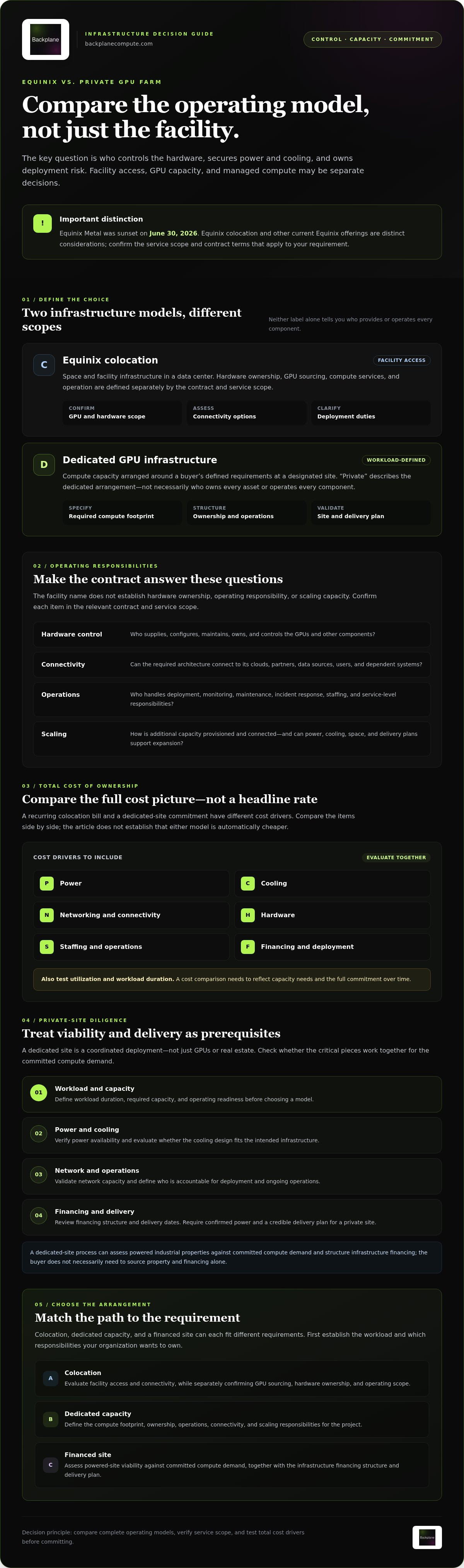
Compare the operating model, not just the site. Colocation may provide access to a facility and its connectivity options; a dedicated GPU farm may define a specific infrastructure footprint. Neither label tells you who owns the hardware, manages access, or handles scaling. Those responsibilities depend on the contract, facility arrangement, and service scope.
| Decision area | Equinix colocation | Private GPU farm |
|---|---|---|
| Hardware control | Check who supplies, configures, and maintains the GPUs. Facility access alone doesn’t establish hardware ownership. | A dedicated footprint can be specified around workload needs. Confirm who owns and controls each component. |
| Connectivity | Assess available connections to clouds, partners, data sources, and users for the required architecture. | Validate network capacity and routes to the systems the workload depends on. |
| Operations | Confirm which party covers deployment, monitoring, maintenance, and incident response. | Define operational ownership, staffing, maintenance, and service-level responsibilities before committing. |
| Scaling | Determine how additional capacity is requested, provisioned, and connected. | Check whether power, cooling, space, and delivery plans can support the intended expansion. |
Where connectivity and ecosystem access matter most
Start with where the data lives and which clouds, partners, and users the workload must reach. An established interconnection ecosystem may simplify a distributed architecture, but the benefit depends on the connections you need and service availability. Don’t assume a latency advantage. Measure performance against workload requirements and confirm routes, bandwidth, and data-location needs for the specific arrangement.
Where dedicated control and operating responsibility matter most
A defined GPU footprint can help when hardware configuration, deployment, or utilization requirements call for tighter site-level control. That control also brings operational obligations. Specify who monitors systems, performs maintenance, manages access, and responds to service issues. For security planning, the NIST Risk Management Framework offers a reference for organizing information-system controls. Adapt the approach to the project’s actual requirements.
The central trade-off is ecosystem access versus site-level control, not an automatic win for either model. In the Equinix vs private GPU farm decision, map each requirement to a named responsibility, then check whether the proposed service scope covers it. If a dedicated site is under consideration, a property viability assessment can help evaluate whether a powered industrial property aligns with committed compute demand.
Compare Total Cost Drivers Without Assuming a Private GPU Farm Is Cheaper
A credible total cost of ownership comparison starts with equivalent requirements, not headline rates. Compare the same GPU capacity, workload period, availability expectations, and service scope. A lower recurring charge may exclude hardware, deployment, network services, or operational work that the other option includes. Put costs and responsibilities on the same ledger before drawing a conclusion.
Which cost inputs belong in an apples-to-apples comparison?
Separate recurring facility and service charges from one-time commitments and ongoing operating expenses. For each option, record what’s included, what’s billed separately, and what your team must supply.
- Facility and power: Space, power charges, available capacity, and any electrical upgrades required for the project.
- Cooling and infrastructure: Cooling design, supporting systems, and deployment work needed to make the site suitable for the GPU configuration.
- Hardware and networking: GPU acquisition or access, storage, network connectivity, and any capacity or connection changes as the workload grows.
- Operations: Staffing, monitoring, maintenance, and other responsibilities not included in the service scope.
- Financing and delivery: Financing structure, deployment costs, delivery schedule, and the cost of changes or delays.
Mark each input as quoted, estimated, or unverified. Use project-specific proposals instead of generic assumptions. Don’t calculate a definitive total until suppliers have confirmed the relevant scope, power availability, cooling design, network requirements, financing terms, and delivery plan.
How financing and utilization change the decision
Model expected utilization across the full commitment period. A cluster sized for peak demand may sit idle during quieter periods, while a long-term facility or financing obligation can remain even if the workload contracts. Include planned expansion, the cost and timing of adding capacity, and exposure to stranded capacity if demand falls or the site can’t support the next phase.
Then compare capital exposure with service-based access or structured financing, where available. These approaches change the timing and allocation of obligations; they don’t remove the need to understand total cost, utilization assumptions, or contract terms. For more on capital structures and decision factors, see the guide to financing AI infrastructure.
In the Equinix vs private GPU farm analysis, the lower-cost option depends on workload duration, utilization, and what each proposal covers. Run the same scenario against both models, including expansion and downside cases. Compare full obligations, not a single monthly line item.
Use This Decision Framework to Test Whether a Private GPU Farm Fits
Test feasibility before comparing final proposals. A dedicated site merits consideration only if the workload, capacity, delivery plan, and operating model align. Power availability and a credible path to deployment are gates, not details to resolve after committing.
Five diligence questions before selecting an infrastructure model
- What workload are you supporting? Specify GPU type, cluster scale, expected utilization, workload duration, and the shape of future demand. Separate sustained capacity needs from temporary peaks.
- What footprint does that demand require? Define capacity now and the expansion profile you expect. If demand is uncertain or short-lived, compare the commitment with colocation or service-based access before pursuing a dedicated footprint.
- Is the power path evidenced? Confirm available power for the proposed deployment and identify any upgrades or dependencies. Treat unverified capacity as a blocker, not a planning assumption.
- Can the site support the technical design? Review the cooling approach, network design, and site readiness against the actual workload. Ask for evidence and a credible delivery plan, including dependencies that could affect deployment dates.
- Who owns execution and operations? Assign responsibility for deployment, monitoring, maintenance, security, and ongoing service delivery. Confirm the boundaries in writing, including what happens as the cluster scales.
For broader diligence, use this AI data center site selection checklist. It can help organize site questions before commercial commitments advance.
When to consider a ready-to-use or dedicated site
Dedicated infrastructure merits evaluation when sustained workload requirements justify a defined capacity footprint and greater control over configuration. A ready-to-use site may also warrant diligence, but the label alone doesn’t establish readiness or speed. Verify power, cooling, networking, deployment responsibilities, financing terms, and delivery dates for the specific project. This ready-to-use GPU sites buyer’s guide covers additional deployment considerations.
Colocation may deserve further diligence if facility access and connectivity fit the workload and your team can manage, or contract for, the required GPU capacity and operations. A mixed approach can make sense when workloads have different duration, control, or connectivity needs. The Equinix vs private GPU farm decision doesn’t require choosing one model for every workload.
If a dedicated site passes the technical and delivery gates, Backplane can assess site viability against compute requirements and help structure infrastructure financing. Review Backplane’s property viability assessment when evaluating whether a powered industrial site merits further diligence.
Choose Your Next Step: Colocation, Dedicated Capacity, or a Financed Site
The right model follows from the workload and the team that will operate it. Colocation can fit when facility access and connectivity are priorities, and the buyer has a clear plan for GPU capacity and operations. Dedicated capacity or a financed site may suit sustained requirements that call for a defined infrastructure footprint and greater deployment control. A blended approach can preserve options across workloads with different connectivity, duration, or control needs.
Match the operating model to your workload and team
Make the decision against four tests: required connectivity, control over deployment, internal operating capacity, and evidence supporting the proposed timeline. A model that depends on unconfirmed power, unresolved financing, or speculative workload commitments needs more diligence before it advances. For a broader view of private infrastructure, see the dedicated AI compute sites enterprise guide.
These paths are not interchangeable. GPUs-as-a-Service can address a need for GPU compute without the buyer independently arranging a dedicated site. A dedicated financed site is a different route, tied to a project’s requirements and financing structure. Colocation remains a separate facility decision. Compare the service scope and obligations in each proposal before deciding which model fits.
Move from infrastructure requirements to a viable project
Backplane connects powered industrial properties with AI compute demand. Its process spans property viability assessment, infrastructure financing structuring, and GPU infrastructure deployment. For compute buyers, start with a defined capacity requirement, workload profile, and deployment constraints. For property owners, assess the asset’s power, cooling, network capacity, and readiness for the proposed compute demand. Site fit and commercial terms require project-specific assessment; neither should be assumed from a property description alone.
The Equinix vs private GPU farm decision is ultimately about fit, control, and responsibility. If power availability, financing, or committed demand remains uncertain, keep the project in diligence rather than treating a site or timeline as confirmed. A private farm doesn’t require every buyer to independently source property and financing, but it does require a credible project structure.
Learn more about the options for a compute requirement or powered industrial asset: Discuss a GPU capacity requirement or site assessment.
Turn Your GPU Requirements Into an Infrastructure Decision
The right choice in the Equinix vs private GPU farm comparison depends on the workload, not the facility label. Prioritize the connectivity and operating model your team needs, then compare full cost drivers and documented responsibilities. For a dedicated site, treat verified power, cooling, network capacity, and delivery plans as prerequisites, not assumptions.
A private GPU project also doesn’t require every buyer to source property and financing alone. Backplane matches powered industrial properties with AI compute demand. Depending on the project, its scope can include site assessment, financing structuring, and infrastructure deployment. Evaluate the workload and site requirements together.
Discuss your GPU capacity requirements or assess a powered site. Bring your capacity needs and site requirements to start a project-specific assessment.
Frequently Asked Questions
Is Equinix a GPU cloud provider or a colocation provider?
Equinix is primarily a colocation and data center connectivity provider, but its current AI infrastructure offerings may extend beyond facility access. The exact service scope matters: colocation doesn’t automatically include GPU hardware or managed compute. Equinix Metal was sunset on June 30, 2026, so don’t treat it as an available bare-metal option. Verify current Equinix services, hardware responsibilities, and contract terms for the specific deployment.
What is the difference between Equinix and a private GPU farm?
Equinix colocation generally concerns access to data center facilities and connectivity, while a private GPU farm is dedicated GPU infrastructure arranged around a buyer’s compute requirements. These aren’t equivalent products. Hardware ownership, operations, financing, and deployment can differ in either arrangement. Compare the actual contract scope: who provides and manages GPUs, what connectivity is included, and who is accountable for power, cooling, maintenance, and scaling.
Can a private GPU farm provide the connectivity an enterprise needs?
Yes, if the site’s network design and available connections meet the workload’s requirements. Confirm how the infrastructure will reach required clouds, data sources, partners, and users, then validate capacity, routes, security controls, and performance against measured application needs. Don’t assume a private site inherently offers better or worse connectivity than colocation. The relevant test is whether the proposed design supports the enterprise’s specific traffic patterns and architecture.
Is a private GPU farm cheaper than Equinix?
Not necessarily. Compare equivalent capacity and service scope over the same period, including facility charges, power, cooling, networking, hardware, staffing, deployment, and financing. A lower headline rate may exclude costs or responsibilities included elsewhere. Utilization also matters: fixed commitments can weigh on economics if the GPUs are underused, while expansion can create additional costs. Use project-specific quotes and model expected demand rather than assuming either option is cheaper.
When should an enterprise choose a dedicated GPU site over colocation?
Consider a dedicated site when sustained compute demand justifies a defined infrastructure footprint and your requirements call for control over configuration or deployment. Colocation may fit better when facility access and connectivity are central, and your organization has a suitable plan for GPU capacity and operations. Before choosing a dedicated site, confirm power, cooling, networking, delivery evidence, financing terms, and who will operate the infrastructure.
What should buyers verify before committing to a private GPU farm?
Verify the workload and capacity plan, then require evidence for power availability, cooling design, network capacity, site readiness, and delivery dates. Define who supplies hardware and owns deployment, monitoring, maintenance, security, and ongoing service delivery. Review financing terms and expansion dependencies, too. Backplane can assess powered industrial properties against committed compute requirements, with project scope that may include site assessment, financing structuring, and infrastructure deployment.
Can a company use Equinix and a private GPU farm at the same time?
Yes. A company can use different infrastructure models for workloads with different connectivity, control, duration, or capacity needs. For example, it might keep some systems in colocation while evaluating a dedicated site for sustained GPU demand. The architecture must account for data movement, network design, security, and operational ownership across environments. Assess each workload separately, and verify that the proposed connections and service scopes work together.


