

The fastest route to AI capacity may not be the one that gives you the most control. If you’re weighing CyrusOne vs dedicated AI sites, ask whether a colocation proposal can meet your workload’s power and cooling needs, or whether a dedicated site’s customization is worth the added development and financing work.
AI infrastructure decisions hinge on more than rack space. Power availability, rack density, cooling design, deployment timing, and responsibility for project risks all matter. A dedicated site can offer more opportunity to shape the infrastructure, but its readiness depends on project-specific site, power, buyer, and financing diligence. Colocation may reduce the need to develop infrastructure yourself, but you still need to verify the specific capacity and terms on offer.
This guide compares the two models across capacity, control, deployment, and financing. Use the framework to test each proposal against your workload and identify what to verify next. If standard colocation doesn’t fit, a dedicated-site pathway may be worth assessing, with readiness and timelines confirmed case by case.
Key Takeaways
- In the CyrusOne vs dedicated AI sites comparison, assess the specific facility or project proposal, not just the delivery model.
- Map training or inference needs, cluster scale, utilization, and growth expectations before judging capacity fit.
- Request evidence for power availability, utility interconnection, cooling design, redundancy, and delivery milestones.
- Compare timelines only when both options use like-for-like assumptions, then identify who carries each delivery and operating risk.
- If colocation does not meet your requirements, evaluate a dedicated site through site viability, power, buyer, and financing diligence.
CyrusOne vs. dedicated AI sites: what is actually being compared?
The CyrusOne vs dedicated AI sites decision compares two ways to secure compute infrastructure. CyrusOne is the colocation provider under evaluation. A dedicated AI site is infrastructure developed or secured for a specific buyer or workload. One is a provider portfolio and contract; the other is a site-specific pathway that may give a buyer more influence over design while placing more development responsibility on the project team.
The distinction matters more than the labels. A provider’s general capabilities don’t establish what a particular facility can deliver to a specific customer. Likewise, “dedicated site” doesn’t say whether a property is ready, what infrastructure it includes, or who will operate it. The CyrusOne overview offers background on the provider, but current services, capacity, and commitments must be verified in the proposal being assessed.
What does a CyrusOne comparison need to verify?
Evaluate the specific facility and written offer, not general provider descriptions. Confirm the proposed capacity, power commitments, technical specifications, delivery milestones, and applicable terms. Distinguish what the provider may offer generally from what is available and committed to your project. Clarify service boundaries, including who manages facility operations and where responsibility for customer-owned equipment begins.
What counts as a dedicated AI site?
A dedicated site is capacity aligned to an identified workload and customer requirement. It could be a new-build facility, a converted industrial asset, or a powered property. These options differ in infrastructure, readiness, and development obligations.
A powered property is not necessarily a commissioned facility ready for compute deployment. Before treating a site as usable capacity, establish what remains to be completed and evidenced, including utility interconnection, cooling, permitting, and financing readiness. These factors vary by project and can affect feasibility and timing.
In brief: CyrusOne means evaluating provider-led capacity under a specific proposal. A dedicated AI site means evaluating a specific infrastructure project, its control arrangements, and its remaining development work. Neither model is automatically faster or better. The right comparison depends on the workload, documented commitments, and which party can manage outstanding delivery responsibilities.
Compare CyrusOne and dedicated AI sites across control, capacity, and delivery
The CyrusOne vs dedicated AI sites comparison comes down to what each proposal commits to and what the buyer must deliver. Colocation may place more facility responsibilities with the provider. Dedicated development can align infrastructure more closely with a workload, while shifting more diligence, capital planning, and delivery risk to the project. The actual balance depends on the facility, agreement, workload, and project readiness.
| Dimension | Provider-led colocation | Dedicated AI site |
|---|---|---|
| Control | Control is bounded by the service agreement and facility rules. | Potentially more influence over site-specific design, alongside more development decisions. |
| Capacity configuration | Fit depends on capacity available and committed at the proposed facility. | Configuration may be planned around an identified workload, subject to feasibility. |
| Power | Verify documented power commitments and what the contract reserves for you. | Confirm utility interconnection, firm power, and project milestones. A powered property alone isn’t deployment-ready. |
| Cooling | Check whether the proposed cooling design supports your equipment and operating profile. Advanced cooling strategies may include hybrid air and liquid approaches, depending on engineering requirements. | Cooling can be specified for the intended workload, but design, delivery, and commissioning must be validated. |
| Deployment | Timing depends on facility availability, agreed delivery milestones, and readiness for customer equipment. | Timing depends on site readiness and development dependencies, including power, cooling, and financing. |
| Operating responsibility | The agreement defines provider duties and the boundary around customer-owned equipment. | Responsibilities must be allocated across facility and compute operations. |
| Flexibility | Contract terms may provide expansion or other options; they don’t equal physical control of infrastructure. | Physical design may allow greater alignment, while changes can require project-level coordination. |
Where a provider-led colocation model may fit
Colocation may suit a workload if the proposed facility can meet its density requirements and the offer documents suitable power, cooling, connectivity, and service commitments at the required location. Review contract duration, expansion options, and operating boundaries. Don’t treat a provider’s general capabilities as a substitute for written commitments to your project.
Where a dedicated AI site may fit
A dedicated site may be worth evaluating when requirements call for site-specific configuration or closer infrastructure alignment, and the buyer can coordinate diligence, financing, and deployment dependencies. For more on the model, see this dedicated AI compute site guide.
If the comparison points toward a dedicated pathway, Backplane can assess property viability and structure infrastructure financing on a project-specific basis. Explore dedicated site assessment and financing structuring as a potential next step.
Test each option against AI workload, power, and cooling requirements
Start with the compute requirement, not the facility’s headline capacity. Define whether the workload is training, inference, or a mix. Specify cluster scale, expected utilization, and planned growth. Continuous inference demand may place different demands on sustained power and operations than a training workload with changing utilization. Then test each proposal against the GPU configuration, network requirements, and deployment plan.
Advertised capacity is not proof of AI readiness. Readiness depends on documented power, cooling, connectivity, and delivery commitments that fit the workload. Apply the same evidence standard to both options in the CyrusOne vs dedicated AI sites evaluation. A provider proposal and a site-development plan may describe capacity differently, so clarify what is energized, reserved, planned, and dependent on future work.
How to assess power and interconnection
Ask for documentation that separates existing energized capacity from planned or prospective utility capacity. Confirm interconnection status, responsible parties, outstanding dependencies, redundancy provisions, and schedule assumptions. Check that the power commitment applies to your proposed load and location, not just the broader facility or site. Treat availability and delivery dates as site-specific facts to verify, not assumptions drawn from a general capability statement.
How to validate cooling and workload fit
Match the cooling design and supported rack density to the planned equipment configuration. Ask for facility-specific limits and evidence that the proposed environment can support the deployment, including how redundancy, maintenance, and thermal operating limits affect operations. AI cooling approaches vary; this overview of AI data center site selection criteria can help structure broader diligence.
Capacity and cooling are only part of the test. Verify that network connectivity meets workload requirements, then map deployment dependencies such as equipment installation, commissioning, and access. Establish who owns each operational task, including responsibility for facility systems and customer equipment. The agreement or project plan should make these boundaries clear.
Build a short evidence file for each option:
- Workload: Workload type, cluster scale, utilization, and growth assumptions.
- Power: Energized capacity, commitments, interconnection status, redundancy, and milestones.
- Cooling: Design, supported rack density, and operating limits for the intended equipment.
- Delivery: Network readiness, dependencies, responsible parties, and documented dates.
Compare only what the evidence supports. If key details are missing, record them as open diligence items, not confirmed capacity.
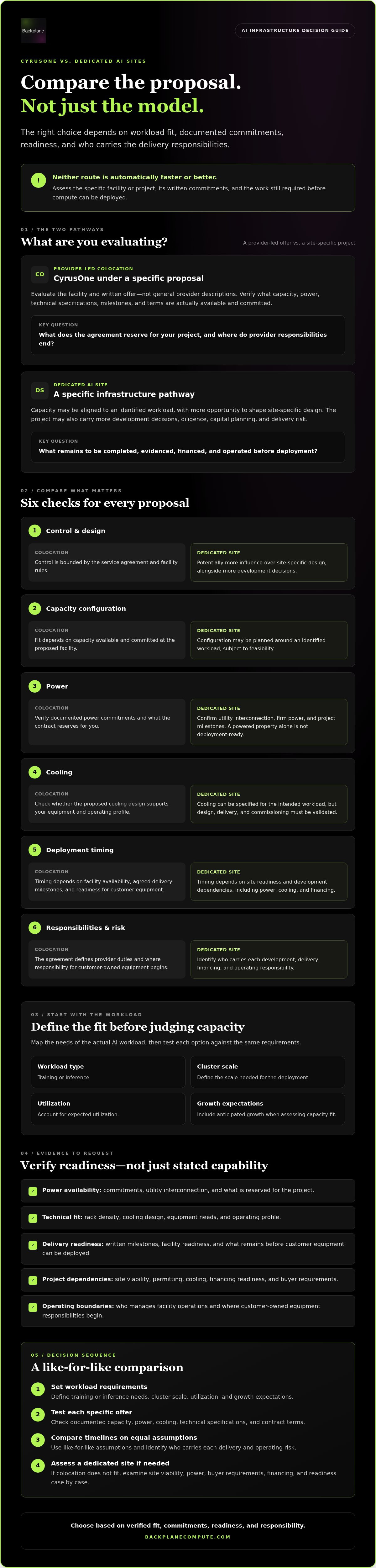
Compare risk, financing, and time-to-capacity framework
Compare delivery risk alongside capacity. A provider agreement and a dedicated-site project allocate obligations differently, but neither removes the need to verify counterparties, commitments, and assumptions. For a useful CyrusOne vs dedicated AI sites decision, apply the same five-step screen to each option:
- Workload: Define the requirement the capacity must serve.
- Capacity evidence: Separate committed capacity from planned or conditional capacity.
- Power and cooling: Confirm readiness and technical fit using project-specific documentation.
- Risk allocation: Identify who owns each dependency, delay exposure, and operating responsibility.
- Commercial structure: Compare contract obligations with the financing and funding plan for a dedicated project.
Compare time-to-capacity only when both options provide documented, like-for-like milestones. Include equipment procurement, utility work, permitting, financing, and commissioning in the schedule. A provider’s stated delivery date and a site developer’s target may rely on different assumptions. Ask what must happen first, who is responsible, and what evidence supports each milestone.
Financing also needs separate diligence. A provider contract is not the same as project finance: one sets terms for an arrangement with a provider, while the other must support development obligations and dependencies. Neither structure guarantees delivery. For a deeper look at how capital structure can shape the decision, review these financing strategies for AI infrastructure.
When should a buyer lean toward a provider arrangement?
Consider it when verified existing capacity fits the workload and the proposed contractual terms are workable. Check whether the operating model limits project coordination your team doesn’t want to own. Confirm expansion pathways, responsibilities, and delivery commitments directly in the provider’s offer. Treat each as a specific commitment to validate, not an assumption based on general capability.
When should a buyer assess a dedicated site?
Assess this path when specific control, configuration, or capacity needs justify project-level diligence. Test whether property, power, financing, and compute demand can be aligned in a viable plan. Use sensitivity analysis to examine how schedule changes, utilization assumptions, or infrastructure dependencies could affect project feasibility before advancing.
If a dedicated pathway merits further review, Backplane can assess property viability and structure infrastructure financing for a specific project. Assess a dedicated site and its financing structure against your documented requirements.
How Backplane can help assess a dedicated AI site pathway
A dedicated AI site requires alignment across property, power, compute demand, and financing. Backplane connects powered industrial properties with AI compute demand and can assess whether a property may support a specific infrastructure project. This offers another pathway in the CyrusOne vs dedicated AI sites decision when a buyer’s requirements may not fit a standard colocation arrangement.
The process is project-specific, not a promise of capacity or delivery. It begins with the buyer’s workload and requirements, followed by an assessment of the asset and available infrastructure evidence. The parties can then identify diligence gaps, evaluate financing structure, and plan deployment dependencies. Each stage depends on verified information and responsibilities agreed by the relevant parties.
What Backplane evaluates in a potential site
A property viability assessment considers available evidence about power, site characteristics, infrastructure requirements, and buyer demand. A powered property is not automatically ready for compute deployment. Documentation may reveal remaining dependencies, such as infrastructure work or other project requirements that need to be resolved before a deployment plan is credible.
Backplane can identify gaps for further diligence and structure infrastructure financing for a specific project. Capacity, financing, timing, and outcomes must be confirmed case by case. The aim is to clarify what is established, what remains uncertain, and what would need to happen next, rather than present an unverified site as deployment-ready.
What to prepare before discussing a project
Clear inputs help frame an initial assessment. Buyers should outline workload scale, target deployment window, location parameters, and operating requirements. Property owners should gather available documentation on power, site characteristics, and existing infrastructure. These materials help identify which questions need answers before a project can advance.
Backplane also offers GPUs-as-a-Service for buyers seeking compute access rather than a dedicated-site pathway. The right route depends on the buyer’s requirements and project circumstances; neither should be assumed to fit without evaluation.
For a project-specific discussion, discuss your AI infrastructure requirements. Buyers and property owners can share their requirements and available documentation to explore whether a dedicated site assessment, financing structure, or compute-access option merits consideration.
Make the Next Capacity Decision on Evidence
The right choice isn’t determined by the provider name or the promise of a dedicated site. It depends on whether documented capacity, power, cooling, and delivery commitments fit your workload, and whether your team is prepared to take on project-level responsibilities. Compare timelines only when the assumptions match. Verify what’s committed, what depends on future work, and who carries each risk.
If your requirements point toward a dedicated pathway, assess property viability and financing as carefully as technical design. Backplane connects powered industrial properties with AI compute demand and offers project-specific property viability assessment and infrastructure financing structuring. Neither establishes readiness or outcomes without diligence, but both can help clarify whether a site merits further evaluation.
Use the CyrusOne vs dedicated AI sites comparison to turn an infrastructure choice into a documented decision. Bring your workload requirements and available site or provider evidence to the next discussion. Discuss your AI infrastructure requirements and explore the pathway that fits your project.
Frequently Asked Questions
Is CyrusOne a good fit for AI workloads?
CyrusOne may fit an AI workload if the specific facility and contract meet its requirements. In the CyrusOne vs dedicated AI sites evaluation, verify location-specific power availability, supported rack density, cooling design, network capability, and delivery commitments. A general provider description doesn’t confirm that every facility supports your GPU configuration. Compare the written proposal with your workload profile and target schedule, and clarify capacity or technical assumptions before relying on them.
What is the difference between CyrusOne and a dedicated AI site?
CyrusOne is the provider being evaluated; a dedicated AI site is an infrastructure approach aligned to a particular buyer or workload. The distinction isn’t automatically provider versus owner, since dedicated sites can have different ownership and operating structures. Compare the actual arrangement: contract terms, site readiness, power and cooling evidence, control, financing, and delivery responsibilities. The label alone won’t tell you who bears development risk or what capacity is committed.
Are dedicated AI sites faster to deploy than colocation?
Not necessarily. An existing powered property may still need interconnection work, cooling, permitting, equipment, financing, and commissioning before compute can be deployed. Colocation timing also depends on facility availability, capacity, and contractual milestones. Request a dependency-based schedule for each option. Compare equivalent milestones, such as when power is available and when the environment is ready for equipment, then verify which dates are committed and which rely on assumptions.
How do I compare power availability at CyrusOne and a dedicated site?
Request location-specific power documentation for both options. Separate capacity that is energized and available from capacity that is planned or prospective. Confirm who is responsible for utility coordination or upgrades, what dependencies remain, and which milestones have written support. Check that the power profile and redundancy match the intended GPU deployment. Treat unsupported capacity or schedule statements as assumptions, then have technical and commercial teams validate them before deciding.
Can a dedicated industrial site support high-density AI infrastructure?
Some industrial sites may be viable, but power access alone doesn’t establish suitability. Assess interconnection evidence, electrical infrastructure, cooling, network connectivity, available space, permitting, and equipment deployment requirements against the planned workload. Technical needs depend on the equipment and site design. A property viability assessment should identify unresolved gaps and dependencies before anyone characterizes the site as ready for AI compute.
What should an enterprise compare besides capacity?
Compare control, workload configuration, power and cooling evidence, network requirements, operating responsibilities, expansion options, commercial structure, and delivery dependencies. Capacity figures help only when you understand what is available, at what configuration, and under what conditions. Use the same workload assumptions and equivalent milestones for both options. This keeps the decision focused on project fit rather than terminology or headline capacity.
How can Backplane help evaluate a dedicated AI site?
Backplane connects powered industrial properties with AI compute demand, offers property viability assessment, and structures infrastructure financing for projects. Its role depends on the project and what diligence confirms; a site isn’t automatically viable or deployment-ready. Buyers can prepare workload requirements, while property owners can gather available power, site, and infrastructure documentation. These details help frame a discussion about feasibility and potential next steps without presuming capacity, financing, timing, or outcomes.


