

What if the biggest constraint on your AI roadmap isn’t the model, but access to the infrastructure it needs? Dedicated AI compute sites are becoming a strategic option for enterprises facing long waits for H100 and B300 capacity, unpredictable cloud egress costs, and limited control over physical hardware. For production workloads, compute is no longer just a cloud line item. It’s where industrial power, financing, and high-density hardware come together.
The challenge is familiar: product timelines depend on GPU availability, while variable usage costs make long-term planning difficult. A dedicated site can give enterprises more control over capacity, costs, and data assets. But securing one takes more than finding an available building. Power, cooling, grid interconnection, financing, and deployment all affect whether a site is viable.
This guide explains how to move from shared cloud instances toward dedicated AI infrastructure. We’ll cover site selection, property viability, financing structures, deployment constraints, and the trade-offs between private infrastructure and hyperscalers. You’ll also learn how Backplane connects industrial assets with compute demand through Dedicated Financed Sites, a CAPEX-efficient path to private compute.
Key Takeaways
- Understand what distinguishes dedicated AI compute sites from shared cloud instances, and when private infrastructure may suit sustained workloads.
- Assess power access, interconnection, and high-density capacity before planning a property conversion.
- Compare cloud operating costs with the capital and operating requirements of private infrastructure across a GPU lifecycle.
- Use a structured viability and due diligence process to evaluate retired power plants and closed mills for compute use.
- Explore how Backplane’s brokerage model and Dedicated Financed Sites connect enterprise compute demand with powered industrial assets.
Dedicated AI Compute Sites: Beyond the Cloud
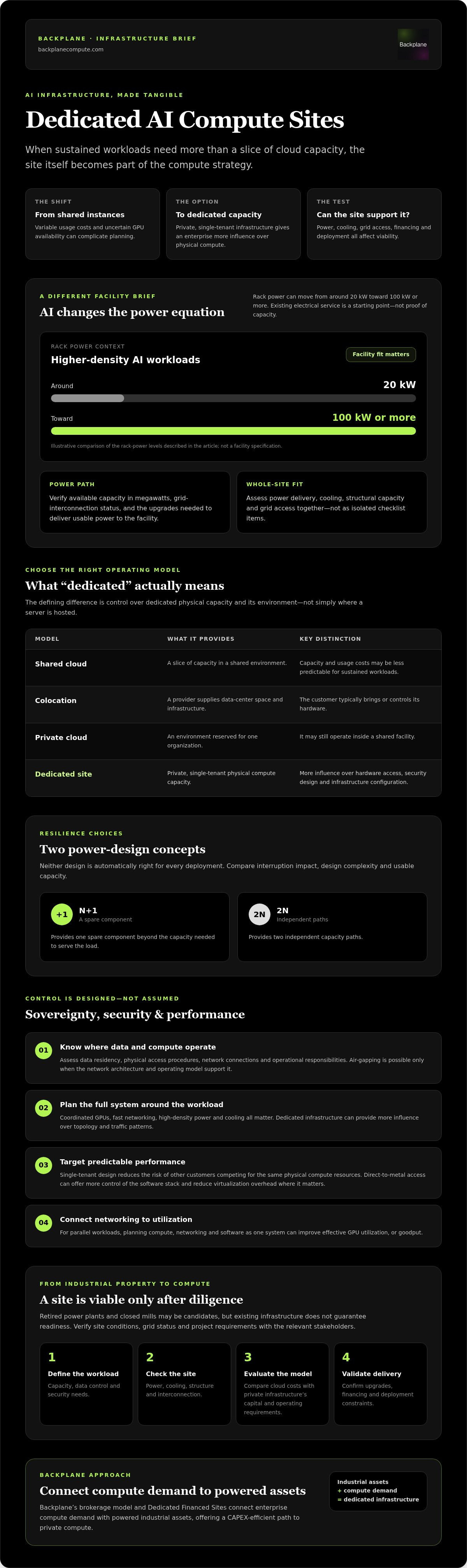
A cloud instance gives you a slice of capacity. A dedicated AI compute site gives your organization control over the physical environment where that capacity runs. It’s private, single-tenant infrastructure provisioned for one enterprise’s compute needs, rather than hardware shared among unrelated customers. The site may be financed or operated through different arrangements, but the defining feature is dedicated physical capacity and greater control over its configuration and security.
That distinction matters as AI moves from experimentation to sustained workloads. Training and serving large language models can depend on coordinated GPUs, fast networking, and high-density power and cooling. Managing isolated instances is not the same as planning the infrastructure that connects them. An overview of the specialized data center facility explains why AI workloads place distinct demands on hardware and power. Enterprises evaluating dedicated AI compute sites need to assess those physical requirements alongside software and capacity.
The terms aren’t interchangeable. In colocation, a provider supplies data center space and infrastructure while the customer typically brings or controls its hardware. A private cloud describes an environment reserved for one organization, but it may still run in a shared facility. A dedicated site puts the physical compute environment at the center of the arrangement, giving the enterprise more influence over hardware access, security design, and infrastructure configuration.
The Sovereignty Requirement
For regulated industries and organizations handling sensitive workloads, control has physical and operational dimensions. Teams may need to know where data is processed, who can access the hardware, and how systems are isolated. A dedicated environment can support stricter security controls, including air-gapping where the network architecture and operating model allow it. These capabilities aren’t automatic. They must be designed, implemented, and validated against the organization’s requirements.
That’s the practical meaning of Sovereign AI: not just choosing a model, but retaining meaningful control over data, compute, and the environment they depend on. Before selecting a site, assess data residency requirements, physical access procedures, network connections, and operational responsibilities.
Performance Without the Hypervisor Tax
Shared environments can introduce contention. A single-tenant design reduces the risk of other customers competing for the same physical compute resources, though performance still depends on the full system configuration. Direct-to-metal access can also give infrastructure teams more control over the software stack and reduce virtualization overhead where it matters. The goal is predictable performance, not an assumption that virtualization is always a bottleneck.
Large-model workloads may also benefit from networking designed around their parallelism needs. Dedicated infrastructure can give teams more influence over topology and traffic patterns. That control can improve effective GPU utilization, or goodput, when compute, networking, and software are planned as one system.
The Critical Anatomy of a High-Density AI Site
A GPU cluster is only as capable as the facility supporting it. AI workloads can push rack power from around 20 kW toward 100 kW or more. That changes the site brief. Power delivery, cooling, structural capacity, and grid access must be assessed as one system, not as separate checklist items. For enterprises assessing dedicated AI compute sites, a building’s existing electrical service is a starting point, not proof that it can support the target load.
Power: The New Gold Standard
Start by tracing the power path. Confirm the site’s available capacity in megawatts, the status of its grid interconnection, and what upgrades may be needed to deliver usable power to the facility. A retired industrial site may have valuable power infrastructure, but its current condition and interconnection status require diligence. Timelines vary by location and project, so verify them with the relevant utility and grid stakeholders rather than relying on assumptions.
Next, model resilience against the workload. N+1 provides a spare component beyond the capacity needed to serve the load. A 2N design provides two independent capacity paths. Neither is automatically right for every AI deployment. Compare the consequences of interruption, the design’s complexity, and the effect on usable capacity. Long-term power purchase agreements can also help structure supply and price exposure, but contract terms, delivery arrangements, and interconnection obligations need careful review.
Liquid Cooling and Thermal Management
At high rack densities, air cooling alone may not be a practical design basis. Liquid cooling is increasingly central to new high-density facilities, but the right approach depends on hardware, operating requirements, and site design. Direct-to-chip systems circulate coolant to components that generate substantial heat. Immersion cooling places equipment in dielectric fluid. Each approach has different implications for equipment compatibility, maintenance procedures, and facility layout. Confirm support for the intended GPU systems before selecting a method.
Retrofitting an existing data center can preserve useful infrastructure, but it may require substantial changes to power distribution, cooling loops, and floor layout. A purpose-built site can align these systems from the outset. In either case, evaluate water use effectiveness (WUE) alongside cooling performance, water availability, and the site’s operating constraints. A favorable WUE figure is useful only in context.
Physical capacity matters, too. Review floor loading, equipment access routes, ceiling clearance, cable pathways, and space for electrical and cooling equipment. These determine whether racks can be installed, serviced, and connected as planned. A property viability assessment can help organize the diligence needed to evaluate an industrial site for compute use.
Strategic Comparison: Hyperscalers vs. Dedicated Private Sites
Cloud and private infrastructure solve different problems. Hyperscalers offer on-demand access and flexible capacity, making them useful for experimentation, variable workloads, and rapid starts. Dedicated AI compute sites can make more sense when production workloads run steadily and teams need control over hardware, networking, and capacity. The decision is not simply rent versus buy. Compare utilization, total cost, procurement risk, and the value of control.
Total Cost of Ownership Over a GPU Lifecycle
Build a three-year comparison using the same expected workload on both sides. For cloud, include compute, storage, data egress, support, and the engineering effort required to manage distributed services. These less visible costs can materially change the total. For private infrastructure, account for site and infrastructure costs, hardware procurement, power, cooling, operations, and financing. Model utilization carefully: assets that sit idle can undermine the economics of ownership.
Also account for asset depreciation and residual value with finance and tax advisers. Treatment depends on the organization’s accounting and tax position, so don’t assume an ownership structure creates a particular benefit. Dedicated Financed Sites may offer a CAPEX-efficient path to dedicated infrastructure, but compare the actual structure and obligations with your cloud baseline.
Run more than one scenario. Test sustained production demand against a lower-utilization case, then vary egress, storage growth, and hardware lifecycle assumptions. A switch is most compelling when workload demand is predictable and recurring cloud charges outweigh the full cost of operating dedicated capacity. A hybrid deployment may be a better fit: keep bursty experiments in the cloud and evaluate private infrastructure for steady workloads.
Deployment Speed and Availability
Cloud capacity can be constrained, particularly for high-demand accelerators. Enterprise orders for newer GPUs such as B200 may face lead times of 12 to 18 months. That’s a hardware procurement constraint, not a universal cloud-instance wait time. A private site won’t eliminate GPU supply risk, but it can give an enterprise a direct path to planning capacity rather than relying only on shared availability.
Converting a powered industrial property may avoid some steps involved in developing a new site. It is not automatically ready to host compute. Verify power availability and interconnection, building condition, cooling options, and equipment lead times. Brownfield and greenfield projects each have distinct dependencies. Actual timelines depend on site diligence, utility coordination, permitting, construction, and supply chains.
Control, Customization, and Scale
Private infrastructure can support networking and storage designs tailored to model training, data movement, and security requirements. Cloud offers elastic scaling, but ongoing egress and storage charges should be measured against workload patterns. Dedicated capacity brings more configuration control and cost predictability, while also making the enterprise responsible for forecasting demand and planning expansion.
From Industrial Asset to Live GPU Farm: The Conversion Workflow
A retired power plant or closed mill can look like an AI infrastructure opportunity. But industrial history alone doesn’t make a site viable. Start by testing whether the property can support the intended compute load, then align diligence, financing, and deployment with what the assessment finds. This is how underused industrial assets can become dedicated AI compute sites.
Industrial Asset Repurposing
Former power plants may offer useful starting points, such as existing power infrastructure or industrial-scale space. Those are leads for investigation, not guarantees of usable capacity. Verify the site’s current electrical condition, grid interconnection status, building integrity, and suitability for planned cooling and equipment. Closed mills may also merit review, but their infrastructure and constraints will differ by property.
A structured industrial site assessment for AI helps organize that diligence. Review power availability, access, floor loading, equipment routes, and the feasibility of installing required systems. Brownfield work can also surface hazardous materials, deferred maintenance, or structural reinforcement needs. These issues can affect project scope and schedule. Confirm them through appropriate technical and environmental assessments before committing to a conversion plan.
Backplane’s brokerage model connects powered industrial properties with compute demand. Site assessment, diligence, and deployment form part of its work. This helps decision-makers evaluate a property against a real compute requirement, rather than treating the building as an isolated asset.
Financing the Future of Compute
Industrial property and AI hardware involve different asset profiles, useful lives, and financing considerations. A conversion plan must bring them into one coherent structure: the site, power and cooling infrastructure, and compute deployment. Infrastructure financing can help enterprises assess how these components fit together and what obligations a proposed arrangement creates.
Dedicated Financed Sites offer a CAPEX-efficient path to dedicated infrastructure. Financing structure matters: compare funding needs, repayment terms, asset ownership, and how the commitment affects corporate liquidity. Don’t assume a structure preserves cash in every case. Evaluate it against the organization’s capital priorities and risk tolerance.
Deployment turns the approved plan into an operating GPU cluster. Coordinate site readiness with equipment procurement, power and cooling installation, network configuration, and system testing. Assign an owner to each dependency and establish the sequence. Backplane handles assessment, diligence, and deployment as part of its infrastructure model. Enterprises evaluating an industrial conversion can explore dedicated site options.
Securing Your Compute Future with Backplane
Private AI infrastructure brings together two markets with different constraints: industrial property and high-performance compute. Backplane works at that intersection. Its brokerage model matches compute demand with powered industrial sites, including underused properties such as retired power plants and closed mills. The process can include assessment, diligence, financing structuring, and deployment to identify viable infrastructure and move a project forward.
The Two-Sided Marketplace Advantage
For property owners, a powered industrial asset may have a new use. For an enterprise, that same site may offer a route to dedicated capacity outside shared cloud queues. Backplane helps connect those interests and assess whether a site can serve the intended workload. Power availability, interconnection status, building condition, and conversion requirements still need to be verified. A match is a starting point, not a substitute for diligence.
Financing is part of the equation, not an afterthought. Backplane’s Infrastructure Financing Structuring and Dedicated Financed Sites offerings help enterprises consider how property and compute requirements fit into a capital plan. For organizations that need capacity before a dedicated site is ready, GPUs-as-a-Service provides another compute option to evaluate. Availability and fit depend on the specific requirement.
Getting Started: Your Site Viability Roadmap
Start with the workload. Define the compute capacity, deployment priorities, data and security requirements, and expected utilization. Then assess potential properties against those needs. A practical review should establish the site’s power and interconnection position, identify building or conversion constraints, and clarify what further diligence is required. Use those findings to structure financing around the project scope and plan how deployment dependencies will be managed.
There’s no reliable universal timeline for converting an industrial property into a live GPU site. Grid interconnection, site condition, permitting, equipment procurement, and construction can all affect timing. Establish a project schedule only after investigating the key constraints.
Backplane connects industrial asset brokerage and infrastructure financing with a market where property, power, and compute must align. Enterprises evaluating dedicated AI compute sites can explore a dedicated AI compute site with Backplane, starting with the workload and the site requirements it demands.
Build Your Next Phase of AI on Infrastructure You Control
Moving to private compute is a strategic infrastructure decision. Site power, cooling, security, and financing must align with the workload. Dedicated AI compute sites can give enterprises more control over physical assets and a clearer path to planning sustained capacity.
Execution depends on more than securing GPUs. It requires viable industrial property, disciplined diligence, and a financing structure suited to the project. Backplane connects compute demand with powered sites and helps move projects through assessment, financing structuring, and deployment. Site and equipment readiness still shape deployment timelines.
For organizations ready to assess the transition, define the workload and test the site requirements against it. Explore a dedicated, financed AI compute site with Backplane and discuss a path from infrastructure strategy to execution.
Frequently Asked Questions
What are dedicated AI compute sites?
Dedicated AI compute sites are private physical environments built or converted to support an organization’s AI workloads. Unlike shared instances, the compute capacity is assigned to a single enterprise, giving it more control over hardware access, security design, networking, and infrastructure planning. Sites may be newly developed or adapted from industrial properties. Their suitability depends on practical factors such as power availability, cooling, building condition, and the workload they’re intended to serve.
How much power does a dedicated AI site require in 2026?
Power requirements depend on the number and type of systems, rack density, cooling design, and redundancy targets. AI racks may range from around 20 kW to 100 kW or more, so a site’s total demand must be modeled against its planned deployment. Assess usable capacity in megawatts, not just a property’s historic electrical service. Confirm interconnection status and potential upgrades with the relevant utility and project specialists.
What is the difference between a dedicated AI site and traditional colocation?
Traditional colocation generally provides space, power, and facility services where customers install or manage their equipment. A dedicated AI site refers to private infrastructure reserved for one enterprise’s compute requirements, which may be located in a facility the enterprise owns, finances, or accesses through an arrangement. The distinction is primarily about control and allocation, not simply the building. Review who controls the hardware, security, operations, and infrastructure decisions in any proposed model.
Can I repurpose an old factory for AI compute?
Yes, an old factory may be a candidate, but its industrial past doesn’t establish that it can support AI workloads. A property viability assessment should examine power capacity and interconnection, structural condition, floor loading, equipment access, cooling options, and conversion constraints. Diligence may also identify hazardous materials or reinforcement needs. Retired plants and closed mills can offer useful infrastructure, but each site needs technical and environmental review before a project plan is established.
How long does it take to deploy a dedicated AI compute site?
There’s no reliable universal timeline. Deployment depends on site condition, grid interconnection, required upgrades, permitting, cooling and electrical work, and hardware availability. Enterprise orders for newer GPUs such as B200 may face lead times of 12 to 18 months, but that is a hardware procurement estimate, not a guaranteed site schedule. Establish a timeline after diligence identifies dependencies, assigns responsibilities, and confirms procurement assumptions.
How is financing structured for dedicated AI infrastructure?
Financing is structured around the project’s assets, capital needs, and risk profile. The analysis may need to account for the property, infrastructure conversion, compute equipment, and deployment as related but distinct requirements. Backplane offers Infrastructure Financing Structuring and Dedicated Financed Sites. Enterprises should review proposed ownership, repayment obligations, asset treatment, and effects on liquidity with their finance and tax advisers. Terms depend on the specific transaction; don’t assume a structure fits every organization.
Why should I choose a dedicated site over a hyperscaler like AWS or Azure?
Consider a dedicated site when workloads are sustained and predictable, and control over physical capacity, security, or infrastructure design is a priority. It can reduce exposure to shared-capacity constraints and make long-term compute planning more direct, but it also requires planning for site readiness, operations, and utilization. Hyperscalers remain useful for experimentation, burst demand, and workloads that change quickly. Compare total costs and workload needs before deciding, or consider a hybrid approach.
Is liquid cooling required for all dedicated AI compute sites?
No, liquid cooling isn’t automatically required for every site. The right cooling design depends on equipment specifications, rack density, ambient conditions, and facility capabilities. As compute density rises, air cooling alone may no longer meet thermal requirements, making direct-to-chip or immersion approaches worth evaluating. Confirm the chosen system is compatible with the hardware and operating plan. Also assess water availability, maintenance requirements, and thermal performance as part of site and cooling design diligence.


