

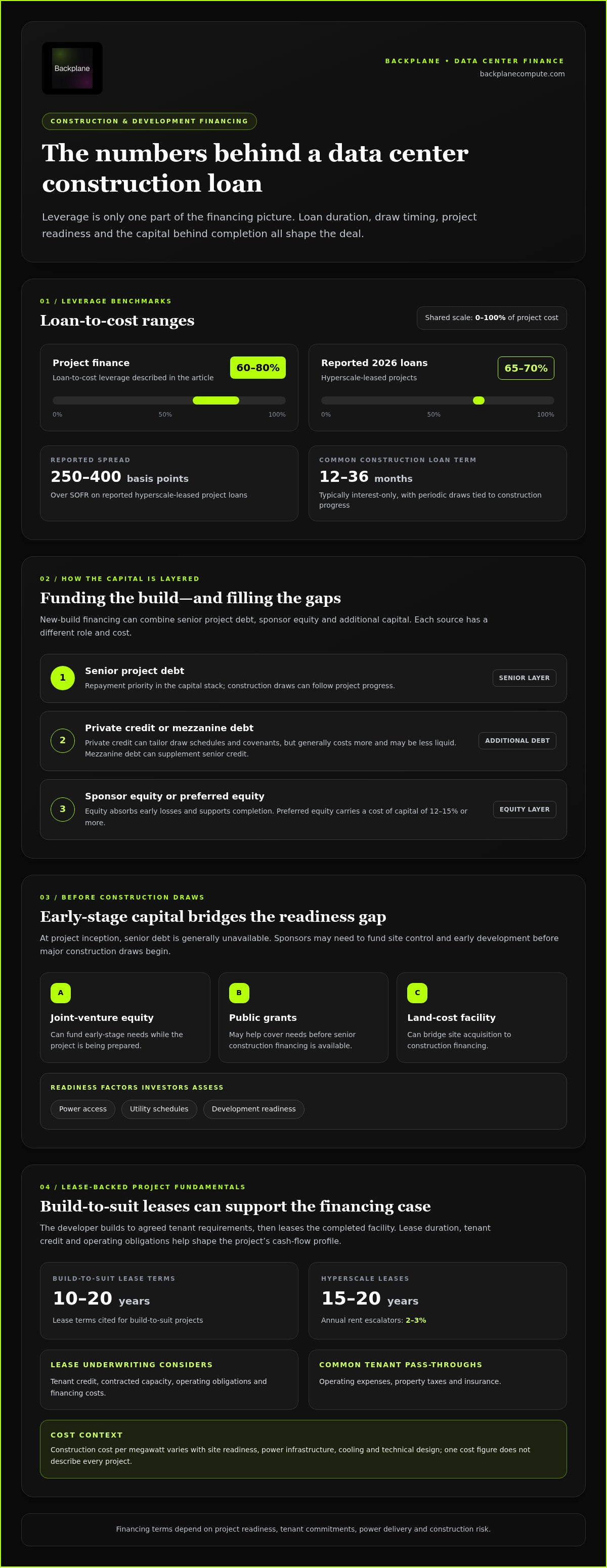
For data center build-to-suit financing, construction loans commonly run 12 to 36 months, with interest-only payments and periodic draws tied to construction progress. Project finance can support loan-to-cost leverage of 60% to 80%, though the structure depends on the project’s lease, power plan, and construction risk.
That range is only a starting point. A preleased facility with a creditworthy anchor tenant can have a different risk profile from a speculative build. Lenders assess more than the real estate: they also weigh utility commitments, delivery schedules, contractor capacity, equipment lead times, contingency reserves, and the sponsor’s ability to cover completion risk.
This article explains typical construction loan terms, how project finance separates project cash flows from a sponsor’s balance sheet, and how debt and equity fit into capital stacks for new builds and existing assets. It also covers specialized data center underwriting, so you can see which project fundamentals shape leverage, recourse, and financing structure.
Key Takeaways
- Assess construction debt by its term, draw schedule, and sponsor obligations, not just its headline leverage. Private credit may offer more flexibility, while mezzanine financing can fill a gap above senior debt.
- Project finance ties repayment to the facility’s projected cash flows. Technology changes can affect tenant demand and refinancing prospects, so the project’s ability to remain useful matters beyond construction completion.
- New builds and operating assets call for different capital stacks: construction risk shapes early funding, while stabilized cash flows can support securitization or REIT-style capital.
- Strengthen an underwriting case by connecting power delivery, construction execution, tenant resilience, and re-leasing prospects to the project’s ability to repay.
What are typical data center construction loan terms?
Construction loans fund development before a facility generates operating cash flow. Terms depend on project readiness, tenant commitments, power delivery, and construction risk.
Construction and Development Financing
Construction and development financing combines project debt and equity to fund a facility through completion. Data center construction loans commonly run 12 to 36 months, with interest-only payments and periodic draws tied to progress. Project finance can reach 60% to 80% loan-to-cost. Reported 2026 loans for hyperscale-leased projects provide 65 to 70 percent of project cost, with spreads of 250 to 400 basis points over SOFR. Private credit can tailor draw schedules and covenants, but generally costs more and may be less liquid. Mezzanine debt can supplement senior credit; preferred equity carries a cost of capital of 12-15% or more. Modular or prefabricated components still need to fit the construction budget and draw milestones.
Land and Pre-Construction Capital
Land and pre-construction capital fund site control and early development work before major construction draws begin. At project inception, senior debt is generally unavailable, so sponsors may use joint-venture equity or public grants to cover early-stage needs. A land-cost facility can bridge site acquisition to construction financing, while investors assess power access, utility schedules, and development readiness. These commitments matter because delays can tie up capital before the facility generates revenue. For operators, aligning land funding with the construction plan helps limit gaps between acquisition, infrastructure work, and loan availability.
Build-to-Suit Costs, Leases, and Returns
Build-to-suit financing funds a facility designed around a tenant’s requirements, with repayment supported by project cash flow and lease income. U.S. construction costs per megawatt depend on site readiness, power infrastructure, cooling, and the facility’s technical design, so a single cost figure would not describe every project. Lease rates and returns likewise hinge on tenant credit, contracted capacity, operating obligations, and financing costs. Build-to-suit projects can have 10-20 years of lease terms; hyperscale leases typically run 15 to 20 years, with annual rent escalators of 2% to 3%. These leases commonly pass operating expenses, property taxes, and insurance to tenants. The developer builds to agreed requirements, then leases the completed facility to the tenant.
What is data center project finance?
Project finance funds a facility through a dedicated entity, with repayment tied primarily to projected project cash flow rather than the sponsor’s corporate balance sheet. Developers use this structure to align infrastructure investment, tenant leases, and operating revenue within a defined financing plan.
That separation makes technology obsolescence a core underwriting concern. A facility can remain physically sound while its power density, cooling systems, or network configuration fall behind tenant requirements. Lower demand or an anchor tenant’s departure can weaken cash flow just as a loan matures. Investors therefore assess whether equipment can be upgraded, capacity reconfigured, and replacement tenants attracted to the site.
Operational facilities can refinance through asset-backed securities (ABS) or commercial mortgage-backed securities (CMBS). ABS issuance has been active since 2018, and typical deal size was around $600 million as of mid-2026. Data center ABS issuance reached about $27 billion in 2025. KBRA reported more than $48 billion across 88 transactions as of mid-2025. Morgan Stanley estimated ABS and CMBS could finance approximately $150 billion of data center investment through 2028.
For a stabilized asset, securitization can convert contracted leases and operating cash flow into financing. The borrower’s position depends on tenant credit, occupancy, asset performance, and debt maturity. As of mid-2026, typical data center ABS financing had a five-year anticipated repayment date. That timing makes refinancing exposure important well before maturity, especially if computing demand or equipment requirements shift during the loan term.
Takeout planning should connect construction completion to a clear operating and refinancing path. Developers can model permanent debt, securitization, or corporate financing against lease duration, tenant concentration, and upgrade needs. Stress-testing a weaker tenant or obsolete infrastructure scenario shows how much cash flow remains available for debt service. A tailored project financing structure can align funding with those asset-level risks.
Capital stacks for new builds versus existing assets
A new-build capital stack funds development risk before the facility generates operating cash flow. A typical structure can combine senior project debt, sponsor equity, and private credit or preferred equity. Each layer has a different position: senior lenders have repayment priority, while equity absorbs early losses and supports completion. The mix depends on leases, construction readiness, and the project’s path to stable operations.
For build-to-suit financing, the developer or a project-specific entity commonly owns the facility, while the tenant leases its capacity. The owner arranges capital through debt and equity, and the tenant’s lease can support lender underwriting. Compared with owning an existing facility, a new build brings construction and delivery exposure. Leasing an existing site avoids funding its construction, while ownership requires capital for acquisition and future upgrades. Compare total funding needs, lease obligations, and operating control.
Existing assets can support a different capital stack once stabilized and producing cash flow. Data center asset-backed securities (ABS) and commercial mortgage-backed securities (CMBS) can turn portfolio cash flows into financing. ABS or REIT-style capital may suit platforms with diverse customers and standardized facilities across multiple cities. Institutional investors can then assess a portfolio rather than underwrite each development as a standalone construction project. Tenant mix, lease performance, and operating consistency shape that assessment.
Warehousing provides interim capital while developers assemble assets or prepare them for permanent financing. A warehouse facility can hold eligible loans or properties until a portfolio reaches a scale or operating profile suited to a takeout. The permanent capital plan should identify the intended exit, such as refinancing stabilized assets through ABS, CMBS, or a REIT-style vehicle. Lenders assess whether cash flow, leases, and asset performance can support that transition. If assets perform unevenly across markets, structuring a portfolio-wide takeout may be harder.
Build-to-suit financing funds construction through debt and equity, with the tenant’s lease supporting lender underwriting and the project carrying construction and delivery exposure. Leasing an existing site avoids construction funding, while owning one requires capital for acquisition and future upgrades. The comparison also depends on lease obligations and operating control.
Specialized data center underwriting
Data center underwriting tests whether power, tenants, construction, and revenue can support debt through operations. Hyperscale projects often depend on a single anchor tenant, so lenders examine lease strength, tenant concentration, and exposure to default or early termination. They also consider whether a purpose-built campus could attract replacement tenants if vacant. A strong tenant rating helps, but does not remove re-leasing risk or guarantee projected revenue.
Power is a financing condition, not a background utility detail. Lenders assess utility commitments, delivery schedules, and contingency plans because delayed power can postpone revenue while construction obligations continue. Zoning and permitting affect whether the planned campus can proceed on schedule; tax incentives can influence projected project economics and capital needs. Together, these factors shape lender confidence, leverage, and funding availability. A site with land but uncertain power delivery presents a different credit case from one with committed service and a viable backup plan.
Construction underwriting also tests execution. Lenders review contractor strength, equipment lead times, and contingency reserves against the development budget. For senior bank debt, 40 or more ASNs can be a gating item in financing comparisons. That network criterion sits alongside, not in place of, power capacity, tenant credit, and project readiness. Underwriting should connect each risk to a mitigation: documented utility commitments, credible construction planning, or lease protections that support cash flow.
Build-to-suit analysis must also account for a tenant’s ability to use the delivered facility as designed. Hyperscale specifications can make re-leasing harder if another operator needs different capacity or infrastructure. Model anchor-tenant default and early termination against the remaining debt, then assess realistic re-leasing prospects. That scenario reveals whether leverage depends on one contract or on durable asset demand. Use a property viability and financing assessment to align site constraints with the project’s underwriting case.
Backplane: GPUs-as-a-Service
Backplane connects AI compute demand with powered industrial sites through AI compute infrastructure brokerage, financing, and compute access. Organizations that need GPU capacity without waiting for hyperscaler queues can access it directly through GPUs-as-a-Service. Buyers seeking dedicated infrastructure can consider Dedicated Financed Sites. Each option addresses a different capital and operating requirement.
For site owners and developers, a Property Viability Assessment evaluates whether an underused asset, such as a retired power plant or closed mill, can support conversion into a GPU farm. Infrastructure Financing Structuring helps shape financing around the project. The right path depends on whether your priority is compute access, a dedicated site, or assessing and financing an asset for conversion.
Contact Backplane to discuss the financing or compute path that fits your project.
Turn the Financing Thesis into an Executable Plan
The next step is to turn underwriting assumptions into decisions that hold up under pressure. Map how power delivery, tenant requirements, construction milestones, and financing obligations interact. Then identify which decisions need to be fixed early and which can remain flexible as the project advances. This alignment can help prevent a promising site from becoming a capital structure built around untested assumptions.
For data center build-to-suit financing, the central question is not simply whether capital is available. It is whether the ownership model, operating plan, and financing stay aligned as the facility moves from development into service. A disciplined financing plan gives stakeholders a shared basis for evaluating tradeoffs, timing, and exposure before commitments narrow their options.
If you’re ready to assess the financing path for a site or project, contact Backplane to discuss financing. A clear plan is the first step toward moving infrastructure from concept to execution.
Frequently Asked Questions
What financing options are available for data center build-to-suit projects?
Projects can combine senior construction debt with sponsor equity, private credit, mezzanine debt, or preferred equity. At inception, joint-venture equity or public grants may fund early development before senior debt is available. For example, a sponsor might use equity to advance site preparation, then introduce construction debt as the project becomes financeable. Once operating cash flow is established, ABS or CMBS can provide a potential takeout route.
What credit, preleasing, and tenant requirements do lenders impose?
Lenders focus on whether the lease and tenant can support repayment through construction and operations. They assess tenant credit quality, concentration, lease obligations, and the consequences of default or early termination. Preleasing can strengthen financing terms, while sponsor support may also matter: project lenders can require completion, cost-overrun, or construction-period debt-service carry guarantees. These obligations affect the sponsor’s liquidity needs beyond the initial equity contribution.
What are the major risks in data center build-to-suit financing?
The main risks are delayed power, construction overruns, tenant loss, technology obsolescence, and refinancing exposure. Each can reduce revenue or increase the capital needed to complete and operate the facility. Sponsors should model different interest-rate scenarios and include hedging costs in project analysis, particularly if construction takes longer. A lender may also require guarantees or partial recourse, especially when the development lacks a committed tenant.
How do data center build-to-suit financing costs compare with owning or leasing existing facilities?
Build-to-suit financing covers construction through debt and equity and carries construction and delivery risk. Costs vary with site readiness, power infrastructure, cooling, design, and financing terms. Leasing an existing facility avoids construction funding, while owning one requires capital for acquisition and future upgrades. Compare total funding needs, lease obligations, and operating control.


