

U.S. data centers consumed 176 terawatt-hours of electricity in 2023, equal to 4.4% of total U.S. electricity consumption, according to the U.S. Department of Energy. The data center power requirements behind that load involve both the facility’s peak electrical capacity and the energy it uses over time. The Department estimates annual consumption could reach as much as 580 TWh in 2028.
Rising demand puts power availability at the center of data center planning. A site’s usable capacity, cooling needs, and IT load determine how much electricity it must secure, and how much of that supply can go to computing rather than facility overhead.
This article explains how to distinguish power demand from energy use, what drives data center consumption, and how U.S. demand is projected to change. It also shows how these requirements shape site viability and infrastructure decisions, helping you assess the gap between a facility’s available power and the compute capacity it can support.
Key Takeaways
- Separate a facility’s peak power capacity, measured in MW, from the electricity it consumes over time; each answers a different planning question.
- Assess IT load and cooling together to understand where a data center’s energy use goes and which infrastructure constraints shape demand.
- Compare a site’s available power with its intended compute load to identify whether its capacity can support the planned operation.
- When power access or site viability is the constraint, Backplane’s Property Viability Assessment and GPUs-as-a-Service can help connect infrastructure needs with compute capacity.
Data center energy-use breakdown
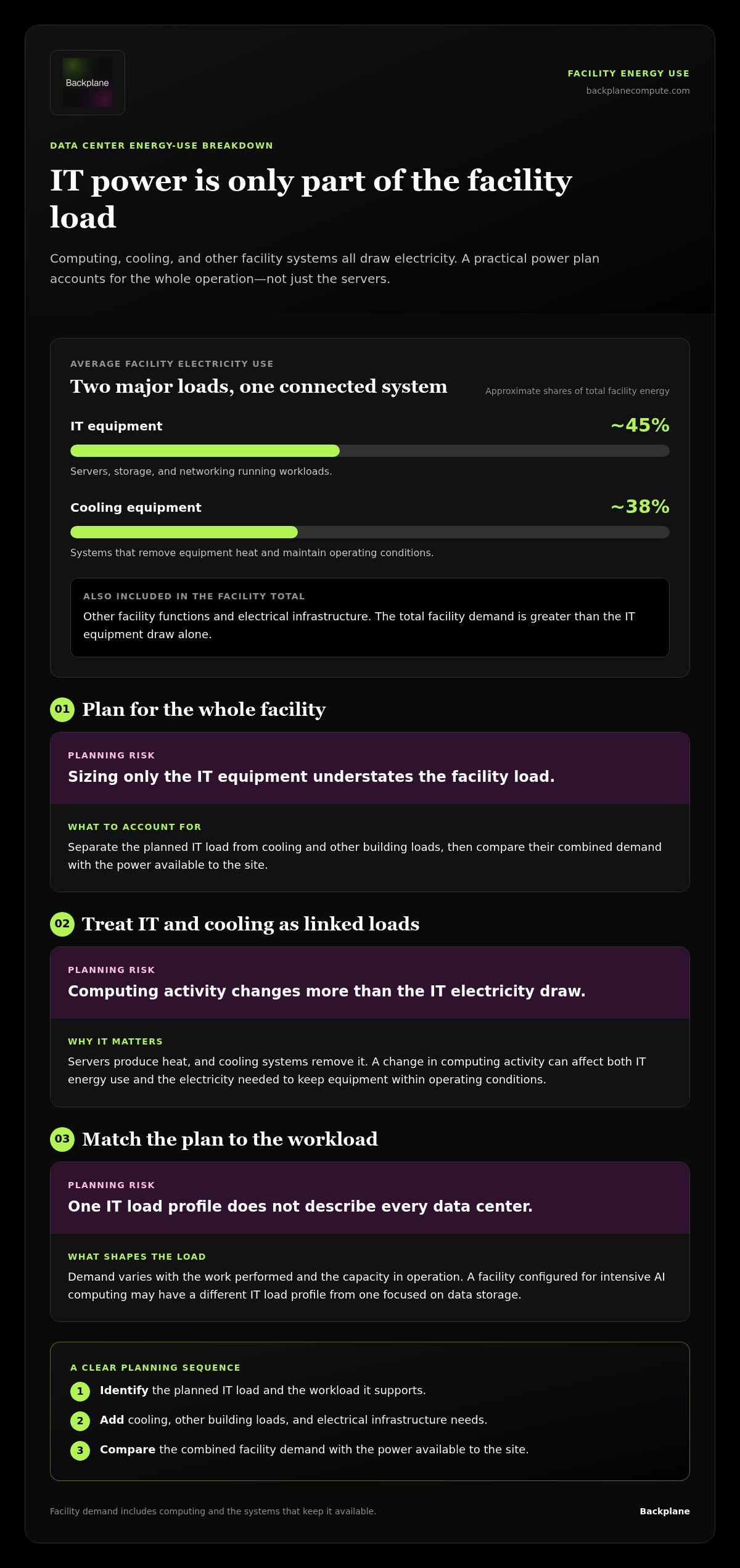
An average data center’s electricity use is split between computing and the systems that keep computing available. IT equipment typically consumes about 45% of facility energy. Cooling equipment accounts for about 38%. These loads interact: servers produce heat, and cooling systems remove it. The breakdown shows why a power plan cannot size IT equipment alone.
The IT share covers equipment running workloads, including servers, storage, and networking. Demand varies with the work performed and the capacity in operation. For example, a facility configured for intensive AI computing may have a different IT load profile from one focused on data storage. In both cases, the equipment’s electrical draw becomes heat that the facility must manage.
Cooling’s 38% share reflects the energy required to control that heat. Cooling demand is connected to the IT load, but it is also shaped by the facility’s design and operating conditions. A change in computing activity can therefore affect two parts of the energy profile: electricity used by IT equipment and electricity used to keep equipment within operating conditions.
The rest of the electricity supports facility functions and electrical infrastructure. These loads matter because total facility demand exceeds the draw of IT equipment alone. For a practical assessment, separate the planned IT load from cooling and other building loads, then compare their combined demand with the power available to the site. This helps clarify whether a capacity figure describes computing equipment or the entire facility.
Energy use also connects to emissions, though the two measures are not interchangeable. Data centers emitted about 105 million metric tons of carbon emissions in 2023. In the United States, data centers emitted 31.5 million metric tons of greenhouse gas emissions in 2018. These figures describe different years and scopes. The energy breakdown helps operators identify where electricity is consumed; emissions also depend on the electricity supplying the facility.
Projected data center power demand
U.S. data center demand is projected to rise sharply, putting more pressure on electricity grids. This outlook affects capacity planning, infrastructure design, and the timing of new facilities.
The U.S. Department of Energy estimates that data centers could consume as much as 580 TWh annually in 2028. U.S. data center electricity demand is projected to reach up to 130 GW, or 1,050 TWh, in 2030, close to 12% of annual U.S. demand. These projections describe different years and measures. GW indicates power capacity or demand at a point in time; TWh measures electricity consumed over time. Grid demand growth matters because data centers must secure power alongside other users. A rising regional load can make available capacity, utility upgrades, and connection timing central to a project’s viability.
Rack Power and Density Trends
Rack power is the electrical load required by the equipment in a server rack. Rack density describes how much computing equipment, and therefore electrical demand, is concentrated in that space. Higher-density deployments can concentrate more load in a smaller footprint, shaping power distribution and cooling design. For example, an AI computing deployment may need a different rack-level plan from a storage-focused installation. Evaluate rack configuration alongside the facility’s total IT load, not in isolation.
Electrical Infrastructure Needs
Data center electrical infrastructure carries utility power through equipment such as utility feeds, transformers, and substations to the facility’s distribution systems. The required configuration depends on the site’s load, utility connection, and resilience design. Applicable permits and electrical codes vary by jurisdiction; utility interconnection requirements and reliability standards also shape design and approval. Electricity prices per kWh vary by region and contract, reflecting local tariffs and supply conditions; compare the applicable rate structure rather than assuming one national price. Projects with financing needs can consider infrastructure financing structuring as part of planning.
Grid Connections and Power Risks
Grid connection times in the United States depend on utility capacity, required network upgrades, approvals, and construction sequencing. No single timeline applies to every site. Power shortages can limit how much computing equipment a facility can run; outages interrupt service, while grid constraints can delay commissioning or restrict expansion. Assessing available supply and infrastructure needs early helps establish whether a site can support its intended load before development advances.
U.S. data center electricity consumption
U.S. data centers consumed 176 terawatt-hours of electricity in 2023, equal to 4.4% of total U.S. electricity consumption, according to the U.S. Department of Energy. This national figure captures electricity consumed across facilities, not the demand profile of one building. For operators, the distinction matters: annual energy use describes total consumption, while power demand describes the load a facility must support at a given time.
Earlier figures show how that footprint has grown. U.S. data centers used about 11 GW of power in 2018 and accounted for 1.9% of annual U.S. electricity consumption that year. By 2022, they collectively consumed about 17 gigawatts of power. These figures use different measures and years, so they should not be treated as a direct year-over-year comparison. They do, however, show why facility scale and grid access have become central planning considerations.
Consumption is concentrated among larger facilities. Hyperscale and colocation data centers are responsible for 60-70% of all U.S. data center load, while small-scale data centers account for about 10%. That distribution means national totals do not describe every site equally. A large campus can have a very different load profile from a small enterprise facility, even though both contribute to the sector’s overall electricity demand.
The source of electricity also shapes the sector’s energy profile. Fossil fuels supplied 56% of electricity used by U.S. data centers from September 2023 to August 2024. This figure describes the reported supply mix for that period, not the energy use of a particular facility. Site-level consumption and electricity supply are separate inputs when assessing operations and emissions.
For planning, compare a facility’s expected IT load with its total electricity demand, including cooling and other building systems. Then examine how that load fits the site’s available utility capacity. A national figure such as 176 TWh provides scale; local infrastructure determines whether a specific project can draw the power it needs.
Looking ahead, the Electric Power Research Institute estimates that data centers could consume up to 9% of U.S. electricity generation annually by 2030, a projection that underscores the importance of evaluating future grid capacity alongside current site requirements.
How much power does a typical data center use in MW?
No single MW figure represents a typical data center. Data center power requirements vary with facility scale, IT equipment, cooling systems, and operating load. MW measures power demand at a given moment, while TWh measures electricity consumed over time. A small enterprise data room and a large AI compute campus are not equivalent examples.
Start with the planned IT load: the electricity servers, storage, and networking equipment require. Then account for cooling and other facility systems to estimate total site demand. That figure represents the facility’s power requirement, not just the rating of its computing equipment. The distinction matters when comparing a site’s electrical capacity with the load its planned operations will place on it.
Workload mix changes the demand profile. An AI-focused facility may concentrate computing equipment and heat differently from a storage-oriented site. Cooling design must match the heat produced by the IT load. Operating patterns matter, too: equipment running continuously creates a different demand profile from systems used intermittently.
Compare three values during planning: IT equipment load, full facility load, and power available to the site. Keep each value in MW to make a clear capacity comparison. Use TWh separately to evaluate total electricity consumption over a period. This prevents an annual energy figure from being mistaken for the instantaneous capacity a facility needs.
Before assessing site capacity, translate the proposed compute plan into expected electrical demand, including cooling and supporting infrastructure. Data center power requirements are project-specific, not a universal industry average. If planned demand exceeds available power, the gap affects how much equipment can operate and whether the site can support the intended deployment.
Assess site power viability against the planned IT load, cooling demand, and available electrical capacity before committing to a facility.
Backplane: GPUs-as-a-Service
Backplane connects compute demand with powered infrastructure through GPUs-as-a-Service and Dedicated Financed Sites. If your project needs GPU capacity without waiting for a dedicated site, GPUs-as-a-Service offers direct access to compute. If you need infrastructure aligned with a specific deployment, a Dedicated Financed Site may be a better fit.
For site owners and project teams assessing power availability, Backplane’s Property Viability Assessment helps determine whether an asset can support data center use. Infrastructure Financing Structuring addresses the capital framework for converting viable infrastructure into operational capacity. These services are useful when grid access, site suitability, or project financing shapes the next decision.
To discuss your compute or infrastructure needs, contact Backplane.
Turn power planning into a viable project
The next step is to turn a demand estimate into an executable plan. Align the computing objective with the site’s available power, infrastructure, and development path. This makes data center power requirements a strategic input, not just a technical specification. It helps decision-makers identify capacity constraints and determine which assumptions should guide the project.
Compute buyers may prioritize access to GPU capacity, while site owners may need to establish whether an asset can support data center operations. The right path depends on the project’s stage and what needs to happen next. A clear view of those needs provides a stronger basis for moving forward.
Contact Backplane to discuss your power needs and consider the next step for your project. With a defined direction, power constraints become part of the plan you can act on.
Frequently Asked Questions
What permits, codes, and reliability standards apply to data center power systems?
Applicable permits and electrical codes vary by jurisdiction. Utility interconnection requirements and reliability standards also shape system design and approval.
How much does data center electricity cost per kWh in the United States, by region?
Electricity prices per kWh vary by region and contract, reflecting local tariffs and supply conditions. Compare the rate structure that applies to the site.


