

The monthly payment is only half the decision. Financing for GPU infrastructure commonly runs from 1 to 4 years, with GPU loans often structured as equal monthly payments covering principal and interest. The investment must also generate enough value to justify those borrowing costs.
That calculation can be difficult when hardware, power, site readiness, and expected compute demand all affect project economics. The financing structure matters too: loans, leases, and equity have different ownership and risk trade-offs. This guide explains how to prepare a financing application, what funders assess, and how to compare projected infrastructure returns with the full cost of capital. It also covers estimating monthly loan payments and weighing GPU ownership against alternatives such as cloud compute. The aim is a clear decision framework based on project viability, not headline financing terms.
Key Takeaways
- Build an application around the project’s hardware needs, site readiness, power capacity, and repayment plan.
- Compare expected infrastructure revenue with borrowing costs before committing capital.
- Separate principal from interest to understand the full monthly payment and compare it with equivalent cloud compute.
- Weigh ownership and depreciation under a loan against leasing or raising equity, which carry different trade-offs.
Application, review, and funding process
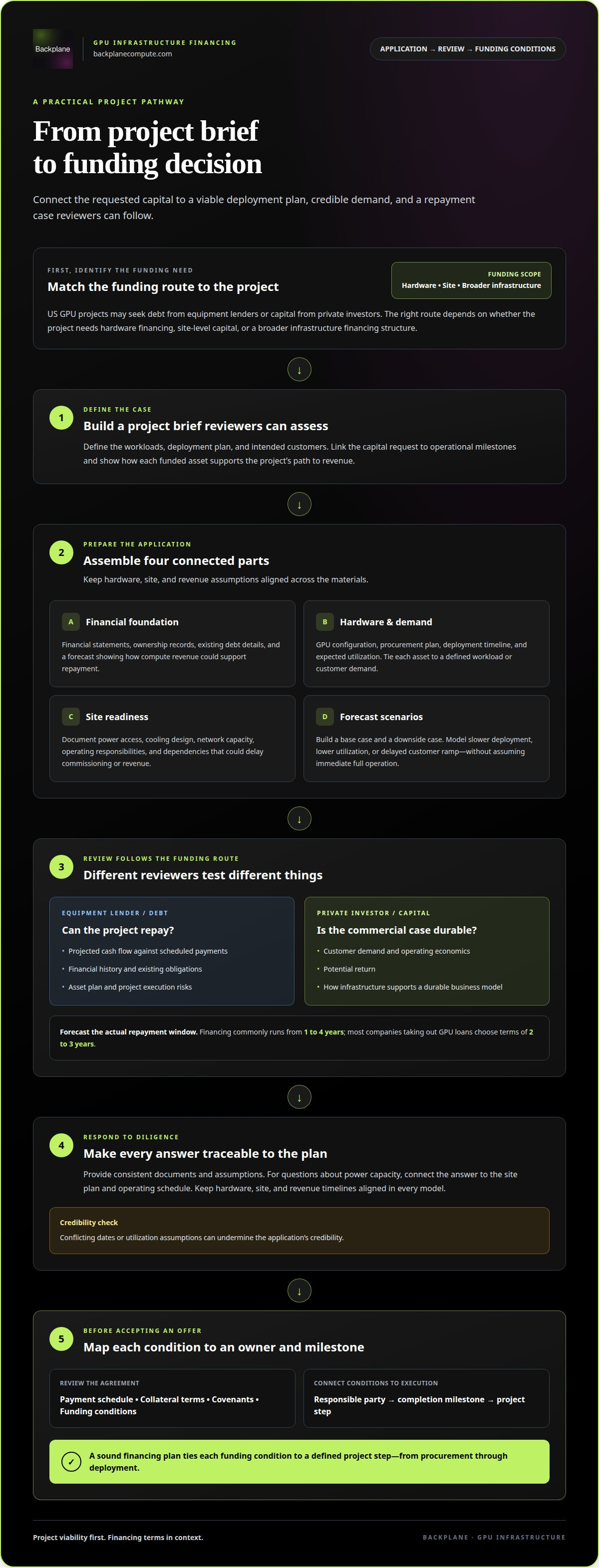
US GPU projects can seek debt from equipment lenders or capital from private investors. Lenders assess repayment capacity; investors assess the commercial case and potential return. The right funding route depends on whether the project needs hardware financing, site-level capital, or a broader infrastructure financing structure.
Start an application for financing for GPU infrastructure with a project brief that defines the workloads, deployment plan, and intended customers. Then connect the requested capital to operational milestones. Showing how each funded asset supports the project helps reviewers assess its path to revenue.
- Prepare financial statements, ownership records, existing debt details, and a forecast showing how compute revenue could support repayment.
- Describe the GPU configuration, procurement plan, deployment timeline, and expected utilization. Connect each asset to a defined workload or customer demand.
- Document site readiness, power access, cooling design, network capacity, and operating responsibilities. Explain dependencies that could delay commissioning or revenue.
- Build a base case and a downside case. Model slower deployment, lower utilization, or delayed customer ramp without assuming immediate full operation.
During review, lenders examine whether projected cash flow can carry scheduled payments. They also assess the borrower’s financial history, existing obligations, asset plan, and project execution risks. Investors focus on demand, operating economics, and how the infrastructure supports a durable business model. Most companies taking out GPU loans choose repayment terms of two to three years, so the forecast should reflect the repayment period.
Respond to diligence requests with consistent documents and assumptions. If a reviewer asks how power capacity supports deployment, connect the answer to the site plan and operating schedule. Keep hardware, site, and revenue timelines aligned across every model. Conflicting dates or utilization assumptions can undermine the application’s credibility.
Before accepting an offer, review the payment schedule, collateral terms, covenants, and conditions for funding. Map each condition to a responsible party and a completion milestone. Sound financing for GPU infrastructure connects each funding condition to a defined project step, from procurement through deployment.
GPU infrastructure projects in the US can seek debt from equipment lenders or capital from private investors. The right funding route depends on whether the project needs hardware financing, site-level capital, or broader infrastructure financing. For UK businesses and limited companies seeking commercial debt or asset funding, services like Lending Box help match applicants with whole-of-market financing options to support their operational plans.
Assessing infrastructure returns against borrowing costs
Test projected operating returns against the full cost of funding. Compare financing options using equivalent compute capacity, deployment timing, and utilization.
Total Cost Comparisons
Compare GPU leasing, loans, cloud rentals, and outright purchases for the same workload and operating period. Include financing charges, power, site operations, maintenance, and expected utilization, not just acquisition cost. A loan gives the borrower hardware ownership but also leaves them carrying depreciation risk. Leasing and cloud rentals can offer alternatives to owning hardware, but their costs and allocation of risk vary. Match each option to demand certainty and control needs.
Tax Incentives and Depreciation
US tax effects depend on whether the business owns or leases the hardware and how the asset is classified. Ownership and lease structures can therefore receive different depreciation treatment. Don’t include a projected incentive in the base case without support. First model operating returns before tax, then assess tax effects separately against the company’s actual structure and applicable rules. This helps prevent expected tax treatment from obscuring weak project economics.
Build and Purchase Costs
That hardware figure is only one part of a build budget. Account separately for site readiness, power delivery, cooling, networking, and installation, since each can affect capital needs and deployment timing. Compare a purchase with a complete infrastructure plan, not just an equipment quote. Then test whether expected utilization and customer demand can support operating expenses as well as borrowing costs.
Financing Risks
Hardware obsolescence can reduce utilization or pricing power before a loan is repaid. Power costs can also compress operating returns, especially when usage or site efficiency differs from the forecast. Stress-test lower utilization, higher operating expenses, and delayed deployment together. Check whether projected cash flow still covers scheduled debt payments. For projects involving site conversion, infrastructure financing structuring can help align capital needs with the asset plan.
Monthly principal and interest payments
GPU loans often use equal monthly payments covering principal and interest. Each payment reduces the outstanding balance while covering interest under the loan agreement. The principal and interest shares change over the repayment schedule, so the payment amount alone doesn’t show how quickly the balance falls. Review the lender’s amortization schedule alongside the monthly payment.
To estimate a standard payment, use the principal, monthly interest rate, and number of monthly payments. The amortization formula is: payment = P × r ÷ (1 − (1 + r)−n). Here, P is the amount borrowed, r is the monthly interest rate, and n is the total number of payments. Use the agreement’s rate and term, not an assumed market figure.
Check these items in the lender’s schedule:
- Principal: Confirm the financed amount and any project costs included in the loan.
- Interest: Identify the rate, how it applies to the balance, and whether the agreement allows rate changes.
- Payment timing: Record the first due date and each recurring monthly due date.
- Additional charges: Include any disclosed fees or required payments when calculating the all-in monthly outlay.
Then compare the all-in loan payment with cloud compute for equivalent capacity. Keep the workload, capacity, and operating period consistent. A cloud quote for a different capacity won’t provide a useful comparison. Compare the loan payment and relevant operating expenses with cloud charges for the same compute requirement. This focuses the decision on equivalent service, not financing terms alone.
Finally, test the payment against projected cash flow. Map expected customer receipts and operating expenses against each monthly due date. A gap between deployment and revenue can strain cash even when the project’s long-term economics look positive. Model delayed utilization separately, then assess how much operating cash remains after scheduled debt payments. Use that result to decide whether the repayment schedule fits the project’s revenue ramp and operating plan.
What financing options are available for GPU infrastructure in the US?
US projects can use equipment loans, leases, cloud rentals, or equity. GPU infrastructure financing terms range from 1 to 4 years. Equipment loans commonly have terms of two to four years. Some lenders offer an initial interest-only period.
- Equipment loan: The borrower owns the hardware from day one and pays interest. The borrower also carries depreciation risk. Compare the repayment schedule with the expected operating life and revenue ramp.
- Lease: The lessee pays to use hardware owned by another party. The leasing company carries the hardware’s depreciation risk. Compare the lease payments and terms with the value of ownership and the project’s planned usage.
- Cloud rental: The business pays to access compute capacity rather than buying the hardware. Compare the all-in rental cost with owning or leasing equivalent capacity. This can suit demand that is uncertain or changes over time.
- Equity: An equity raise exchanges a permanent percentage of company ownership for capital. Hardware debt costs interest instead of company ownership. Compare the long-term cost of dilution with the debt service the project can support.
Choose a capital structure that fits demand certainty, cash flow, and control. A loan may suit a project with a defined hardware plan and the capacity to repay. A lease shifts depreciation exposure. Cloud access avoids hardware ownership, while equity avoids scheduled loan payments but dilutes ownership.
Early-stage companies with limited financial history may find it harder to qualify for GPU loans or may face higher rates. They should model both debt service and ownership dilution before choosing a path. Compare total funding needs, project revenue timing, and asset control, not just the initial payment.
For a site-based project, align the capital structure with the site, hardware, and deployment plan. Build a capital plan for your GPU project around those requirements.
GPU borrowers own the hardware and bear depreciation risk. Lessees use someone else’s hardware and transfer that risk. Equity investors receive an ownership stake, while hardware debt requires interest payments instead.
Backplane: GPUs-as-a-Service
Backplane connects compute demand with GPU infrastructure through GPUs-as-a-Service and Dedicated Financed Sites. Teams that need compute capacity without developing a site can access GPUs through GPUs-as-a-Service. Operators pursuing dedicated infrastructure can use Dedicated Financed Sites, with financing structured for the build-out.
Project economics still come first. A Property Viability Assessment evaluates whether an underused industrial asset can support a GPU farm. Infrastructure Financing Structuring aligns capital needs with the site and deployment plan. These services fit projects where the challenge extends beyond hardware to the powered location and financing needed to put infrastructure into operation.
Contact Backplane to discuss the path that fits your GPU infrastructure plans.
Turn the financing decision into a project plan
The next step is to turn financing assumptions into a decision your operating team can execute. Align the capital plan with deployment priorities, site requirements, and the workloads that will use the compute. This gives finance and infrastructure teams a shared basis for moving forward.
Before advancing, assign responsibility for key assumptions: demand forecasts, site readiness, deployment sequencing, and the level of GPU access required. Clear accountability keeps the financing plan connected to operational reality. It also gives stakeholders a practical framework for reviewing financing for GPU infrastructure as the project develops.
Backplane can help teams assess a site’s viability and determine a path suited to their infrastructure needs. Contact Backplane about GPU financing to discuss your project and its next steps.
Start with a defined plan, then move forward with clarity.
Frequently Asked Questions
What collateral, credit requirements, and down payments do GPU equipment loans require?
Lenders set collateral and down-payment terms through underwriting. For a GPU equipment loan, they may assess the hardware being financed, the company’s credit history, existing obligations, and ability to repay. Prepare a clear asset schedule showing the equipment and how it supports operations. Strong project documentation can help explain the business case, particularly when the company has limited operating history.
How can a business estimate GPU infrastructure ROI and debt-service coverage?
Estimate ROI by comparing projected operating returns with total project investment over the same period. To assess debt-service coverage, divide cash available for debt payments by scheduled principal and interest. For example, forecast compute revenue, subtract power and operating expenses, then compare the remainder with scheduled payments. Run separate scenarios for slower customer demand or lower utilization to see how repayment capacity changes.
What steps and documents are needed to apply for GPU infrastructure financing?
Prepare a financing package that connects the requested capital to a specific deployment plan. Include a GPU vendor quotation, company financial statements, ownership structure, customer contracts or other evidence of demand, and documentation for the proposed site and power arrangements. Add a deployment schedule showing dependencies such as equipment delivery and site readiness. Keep assumptions consistent across the financial model, procurement plan, and customer materials.


