

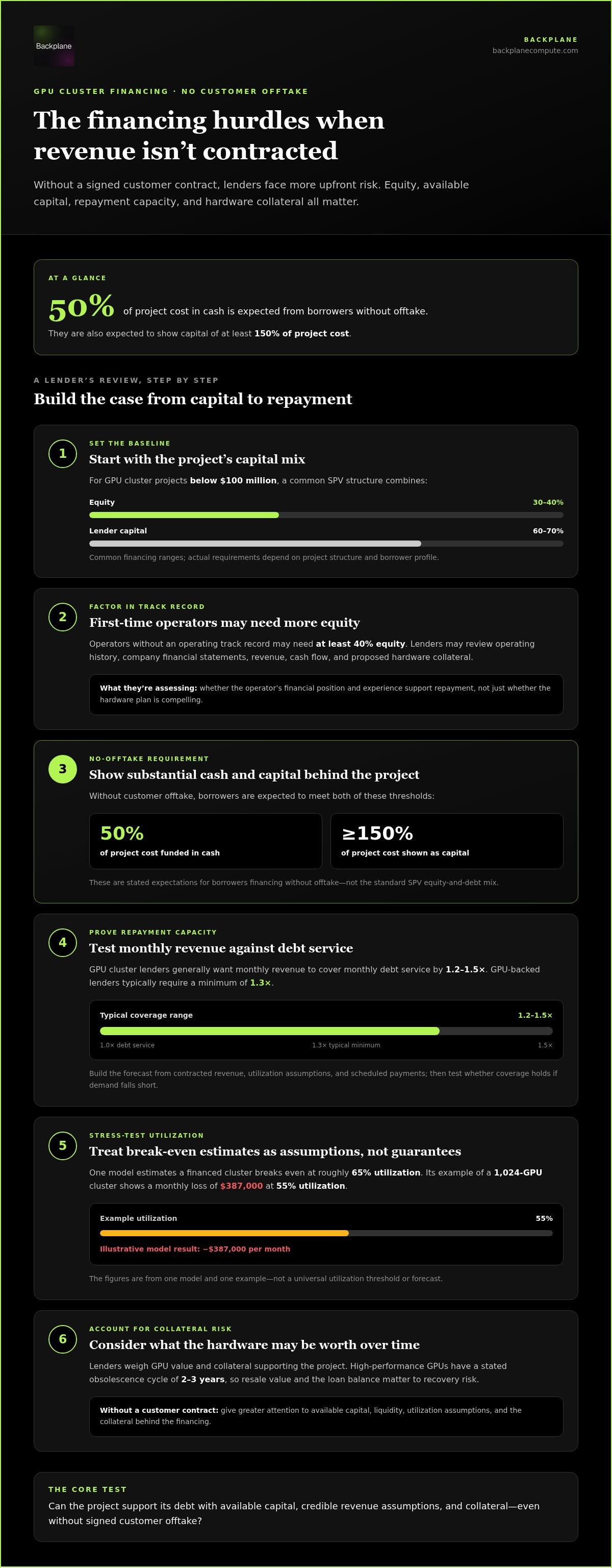
Without customer offtake, GPU cluster financing demands more than a compelling hardware plan. For projects below $100 million, dedicated GPU cluster financing commonly combines 30-40% equity with 60-70% lender capital through an SPV. First-time operators may need at least 40% equity; without offtake, borrowers are expected to fund 50% of project cost in cash and show capital of at least 150% of project cost.
A signed customer contract can strengthen a financing case, while a cluster without one carries more risk upfront. Equity is only one part of the decision. Interest, loan structure, repayment timing, deployment milestones, and GPU resale risk all affect whether the project can support its debt.
This article explains equity requirements, financing costs and terms, how timelines compare with traditional loans, and what changes when customer offtake is absent. Learn which factors lenders weigh and how to assess financing against your cluster’s revenue plan and deployment schedule.
Key Takeaways
- Compare the full financing structure, not just the interest rate: credit strength, GPU value and recourse terms can all move the cost.
- Choose between a loan and a lease with ownership and depreciation risk in view, then match repayment timing to the deployment plan.
- Strengthen the financing case with credible utilization and revenue assumptions, operating history, and a clear picture of customer concentration.
- Without customer offtake, put greater focus on available capital, liquidity and the collateral supporting the project.
Typical advance rates, down payments, loan terms, interest rates, and fees
GPU financing terms depend on collateral, operator credit, customer contracts, and expected cash flow. Compare the full repayment burden, not just the stated interest rate.
Advance Rates, Down Payments, and Fees
Asset-backed GPU SPV loans typically carry 60-70% loan-to-value, while equipment financing can advance 50-80% of equipment cost. That leaves a typical 20-30% down payment, though the project structure and borrower profile affect the equity requirement. Fees also shape closing capital: financing fees commonly run 1-3% of the loan, while some SPV facilities add monitoring and custody charges of 0.5-1%. Include each charge in the sources-and-uses plan.
Interest Rates and Loan Terms
GPU-backed private-credit SPV loans for non-hyperscale operators typically cost 8-15% a year before a credit track record exists. Non-recourse loans carry rates 2-3 percentage points above recourse structures. Senior debt is commonly priced at 12-15%, compared with 15-20% for mezzanine financing. GPU financing terms typically span 3-5 years, but rates vary with credit, hardware, and residual-value risk. Model the rate alongside fees and amortization.
Loan Tenor and Contract Alignment
Match the repayment period to contracted revenue and the useful earning life of the hardware. GPU offtake agreements typically run 3-6 years, while high-performance GPUs have a stated obsolescence cycle of 2-3 years. A longer loan may keep payments lower but extend debt beyond the strongest hardware value. A shorter tenor reduces that exposure but raises scheduled payments. Test both against contracted cash flow and replacement needs.
Repayment Schedules and Interest-Only Periods
Most GPU loans use equal monthly payments covering principal and interest. Some lenders allow interest-only payments during the first few months of deployment, easing early cash flow while hardware becomes operational. Compare the full scheduled payments with current cloud compute spending, expected utilization, and revenue generating capacity. A 1.3x minimum debt service coverage ratio is typical for GPU-backed lenders. Stress-test lower utilization too; cloud costs can flex with demand, while loan payments remain due.
GPU financing timelines compared with traditional loans
GPU-backed asset financing and SPV loans can align capital with equipment deployment. Approval still depends on the operator, collateral, revenue plan, and lender underwriting. Compare the financing timeline with hardware delivery and customer demand, not just the approval date.
Lease costs depend on the equipment, term, and residual-value assumptions. Compare the full payment schedule rather than assuming it matches a loan.
Traditional bank GPU financing typically takes 60 to 90 days for approval. Equipment leasing companies typically take 45 to 75 days. These timelines cover financing, not necessarily site readiness, procurement, or deployment. Build those workstreams in parallel so approval does not become the critical path.
Delayed-draw term loans release capital as equipment is needed instead of funding the full purchase upfront. This can reduce interest on undrawn capital, but draw conditions and deployment milestones matter.
GPU loans give the borrower ownership from the start and leave depreciation risk with the operator. A lease provides use of equipment owned by another party and transfers that depreciation risk to the leasing company. GPU loans for H100 or H200 clusters may be repaid over 2-4 years. Choose based on the purpose: owning hardware builds control, while leasing can shift residual-value exposure.
Map each funding route against approval time, draw timing, and the date compute revenue begins generating cash flow. Then compare scheduled payments with cloud capacity costs and committed contracts. For projects requiring coordinated site and capital planning, structured infrastructure financing can connect those requirements in one financing plan.
How much equity do you need to finance a GPU cluster?
For GPU cluster projects below $100 million, a common structure combines 30-40% equity with 60-70% lender capital through an SPV. First-time operators without a track record may need at least 40% equity.
Utilization and Lender Track Records
Utilization supports the revenue forecast behind a financing request. One model estimates a financed cluster breaks even at roughly 65% utilization; a 1,024-GPU example shows a monthly loss of $387,000 at 55%. Lenders also weigh operating history and signed customer demand. A single customer generating more than 40% of revenue may raise concentration concerns.
GPU-backed private-credit lenders, banks, and equipment-leasing companies may finance GPU servers through loans, leases, or SPV facilities. Lenders may review company financial statements, operating history, revenue, cash flow, and the proposed hardware collateral.
Debt Service Coverage Requirements
GPU cluster lenders generally want monthly revenue to cover monthly debt service by 1.2-1.5 times. GPU-backed lenders typically require a minimum debt service coverage ratio of 1.3x. Build the forecast from contracted revenue, utilization assumptions, and scheduled payments, then test whether coverage holds if demand falls short.
To apply, assemble financial statements, operating history, revenue and cash-flow records, hardware specifications, and signed offtake contracts. Present them together in a financing model so lenders can assess repayment capacity and collateral in one review.
Depreciation and Financing Costs
GPU depreciation affects collateral value and the lender’s view of recovery if the borrower defaults. High-performance GPUs have a stated obsolescence cycle of 2-3 years, so model resale value against the loan balance over time. Nvidia’s contribution of up to $2 billion to the equity of the xAI Colossus 2 SPV illustrates how equity can sit alongside debt in an infrastructure structure.
Section 179 expensing and bonus depreciation are potential tax benefits of GPU loans. Most business-use equipment placed in service during the tax year may qualify for Section 179 expensing, which can affect after-tax project economics but does not replace the debt-service plan.
Financing GPU clusters without customer offtake
Without customer offtake, the financing case lacks contracted revenue. The lender must instead assess the operator’s equity, liquidity, collateral, and ability to sell capacity after deployment.
For a GPU purchase without offtake, borrowers are expected to contribute 50% of project cost in cash and show funding or capital of at least 150% of project cost. Those requirements make an uncontracted build materially more demanding. They test whether the enterprise can absorb operating costs and debt payments while generating customers.
GPU-backed private-credit SPV facilities for non-hyperscale operators typically range from $20 million to $500 million. Without a signed customer contract, the financing case depends more heavily on the equipment’s collateral value, operator credit, cash reserves, and credible utilization assumptions. Lenders also assess the infrastructure plan, including whether the data center can support the proposed capacity.
That scale calls for a clear funding plan before procurement: identify equity sources, document available liquidity, and show how the cluster can generate revenue without relying on a single uncontracted enterprise prospect. A customer pipeline can inform projections, but it does not replace signed offtake.
Prepare a downside case alongside the base forecast. Show how debt service holds up if utilization ramps slowly, rental rates weaken, or hardware resale values fall. GPU fire-sale recovery could reach only 30% to 50% of face value in a default scenario, so collateral alone may not protect the lender. A credible record of operations and diversified demand can help strengthen the case.
If the project depends on converting a powered property into active compute infrastructure, explore dedicated financed sites as a financing path. Align the site, GPU capacity, equity, and customer strategy before committing to deployment.
Backplane: GPUs-as-a-Service
Backplane connects AI compute demand with powered industrial sites and financing pathways. If you need GPU capacity without building and financing a dedicated cluster, GPUs-as-a-Service provides direct access to compute. For buyers seeking dedicated infrastructure, Dedicated Financed Sites support the development of operational GPU farms without relying on hyperscaler queues.
Projects involving underused property can begin with a Property Viability Assessment. Infrastructure Financing Structuring helps align asset conversion with the capital plan. These options address different needs: immediate GPU capacity, a dedicated site, or an assessment of a property’s potential for infrastructure deployment.
Bring your capacity needs, site details, and financing priorities to Backplane. Contact the team to discuss the pathway that fits your project.
Turn the financing plan into an execution path
The next step is to turn the financing case into an operational plan. Bring the deployment sequence, expected demand, collateral assumptions, and revenue plan into one decision model. This makes trade-offs visible before capital is committed and helps align procurement with the infrastructure’s ability to generate returns.
For dedicated GPU cluster financing, the key question is not just whether the structure can close. It is whether the project can sustain operations as hardware, customer demand, and utilization evolve. Set decision gates for funding, deployment, and capacity ramp-up, then use them to track whether the plan remains viable.
Backplane can help connect compute demand with the infrastructure and financing path that fits the project. Start a conversation about your GPU financing plan and define the next step with clarity.
Strong infrastructure starts with disciplined execution. Move forward with a plan built around your project’s real operating conditions.
Frequently Asked Questions
Can you finance a purchase order, before the servers are installed?
Pre-installation financing can be structured around a purchase order and staged equipment delivery. The lender assesses purchase documents, the supplier’s payment schedule, borrower credit, and collateral control. Match funding draws to equipment milestones, then align each draw with site readiness and deployment steps. This limits the time capital sits unused while keeping procurement and financing coordinated.
Loan or lease?
Choose a loan when owning the GPUs and controlling their use matters most. Choose a lease when access to equipment is the priority and transferring residual-value exposure is valuable. Compare total payments, end-of-term obligations, maintenance responsibilities, and flexibility to refresh hardware. For example, an operator planning frequent upgrades may value a lease differently from one building a long-lived dedicated capacity base.
TL;DR: How Do You Fund a GPU Buildout in 2026?
Start with the deployment plan, then map each capital need to its timing and source. Separate site costs, equipment purchases, and operating liquidity in the project model. Secure customer demand where available, document equity and collateral, and stress-test the revenue plan against slower utilization. A strong financing package connects procurement milestones to operational readiness and a credible path to cash generation.
What are the rates and terms?
Rates and repayment terms vary with borrower credit, hardware type, collateral value, residual-value risk, and whether the loan is recourse or non-recourse. Align the loan term with contracted revenue and the equipment’s earning life. Compare amortization, any interest-only period, upfront charges, and payment frequency. The lowest stated interest rate may not mean the lowest total financing burden.
What is dedicated GPU cluster financing?
Dedicated GPU cluster financing is capital arranged to acquire or deploy GPU capacity for a specific operator or project. It can combine equipment-backed debt, equity, leases, or project-level financing through an SPV. Unlike pay-per-use cloud compute, a dedicated cluster ties funding to infrastructure, deployment, and a revenue plan. The structure determines who owns the hardware and carries its residual-value risk.
What financing options are available for dedicated GPU clusters in the United States?
US buyers can consider equipment loans secured by GPUs, equipment leases, private-credit facilities, and SPV financing. A cluster at a powered site may also need project-level infrastructure capital, not just hardware funding. Compare options by ownership, collateral, recourse, draw schedule, and fit with contracted demand. Buyers who need capacity without owning a site or hardware can also consider GPUs-as-a-Service.


