

A data center’s financing structure can matter as much as its location. Data center infrastructure financing combines debt and equity to fund land, buildings, power systems, and IT equipment, often through separate or blended structures. Development financing typically involves 65% to 80% loan-to-cost, with the remaining capital and overall risk shaped by collateral, contracted cash flows, and equipment residual value.
A data center isn’t one asset with one useful life. Real estate can support long-term debt, while rapidly evolving hardware may need shorter financing and a clear replacement or resale plan. Bundling assets can simplify the capital structure; financing them separately can better match debt to each asset’s life and income.
This article explains key financing structures, how real estate and equipment can be funded, and what lenders assess when evaluating risk. It covers how cash flow, lease terms, collateral, and residual value shape the fit between a project and its financing, helping clarify the trade-offs in a capital strategy for development and operations.
Key Takeaways
- Match financing to the asset: property, power infrastructure, and IT equipment have different useful lives and risk profiles.
- Compare bundled and separate funding structures to understand how asset separation can affect interest costs and financing flexibility.
- Assess whether stabilized cash flows and lease terms can support permanent debt, including CMBS or life company financing.
- Evaluate collateral alongside contract duration and equipment residual value; a Property Viability Assessment or Infrastructure Financing Structuring can help frame the next step.
What is data center financing?
Data center infrastructure financing combines capital for a site, construction, power systems, and computing equipment. The right structure depends on the project’s assets, cash flows, and stage of development.
Insolvency Remoteness and Regulatory Constraints
An insolvency-remote structure places project assets and obligations in a dedicated entity, separating them from the sponsor’s insolvency exposure. This can give lenders clearer claims on the facility and its cash flows while limiting overlap with the sponsor’s other operations. In the U.S., constraints include site approvals, environmental review, and utility access. Incentives vary by location; Pew Research Center reports that many states offer financial incentives and expedited permitting.
Capital Intensity of Construction
Capital intensity describes the large upfront investment required before a facility produces operating income. Financing costs differ by project: hyperscale builds depend heavily on scale, power commitments, and tenant contracts; colocation and enterprise projects have different capacity and income profiles. In Northern Virginia, Phoenix, and Dallas, utility interconnection timelines run 24 to 60 months, affecting project schedules and financing needs.
Acquisition and Construction Debt
Acquisition debt funds the purchase of a site or existing facility; construction debt funds development and build-out. Data center development financing typically involves 65% to 80% loan-to-cost. Bridge-to-permanent loans typically have 24 to 48 month terms, while construction debt for a hyperscale build-to-suit typically runs 36 to 60 months. Securing financing generally means defining the project, establishing site and power plans, documenting expected income, then presenting costs, collateral, and repayment assumptions to a lender.
Project-Level Construction Debt
Project-level construction debt is borrowed by a dedicated entity formed to develop a specific facility. Lenders assess the project’s construction budget, collateral, permits, power access, and expected cash flows. This can make the project’s risk and repayment sources easier to evaluate separately from the sponsor’s wider business. The structure is most useful when the site, development plan, and financing obligations can be clearly ring-fenced and tracked through completion.
Bundled versus separate equipment and real estate financing
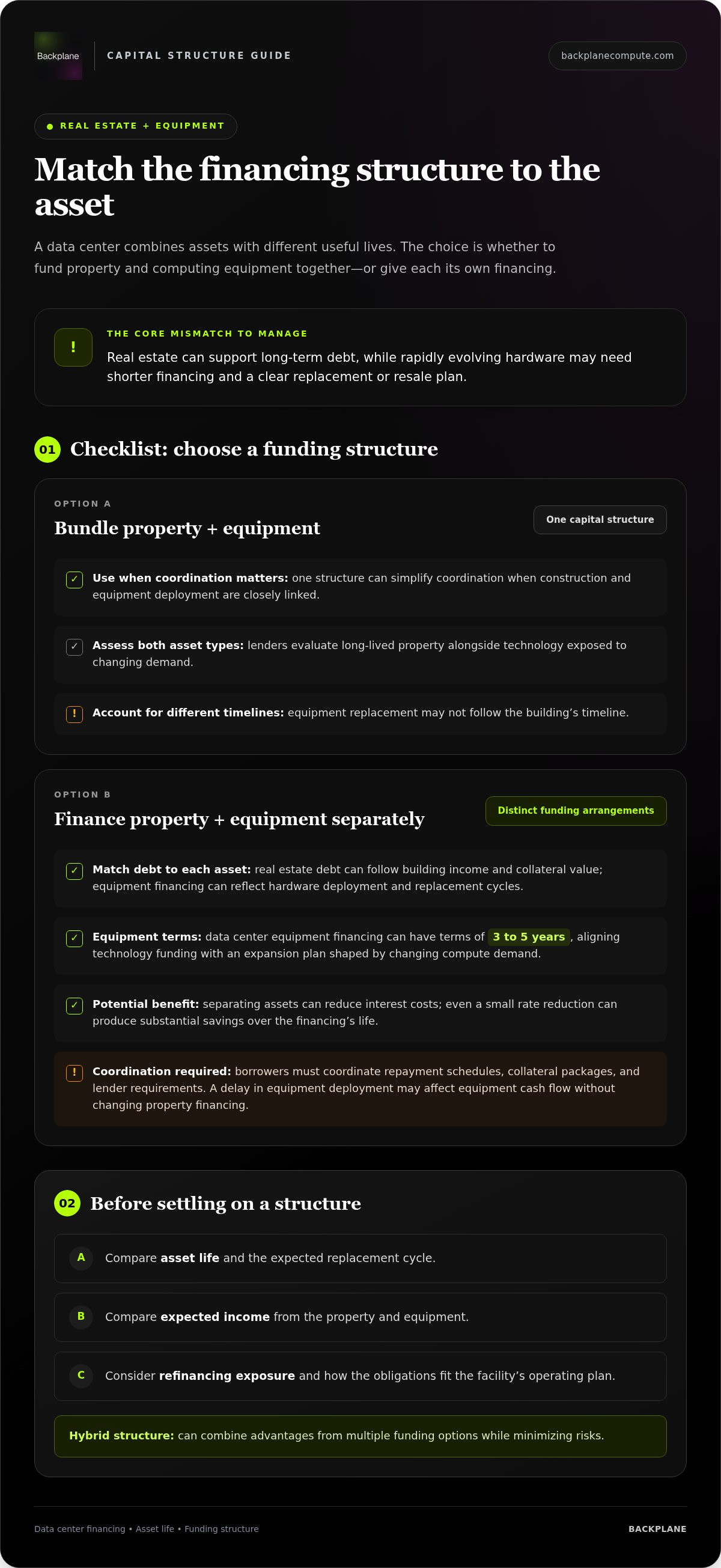
A capital structure can finance the building and computing equipment together or through separate facilities. The choice shapes how repayment, collateral, and future expansion align with each asset’s useful life.
Bundled Equipment and Real Estate Financing
Bundled financing places real estate and equipment under one structure, with the combined project as its basis. For a hyperscale facility, this can bring building development, power infrastructure, and computing capacity into one capital plan. A single structure may simplify coordination when construction and equipment deployment are closely linked. But lenders must assess both long-lived property and technology exposed to changing demand.
This approach can suit a project where the same operator controls the site and compute deployment. But equipment replacement may not follow the building’s timeline. The financing should account for that difference rather than treating every asset as equally durable.
Separate Equipment and Real Estate Financing
Separate financing gives property and equipment distinct funding arrangements. Real estate debt can follow the building’s income and collateral value, while equipment financing can reflect hardware deployment and replacement cycles. Data center equipment financing can have terms of three to five years. That shorter horizon can better match technology funding to an expansion plan shaped by changing compute demand.
Separating the assets can reduce interest costs, and even a small rate reduction can produce substantial savings over the financing’s life. In return, borrowers must coordinate repayment schedules, collateral packages, and lender requirements. A delay in equipment deployment, for example, may affect equipment cash flow without changing the property financing.
A hybrid structure can combine advantages from multiple funding options while minimizing risks. Compare asset life, expected income, and refinancing exposure before choosing. For project-specific Infrastructure Financing Structuring, align the property and equipment obligations with the facility’s operating plan.
CMBS and life company permanent debt
Permanent debt can refinance a completed, income-producing data center once construction risk has fallen. CMBS and life company loans are two options, each with different lender criteria, fixed-rate terms, and execution profiles. The right fit depends on lease strength, operating cash flow, and the leverage the asset can support.
CMBS loans for stabilized data centers typically have fixed-rate terms of 5 to 10 years and loan-to-value ratios of 55 to 65 percent. Lenders commonly require a debt service coverage ratio of 1.30x to 1.45x and debt yield of 8 to 11 percent. Those tests measure repayment capacity from different angles: cash available for debt service and property income relative to loan size. Strong leased occupancy can help support underwriting, while rollover exposure can weaken projected income.
Life company permanent loans typically carry fixed-rate terms of 10 to 25 years and loan-to-value ratios of 55 to 70 percent. Their typical debt service coverage ratio requirement is 1.40x to 1.65x. A longer fixed-rate period can suit owners prioritizing predictable payments and a strategic hold. Lenders still assess the tenant, lease duration, facility performance, and operating expenses before sizing proceeds.
Execution starts with stabilized operating records, current leases, and a defensible valuation. Compare the proposed loan amount against both coverage and value tests; the tightest constraint can govern proceeds. A 15-year triple-net lease to an investment-grade hyperscale tenant can support 65 to 70 percent loan-to-value for permanent debt. Shorter or weaker lease commitments can shift lender focus toward tenant credit, renewal risk, and alternative demand for the facility.
CMBS platforms can suit owners seeking capital markets execution; life companies may fit borrowers seeking longer fixed-rate financing. Data center real estate financing typically has 15 to 30 year terms, so match debt maturity and refinancing plans to the asset’s leases and cash-flow profile.
Collateral, cash flows, and residual-value risk
Lenders assess potential recovery, the reliability of project revenue, and the future value of equipment. These factors shape loan size, repayment terms, and borrower flexibility.
Cash Flows
Cash flows are the project income available to cover operating expenses and debt service. Lenders often require a minimum debt service coverage ratio of 1.35x to 1.45x, so projected revenue must support scheduled payments. A tenant lease, inference services, or take-or-pay contract can provide income, but each carries a different duration and risk profile.
Tenant lease income is assigned an approximate duration of 10 years in financing models, while inference revenue or take-or-pay contracts span 3-5 years. A build-to-suit tenant typically commits to a 10 to 20 year triple-net lease before vertical construction starts. Contract length, tenant credit, and renewal exposure influence the lender’s view of repayment reliability.
Residual-Value Risk
Residual-value risk is the chance that equipment will be worth less than expected when financing ends. Data center hardware typically has a maximum useful life of five years, while land and a powered-shell facility can support a 20-30 year duration. That mismatch matters: a lender can’t treat short-lived GPUs as equivalent collateral to a durable building.
IT equipment in most data centers costs more than land and construction, and AI data center core assets are valued at almost four times the shell. Yet resale value depends on hardware generation, condition, and secondary demand. Data center lenders size replacement reserves at 1 to 3 percent of effective gross income, depending on facility age, Tier rating, and capital expense history.
Debt structure must reflect both asset life and income duration. Data center ABS leverage often runs at roughly 65-70% loan-to-value, while private placements often have tenors of 20+ years and hyperscale customer contracts are typically ten years. Aligning collateral, contract cash flows, and replacement reserves clarifies the project’s risk position. Use Infrastructure Financing Structuring to align those elements in a project’s capital plan.
Backplane: GPUs-as-a-Service
Backplane connects compute demand with infrastructure options, including GPUs-as-a-Service and Dedicated Financed Sites. Choose GPUs-as-a-Service for GPU capacity without building an entire site around ownership. For operators assessing a powered property, a Property Viability Assessment can evaluate its potential, while Infrastructure Financing Structuring addresses how project assets and capital fit together.
The financing choice should follow the operating need. A compute buyer focused on capacity has different requirements from an operator converting an underused industrial site into a GPU farm. Backplane’s offerings address those distinct decisions: compute access, dedicated site financing, property viability, and capital structure. If you’re evaluating a project or compute requirement, visit Backplane to discuss the relevant path.
Make the Next Financing Decision Deliberate
Before committing capital, define the operating position you want the business to hold in 10 years. Decide whether the priority is owning infrastructure, securing compute capacity, or converting an existing property. That choice sets the direction for data center infrastructure financing and clarifies which trade-offs deserve attention.
Then test the plan against change. Consider how a tenant transition, equipment refresh, or power delay could affect revenue and repayment. Financing should reflect operating realities, not just the initial development model. A useful next step is a focused discussion of the project, its assets, and the outcome you need from the capital structure.
Backplane offers GPUs-as-a-Service, Dedicated Financed Sites, and Property Viability Assessment. Contact Backplane to discuss financing and identify a practical path for your project. A clear operating objective gives the financing conversation a stronger starting point.
Frequently Asked Questions
What does data center infrastructure financing cover?
Data center infrastructure financing can fund land, building construction, electrical systems, cooling, and IT equipment. Depending on the structure, it may also cover project costs involved in bringing a facility into operation. For example, a borrower can finance property and equipment together or use separate facilities, matching repayment and collateral arrangements to each asset’s role.
How much does it cost to build and equip a U.S. data center per megawatt?
Per-megawatt cost depends on the project’s scope and design. A powered shell, a fully fitted facility, and a site equipped with GPU servers involve different work. Power availability, cooling requirements, electrical capacity, and equipment selection all affect the budget. Compare estimates using the same scope and capacity assumptions to make them meaningful.
What are current interest rates and loan terms for data center construction financing?
Bridge-to-permanent data center loans typically price at SOFR plus 300 to 550 basis points and have 24 to 48 month terms. Data center debt funds typically price transitional loans at SOFR plus 400 to 700 basis points, with 24 to 60 month interest-only terms. Because these rates are benchmark-linked, borrowers should model how changing SOFR affects payments and refinancing capacity.
How do lenders assess data center project creditworthiness and loan-to-value?
Lenders assess repayment capacity, collateral value, lease income, tenant credit, construction readiness, and power access. Debt service coverage ratio and debt yield test whether operating income can support the requested loan. Permanent data center financing usually ranges from 65% to 75% loan-to-value, while bridge-to-permanent loans typically have 60 to 70 percent loan-to-value. Valuation and cash-flow assumptions influence proceeds.
What are the main financial and construction risks in data center infrastructure financing?
Key risks include utility delays, construction overruns, tenant concentration, and equipment obsolescence. In Northern Virginia, Phoenix, and Dallas, utility interconnection timelines run 24 to 60 months, which can affect construction sequencing and the timing of revenue. Hardware typically has a maximum useful life of five years, so replacement planning matters. Lenders also consider environmental conditions and the project’s capacity to service debt during delays.
How do data center leases and tenant commitments affect financing?
Leases give lenders a basis for evaluating recurring income, tenant credit, and revenue continuity. A data center build-to-suit tenant typically commits to a 10 to 20 year triple-net lease before vertical construction starts. That commitment can strengthen underwriting by establishing expected occupancy and payment obligations. Lease terms also shape flexibility: termination rights, renewal options, and rent structure affect projected cash flows and lender confidence.


